
SMIC(00981)

Search documents
净买入超28亿港元 加仓阿里健康减持小米和晶泰控股
Xin Lang Cai Jing· 2026-01-14 10:14
Core Viewpoint - Southbound capital continues to flow into Hong Kong stocks, with a net inflow of approximately 28.65 billion HKD today, marking the fourth consecutive day of inflows [1]. Group 1: Southbound Capital Flow - Today's southbound trading volume reached approximately 1606.16 billion HKD, an increase of 233 billion HKD from the previous day, accounting for 47.20% of the total turnover of the Hang Seng Index [1]. - The net inflow from the Shanghai-Hong Kong Stock Connect was about 25.14 billion HKD, while the Shenzhen-Hong Kong Stock Connect saw a net inflow of approximately 3.52 billion HKD [1]. Group 2: Individual Stock Performance - Tencent Holdings (0700.HK) saw a net buy of 20.09 billion HKD, with a 0.88% increase in stock price today [1][2]. - Alibaba Health (00241.HK) experienced a significant rise of 18.96%, with a net buy of 14.58 billion HKD [1][2]. - Alibaba Group (09988.HK) had a net buy of 11.34 billion HKD, with a stock price increase of 5.69% [1][2]. - Kuaishou Technology (01024.HK) recorded a net buy of 4.42 billion HKD, with a 4.46% increase in stock price [1][2]. - China Mobile (00941.HK) faced a net outflow of 9.13 billion HKD, with a slight decline of 0.19% [1][2]. - Xiaomi Group (01810.HK) had a net outflow of 4.23 billion HKD, with a decrease of 0.53% [1][2]. - Crystal International (02228.HK) saw a net outflow of 3.09 billion HKD, with a 3.87% increase in stock price [1][2]. - Semiconductor Manufacturing International Corporation (00981.HK) had a net outflow of 2.43 billion HKD, with a 2.01% increase in stock price [1][2].




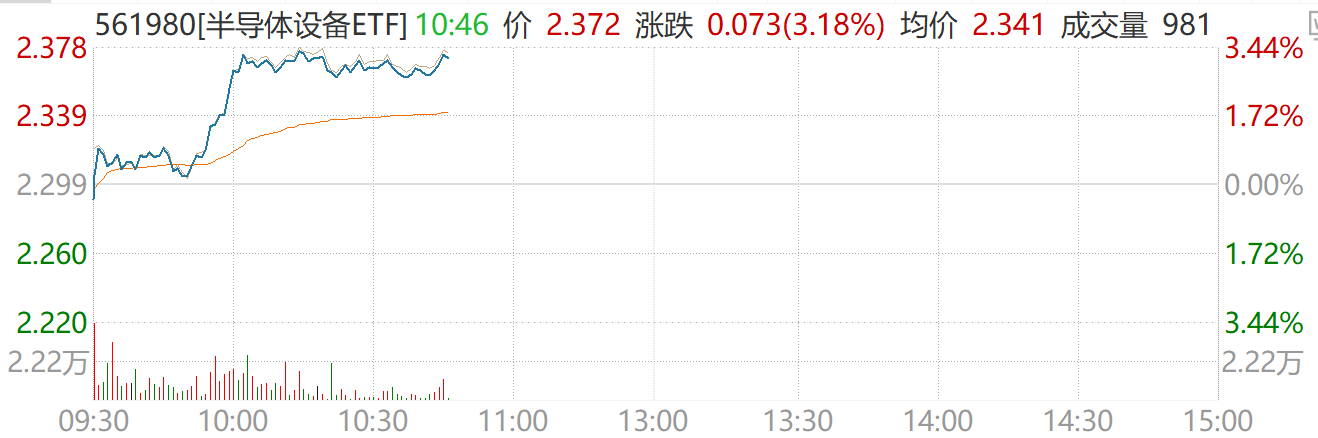
半导体设备ETF(561980)盘中上涨3.26%!机构:存储周期持续上行,重点关注设备投资机遇
Sou Hu Cai Jing· 2026-01-14 03:50
Group 1 - The core viewpoint of the news highlights a resurgence in the storage and semiconductor equipment sectors, driven by a "super cycle" in storage demand, with several storage companies experiencing significant stock price increases [1] - The semiconductor equipment ETF (561980) saw a 3.26% increase, with a trading volume exceeding 1.4 billion yuan, reflecting a recent peak in fund size [1] - The first annual report forecast indicates a substantial net profit growth of 427.19%-520.22% for 2025, boosting market sentiment in the sector [1] Group 2 - From an industry perspective, storage chips represent one of the largest downstream markets in the semiconductor equipment space, with expected price increases for storage products continuing into 2026 [2] - TrendForce forecasts a 55-60% quarter-on-quarter increase in conventional DRAM prices and over 60% for Server DRAM in Q1 2026, alongside a 33-38% increase in NAND Flash prices [4] - The demand for storage is driven by new platforms like NV's Rubin AI, which is expected to significantly increase memory capacity and NAND demand [3] Group 3 - The domestic storage leader is set to receive IPO approval, aiming to raise 29.5 billion yuan for production line upgrades and next-generation technology, which is expected to enhance domestic equipment demand [5] - The localization rate of semiconductor manufacturing equipment in China is currently low, with projections indicating an increase from 25% in 2024 to 30% by 2026 [5] - The semiconductor equipment ETF (561980) focuses on high-tech segments of the semiconductor industry, with a significant concentration in leading companies across various sub-sectors [6]





最高涨 20%!8 英寸晶圆代工开启全行业涨价
是说芯语· 2026-01-14 03:30
Core Viewpoint - The global 8-inch wafer foundry capacity is expected to decrease by 2.4% in 2026 due to TSMC and Samsung Electronics reducing their production capacity, while demand for AI-driven power management chips remains strong, leading to an anticipated increase in capacity utilization rates to 90% this year [2][8]. Group 1: Company-Specific Insights - TSMC plans to gradually exit the 6-inch wafer manufacturing business within two years and continue to reduce 8-inch wafer capacity, with a current monthly capacity of approximately 528,000 wafers [4]. - Samsung Electronics will also reduce its 8-inch wafer production starting in the second half of 2025, aiming to allocate more resources to the 12-inch wafer market, with a similar monthly capacity of 528,000 wafers [4]. - UMC's 8-inch wafer monthly capacity was previously over 360,000 wafers, with a current utilization rate of about 70%, and the company is optimistic about continued growth in 2026 [5]. - SMIC has a monthly capacity of approximately 355,000 8-inch wafers, with a utilization rate of 95.8% as of Q3 2025, and has raised prices by about 10% due to high demand [5]. - Hua Hong Semiconductor's 8-inch wafer foundry utilization rate reached 109.5%, indicating overcapacity, and the company is expanding its production capacity [6]. - Powerchip's 8-inch wafer monthly capacity is around 120,000 wafers, benefiting from the tight supply of memory chips and the recovery of logic process products [6]. - GlobalFoundries is focusing on expanding its 12-inch wafer production, with a projected decline of about 0.3% in global 8-inch wafer foundry capacity in 2025 [7]. Group 2: Market Trends and Projections - The average capacity utilization rate for global 8-inch wafer foundries is expected to rise to 85% to 90% in 2026, significantly better than the 75% to 80% range in 2025 [8]. - Some foundries are notifying customers of price increases ranging from 5% to 20% due to tightening capacity, marking a shift from previous selective price adjustments [8].

10只科创板股获融资净买入额超1亿元
Zheng Quan Shi Bao Wang· 2026-01-14 02:16
Core Viewpoint - The total margin balance of the Sci-Tech Innovation Board reached 288.907 billion yuan on January 13, showing an increase of 1.127 billion yuan compared to the previous trading day [1] Group 1: Margin Balance - The financing balance amounted to 287.888 billion yuan, increasing by 1.178 billion yuan from the previous trading day [1] - The margin trading balance decreased to 10.19 billion yuan, down by 0.051 billion yuan from the previous trading day [1] Group 2: Individual Stock Performance - On January 13, 311 stocks on the Sci-Tech Innovation Board experienced net financing inflows, with 10 stocks having net inflows exceeding 100 million yuan [1] - Kingsoft Office topped the list with a net financing inflow of 276 million yuan [1] - Other notable stocks with significant net financing inflows include Chengdu Xian Dao, Zhongke Xingtu, Zhongxin International, Rongchang Bio, Western Superconducting, and Green Harmony [1]




电子行业周报:半导体景气超预期,多环节陆续提价,AI 眼镜放量在即-20260114
Guoxin Securities· 2026-01-14 00:57
Investment Rating - The report maintains an "Outperform" rating for the electronics industry [1][10]. Core Insights - The semiconductor sector is experiencing better-than-expected conditions, with price increases across multiple segments driven by rising AI demand. The industry is seeing a recovery in profitability as price hikes are being passed on to consumers [1]. - The CES 2026 event has showcased significant advancements in AR glasses, indicating a year of hardware innovation. Companies are encouraged to focus on AR glasses as they become independent smart devices with enhanced communication and computing capabilities [3]. - NVIDIA has introduced a new storage architecture that redefines the role of NAND Flash, significantly increasing its demand and value in AI applications. This shift is expected to benefit companies in the storage industry [4]. Summary by Sections Semiconductor Industry - The semiconductor industry is witnessing a supply-demand imbalance, particularly in storage and high-end PCB segments. Price increases are anticipated across various manufacturing stages, including wafer foundries and high-end packaging [1]. - The report highlights the potential for domestic semiconductor materials to replace imports, particularly in light of recent anti-dumping investigations against Japanese products [2]. AR Glasses and Consumer Electronics - CES 2026 has seen a variety of AR glasses, with advancements in full-color display technology enhancing user experience and application scenarios. Companies are advised to monitor developments in this area [3]. - The report emphasizes the importance of AR glasses as a platform for AI technology, suggesting a growing market for these devices [3]. Storage Industry - The introduction of NVIDIA's new storage processor platform is expected to revolutionize the role of NAND Flash, making it a critical component in AI processing. This change is likely to drive demand for storage-related companies [4]. - The storage industry is projected to benefit from ongoing AI demand, with a positive outlook for companies involved in NAND Flash production [4]. Key Companies and Recommendations - The report recommends several companies for investment, including: - Semiconductor: 中芯国际 (SMIC), 翱捷科技 (Aojie Technology), 德明利 (Demingli), 蓝思科技 (Lens Technology) [10]. - Storage: 德明利 (Demingli), 江波龙 (Jiangbolong), 佰维存储 (Baiwei Storage) [4][10]. - AR Glasses: 蓝特光学 (Lante Optics), 水晶光电 (Crystal Optoelectronics) [3].



美国政府批准向中国出口英伟达H200芯片;五部门出手规范网络招聘秩序丨盘前情报
2 1 Shi Ji Jing Ji Bao Dao· 2026-01-14 00:47
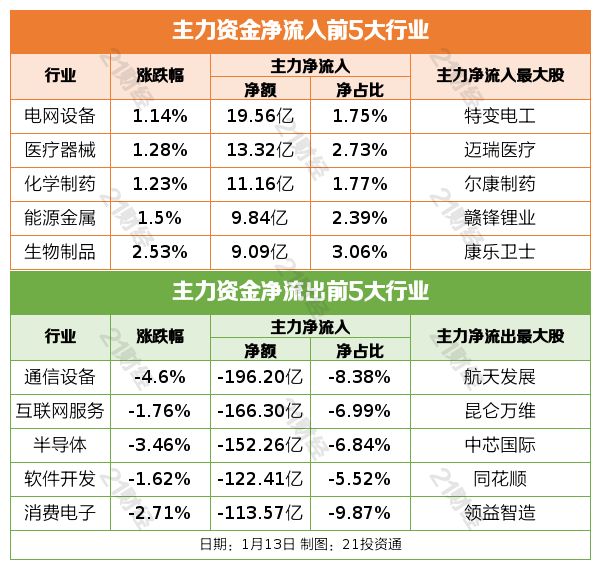
Market Overview - On January 13, major indices in China experienced collective adjustments, with the Shenzhen Component Index falling over 1% and the ChiNext Index dropping nearly 2%. The Shanghai Composite Index closed down 0.64%, the Shenzhen Component Index down 1.37%, and the ChiNext Index down 1.96%. The total trading volume in the Shanghai and Shenzhen markets reached 3.65 trillion yuan, an increase of 49.6 billion yuan compared to the previous trading day [1] - In the U.S. stock market, the three major indices also declined on January 13. The Dow Jones Industrial Average fell by 398.21 points to close at 49,191.99, a decrease of 0.80%. The S&P 500 Index dropped by 13.53 points to 6,963.74, down 0.19%, while the Nasdaq Composite Index decreased by 24.03 points to 23,709.87, a decline of 0.10% [1] Sector Performance - In the Chinese market, over 3,700 stocks declined, with the AI application concept sector rising against the trend, seeing over ten constituent stocks hitting the daily limit up. The AI medical concept remained active, while the power grid equipment sector strengthened in the afternoon. The retail sector also showed active performance. Conversely, the commercial aerospace and controllable nuclear fusion sectors experienced significant declines [1] - In the U.S., the performance of major indices reflected a general downward trend, indicating a cautious market sentiment [1] Commodity Prices - International oil prices rose on January 13. The price of light crude oil futures for February delivery on the New York Mercantile Exchange increased by $1.65 to $61.15 per barrel, a rise of 2.77%. The March delivery Brent crude oil futures price rose by $1.60 to $65.47 per barrel, an increase of 2.51% [2] Policy and Regulatory Updates - The Ministry of Commerce of China announced the continuation of anti-dumping duties on imported solar-grade polysilicon from the U.S. and South Korea, effective from January 14, 2026, for a period of five years [2] - The Ministry of Industry and Information Technology issued an action plan for the high-quality development of industrial internet platforms from 2026 to 2028, aiming for significant progress in platform development and resource connectivity by 2028 [3][4] Company-Specific Developments - The approval of NVIDIA to export its H200 AI chips to China is expected to restart shipments to Chinese customers. This decision will be overseen by the U.S. Department of Commerce, which will also impose a fee of approximately 25% on the related transactions [7]




1月13日港股通净买入12.96亿港元




Zheng Quan Shi Bao Wang· 2026-01-13 14:52
Market Overview - On January 13, the Hang Seng Index rose by 0.90%, closing at 26,848.47 points, with a total net inflow of HKD 1.296 billion through the southbound trading channel [1][4] - The total trading volume for the southbound trading was HKD 137.348 billion, with a net buy of HKD 1.296 billion [1] Trading Activity - In the Shanghai-Hong Kong Stock Connect, the trading volume was HKD 82.493 billion, with a net buy of HKD 0.149 billion, while the Shenzhen-Hong Kong Stock Connect had a trading volume of HKD 54.855 billion and a net buy of HKD 1.147 billion [1] - The most actively traded stock in the Shanghai-Hong Kong Stock Connect was Alibaba-W, with a trading amount of HKD 81.051 billion, followed by Tencent Holdings and Xiaomi Group-W, with trading amounts of HKD 29.445 billion and HKD 28.570 billion, respectively [1][3] Stock Performance - In terms of net buy amounts, Xiaomi Group-W led with a net buy of HKD 0.324 billion, despite its closing price dropping by 1.96% [1] - Alibaba-W had the highest net buy in the Shenzhen-Hong Kong Stock Connect, amounting to HKD 1.161 billion, with its closing price increasing by 3.63% [2][3] - The stock with the highest net sell was China Mobile, with a net sell of HKD 0.804 billion, and its closing price decreased by 0.25% [1][3] Detailed Trading Data - The top ten actively traded stocks in the southbound trading included: - Alibaba-W: HKD 81,050.183 million (net sell: HKD 9.046 million, daily change: +3.63%) [3] - Tencent Holdings: HKD 29,449.159 million (net buy: HKD 0.661 million, daily change: +0.72%) [3] - Xiaomi Group-W: HKD 28,572.459 million (net buy: HKD 32.370 million, daily change: -1.96%) [3] - SMIC: HKD 22,715.902 million (net sell: HKD 17.347 million, daily change: -1.13%) [3]
港股通1月13日成交活跃股名单

Zheng Quan Shi Bao Wang· 2026-01-13 14:49
Market Overview - On January 13, the Hang Seng Index rose by 0.90%, with total southbound trading amounting to HKD 137.35 billion, including buy transactions of HKD 69.32 billion and sell transactions of HKD 68.03 billion, resulting in a net buying amount of HKD 1.30 billion [1] Southbound Trading Activity - The southbound trading through Stock Connect (Shenzhen) recorded a total trading amount of HKD 54.86 billion, with buy transactions of HKD 28.00 billion and sell transactions of HKD 26.85 billion, leading to a net buying amount of HKD 1.15 billion [1] - The southbound trading through Stock Connect (Shanghai) had a total trading amount of HKD 82.49 billion, with buy transactions of HKD 41.32 billion and sell transactions of HKD 41.17 billion, resulting in a net buying amount of HKD 0.15 billion [1] Active Stocks - Alibaba-W was the most actively traded stock with a total trading amount of HKD 139.06 billion and a net buying amount of HKD 10.71 billion, closing with a price increase of 3.63% [1][2] - Tencent Holdings followed with a total trading amount of HKD 52.93 billion and a net buying amount of HKD 7.56 billion, closing with a price increase of 0.72% [1][2] - Xiaomi Group-W had a total trading amount of HKD 49.62 billion and a net buying amount of HKD 6.07 billion, closing with a price decrease of 1.96% [1][2] Continuous Net Buying and Selling - Three stocks experienced continuous net buying for more than three days, with Xiaomi Group-W, Tencent Holdings, and Kuaishou-W having net buying days of 9, 5, and 3 respectively [2] - Tencent Holdings had the highest cumulative net buying amount of HKD 69.99 billion, followed closely by Xiaomi Group-W with HKD 69.33 billion [2] - Two stocks faced continuous net selling, with China Mobile and Meituan-W having net selling amounts of HKD 52.84 billion and HKD 11.67 billion respectively [2]
智通港股通活跃成交|1月13日

智通财经网· 2026-01-13 11:02
Core Insights - On January 13, 2026, Alibaba-W (09988), Tencent Holdings (00700), and Xiaomi Group-W (01810) were the top three companies by trading volume in the Southbound Stock Connect, with trading amounts of 81.05 billion, 29.45 billion, and 28.57 billion respectively [1] - The same companies also led in trading volume in the Shenzhen-Hong Kong Stock Connect, with trading amounts of 58.01 billion, 23.48 billion, and 21.05 billion respectively [1] Southbound Stock Connect (Shanghai-Hong Kong) - Alibaba-W (09988) had a trading amount of 81.05 billion and a net buy amount of -90.46 million [2] - Tencent Holdings (00700) recorded a trading amount of 29.45 billion with a net buy amount of +6.61 million [2] - Xiaomi Group-W (01810) achieved a trading amount of 28.57 billion and a net buy amount of +3.24 billion [2] - Other notable companies included Goldwind Technology (02208) with 23.07 billion and a net buy of +85.70 million, and SMIC (00981) with 22.72 billion and a net buy of -1.73 billion [2] Southbound Stock Connect (Shenzhen-Hong Kong) - Alibaba-W (09988) had a trading amount of 58.01 billion and a net buy amount of +1.16 billion [2] - Tencent Holdings (00700) recorded a trading amount of 23.48 billion with a net buy amount of +749 million [2] - Xiaomi Group-W (01810) achieved a trading amount of 21.05 billion and a net buy amount of +283 million [2] - Other significant companies included SMIC (00981) with 18.13 billion and a net buy of -661 million, and Kuaishou-W (01024) with 12.21 billion and a net buy of +114 million [2]
中芯国际跌3.16%,成交额81.54亿元,近3日主力净流入-27.59亿
Xin Lang Cai Jing· 2026-01-13 07:48
Core Viewpoint - SMIC's stock price decreased by 3.16% on January 13, with a trading volume of 8.154 billion yuan and a market capitalization of 989.09 billion yuan [1] Group 1: Company Overview - SMIC received an investment from the National Integrated Circuit Industry Investment Fund, holding 1.61% of the total share capital [2] - SMIC is the largest integrated circuit manufacturing enterprise group in mainland China, known for its advanced technology and comprehensive support [2] - The main business of SMIC includes integrated circuit wafer foundry services based on various technology nodes and platforms, design services, IP support, and photomask manufacturing [2] - SMIC ranks second globally among pure wafer foundry companies and first among mainland Chinese enterprises based on the latest sales figures for 2024 [2] Group 2: Financial Performance - For the period from January to September 2025, SMIC achieved a revenue of 49.51 billion yuan, representing a year-on-year growth of 18.22%, and a net profit attributable to shareholders of 3.818 billion yuan, up 41.09% year-on-year [5] - The main revenue composition of SMIC is 93.83% from integrated circuit wafer foundry and 6.17% from other services [5] Group 3: Market Activity - The net inflow of main funds today was -1.105 billion yuan, with a continuous reduction in main funds for three consecutive days [3] - The average trading cost of SMIC's shares is 123.32 yuan, with the stock price approaching a resistance level of 125.50 yuan, indicating potential for a price correction if it fails to break through this level [4]