SMIC(00981)

Search documents
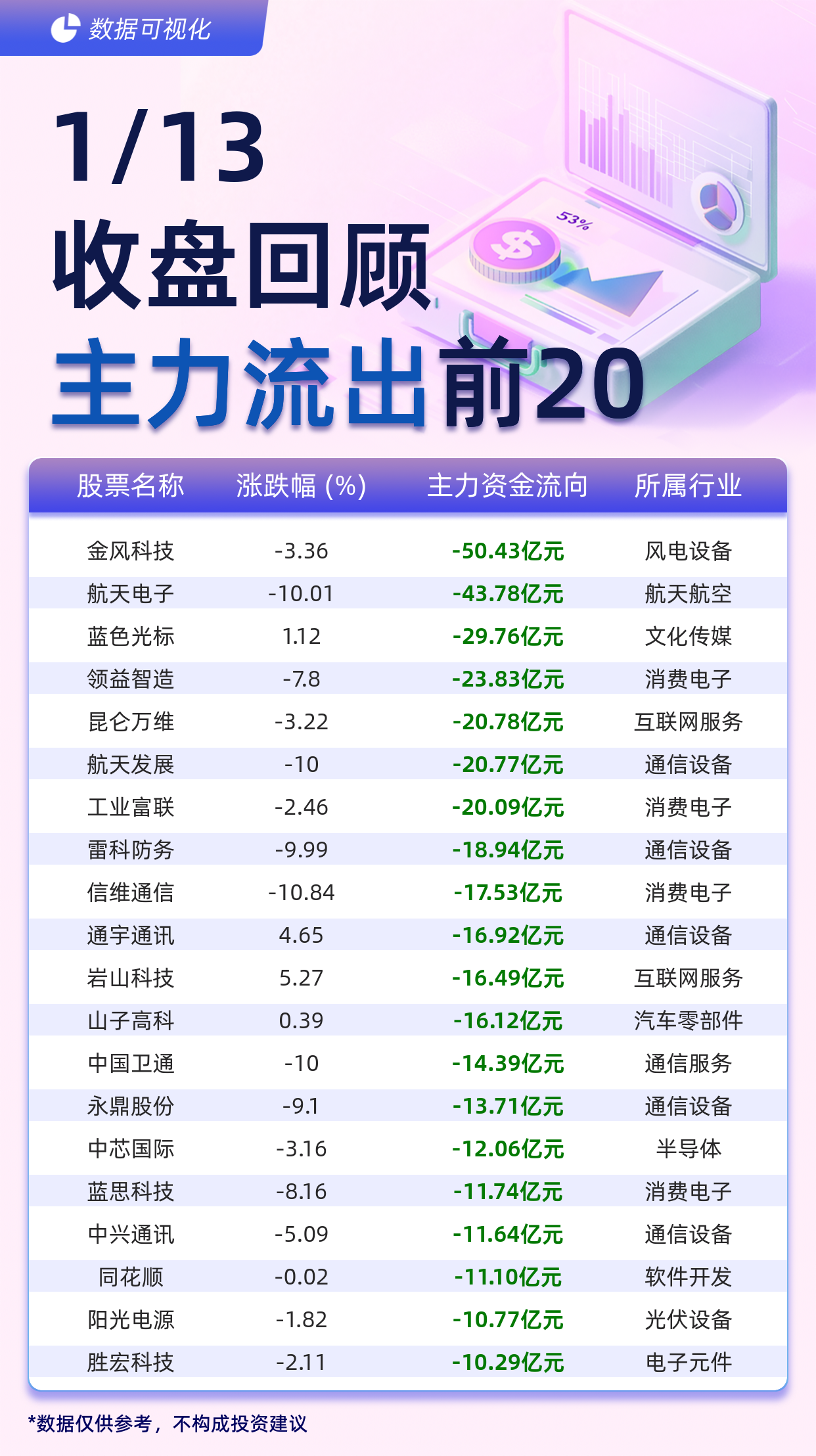
主力个股资金流出前20:金风科技流出50.43亿元、航天电子流出43.78亿元
Jin Rong Jie· 2026-01-13 07:33
Core Viewpoint - The data indicates significant outflows of capital from various stocks, with notable declines in share prices across multiple sectors, particularly in aerospace, communication, and consumer electronics. Group 1: Major Stock Outflows - The stock with the highest capital outflow is Goldwind Technology, with an outflow of 5.043 billion yuan and a price drop of 3.36% [1][2] - Aerospace Electronics experienced a capital outflow of 4.378 billion yuan, with a significant price decline of 10.01% [1][2] - BlueFocus Media saw an outflow of 2.976 billion yuan, but its share price increased by 1.12% [1][2] Group 2: Sector Performance - The wind power equipment sector, represented by Goldwind Technology, is facing challenges with a notable capital outflow [2] - The aerospace sector, particularly Aerospace Electronics and Aerospace Development, is experiencing substantial capital withdrawals, indicating potential investor concerns [1][2] - The consumer electronics sector, including Industrial Fulian and Xunwei Communication, is also seeing significant outflows, reflecting broader market trends [1][3] Group 3: Additional Notable Stocks - Other companies with significant capital outflows include Kunlun Wanwei (2.078 billion yuan), Raytheon Defense (1.894 billion yuan), and China Satcom (1.439 billion yuan), all of which are in the communication and internet service sectors [1][3] - Semiconductor company SMIC reported an outflow of 1.206 billion yuan, indicating investor caution in the semiconductor industry [1][3] - The photovoltaic equipment sector, represented by Sunshine Power, also faced an outflow of 1.077 billion yuan, highlighting challenges in renewable energy investments [1][3]





中芯国际股价连续3天下跌累计跌幅5.01%,长安基金旗下1只基金持2407股,浮亏损失1.57万元
Xin Lang Cai Jing· 2026-01-13 07:08
Group 1 - SMIC's stock price fell by 3.16% on January 13, closing at 123.63 CNY per share, with a trading volume of 8.154 billion CNY and a turnover rate of 3.26%, resulting in a total market capitalization of 989.09 billion CNY [1] - The stock has experienced a continuous decline over three days, with a cumulative drop of 5.01% during this period [1] - SMIC specializes in integrated circuit wafer foundry services, offering a range of technology nodes from 0.35 microns to 14 nanometers, with 93.83% of its revenue coming from wafer foundry services and 6.17% from other services [1] Group 2 - Chang'an Fund holds a significant position in SMIC through its Chang'an CSI 300 Non-Cyclical Index A fund, which held 2,407 shares, accounting for 1.59% of the fund's net value, ranking as the eighth largest holding [2] - The fund has incurred a floating loss of approximately 9,700.21 CNY today, with a total floating loss of 15,700 CNY over the three-day decline [2] - The Chang'an CSI 300 Non-Cyclical Index A fund was established on June 25, 2012, with a current size of 20.97 million CNY, and has achieved a year-to-date return of 3.89% and a one-year return of 27.52% [2]

芯片龙头ETF(516640)开盘跌0.08%,重仓股中芯国际跌0.13%,寒武纪跌1.65%
Xin Lang Cai Jing· 2026-01-13 04:14
Core Viewpoint - The Chip Leader ETF (516640) opened with a slight decline of 0.08%, indicating a mixed performance in the semiconductor sector [1] Group 1: ETF Performance - The Chip Leader ETF (516640) opened at 1.188 yuan [1] - Since its establishment on August 19, 2021, the fund has achieved a return of 19.13% [1] - The fund's return over the past month is reported at 13.34% [1] Group 2: Major Holdings Performance - Major holdings in the ETF include: - SMIC: down 0.13% [1] - Cambricon: down 1.65% [1] - Haiguang Information: unchanged [1] - Northern Huachuang: down 0.37% [1] - Lattice Semiconductor: unchanged [1] - Zhaoyi Innovation: up 1.59% [1] - Zhongwei Company: down 1.20% [1] - OmniVision: up 0.19% [1] - Chipone: up 0.23% [1] - Changdian Technology: down 0.41% [1]


中芯国际1月12日获融资买入11.23亿元,融资余额129.26亿元
Xin Lang Cai Jing· 2026-01-13 03:27
Group 1 - On January 12, SMIC's stock fell by 0.95% with a trading volume of 7.202 billion yuan, and the net financing buy was -99.07 million yuan [1] - As of January 12, the total margin balance for SMIC was 12.957 billion yuan, which is 5.06% of its market capitalization, indicating a high level compared to the past year [1] - The company reported a financing buy of 1.123 billion yuan on the same day, with a margin balance exceeding the 70th percentile of the past year [1] Group 2 - As of September 30, SMIC had 336,200 shareholders, an increase of 33.27% from the previous period, while the average circulating shares per person decreased by 25.41% [2] - For the period from January to September 2025, SMIC achieved operating revenue of 49.51 billion yuan, a year-on-year increase of 18.22%, and a net profit attributable to shareholders of 3.818 billion yuan, up 41.09% year-on-year [2] - The top ten circulating shareholders of SMIC saw significant changes, with notable reductions in holdings from several ETFs, while new shareholders entered the list [2]
中芯国际遭国家集成电路产业投资基金股份有限公司减持840万股
Xin Lang Cai Jing· 2026-01-13 00:36
香港联交所最新资料显示,1月7日,国家集成电路产业投资基金股份有限公司减持中芯国际(00981) 840万股,每股作价74.93港元,总金额约为6.29亿港元。减持后最新持股数目约为7.17亿股,最新持股 比例为8.96%。 来源:新浪港股 ...
智通港股通资金流向统计(T+2)|1月13日





智通财经网· 2026-01-12 23:32
Core Insights - The article highlights the net inflow and outflow of funds in the Hong Kong stock market, with Xiaomi Group, Tencent Holdings, and China Construction Bank leading in net inflows, while the Yingfu Fund, Hang Seng China Enterprises, and Southern Hang Seng Technology experienced the highest net outflows [1] Group 1: Net Inflows - Xiaomi Group-W (01810) recorded a net inflow of 1.07 billion, representing a 16.36% increase in its closing price [2] - Tencent Holdings (00700) saw a net inflow of 863 million, with a 7.49% increase in its closing price [2] - China Construction Bank (00939) had a net inflow of 699 million, with a significant 41.06% increase in its closing price [2] Group 2: Net Outflows - Yingfu Fund (02800) experienced the largest net outflow of 6.289 billion, reflecting a -31.44% change in its closing price [2] - Hang Seng China Enterprises (02828) had a net outflow of 2.880 billion, with a -17.89% change in its closing price [2] - Southern Hang Seng Technology (03033) faced a net outflow of 1.289 billion, showing a -11.37% change in its closing price [2] Group 3: Net Inflow Ratios - 361 Degrees (01361) led with a net inflow ratio of 74.40%, with a net inflow of 8.9117 million [3] - BRILLIANCE CHI (01114) followed with a net inflow ratio of 64.04%, amounting to a net inflow of 36.4910 million [3] - Qin Port Co. (03369) had a net inflow ratio of 61.05%, with a net inflow of 846,600 [3] Group 4: Net Outflow Ratios - Wisdom Hong Kong 100 (02825) had a net outflow ratio of -100.00%, with a net outflow of -18,200 [3] - Stone Pharmaceutical Group (02005) recorded a net outflow ratio of -68.86%, with a net outflow of -14.1501 million [3] - Dexion Shipping (02510) experienced a net outflow ratio of -53.53%, with a net outflow of -10.0204 million [3]
半导体并购估值博弈加剧?差异化定价成各方共识
Zheng Quan Shi Bao Wang· 2026-01-12 23:29
Core Viewpoint - The semiconductor merger and acquisition (M&A) landscape is experiencing increased valuation disputes, leading to a rise in failure rates of deals, despite a more accommodating regulatory environment [1][2][4]. Group 1: M&A Activity and Trends - In 2025, the number of M&A cases in the semiconductor sector increased by nearly 25% year-on-year, reaching 161 cases, with 12 failures, marking a five-year high [2][3]. - The total M&A amount in China's semiconductor industry reached approximately 279.67 billion, with 496 cases and 32 failures, a more than twofold increase compared to previous years [3]. - The overall M&A market in A-shares saw about 4,773 cases in 2025, a 5% increase year-on-year, with a slight decline in overall failure rates [2][3]. Group 2: Valuation Discrepancies - There is a significant divergence in valuations between buyers and sellers, particularly as sellers' expectations remain high due to previous market conditions, while buyers are cautious due to industry adjustments [4][5]. - The average price-to-earnings ratio for the semiconductor industry peaked at 291 times in 2021 but fell to 53 times by 2024, reflecting a substantial valuation correction [5]. - The termination of several high-profile M&A deals, such as the merger between Haiguang Information and Zhongke Shuguang, was attributed to disagreements over core terms, particularly valuation [4][5]. Group 3: Differentiated Pricing Strategies - Industry experts suggest implementing differentiated pricing strategies to address valuation discrepancies, allowing for tailored exit options for different investor types [10][11]. - Recent M&A cases have shown a trend towards differentiated arrangements in terms of valuation, payment methods, and performance commitments, which can help align interests among diverse stakeholders [10][11]. - Regulatory support for differentiated M&A practices has increased, encouraging the use of various assessment methods and flexible payment structures [11][12]. Group 4: Challenges in M&A Execution - The semiconductor industry is characterized by high cyclicality, complicating M&A negotiations as both parties seek to capitalize on market recovery while managing inherent risks [6][12]. - The presence of a "trilemma" in M&A—high seller expectations, buyer performance commitments, and high success rate targets—poses significant challenges, especially during industry downturns [12][14]. - The need for performance guarantees in M&A deals has led to complications, particularly for unprofitable semiconductor firms, as they may resist signing performance commitments [12][14].


中国算力行业决策建议及项目可行性研究报告2026-2032年
Sou Hu Cai Jing· 2026-01-12 21:05
Group 1 - The report outlines the strategic importance of computing power as a new type of infrastructure and its collaborative relationship with data and algorithms [3][4] - The global computing power market is characterized by a significant scale and growth, with North America leading and the Asia-Pacific region rapidly catching up [4][5] - The report highlights the evolution of computing power technology, with heterogeneous computing architectures becoming mainstream [4][5] Group 2 - During the "14th Five-Year Plan" period, China's computing power scale has expanded significantly, with the total computing power surpassing previous levels [5][6] - The report discusses the impact of the East Data West Computing project on the geographical restructuring of computing power in China [5][6] - The establishment of a domestic computing ecosystem is underway, with a notable increase in the annual growth rate of domestic AI chip shipments [6][7] Group 3 - The report identifies key segments of the computing power industry chain, including advancements in chiplet technology and optical interconnects that enhance computing density [4][5] - The deployment of edge computing nodes in industrial and automotive internet applications is increasing, reflecting a shift towards more decentralized computing solutions [5][6] - The demand for computing power in various applications, such as AI model training, scientific computing, and smart manufacturing, is analyzed, indicating a growing need for high-performance computing resources [6][7] Group 4 - The competitive landscape of the global computing power industry is dominated by American companies, with major players like NVIDIA, AMD, and Intel leading the high-end computing ecosystem [6][7] - In China, the report highlights the emergence of a "national team" in domestic computing power, with traditional hardware manufacturers transitioning to computing service providers [7][8] - Key competitive dimensions include hardware performance, software ecosystem compatibility, and the ability to deliver comprehensive solutions [6][7] Group 5 - The report forecasts significant growth in the computing power market from 2026 to 2032, with an expected compound annual growth rate and a shift in the market structure towards AI computing power [10][11] - The analysis indicates that the domestic market share of Chinese computing power is projected to exceed 50% under certain scenarios [10][11] - The report emphasizes the importance of establishing a sustainable and efficient computing power ecosystem, with a focus on energy efficiency and green technologies [10][11]


半导体并购估值博弈加剧 差异化定价成各方共识
Zheng Quan Shi Bao· 2026-01-12 18:23
Core Viewpoint - The semiconductor M&A activity in A-shares is experiencing a surge in 2025, with a notable increase in the number of cases and a focus on asset integration and strategic cooperation, despite a rising failure rate in M&A transactions [1][2][3]. Group 1: M&A Activity and Trends - In 2025, the number of M&A cases in the A-share market reached approximately 4,773, reflecting a year-on-year increase of about 5%, while semiconductor-related M&A cases rose to 161, up nearly 25% year-on-year [2][3]. - The total M&A amount in China's semiconductor sector reached 279.67 billion yuan, with 496 cases reported, and 32 failures, marking a more than twofold increase in failures compared to previous years [3]. - The overall failure rate of M&A transactions in the semiconductor industry has increased, with 12 failures reported in 2025, the highest in five years [2][3]. Group 2: Valuation Discrepancies and Challenges - There is a significant divergence in valuations between buyers and sellers, complicating the consensus on core terms such as price and performance commitments, which has become a critical reason for M&A failures [1][4][5]. - The average price-to-earnings ratio in the semiconductor industry dropped from 291 times in 2021 to 53 times in 2024, reflecting a substantial valuation correction amid changing market conditions [5]. - The introduction of the "M&A Six Guidelines" in 2024 accelerated M&A activities, but the valuation discrepancies have intensified in 2025, particularly as sellers' expectations remain high due to historical peaks in valuations [4][10]. Group 3: Strategic Recommendations - Industry experts suggest adopting differentiated M&A strategies, including staged incubation through M&A funds, to mitigate risks associated with semiconductor M&A transactions [1][7][10]. - Companies are encouraged to implement differentiated pricing strategies based on various financing rounds, allowing for more flexible exit options for investors [8][10]. - Regulatory support for differentiated M&A is evident, with a shift towards more inclusive and prudent approval processes, allowing for diverse valuation methods and payment structures [11][12].
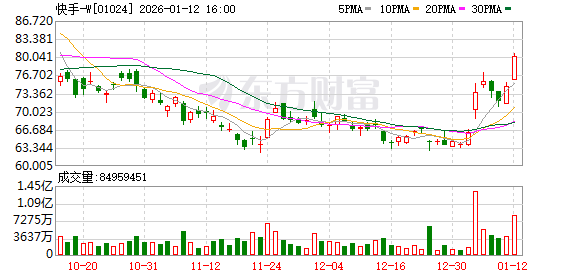
南向资金今日净买入73.06亿港元,快手-W净买入22.45亿港元
Zheng Quan Shi Bao Wang· 2026-01-12 15:13
Market Overview - On January 12, the Hang Seng Index rose by 1.44%, with total southbound trading amounting to HKD 1,474.94 billion, including buy transactions of HKD 774.00 billion and sell transactions of HKD 700.94 billion, resulting in a net buy of HKD 73.06 billion [2][3]. Southbound Trading Details - The southbound trading through Stock Connect (Shenzhen) had a total transaction amount of HKD 610.81 billion, with buy transactions of HKD 334.20 billion and sell transactions of HKD 276.61 billion, leading to a net buy of HKD 57.60 billion [2]. - The southbound trading through Stock Connect (Shanghai) had a total transaction amount of HKD 864.13 billion, with buy transactions of HKD 439.80 billion and sell transactions of HKD 424.33 billion, resulting in a net buy of HKD 15.46 billion [2]. Active Stocks - The most actively traded stock by southbound funds was Alibaba-W, with a total transaction amount of HKD 156.07 billion, followed by Tencent Holdings and Xiaomi Group-W, with transaction amounts of HKD 70.06 billion and HKD 46.71 billion, respectively [2][3]. - Among the net buying stocks, Kuaishou-W had the highest net buy amount of HKD 22.45 billion, with a closing price increase of 7.43%. Tencent Holdings followed with a net buy of HKD 20.12 billion, and Southern Hang Seng Technology had a net buy of HKD 8.58 billion [2][3]. Continuous Net Buying and Selling - Three stocks experienced continuous net buying for more than three days, with Xiaomi Group-W leading at 8 days, followed by Tencent Holdings at 4 days and SMIC at 3 days. The total net buy amounts were HKD 63.26 billion for Xiaomi Group-W, HKD 62.43 billion for Tencent Holdings, and HKD 12.79 billion for SMIC [3]. - Two stocks faced continuous net selling, with China Mobile and Meituan-W having the highest net sell amounts of HKD 44.80 billion and HKD 10.76 billion, respectively [3].