LENOVO GROUP(00992)

Search documents
联想以AI重塑企业流量与增长 乐享企业超级智能体上线累计创收18.9亿元
Zheng Quan Ri Bao Wang· 2025-10-29 14:14
Core Insights - Lenovo's "LeXiang Enterprise Super Intelligent Agent" has generated a revenue of 1.89 billion yuan since its launch, covering over 20 core scenarios and supporting more than 1 million daily interactions, with a 270% increase in user weekly activity and a 30% increase in order conversion rate [1][3] Group 1: Technological Advancements - The LeXiang Super Intelligent Agent integrates cutting-edge technologies such as natural language processing, multimodal large models, knowledge graphs, and reinforcement learning to create an intelligent closed-loop system [2] - The system achieves seamless integration of over 20 heterogeneous systems, reducing inference latency to 200ms, increasing functionality reuse by 60%, and decreasing development costs by 40% [2] Group 2: Market Transformation - The shift from the internet to AI is changing the logic of traffic acquisition, moving from a model where users search for information to one where intelligent agents serve users [2] - Brands must possess "super intelligent agents" that deeply understand users and seamlessly connect services to capture new market opportunities [2] Group 3: Strategic Goals - Lenovo aims for the LeXiang Super Intelligent Agent to serve as the "intelligent core" for enterprises in the AI landscape, transforming the relationship between brands and users [3][4] - The company plans to build a cross-enterprise intelligent agent collaboration alliance and promote intelligent collaboration across the industry chain [3]

首届城市超级智能体论坛开幕,联想加速智慧城市4.0落地
Zheng Quan Shi Bao Wang· 2025-10-29 14:02
Core Insights - The first Urban Super Intelligent Body Development Forum was held in Shenzhen, focusing on the role of urban super intelligent bodies in transforming urban governance and promoting social service innovation, as well as the direction of Smart City 4.0 development [1][2] Group 1: Urban Super Intelligent Body - The Urban Super Intelligent Body, proposed by Lenovo in 2025, is not a single technology product but a complete urban intelligent ecosystem, serving as a multi-modal, cross-platform intelligent hub that helps humans tackle complex problems and execute tasks [1][2] - Lenovo's Urban Super Intelligent Body architecture is described as "1+N," where "1" represents a unified super intelligent hub responsible for perception, interaction, cognition, decision-making, planning, and orchestration, while "N" represents multiple specialized intelligent bodies focusing on vertical tasks [2] Group 2: Trends in AI and Smart Cities - Current trends in China's AI landscape include engineering innovation and open-source ecosystems, a shift from scale competition to efficiency competition, intelligent agents leading human-intelligence co-creation, and industrial integration forming China's AI application advantages [2] - The development of artificial intelligence has transitioned from "perceptual intelligence" to "action intelligence," with a focus on proactive governance models in smart cities [2] Group 3: Implementation and Expansion - Lenovo's Urban Super Intelligent Body has been implemented in various cities across China, including Wuyishan, Yichang, Hongkou, Hohhot, and Xixian New Area, indicating a significant expansion of its operational footprint [3] - A strategic cooperation agreement was signed between Lenovo and the government of Guangming District in Shenzhen, along with other partners, to promote the application and innovation of the Urban Super Intelligent Body in multiple regions and fields [2]
联想戴炜:“1+N”驱动城市超级智能体落地 助智慧城市4.0实现经营闭环
Zheng Quan Ri Bao Wang· 2025-10-29 13:44
Core Insights - The 2025 World Digital City Conference in Shenzhen highlighted four major trends in China's artificial intelligence (AI) landscape, including engineering innovation, a shift from scale competition to efficiency competition, the emergence of intelligent agents, and the integration of industries to form China's AI application advantages [1] Group 1: Smart City 4.0 Development - Smart City 4.0 is characterized by a "city brain" equipped with robust capabilities, allowing for minimal human intervention and enabling true "human-intelligence co-creation" [2] - Lenovo's City Super Intelligent Body serves as a cognitive operating system, functioning as a multi-modal, cross-platform intelligent hub that acts as the total entry point for AI demands [2] - The architecture of the City Super Intelligent Body is based on a "1+N intelligent body" model, coordinating multiple domain-specific intelligent bodies for urban governance and social services [2] Group 2: Implementation and Applications - Lenovo aims to modularize the City Super Intelligent Body for rapid assembly, deployment, and delivery, transitioning smart cities from hardware-centric models to AI-driven operational cycles [3] - Numerous intelligent scenarios have been developed across various sectors, including tourism, education, and government, showcasing the versatility of Lenovo's intelligent bodies [3] - The City Super Intelligent Body adheres to four core principles: leading hybrid architecture, following an open-source route, deepening ecological cooperation, and focusing on industrial innovation [3] Group 3: Accelerating AI Inclusivity - The emergence of the City Super Intelligent Body stems from Lenovo's ongoing exploration in hybrid AI, addressing challenges in achieving AI inclusivity due to privacy and data security concerns [4] - Lenovo proposes a hybrid AI model that effectively combines public and private intelligence, catering to individual and enterprise data protection while enhancing overall urban and societal intelligence [4] - Lenovo has launched the world's first AIPC with five key features and the industry's first personal super intelligent body, Lenovo Tianxi, to lead AI value across various scenarios [4]
联想首提“AI工厂” 助力碎片化AI应用规模化落地
Zheng Quan Shi Bao Wang· 2025-10-29 11:52
Core Insights - Lenovo introduced the concept of "AI Factory" as a new paradigm for urban intelligence at the 2025 World Digital City Conference, aiming for scalable applications of urban super-intelligent systems [1] - The transition to AI requires enterprises to navigate a "three-step leap," facing challenges in data governance, ROI pressures, and the need for continuous model upgrades [1] - The "AI Factory" transforms complex AI development tasks into a standardized, manageable, and replicable system, streamlining the development and deployment processes [1] Infrastructure and Technology - Lenovo's "AI Factory" relies on robust underlying infrastructure, which is categorized into a comprehensive technology layout termed "AI Empowerment + Green Empowerment," covering all product domains and liquid cooling technology [2] - The "One Horizontal and Five Verticals" strategy includes the Wanquan heterogeneous intelligent computing platform, which unifies heterogeneous computing resources to enhance efficiency [2] - The platform integrates various computing types (CPU, GPU, DPU, FPGA) for unified scheduling, creating an efficient collaborative computing pool [2] Hardware Innovations - Lenovo's hardware innovations for the "AI Factory" include ultra-intelligent fusion servers and AI-oriented storage designs, which provide a physical foundation for operations [3] - The ultra-intelligent fusion server features a fully liquid-cooled design, achieving a PUE as low as 1.05, and integrates multiple computing nodes within a single chassis [3] - The AI-oriented storage architecture significantly reduces networking costs and storage capacity requirements compared to traditional setups, enabling efficient data management [3]
联想集团戴炜:超级智能体助力智慧城市4.0实现经营闭环
Zhong Zheng Wang· 2025-10-28 13:41
Core Insights - The article discusses the trends in artificial intelligence (AI) in China, highlighting the shift towards efficiency competition and the emergence of a new paradigm of human-AI collaboration in smart city development [1] Group 1: AI Trends in China - Current trends in Chinese AI include engineering innovation, open-source ecosystems, a shift from scale competition to efficiency competition, and the formation of application advantages through industry integration [1] - The concept of "Smart City 4.0" is introduced, which enhances traditional smart cities by integrating a "city brain" with advanced capabilities, reducing reliance on human intervention [1] Group 2: Lenovo's City Super Intelligent Body - Lenovo's City Super Intelligent Body is described as a cognitive operating system that serves as a multi-modal, cross-platform intelligent hub, acting as the main entry point for AI needs [2] - The architecture of the City Super Intelligent Body is based on a "1+N intelligent body" model, where a central hub coordinates multiple domain-specific intelligent bodies for urban governance and social services [2] - The goal is to transform smart city development from hardware-centric approaches to AI-driven operational cycles, enhancing the overall intelligence of urban governance and services [2]
Counterpoint : Windows 10停服带动换机潮 Q3全球PC出货量同比增长8.1%
智通财经网· 2025-10-28 05:51
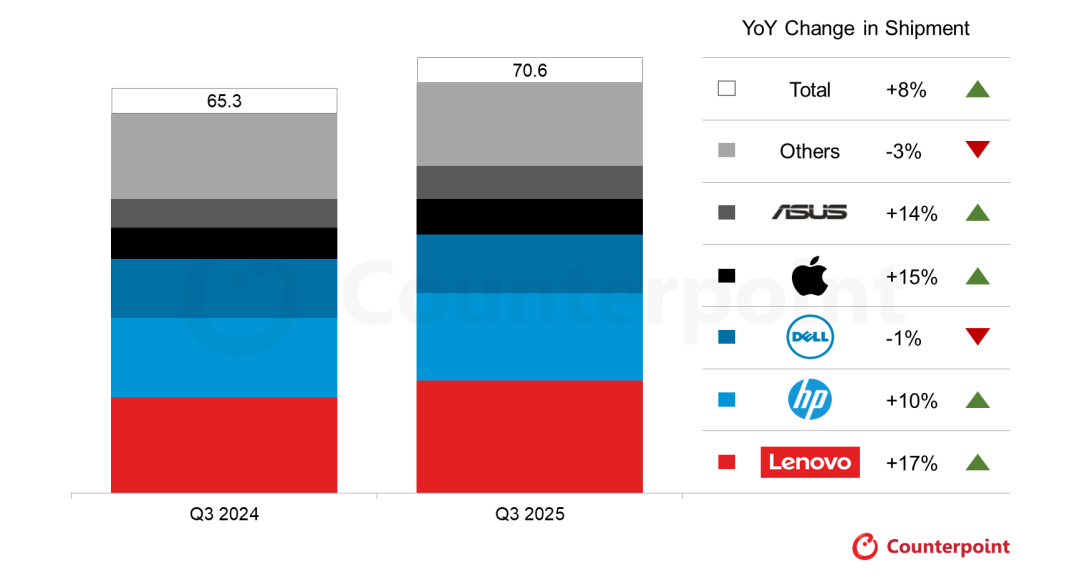
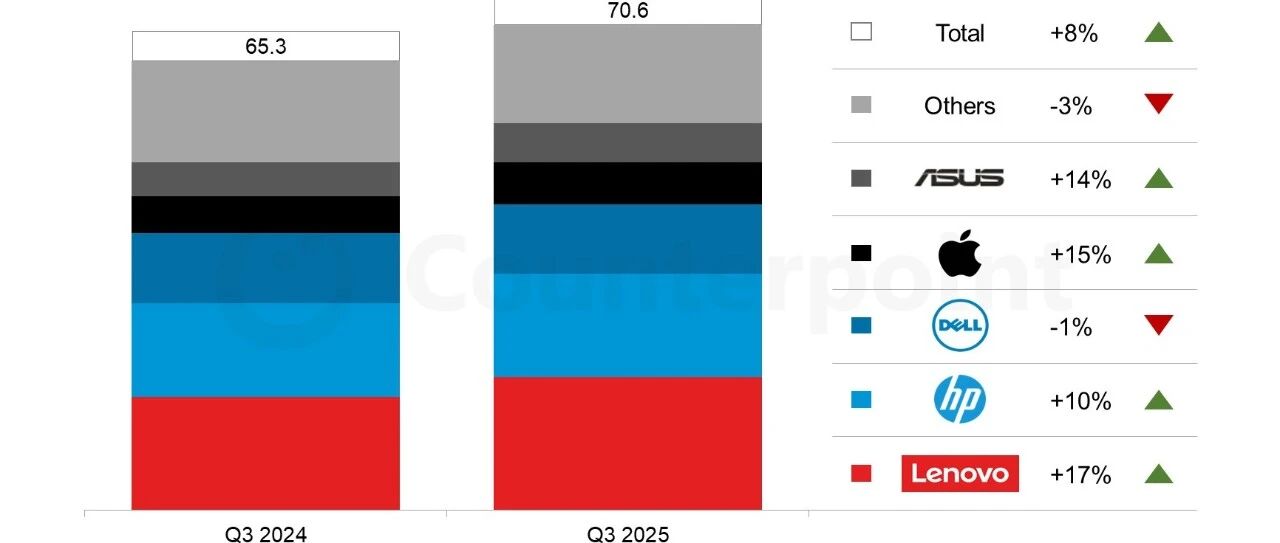
Core Insights - Global PC shipments are projected to grow by 8.1% year-on-year in Q3 2025, driven by the end of Windows 10 support and inventory strategy adjustments related to U.S. import tariffs [1] - Approximately 40% of the PC installed base is still running Windows 10, creating a significant replacement cycle that is expected to boost market growth in the coming years [1] Group 1: Market Performance - Lenovo maintains its position as the global market leader with a 17.4% year-on-year increase in shipments, the highest among the top six manufacturers [3] - HP ranks second with a 10.3% year-on-year growth in shipments, highlighting its strong penetration in the commercial market [3] - Dell shows a slight decline of 0.9% year-on-year in shipments, but a 2.7% quarter-on-quarter increase, indicating cautious purchasing behavior among core enterprise clients [4] - Apple benefits from strong sales of the new MacBook and corporate interest, achieving a 14.9% year-on-year growth in shipments [5] - ASUS experiences a significant quarter-on-quarter increase of 22.5% in shipments, with a 14.1% year-on-year growth driven by robust demand for consumer laptops [6] Group 2: Competitive Landscape and Future Trends - The top five manufacturers collectively account for nearly three-quarters of the global PC market, with increasing concentration in the high-end market, while smaller brands see flat or slightly declining shipments [7] - The current growth is primarily driven by the operating system migration, but the rise of AI PCs is expected to bring deeper changes to the industry [7] - Significant growth in AI PC shipments is anticipated to begin after 2026, driven by the commercialization of next-generation processors designed for local AI computing [7][8] - Companies are beginning to procure AI-enabled PCs to prepare for future applications, even if there is no immediate demand, indicating a shift towards "edge intelligence" as the next wave of replacement [7] - The focus is shifting towards AI PCs as the next growth engine, with manufacturers launching new models featuring local AI acceleration capabilities, although these features have not yet become the main sales drivers [7]



2025年Q3全球PC出货量同比增长8.1%,Windows 10停服与关税变化推动市场回暖
Counterpoint Research· 2025-10-28 04:26
Core Insights - The global PC shipment volume increased by 8.1% year-on-year in Q3 2025, driven by the end of support for Windows 10 and strategic inventory adjustments related to changes in U.S. import tariffs [5][4] - Approximately 40% of the PC installed base is still running Windows 10, indicating a significant replacement cycle that is expected to drive market growth in the coming years [5][9] - Major OEMs capitalized on the replacement cycle, with several companies achieving double-digit year-on-year growth, while smaller brands saw flat or slightly declining shipments [7][8] Market Dynamics - Lenovo maintained its position as the global market leader with a shipment increase of 17.4%, the highest among the top six manufacturers [8] - HP ranked second with a 10.3% year-on-year increase, showcasing its strong penetration in the commercial market [8] - Dell experienced a slight decline of 0.9% year-on-year, reflecting cautious purchasing behavior among core enterprise clients [8] Future Trends - The rise of AI PCs is anticipated to significantly boost shipments starting in 2026, driven by the commercialization of next-generation processors designed for local AI computing [9][12] - Companies are beginning to procure AI-enabled PCs not out of immediate necessity but to prepare for future applications, indicating a shift towards "edge intelligence" as the next wave of replacement [11][12] - The 2026 CES is expected to be a pivotal event for the AI PC market, showcasing numerous local AI demonstrations and new product launches [12]


“国产GPU四小龙之一”成功闯关科创板IPO 联想集团等八大概念股成核心受益标的
Zhi Tong Cai Jing· 2025-10-27 08:43
Core Viewpoint - Muxi Co., Ltd. has successfully passed the IPO review for the Sci-Tech Innovation Board, positioning itself as a significant player in the domestic computing power sector as one of the "Four Little Dragons" of domestic GPUs [1][2] Company Overview - Muxi Co., Ltd. (Muxi Integrated Circuit (Shanghai) Co., Ltd.) was established in September 2020 and is headquartered in the Shanghai Free Trade Zone, focusing on the research and development of full-stack high-performance GPU chips and computing platforms [2] - The company submitted its application for listing on the Sci-Tech Innovation Board in June 2025 and entered the review stage in October, demonstrating rapid growth and industry opportunities within five years [2] Shareholder Structure - Muxi's shareholder structure includes prominent investors such as Ge Weidong and his Chaos Investment, as well as leading investment institutions like Matrix Partners China and Sequoia Capital China [3] - After this issuance, Ge Weidong and Chaos Investment hold a combined stake of 7.48%, while Matrix Partners holds 5.13% and Sequoia Capital holds 4.19% [3] - Lenovo Group has become a significant player in Muxi's ecosystem, having invested since the A-round financing in 2021, and has collaborated with Muxi to launch the "DeepSeek Domestic AI Integrated Machine" [3] Market Context - The uncertainty in the global AI computing power supply chain has made domestic alternatives a necessity, with Muxi's GPU product matrix covering inference, training, and graphics rendering [4] - Muxi's flagship product, the Xiyun C600, has achieved a fully domestic closed loop in design, manufacturing, and testing, competing with international leaders like NVIDIA's A100 [4] - The Chinese AI server market is projected to exceed 50 billion yuan by 2025, with a domestic replacement rate of less than 20%, indicating significant growth potential [4] Business Layout - Muxi focuses on three main areas: AI training and inference, general computing, and graphics rendering, creating an integrated system of "chips + software + platforms" [5] - Core products include high-performance GPU chips, supported by the MXMACA software stack and computing platform, with applications across key industries such as education, finance, transportation, energy, healthcare, and entertainment [5] Financial Performance - Financial data shows that Muxi's revenue surged from 426,400 yuan in 2022 to 743 million yuan in 2024, with a compound annual growth rate of 4074.52% [6] - As of September 5, 2025, Muxi has an order backlog of 1.43 billion yuan, nearly double its total revenue for 2024 [6] Beneficiary Stocks Post-IPO - Companies like Supercom (603322) directly hold an 8% stake in Muxi and have established a joint venture for GPU server production, leading to a projected net profit increase of 130%-219% in the first half of 2025 [8] - Other companies such as Zhongke Lanyun (688332) and Zhongshan Public Utilities (000685) have indirect stakes and potential synergies with Muxi, enhancing their market positions [9]
GPU独角兽沐曦股份冲刺IPO 联想集团等八大概念股受益
Ge Long Hui· 2025-10-27 08:32
Core Viewpoint - Muxi Co., Ltd. has successfully passed the IPO review for the Sci-Tech Innovation Board, positioning itself as a significant player in the domestic GPU market, often referred to as one of the "four little dragons" of domestic GPUs [1][2] Company Overview - Muxi Co., Ltd. (Muxi Integrated Circuit (Shanghai) Co., Ltd.) was established in September 2020 and is headquartered in the Shanghai Free Trade Zone, focusing on the research and development of high-performance GPU chips and computing platforms [2] - The company submitted its IPO application in June 2025 and entered the review stage in October, marking a rapid ascent to the capital market within five years, driven by both strong capabilities and industry opportunities [2] Shareholder Structure - Muxi's shareholder structure includes prominent investors such as Ge Weidong and his Chaos Investment, along with leading investment institutions like Matrix Partners China and Sequoia Capital China [3] - After the IPO, Ge Weidong and Chaos Investment will hold a combined 7.48% stake, while Matrix Partners holds 5.13% and Sequoia Capital holds 4.19% [3] - Lenovo Group has become a key strategic partner, holding 0.98% of shares, and has been involved since the A-round financing in 2021, contributing to the development of the "DeepSeek" AI integrated machine [3] Market Context - In the context of increasing uncertainty in the global AI computing supply chain, domestic alternatives have shifted from being optional to essential [4] - Muxi's GPU product matrix includes inference, training, and graphics rendering, with its flagship product, the Xiyun C600, achieving a fully domestic closed loop in design, manufacturing, and testing, competing with international products like NVIDIA's A100 [4] - The Chinese AI server market is projected to exceed 50 billion yuan by 2025, with a domestic replacement rate of less than 20%, indicating significant growth potential [4] Business Layout - Muxi focuses on three main areas: AI training and inference, general computing, and graphics rendering, creating an integrated system of "chips + software + platforms" [5] - Core products include high-performance GPU chips, supported by the MXMACA software stack and computing platforms, with applications spanning key industries such as education, finance, transportation, energy, healthcare, and entertainment [5] Financial Performance - Financial data shows that Muxi's revenue surged from 426,400 yuan in 2022 to 743 million yuan in 2024, representing a compound annual growth rate of 4074.52% [6] - As of September 5, 2025, Muxi has an order backlog of 1.43 billion yuan, nearly double its total revenue for 2024 [6] Beneficiary Stocks Post-IPO - Companies like ChaoXun Communication hold an 8% stake in Muxi and have established a joint venture for GPU server production, leading to a projected net profit increase of 130%-219% in the first half of 2025 [8] - Other companies such as Lenovo Group and Guanghui New Network are also positioned to benefit from Muxi's growth through various collaborative efforts and product integrations [8][9]
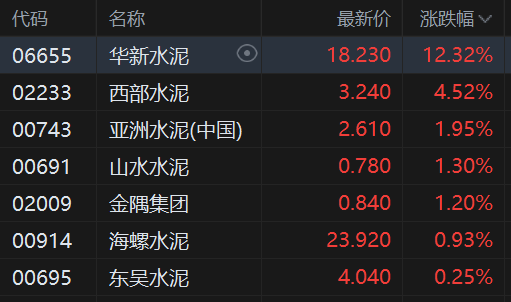
港股异动丨水泥股拉升 华新水泥绩后大涨超12%领衔 西部水泥涨4.5%
Ge Long Hui· 2025-10-27 03:03
Group 1 - The core point of the article highlights a significant rise in Hong Kong cement stocks, particularly Huanxin Cement, which surged over 12% following its earnings announcement [1] - Huanxin Cement reported a net profit of 900 million yuan for Q3, representing a year-on-year increase of 120.73%, and a total net profit of 2 billion yuan for the first three quarters, up 76.01% year-on-year [1] - The company plans to distribute a dividend of 0.34 yuan per share for the first three quarters on December 24, 2025, supported by rising domestic cement prices and reduced production costs [1] Group 2 - Other cement stocks also experienced gains, with Western Cement rising 4.5%, Asia Cement increasing by 2%, and several others, including Shanshui Cement and Jinyu Group, seeing over 1% growth [1] - According to a report by Shenwan Hongyuan, Q3 is traditionally a slow season for the cement industry, and cement prices are expected to peak and then decline in 2025 [1] - The ongoing expansion of overseas operations is showing progress, with Huanxin Cement and Western Cement continuing to increase production capacity, and profitability in African cement operations is expected to remain high and improve [1]