
LENOVO GROUP(00992)

Search documents
联想集团:第三季度营收222亿美元 不及预期
Xin Lang Cai Jing· 2026-02-12 04:06
【联想集团:第三季度营收222亿美元 不及预期】智通财经2月12日电,联想集团在港交所公告称,第 三季度营收222亿美元,预估207.6亿美元;第三季度净利润5.455亿美元;第三季度毛利率15.1%,预估 15.4%。 转自:智通财经 ...
联想集团(00992) - 2026 Q3 - 季度业绩
2026-02-12 04:02
香港交易及結算所有限公司及香港聯合交易所有限公司對本公告的內容概不負責,對其準確性或完整性亦 不發表任何聲明,並明確表示,概不對因本公告全部或任何部份內容而產生或因倚賴該等內容而引致的任 何損失承擔任何責任。 Lenovo Group Limited 聯想集團有限公司 ( 於香港註冊成立之有限公司 ) (港幣櫃台股份代號:992 / 人民幣櫃台股份代號:80992) 二零二五 / 二六年財政年度第三季業績公佈 第三季業績 聯想集團有限公司 (「本公司」) 董事會 (「董事會」) 在此宣佈,本公司及其附屬公司 (「本集團」) 截至二 零二五年十二月三十一日止三個月及九個月未經審核業績及去年同期的比較數字如下: 財務摘要 | | 截至二零二五年 | 截至二零二五年 | 截至二零二四年 | 截至二零二四年 | 年比年轉變 | | | --- | --- | --- | --- | --- | --- | --- | | | 十二月三十一日 | 十二月三十一日 | 十二月三十一日 | 十二月三十一日 | 截至 | 截至 | | | 止三個月 | 止九個月 | 止三個月 | 止九個月 | 十二月三十一日 | 十二月三十 ...
港股大型科网股,集体下跌
Di Yi Cai Jing Zi Xun· 2026-02-12 03:43
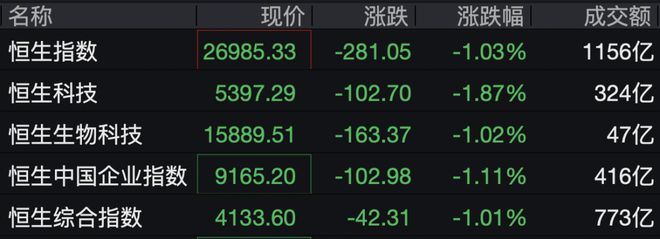
Group 1 - Major tech stocks in Hong Kong experienced a decline, with notable drops of approximately 4% for companies such as NetEase, Meituan, Bilibili, and Trip.com, while Baidu and Tencent fell over 3% [1][2] - The Hang Seng Index saw a broader market downturn, with a decline of 1% and the Hang Seng Tech Index dropping by 1.87% [2] - Specific stock performance included Kingdee International down by 4.98%, NetEase down by 4.15%, and Meituan down by 4.11%, among others [3]





联想申请信息处理方法和电子设备专利,得到目标对象对应的完整编码信息
Jin Rong Jie· 2026-02-12 01:24
Group 1 - Lenovo (Beijing) Co., Ltd. has applied for a patent titled "An Information Processing Method and Electronic Device," with publication number CN121503513A, and the application date is September 2025 [1] - The patent abstract describes a method that involves receiving incomplete coding information based on a damaged label, constructing a dual-domain feature vector from this information, and determining an enhanced feature vector to represent the damaged label's characteristics [1] - The enhanced feature vector is used to identify complete coding information corresponding to the target object through an information processing model [1] Group 2 - Lenovo (Beijing) Co., Ltd. was established in 1992 and is located in Beijing, primarily engaged in the manufacturing of computers, communications, and other electronic devices [2] - The company has a registered capital of 565 million Hong Kong dollars and has invested in 108 enterprises, participated in 5,000 bidding projects, and holds 1,741 trademark records and 5,000 patent records [2] - Additionally, Lenovo (Beijing) Co., Ltd. possesses 238 administrative licenses [2]
联想申请电子设备天线专利,提升天线信号收发性能
Jin Rong Jie· 2026-02-12 00:38
作者:情报员 天眼查资料显示,联想(北京)有限公司,成立于1992年,位于北京市,是一家以从事计算机、通信和 其他电子设备制造业为主的企业。企业注册资本565000万港元。通过天眼查大数据分析,联想(北京) 有限公司共对外投资了108家企业,参与招投标项目5000次,财产线索方面有商标信息1741条,专利信 息5000条,此外企业还拥有行政许可238个。 声明:市场有风险,投资需谨慎。本文为AI基于第三方数据生成,仅供参考,不构成个人投资建议。 本文源自:市场资讯 国家知识产权局信息显示,联想(北京)有限公司申请一项名为"电子设备"的专利,公开号 CN121507384A,申请日期为2025年12月。 专利摘要显示,本申请公开了一种电子设备,天线技术领域,电子设备包括:目标本体;金属板,固定 于目标本体的外表面,金属板的第一金属部分构成电子设备的第一天线;第一金属部分用于收发第一天 线的第一电磁波信号,第一金属部分的面积小于金属板的面积。 ...
恒指站稳27000点盘整向上 短线活跃资金离场观望
Xin Lang Cai Jing· 2026-02-11 13:36
Market Performance - The Hong Kong stock market continued its upward momentum, with the Hang Seng Index and the Hang Seng China Enterprises Index rising by 0.31% and 0.28% respectively, while the Hang Seng Tech Index saw a peak increase of 1.3% before closing up by 0.9% [2] - Major tech stocks showed recovery, with Xiaomi surging by 5.4%, and slight increases in NetEase, Kuaishou, Baidu, and Meituan [2] Sector Analysis - Gold stocks rebounded strongly, contributing to the activity in the non-ferrous sector, while other industries such as building materials, cement, automotive, lithium batteries, shipping, and coal also experienced gains [3][4] - In contrast, sectors such as film, semiconductors, insurance, dining, and aviation showed weak performance, with AI application concepts experiencing divergence [4] Trading Volume and Short Selling - The total trading volume for the day was HKD 217.218 billion, indicating a continued trend of reduced trading activity as some funds began to exit ahead of the holiday [4] - The total short selling amount reached HKD 28.824 billion, accounting for 13.27% of the Hang Seng Index's trading volume, with Alibaba, Tencent, and Xiaomi leading in short selling amounts [4] Macroeconomic Context - The macroeconomic environment appears to be warming, with overseas markets showing overall strength, as evidenced by the Dow Jones Index reaching a new high [5] - The People's Bank of China released a report indicating a focus on supporting key areas such as expanding domestic demand and technological innovation, which may benefit sectors like chemicals and raw material imports [6] Investment Outlook - Analysts suggest that the technology sector remains a long-term investment focus, supported by rising prices in the supply chain, trends towards domestic production, and accelerated AI applications [8] - The consumer sector is also expected to benefit from policy support, with current valuations at relatively low levels, indicating potential for long-term growth [8]






联想发布2025年度报告 中国企业智能化转型进入AI原生驱动新阶段
Xin Lang Cai Jing· 2026-02-11 10:32
Core Insights - The report indicates that Chinese enterprises are transitioning towards an AI-native era, with AI principles increasingly integrated into corporate strategies and a trend towards large-scale implementation of intelligent systems [1][4]. Group 1: Industry Maturity and Trends - By 2025, the proportion of leading enterprises in intelligent transformation (levels 4-5) is expected to rise significantly to 39%, with AI-native enterprises making up 9% of this group, compared to 16%, 22%, and 22% in 2022, 2023, and 2024 respectively [1][7]. - The overall average maturity score across industries reached 3.19, a notable increase from 2.77 in 2024. The financial sector continues to lead with an average score of 3.43, while the healthcare sector has the highest proportion of leading enterprises at 50% [2][8]. - The construction and public utility sectors showed the fastest growth in maturity scores, increasing by 23% and 21% respectively [2][8]. Group 2: Value and Strategic Framework - The report emphasizes a transformation framework focused on "value-driven, systematic advancement," highlighting three main values: operational value, strategic value, and industry and social value [3][9]. - Operational value is projected to maintain a significant presence, with its share being 44%, 40%, and 41% from 2023 to 2025, indicating a preference for immediate operational optimization during economic fluctuations [10]. Group 3: Challenges and Future Directions - As AI technologies advance, the focus is shifting from technical exploration to business integration, with enterprises increasingly concerned about the seamless integration of intelligent systems into business processes [11]. - AI-native enterprises are expected to evolve from "innovation experiments" to mainstream models, aiming for comprehensive value chain reconstruction under an AI-first approach [11].
涨!涨!涨!半导体行业掀涨价风暴
Xin Lang Cai Jing· 2026-02-11 10:16
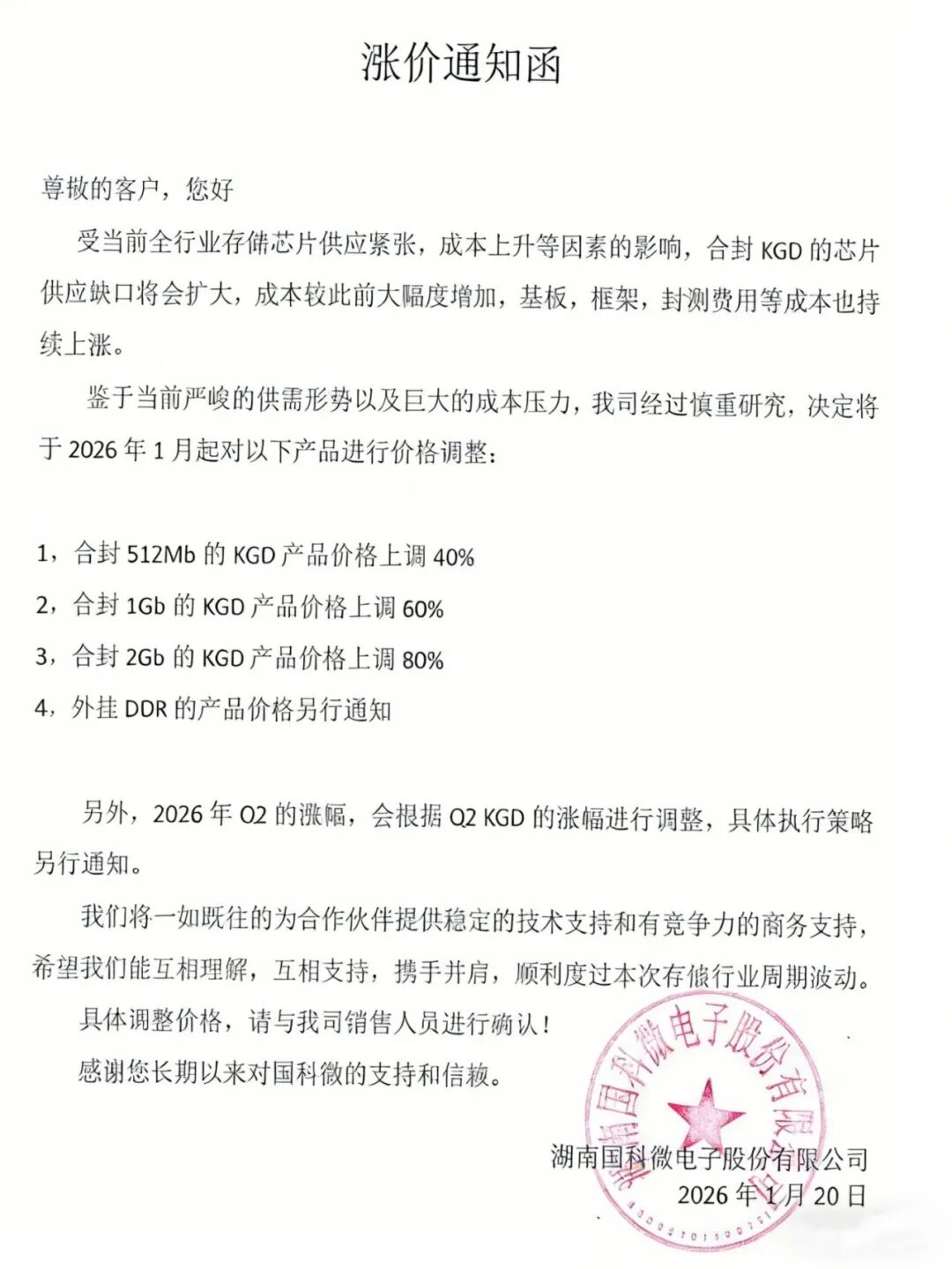
Core Viewpoint - The global semiconductor industry is experiencing a new wave of price increases across the entire supply chain, driven by surging AI demand and rising raw material costs [1][3][61]. Group 1: Price Increases in Domestic Semiconductor Companies - Over 20 semiconductor companies have officially announced price increases [2][62]. - Domestic chip manufacturers are significantly raising prices, with increases as high as 80% for certain products [4][63]. - Guokewai announced price hikes for its KGD storage products, with increases of 40% to 80% [6][66]. - Zhongwei Semiconductor is raising prices for MCU and NOR Flash products by 15% to 50% due to supply chain pressures [9][73]. - Biyiwei has also announced price increases across its entire product line, citing rising raw material costs [17][76]. Group 2: Price Increases in International Semiconductor Companies - International semiconductor giants are also raising prices, with ADI increasing prices by 15% to 30% starting February 1, 2026 [21][81]. - Infineon plans to raise prices for power switches and IC products due to increased demand from AI data centers [24][83]. - Texas Instruments is expected to raise prices by over 30% across nearly all categories due to rising costs [21][81]. Group 3: Price Increases in Wafer Foundry and Packaging - Wafer foundries are increasing prices, with TSMC raising advanced process prices by 3% to 10% [25][85]. - Packaging and testing services are seeing price increases of up to 30%, driven by high demand and capacity constraints [27][86]. Group 4: Impact of Raw Material Costs - The prices of precious metals like gold, silver, and copper are rising, significantly impacting chip manufacturing costs [57][116]. - The increase in raw material costs is leading to a ripple effect across the semiconductor supply chain, prompting many companies to raise their product prices [57][116]. Group 5: Effects on End Markets - The price increases in storage chips are affecting end markets, with PC manufacturers like Dell and Lenovo planning price hikes of 10% to 30% [59][118]. - In the smartphone sector, rising storage costs are pressuring new product pricing, particularly for low-end models [59][118]. - The automotive electronics sector is also feeling the impact, with companies like Xiaomi and NIO reporting cost pressures due to rising semiconductor prices [59][119].


杨元庆:发展“中国人经济”,以“中国+N”重塑中国全球经济竞争力
21世纪经济报道· 2026-02-11 04:56
Core Viewpoint - The article emphasizes the importance of the concept of "Chinese People Economy," which focuses on the Gross National Income (GNI) generated by Chinese individuals and enterprises globally, as opposed to merely the domestic GDP. This shift is seen as essential for achieving high-quality development and ensuring sustainable economic growth during the 14th and 15th Five-Year Plans [1][2]. Group 1: Economic Context - The Chinese economy has demonstrated remarkable high-quality development, maintaining an average growth rate of 5.4% during the 14th Five-Year Plan, and surpassing 140 trillion yuan in total economic output [1]. - The goal for the 15th and 16th Five-Year Plans is to maintain an average annual growth rate of over 4.17% while fully tapping into economic potential [1]. Group 2: Strategic Importance of "Chinese People Economy" - The "Chinese People Economy" encourages enterprises to leverage domestic innovation and manufacturing capabilities to expand globally, thereby enhancing control over global resources and markets [2][5]. - This concept aims to create a virtuous cycle where the development of the "Chinese People Economy" feeds back into the domestic economy, promoting mutual growth and resilience [2][6]. Group 3: Characteristics of Global Competitiveness - To foster the "Chinese People Economy," it is crucial to cultivate globally competitive Chinese enterprises that possess resource allocation capabilities, technological innovation, and brand influence [5]. - Companies should maintain core capabilities in China, as it offers unparalleled industrial advantages and serves as a hub for global resource allocation [5][9]. Group 4: Lenovo's Globalization Practices - Lenovo's journey exemplifies the integration of "Chinese Economy" and "Chinese People Economy," having grown into a global technology giant with over 500 billion yuan in annual revenue and operations in 180 markets [8][9]. - Lenovo emphasizes the importance of "thickening China" by keeping a significant portion of its manufacturing and R&D in China while also building local operations in international markets [10][11]. Group 5: Market Expansion Strategies - The focus on emerging markets, particularly in the "Global South," is becoming a strategic priority for Chinese enterprises, with Lenovo establishing a significant presence in regions like the Middle East and Latin America [12]. - Lenovo's partnership with Saudi Arabia's Public Investment Fund aims to enhance its market position in the region while contributing to local economic diversification and job creation [12]. Group 6: Innovation and AI Development - Technological innovation, particularly in artificial intelligence, is identified as a core driver of the "Chinese People Economy," with Lenovo positioned as a key player in this space [13]. - The company aims to promote AI products that serve global users while adhering to a human-centric approach, reflecting Chinese cultural values [13][14].

技术硬件与设备行业2025年信用回顾与2026年展望
新世纪评级· 2026-02-11 01:17
Investment Rating - The technology hardware and equipment industry is rated as stable for 2025 and 2026 [1] Core Insights - The technology hardware and equipment industry is experiencing a slow recovery driven by inventory replenishment cycles and AI technology, despite overall pressure from weak global economic growth since 2025. There is significant differentiation among sub-industries, with strong demand for data center equipment driven by computing power, while traditional telecom equipment shows sluggish growth [2][3] - The Chinese government has established a policy framework to support the industry, focusing on short-term growth stabilization, medium-term supply chain strengthening, and long-term innovation promotion, primarily through domestic substitution to overcome high-end equipment and material bottlenecks [2] - The industry is expected to benefit from the deepening of digital China initiatives and the industrialization of cutting-edge technologies like AI, entering a structurally growth-driven cycle. However, geopolitical disturbances and rapid technological iterations may lead to uneven recovery across the industry [5] Summary by Sections Industry Overview - The electronic information manufacturing industry is closely tied to global economic conditions, showing signs of recovery since 2024 due to inventory replenishment and AI-driven demand. It is a core industry in China's economic structure transformation and upgrade [7][8] - In 2024, the added value of China's electronic information manufacturing industry grew by 11.8%, outperforming overall industrial and high-tech manufacturing growth rates [8] Financial Performance - Sample companies in the technology hardware and equipment industry reported positive revenue growth year-on-year in 2025, aligning with industry recovery trends. However, high R&D investments and asset impairment losses have pressured net profits, while EBITDA showed year-on-year growth, indicating profit resilience [3] - The debt scale and liability ratios of sample companies have increased, with a decline in the EBITDA coverage ratio for rigid debt, although interest coverage has improved due to lower financing costs [3] Sub-Industry Insights Communication Equipment - The communication equipment sector is experiencing growth opportunities driven by AI and industrial interconnectivity, with significant demand for data center equipment but slow growth in traditional telecom network equipment. The market is highly competitive and concentrated [24][27] - The deployment of high-speed optical modules and data center switches is expected to grow significantly, while traditional telecom equipment investments are declining as operators shift focus to computing power networks [28] Computers and Peripheral Devices - The global PC and server markets are stable, with Chinese manufacturers gaining market share due to domestic substitution. The AI PC segment is becoming a core growth driver, with AI PC shipments expected to increase significantly [37][38] - The global server market is experiencing robust growth driven by AI computing demand, with significant revenue increases expected in the coming years [42] Electronic Devices, Instruments, and Components - The electronic devices, instruments, and components sector is seeing overall recovery driven by AI innovation and domestic supply chain localization. Key areas of growth include computing power chips and advanced packaging [48][49] - The semiconductor industry is entering an upward trend, with significant sales growth expected in both global and Chinese markets [56]



