
LENOVO GROUP(00992)

Search documents
研判2025!中国刀片式服务器行业分类、市场规模及重点企业分析:规模扩张与国产化共塑关键窗口期,高端竞争蓄势待发[图]
Chan Ye Xin Xi Wang· 2025-12-15 01:42
Core Viewpoint - The Chinese blade server industry is experiencing a critical development phase driven by technological upgrades, deepening market applications, and supply chain localization, characterized by simultaneous expansion of market size and acceleration of domestic production processes [1] Industry Overview - Blade servers are a high-density server platform designed for specific application industries and high-density computing environments, allowing multiple "blade" modules to be inserted into a unified chassis, providing optimal space efficiency and energy efficiency for large data centers [4][6] - The evolution of the blade server industry in China has transitioned from early architectural exploration to market maturity, showcasing a trajectory from single functionality to multi-fusion [6] Market Size - The market size of the Chinese blade server industry is projected to reach approximately 15.07 billion yuan in 2024, reflecting a year-on-year growth of 2.8%, driven by strong demand from cloud computing and artificial intelligence [1][8] Key Enterprises - Unisplendour Corporation, through its subsidiary H3C, leads the blade server market, leveraging its unique position as the exclusive provider of HPE servers in China and its "plastic architecture" for resource pooling [10] - Inspur Information maintains a strong market share through continuous innovation in liquid cooling technology, while Huawei excels in AI computing scenarios with its self-developed Kunpeng chips [10] - Sugon focuses on high-performance computing and liquid cooling technology, establishing a competitive edge in the research and supercomputing sectors [10] Industry Development Trends 1. **Liquid Cooling Technology and AI Integration** - The industry is accelerating towards green and intelligent infrastructure, with liquid cooling technology expected to penetrate over 30% of the market by 2025, significantly improving energy efficiency [13] 2. **Market Concentration and Localization** - The competition is becoming increasingly oligopolistic, with domestic CPUs gaining traction in government and military sectors, while the supply chain is reducing reliance on imports [14] 3. **Edge Computing Expansion** - The blade server architecture is evolving towards a dual-mode of "centralized large clusters + distributed micro-clusters," adapting to the demands of edge computing driven by 5G and IoT applications [16]





大涨超26%!IDC:2025年第三季度联想(00992)服务器营收稳居全球前三
Zhi Tong Cai Jing· 2025-12-14 07:41
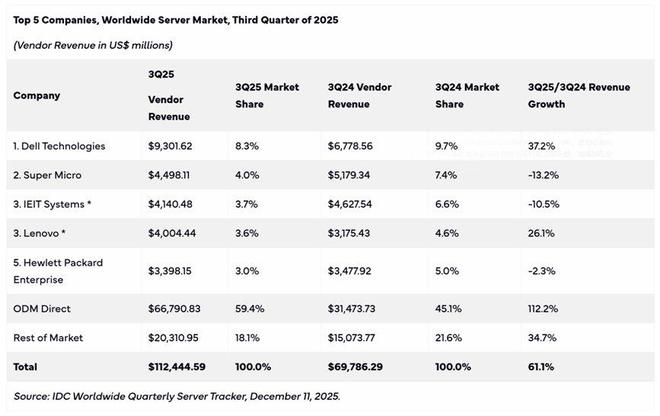
Core Insights - The global server market revenue reached a record $112.4 billion in Q3 2025, marking a significant year-on-year increase of 61% [1][2] - Lenovo has emerged as a key player in the global server market, achieving a revenue growth of 26.1% year-on-year, securing its position among the top three vendors [1][2] Market Performance - Dell Technologies led the market with revenues of $9.3 billion, a growth of 37.2% compared to Q3 2024 [2] - Lenovo's revenue reached $4.0 billion, capturing 3.6% market share, while other competitors like Super Micro and Inspur experienced revenue declines of 13.2% and 10.5%, respectively [2] - The ODM Direct segment saw a remarkable growth of 112.2%, contributing significantly to the overall market expansion [2] Segment Analysis - The x86 server segment grew by 32.8% year-on-year, generating $76.3 billion, while non-x86 servers surged by 192.7% to $36.2 billion [3] - Embedded GPU servers accounted for over half of the total server market revenue, with a year-on-year growth of 49.4% [3] Regional Insights - The U.S. server market experienced the fastest growth at 79.1% year-on-year, driven by a surge in the accelerated server segment [3] - China's market grew by 37.6%, representing nearly one-fifth of the global quarterly revenue [3] - Other regions, including Asia-Pacific (excluding Japan), EMEA, and Japan, also reported healthy double-digit growth rates of 37.4%, 31.0%, and 28.1%, respectively [3]
大涨超26%!IDC:2025年第三季度联想服务器营收稳居全球前三
Zhi Tong Cai Jing· 2025-12-14 07:39
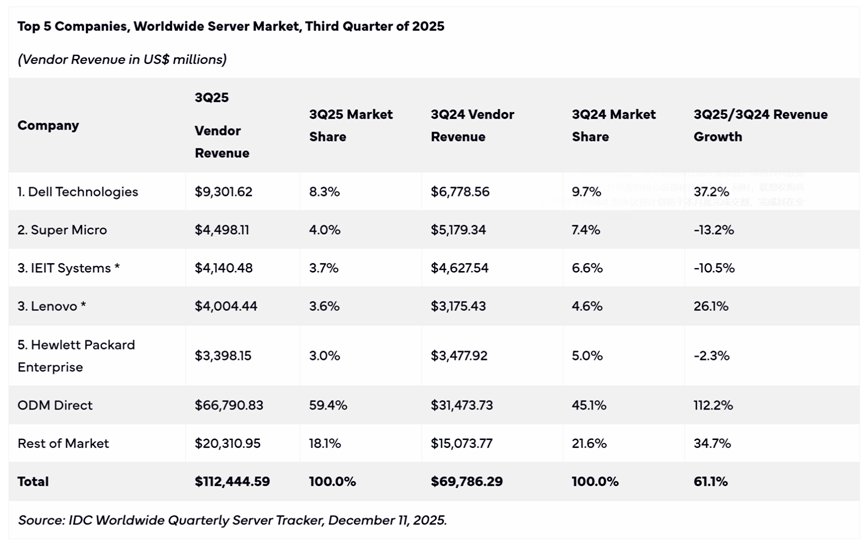
Core Insights - The global server market revenue reached a record $112.4 billion in Q3 2025, marking a significant year-on-year increase of 61% [1][2] - Lenovo has emerged as a key player in the global server market, achieving a revenue growth of 26.1% year-on-year, securing a market share of 3.6% and ranking third alongside Inspur Technology [1][2] Company Performance - Lenovo's revenue in Q3 2025 was $4.004 billion, up from $3.175 billion in Q3 2024, demonstrating a strong competitive advantage in the market [2] - Other major players like Super Micro, Inspur, and Hewlett Packard Enterprise experienced revenue declines of 13.2%, 10.5%, and 2.3% respectively, highlighting Lenovo's robust growth amidst a challenging environment [2] Market Trends - The x86 server revenue grew by 32.8% year-on-year to $76.3 billion, while non-x86 server revenue surged by 192.7% to $36.2 billion in Q3 2025 [3] - Embedded GPU server revenue increased by 49.4%, accounting for over half of the total server market revenue, driven by the rapid adoption from hyperscale data center operators and cloud service providers [3] Regional Insights - The U.S. server market saw the fastest growth, increasing by 79.1% compared to Q3 2024, primarily due to a 105.5% surge in the accelerated server segment [3] - China's market grew by 37.6%, contributing nearly one-fifth of the global quarterly revenue, while the Asia-Pacific region (excluding Japan), EMEA, and Japan also experienced healthy double-digit growth rates [3]
招银国际称2026年AI PC将成主流标配机型 联想凭借内存战略备货防御性最强
Zhi Tong Cai Jing· 2025-12-13 09:03
Core Viewpoint - The report from Zhaoyin International indicates that the penetration rate of AI PCs is expected to exceed 2026, with product portfolio optimization likely to offset rising costs [1] Group 1: Lenovo - Lenovo's AI PC shipment penetration reached 33% in Q3 2025, with expectations for double-digit growth in the coming quarters [1][2] - Lenovo's PC revenue grew by 17% year-on-year in FY2Q26, achieving a global market share of 25.6%, a historical high [2] - The company holds 7-8 months of memory inventory, significantly higher than competitors' 2-3 months, providing a buffer against rising costs [2] Group 2: Dell Technologies - Dell's Client Solutions Group (CSG) revenue grew by 3% year-on-year in F3Q26, with commercial PC sales increasing by 5% [3] - AI server orders surged to $12.3 billion, with backlog orders reaching $18.4 billion, a record high [3] - Dell's direct sales model allows for quicker pricing adjustments, historically recovering about two-thirds of cost increases within 90 days [3] Group 3: HP - HP's Personal Systems revenue grew by 8% year-on-year in FY4Q25, driven by gains in commercial and high-end consumer markets [4] - The company provided a cautious outlook for FY26, lowering its operating profit margin guidance for personal systems to 5-7% [4] - HP announced a cost-saving plan aiming for $1 billion in total savings by FY28, with $300 million targeted for FY26 [4]
招银国际称2026年AI PC将成主流标配机型 联想(00992)凭借内存战略备货防御性最强
智通财经网· 2025-12-13 09:00
Core Viewpoint - The report from CMB International indicates that the penetration rate of AI PCs is expected to exceed 2026, with product portfolio optimization likely to offset cost increases [1] Group 1: Lenovo - Lenovo's AI PC shipment penetration reached 33% in Q3 2025, with expectations for double-digit growth in the coming quarters [1] - Lenovo's PC revenue grew by 17% year-on-year in FY2Q26, achieving a historical global market share of 25.6% [2] - The company holds 7-8 months of memory inventory, significantly higher than competitors' 2-3 months, providing a buffer against rising costs [2] - Management is optimistic about the PC market achieving low single-digit growth in 2026, positioning Lenovo as a core leader in the AI PC trend [2] Group 2: Dell Technologies - Dell's client solutions group revenue grew by 3% year-on-year in F3Q26, with commercial PC sales increasing by 5% [2] - AI server orders surged to $12.3 billion, with backlog orders reaching $18.4 billion, a historical high [2] - Dell's direct sales model allows for quicker pricing adjustments compared to competitors, with a historical ability to recover about two-thirds of cost increases within 90 days [2] - The company expects the PC market to remain flat in 2026, driven by upgrades due to the end of Windows 10 support [2] Group 3: HP - HP's personal systems revenue grew by 8% year-on-year in FY4Q25, with shipment volume increasing by 7% [3] - The company provided a cautious outlook for FY26, lowering its operating profit margin guidance for personal systems to 5-7% due to cost pressures [3] - HP announced a cost-saving plan aiming for $1 billion in total savings by the end of FY28, with $300 million targeted for FY26 [3] - The company anticipates slight revenue growth in FY26, primarily driven by improvements in the AI PC portfolio and price increases rather than significant volume growth [3]
科技2026展望:算力高景气延续,关注端侧AI创新机遇
Zhao Yin Guo Ji· 2025-12-11 05:30
Investment Rating - The report suggests a positive outlook for the technology sector, particularly focusing on AI computing infrastructure and end-side AI innovations [1][24]. Core Insights - The global technology industry is expected to experience a dual trend of differentiated terminal demand and accelerated AI innovation by 2026, driven by rapid iterations of AI large models [1][24]. - The report highlights two main investment themes: 1) AI computing infrastructure, where VR/ASIC architecture upgrades will drive growth in ODM and component suppliers; 2) End-side AI innovations, particularly in AI smartphones, PCs, and glasses, with companies like Luxshare Precision, Hontai Precision, BYD Electronics, Sunny Optical, AAC Technologies, and Xiaomi Group being key players [1][24]. Summary by Sections Server Market - The global server market is projected to be dominated by AI infrastructure investments, with AI server shipments expected to grow by 50% year-on-year to 2.32 million units in 2026 [2][25]. - The market will see a "GPU/ASIC dual-drive" pattern, with VR/ASIC architecture reshaping value and driving demand for connectors, cables, and power supply components [2][25]. Smartphone Market - Global smartphone shipments are anticipated to decline by 5% year-on-year to 1.18 billion units in 2026, primarily affecting low-end models due to macro uncertainties and rising storage costs [2][25]. - However, the high-end market remains resilient, with Apple expected to launch innovative products, including the first foldable iPhone and AI-driven devices [2][25]. AR/VR Market - The report forecasts that global AI glasses shipments will exceed 10 million units by 2026, marking a significant growth in the wearable technology sector [2][25]. - Major tech companies are accelerating their investments in AR/VR, with advancements in optical technologies expected to unlock further potential in the coming years [2][25]. PC and Automotive Electronics - The global PC market is expected to face challenges, with a projected 2% decline in shipments to 275 million units in 2026, influenced by the end of the Windows 11 upgrade cycle and rising storage costs [2][25]. - AI PCs are expected to penetrate the market significantly, with projections indicating that they will account for over 50% of shipments by 2026 [2][25]. Memory Price Impact - The report discusses the impact of rising memory prices on the technology supply chain, predicting that short-term pressures will affect mid-to-low-end consumer markets while high-end products may buffer the cost increases [27][30].




益起联想 与AI相伊 | 伊利与联想打造“生态解法”新实践
Zhong Jin Zai Xian· 2025-12-11 03:01
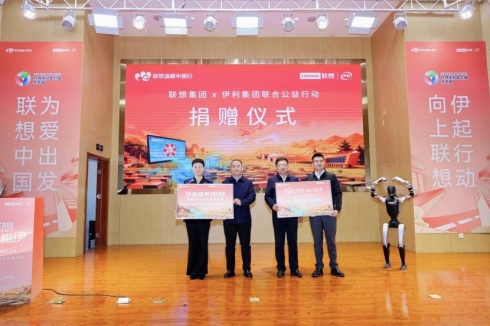
Core Viewpoint - The collaboration between Yili Group and Lenovo Group aims to enhance the nutritional support for students in Inner Mongolia through the "Yili Nutrition 2030" public welfare project, combining nutrition and technology to empower local youth [1][12]. Group 1: Event Overview - On December 9, Yili Group and Lenovo Group launched a public welfare initiative in Hohhot, donating 160,000 boxes of student milk to provide stable nutritional support for students [1]. - The event included interactive activities, such as Tai Chi with Lenovo's first silicon-based employee, "LeXiang YiHao," and various games that engaged children in a fun and educational environment [6][7]. Group 2: Corporate Responsibility - Yili Group's Vice President, Liu Dapeng, emphasized the company's commitment to giving back to its hometown and supporting the growth of local youth as part of its corporate mission [2]. - The initiative is part of Yili's long-term partnership with the 32nd School in Hohhot, where it has consistently provided nutritional support and contributed to the development of youth activity centers [5]. Group 3: Sustainable Development Initiatives - The collaboration represents a significant step in Yili's understanding of future public welfare models, as it aligns with the establishment of a "Sustainable Social Value Ecosystem" with partners like Tencent and Lenovo [12]. - The event is one of the first practical implementations of three joint action plans aimed at creating a collaborative public welfare ecosystem, showcasing the synergistic effect of combining nutrition and technology [14]. Group 4: Future Prospects - Following the event, Yili and Lenovo engaged in discussions about digitalization, smart manufacturing, and green low-carbon initiatives at Yili's ecological smart ranch, indicating a commitment to exploring further opportunities for collaboration [16]. - The initiative aims to create a lasting impact on education and sustainable development, with Yili dedicated to extending its positive influence in the community [16].

美国智能手机市场份额:季度数据(2023 年 Q2 - 2025 年 Q3)
Counterpoint Research· 2025-12-11 01:42
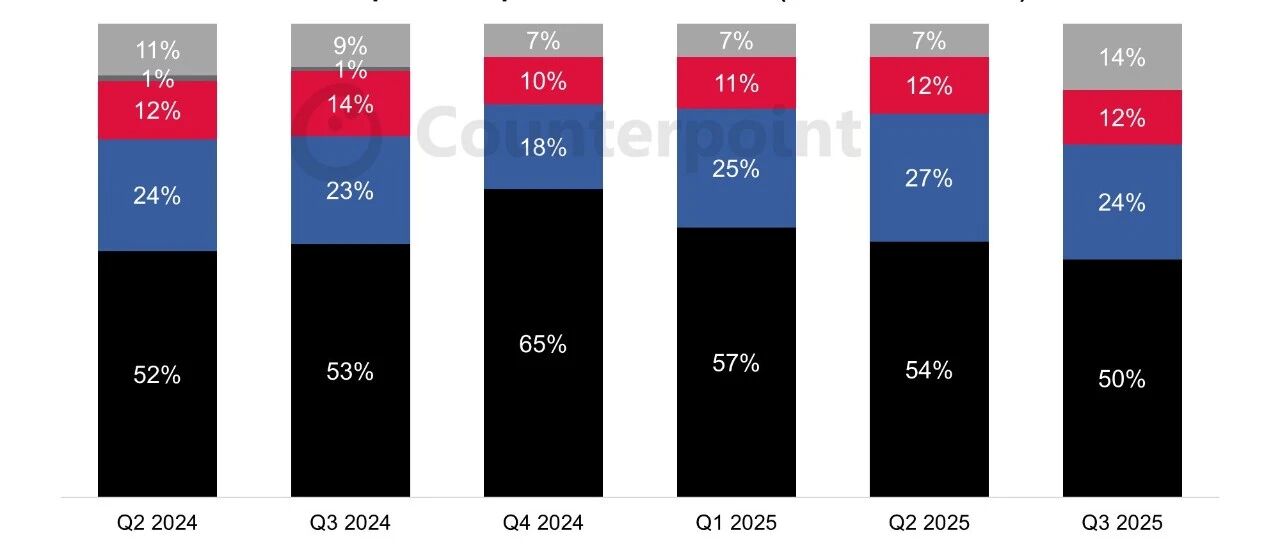
Core Insights - The article discusses the smartphone market trends and shipment volumes, highlighting the performance of major brands in the U.S. market for Q3 2025 and the impact of various economic factors on these trends [4][8][11]. Market Highlights - Despite ongoing tariff issues, U.S. smartphone shipments saw a slight year-on-year increase in Q3 2025, attributed to a rise in imports from Vietnam and India, compensating for the decline in imports from China [8][11]. - Apple experienced a decline in market share both year-on-year and quarter-on-quarter, yet maintained growth in annual shipments due to strong performance from the iPhone 16e. The iPhone 17 series shipments remained stable but faced challenges from strong demand [8][11]. - Samsung's market share saw a minor increase of 1 basis point year-on-year but a decrease of 3 basis points quarter-on-quarter, primarily due to strong growth from Google [8][11]. - Motorola's performance weakened in Q3 due to soft prepaid demand influenced by macroeconomic and political factors, leading to a decline in its market share [8][11]. - HMD exited the U.S. market, prompting a cessation of tracking for this brand by the research firm [8][11]. Brand Performance - In Q2 2024, Apple held a 52% market share, which increased to 53% in Q3 2024, but dropped to 50% by Q3 2025. Samsung's share fluctuated, reaching 24% in Q3 2024 and stabilizing at 24% in Q3 2025. Lenovo's share remained consistent at 12% during the same period [9][15]. - The overall smartphone shipment volume in Q1 2025 increased by 9% year-on-year, driven by preemptive stocking to avoid potential tariff impacts, particularly in March [15][21]. - Motorola achieved its highest market share of 11% in Q1 2025, attributed to the early launch of its G series and improved positioning in the prepaid market [15][21]. Economic Impact - The article notes that the U.S. smartphone market faced a 9% year-on-year decline in Q4 2024, influenced by low upgrade rates and extended upgrade cycles. Apple and Samsung both experienced declines in shipments during this period [18][21]. - In Q3 2024, the U.S. smartphone market saw a 6% year-on-year decline, primarily due to weak demand in both prepaid and postpaid channels [21].


PC巨头开启利润保卫战:集体宣布涨价
智通财经网· 2025-12-11 01:39
Core Viewpoint - The recent price increases by major PC manufacturers Lenovo, Dell, and HP, with rises of 15%-20%, are primarily driven by unprecedented surges in memory chip prices, specifically DRAM and NAND flash [1][2]. Group 1: Price Increase Drivers - The operating profit margins for Lenovo, HP, and Dell are notably low, with Lenovo at 8.3%, and HP and Dell at 5.8% and 6% respectively, making them vulnerable to cost fluctuations in memory components, which account for 15%-18% of total costs [2]. - DRAM prices have surged by 170% year-on-year, with forecasts indicating further increases of 5%-20% for DRAM and NAND contracts by Q4 2025 [2][4]. - The demand for high-performance memory products driven by the AI industry has led to a structural change in the semiconductor supply chain, causing a significant supply shortage for traditional PC memory components [4][6]. Group 2: Market Dynamics and Opportunities - The collective price increase provides a rare opportunity for PC giants to raise prices without losing market share, as the entire industry faces similar cost pressures [3][7]. - The transition from a volume-driven to a profit-centered business model is seen as a positive development by capital markets, alleviating concerns about future profitability [3][9]. - The end of Windows 10 support and the rising demand for AI-capable PCs are creating a rigid replacement demand, allowing manufacturers to pass on costs to business customers [5][7]. Group 3: Competitive Landscape - Lenovo's proactive inventory management, with a 50% higher stock of critical components, positions it favorably to navigate the supply shortages expected through 2026 [8]. - The price increases are expected to reshape the competitive rules in the PC industry, moving the focus from scale to profit quality, with gross margin stability becoming a key competitive indicator [9][10]. - The price hikes are not merely reactive but are strategic moves to establish pricing discipline and enhance pricing power within the industry [11].
涨幅最高20%!戴尔、联想集体宣布涨价 开启利润保卫战
Ge Long Hui· 2025-12-11 01:35
Core Viewpoint - The recent price increase by major PC manufacturers Lenovo, Dell, and HP, with increases of 15%-20%, is primarily driven by unprecedented rises in DRAM and NAND flash memory prices, which has led to warnings from Wall Street regarding future profits and subsequent stock downgrades for these companies [1][2]. Group 1: Price Increase Reasons - The price increase is a response to a significant rise in memory chip costs, with DRAM prices soaring by 170% year-on-year, and predictions of further increases of 5%-20% for DRAM and NAND contracts by Q4 2025 [2][4]. - The cost of memory components constitutes 15%-18% of the total cost for PC manufacturers, making them highly sensitive to price fluctuations [2][4]. - The current memory price surge is attributed to a structural change in the semiconductor supply chain driven by the explosion of the AI industry, leading to a "super cycle" in memory demand [4][6]. Group 2: Market Dynamics - The collective price increase provides a rare opportunity for PC giants to raise prices without losing market share, as all major players face similar cost pressures [3][7]. - The demand from commercial clients, who prioritize reliability and total cost of ownership over initial purchase price, allows manufacturers to pass on costs more effectively [7][8]. - The end of support for Windows 10 and the rising demand for AI-capable PCs create a rigid replacement demand, further supporting the price increases [5][7]. Group 3: Competitive Landscape - The price increase marks a shift in the PC industry from a volume-driven model to a profit-centered approach, with a focus on maintaining gross margins [9][10]. - Companies like Lenovo, with a market share exceeding 25%, have positioned themselves advantageously by maintaining higher inventory levels and securing favorable contracts with suppliers [8][11]. - The price hikes are seen as a strategic move to establish pricing discipline and enhance pricing power, which is crucial for long-term profitability [10][11]. Group 4: Future Implications - The current price adjustments are expected to lead to a structural shift in the PC market, with average selling prices likely to rise rather than fall as seen in the past [10][11]. - Stable profits from core PC operations will provide the necessary cash flow for companies to transition towards higher-growth service and solution-oriented business models [11].
