
LENOVO GROUP(00992)

Search documents
存储成本飙升!惠普、戴尔涨价在即,联想(00992)计划跟进
Zhi Tong Cai Jing· 2025-12-01 13:25
Core Viewpoint - The ongoing "super cycle" in storage chips driven by AI is exerting significant cost pressure on global PC and mobile manufacturers, leading to anticipated price increases across the board [1] Group 1: Company Responses - Dell Technologies has issued a price increase warning, indicating that costs will ultimately be passed on to end customers, with a possibility of repricing certain products [1] - HP's CEO has stated the company is prepared to raise product prices if necessary, noting that memory costs currently account for 15% to 18% of typical PC total costs [1] - Lenovo Group plans to follow suit with price increases to counteract rising storage prices, having already locked in production capacity for 2026 to manage costs [1] Group 2: Market Trends - Storage chip prices have surged by 50% cumulatively since the beginning of the price increase phase, with 512GB chips rising nearly 500 yuan since October [1] - Counterpoint Research forecasts that memory prices are expected to rise by an additional 50% by the second quarter of 2026, suggesting that price hikes for mobile and PC products are inevitable [1]


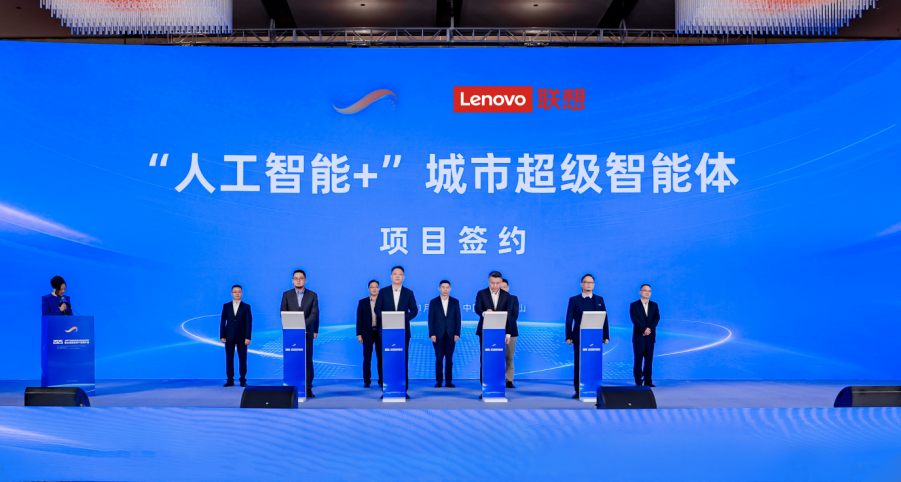
【江北嘴发布】赋能低空经济 联想城市超级智能体“落户”重庆
Zhong Guo Jin Rong Xin Xi Wang· 2025-12-01 09:09
Core Insights - The event in Chongqing focused on the promotion of the low-altitude economy and featured a strategic cooperation agreement between the Chongqing Bishan District and Lenovo Group, aimed at integrating AI technologies into urban development and industry upgrades [1][3] Group 1: Strategic Cooperation - The agreement involves the deployment of Lenovo's "1+N intelligent body" technology architecture, which includes a unified central intelligent body and multiple specialized intelligent bodies for various vertical fields [3] - This initiative aims to enhance the integration of digital and real economies, accelerate innovation in the industrial chain, and establish a high ground for digital economic innovation applications [3] Group 2: Low-Altitude Economy Development - Bishan District is designated as a pilot area for low-altitude equipment industry development and has signed multiple projects related to the low-altitude economy [3] - The district is building a comprehensive service demonstration base for low-altitude commercial operations, focusing on a standardized service system for low-altitude unmanned aerial vehicles [3]


联想集团(00992) - 股份发行人的证券变动月报表(截至2025年11月30日)
2025-12-01 08:42
FF301 股份發行人及根據《上市規則》第十九B章上市的香港預託證券發行人的證券變動月報表 第 1 頁 共 11 頁 v 1.1.1 | 截至月份: | 2025年11月30日 | 狀態: 新提交 | | --- | --- | --- | | 致:香港交易及結算所有限公司 | | | | 公司名稱: | 聯想集團有限公司 | | | 呈交日期: | 2025年12月1日 | | | I. 法定/註冊股本變動 | 不適用 | | FF301 FF301 III.已發行股份及/或庫存股份變動詳情 (A). 股份期權(根據發行人的股份期權計劃) 不適用 第 3 頁 共 11 頁 v 1.1.1 (B). 承諾發行發行人股份的權證 II. 已發行股份及/或庫存股份變動 | 1. 股份分類 | 普通股 | | 股份類別 | 不適用 | | 於香港聯交所上市 (註1) | 是 | | | --- | --- | --- | --- | --- | --- | --- | --- | --- | | 證券代號 (如上市) | 00992 | | 說明 | 港幣櫃台 | | | | | | 多櫃檯證券代號 | 80992 ...
联想取得壳体及设备系统专利,可实现壳体与电子设备的固定连接
Jin Rong Jie· 2025-12-01 05:57
Core Insights - Lenovo (Beijing) Co., Ltd. has obtained a patent titled "Shell and Equipment System," with the authorization announcement number CN223600129U, and the application date is November 2024 [1] - The patent summary indicates that the application provides a shell and equipment system, which includes a shell body with a first connection part for fixing the shell to electronic devices and a first physical contact point for electrical connection with electronic devices [1] Company Overview - Lenovo (Beijing) Co., Ltd. was established in 1992 and is located in Beijing, primarily engaged in the manufacturing of computers, communications, and other electronic devices [1] - The company has a registered capital of 565 million Hong Kong dollars [1] - According to Tianyancha data analysis, Lenovo (Beijing) Co., Ltd. has invested in 107 companies, participated in 5,000 bidding projects, and has 1,751 trademark records and 5,000 patent records, in addition to holding 238 administrative licenses [1]
联想申请一种调度方法、电子设备及存储介质专利,实现待执行任务的最优分配
Jin Rong Jie· 2025-12-01 04:53
Group 1 - Lenovo (Beijing) Co., Ltd. has applied for a patent titled "A Scheduling Method, Electronic Device, and Storage Medium," with publication number CN121029374A, and the application date is June 2025 [1] - The patent abstract indicates that the scheduling method involves determining target resource information required for executing tasks, identifying normal processors in various computing nodes, and selecting candidate computing nodes based on performance parameters, including temperature [1] - The method aims to allocate tasks to the target computing node where the temperature of normal processors is below a specified threshold, enhancing efficiency in task execution [1] Group 2 - Lenovo (Beijing) Co., Ltd. was established in 1992 and is located in Beijing, primarily engaged in the manufacturing of computers, communications, and other electronic devices [2] - The company has a registered capital of 565 million Hong Kong dollars and has invested in 107 enterprises, participated in 5,000 bidding projects, and holds 1,751 trademark records and 5,000 patent records [2] - Additionally, Lenovo (Beijing) has 238 administrative licenses, indicating a robust operational framework and extensive involvement in various business activities [2]
CES2026超前瞻:AI是核心议题,中国企业或将再度霸展
3 6 Ke· 2025-12-01 04:09
Core Insights - CES 2026 is set to showcase significant advancements in AI technology, with major companies like Siemens, Caterpillar, AMD, and Lenovo focusing on AI in their presentations [5][8][19] - The event will highlight a variety of AI hardware products, including AI glasses, AI PCs, AI smartphones, and humanoid robots, indicating a strong trend towards AI integration in consumer electronics [18][19] - Chinese brands are expected to dominate CES, showcasing their technological innovations across various categories, reflecting their growing influence in the global market [40][41] AI as the Central Theme - AI will be the overarching theme of CES 2026, with confirmed keynote speeches from industry leaders emphasizing its importance [5][19] - Companies like Siemens will demonstrate how AI and digital twin technology can transform manufacturing and infrastructure [8] - Lenovo plans to unveil innovations related to AI-driven experiences, including applications in sports and personalized user interactions [11] PC and Gaming Innovations - Intel, AMD, and NVIDIA are anticipated to launch new products, including Intel's Panther Lake mobile processors and AMD's R9 9950X3D processor with enhanced cache capabilities [19][21] - The introduction of new gaming processors and graphics cards is expected to attract significant attention from the gaming community [21][22] Display Technology Competition - Major TV manufacturers, including TCL and Hisense, are expected to showcase advancements in RGB display technology, competing with international brands like LG and Samsung [25][26] - The CES 2026 will feature a variety of display technologies, including Micro RGB LCD and Mini LED, highlighting the competitive landscape in the display sector [25][26] Smart Cleaning Devices - Chinese smart cleaning brands are set to unveil new products, including robotic vacuums and lawn mowers, reinforcing their leadership in the global smart cleaning market [27][30] - The focus will be on comprehensive cleaning solutions that leverage AI and advanced navigation technologies [30] Accessory and Audio Innovations - Accessory brands like Baseus and Ugreen are expected to expand their product lines beyond traditional charging devices, venturing into audio and smart home solutions [31][34] - The introduction of high-end audio products and smart home security devices will be a key focus for these brands at CES 2026 [36] AI Glasses and New Hardware - AI glasses are anticipated to be a major highlight, with various brands competing in this emerging category [38] - The presence of established players and new entrants in the AI hardware space will create a dynamic showcase of innovative products [39] Chinese Brands' Dominance - Chinese companies are projected to play a pivotal role at CES, with a significant share of exhibitors and a focus on technological innovation rather than just cost competitiveness [40][41] - The event serves as a platform for Chinese brands to demonstrate their rapid product development and engineering capabilities across multiple tech sectors [40][41]


谁又募到钱了
投资界· 2025-11-30 08:23
Fundraising Activities - In November, Source Code Capital announced the completion of a new growth fund with a total scale of $600 million, focusing on "AI+" and "Global+" investment directions [4] - Monolith completed fundraising for its dual-currency VC fund with a total scale of approximately $488 million (about 3.5 billion RMB), bringing its total asset management scale to over 10 billion RMB [6] - Hangzhou Runmiao Fund was established with an initial scale of 2 billion RMB, focusing on early-stage investments [8] - The XinKe Industry Investment Fund, initiated by Wuhan High-tech Group, has a total scale of 5 billion RMB, aimed at enhancing local industrial development [10] - CapitaLand Investment announced the completion of its CLARA II private fund with over $650 million raised, focusing on data centers and new economic infrastructure in the Asia-Pacific region [12] - Shenzhen Investment Control and Bank of Communications signed a cooperation agreement for a 2 billion RMB fund focusing on hard technology enterprises [14] - Chip Union Capital completed fundraising of 1.25 billion RMB for its main fund, targeting semiconductor and AI sectors [16] - Cainiao and China Life established a logistics investment fund with a total asset scale of over 1.7 billion RMB [18] - Lenovo announced the establishment of the Lenovo Shanghai Fund with an initial scale of 1 billion RMB, focusing on cutting-edge technology [20] - The Nanjing Jinyu Maowu Fund was established with a total scale of 1 billion RMB, focusing on AI and digital economy sectors [22] - The Henan Lihua Angel Fund was registered with a total scale of 177 million RMB, focusing on frontier technology investments [24] - Northern Light Venture Capital established a QFLP fund in Tianjin, with a registered capital of approximately 1 million RMB [26] - China Rare Earth established a private equity fund management company in Shenzhen with a registered capital of 30 million RMB [28] - The Hubei Zhongying Changjiang Fund was established with a target scale of 10 billion RMB, focusing on high-end equipment manufacturing and AI [30] - The Wuxi Baiwang AI Investment Fund was successfully registered, focusing on AI and data intelligence sectors [32] - Shanghai Jiao Tong University established a fund with a total scale of 100 million RMB, focusing on strategic emerging industries [34] - Yida Capital plans to establish a cross-border investment fund to support Guangzhou's economic development and attract international capital [36]


联想申请频率调整方法及电子设备专利,根据目标核心频率调整环形总线频率以执行应用
Jin Rong Jie· 2025-11-29 12:13
国家知识产权局信息显示,联想(北京)有限公司申请一项名为"频率调整方法及电子设备"的专利,公 开号CN121029375A,申请日期为2025年7月。 本文源自:市场资讯 作者:情报员 声明:市场有风险,投资需谨慎。本文为AI基于第三方数据生成,仅供参考,不构成个人投资建议。 专利摘要显示,本公开提供了一种频率调整方法及电子设备,所述方法包括:获得针对电子设备运行应 用的核心调用指令;核心调用指令用于表征电子设备运行应用需要调用的处理器核心;其中,处理器核 心包括第一核心和第二核心;第一核心的最大工作频率大于第二核心的最大工作频率;响应于核心调用 指令,确定目标核心;目标核心为第一核心或第二核心的任意一个类型;根据目标核心的工作频率,调 整环形总线的工作频率以执行应用。 天眼查资料显示,联想(北京)有限公司,成立于1992年,位于北京市,是一家以从事计算机、通信和 其他电子设备制造业为主的企业。企业注册资本565000万港元。通过天眼查大数据分析,联想(北京) 有限公司共对外投资了107家企业,参与招投标项目5000次,财产线索方面有商标信息1751条,专利信 息5000条,此外企业还拥有行政许可238个。 ...
联想申请一种智能检测方法及装置专利,可生成检测工具执行业务指令
Jin Rong Jie· 2025-11-29 10:28
Core Viewpoint - Lenovo (Beijing) Co., Ltd. has applied for a patent titled "An Intelligent Detection Method and Device," indicating its focus on innovative technology solutions in the field of intelligent detection [1]. Group 1: Patent Application Details - The patent application, published as CN121029590A, was filed on August 2025 [1]. - The method described in the patent involves receiving user input for business execution instructions, intelligently parsing these instructions, and determining executable code based on the parsing results [1]. - The first execution code generated is intended to create a detection tool that executes the business instructions, with the process displayed in a second display area [1]. Group 2: Company Background - Lenovo (Beijing) Co., Ltd. was established in 1992 and is located in Beijing, primarily engaged in the manufacturing of computers, communications, and other electronic devices [1]. - The company has a registered capital of 5.65 billion HKD and has invested in 107 enterprises, participated in 5,000 bidding projects, and holds 1,751 trademark records and 5,000 patent records [1]. - Additionally, Lenovo (Beijing) has 238 administrative licenses, showcasing its extensive operational footprint [1].
联想取得摘要生成方法和装置专利
Jin Rong Jie· 2025-11-29 08:41
国家知识产权局信息显示,联想(北京)有限公司取得一项名为"摘要生成方法和装置"的专利,授权公 告号CN114661893B,申请日期为2022年3月。 声明:市场有风险,投资需谨慎。本文为AI基于第三方数据生成,仅供参考,不构成个人投资建议。 本文源自:市场资讯 天眼查资料显示,联想(北京)有限公司,成立于1992年,位于北京市,是一家以从事计算机、通信和 其他电子设备制造业为主的企业。企业注册资本565000万港元。通过天眼查大数据分析,联想(北京) 有限公司共对外投资了107家企业,参与招投标项目5000次,财产线索方面有商标信息1751条,专利信 息5000条,此外企业还拥有行政许可238个。 作者:情报员 ...