
CNCB(00998)

Search documents
大行高歌猛进中小银行疲态尽显,零售银行二元分化格局已确认
Feng Huang Wang· 2025-09-04 09:03
Core Insights - The retail business has become a focal point for banks, with significant growth reported by the six major banks, while smaller banks show weaker performance in personal loans [1][4][5] - There is a divergence in opinions among banks regarding the risk trends in retail loans, with some believing the peak of bad loans has passed, while others see ongoing risk increases [1][2][7] Retail Business Performance - The six major banks have shown strong growth in retail business, with notable increases in personal consumption and operating loans, capturing a significant market share [1][4] - Specific growth figures include: - China Construction Bank's personal operating loans increased by 20.38% - Industrial and Commercial Bank of China’s personal consumption loans grew by 10.2% - Agricultural Bank of China’s personal operating loans rose by 17.2% [4] Divergence Among Banks - Smaller banks, including joint-stock and city commercial banks, have experienced sluggish growth in personal loans, with some reporting negative growth [1][5][6] - For instance, Ping An Bank's personal loan total decreased by 2.3%, while China Everbright Bank's retail loan growth was only 1.57% [5] Market Conditions and Future Outlook - The introduction of consumption loan subsidies is expected to create more variables in the retail market for the fourth quarter and next year [3] - Smaller banks are under pressure from larger banks and are focusing on improving their retail loan offerings, particularly in housing and consumption loans [3][8] Strategies for Growth - Major banks are expected to continue focusing on personal consumption and operating loans, leveraging central policies to support growth [8][9] - Smaller banks are looking to enhance their loan offerings by collaborating with local enterprises and improving loan approval processes to compete with larger banks [7][9]



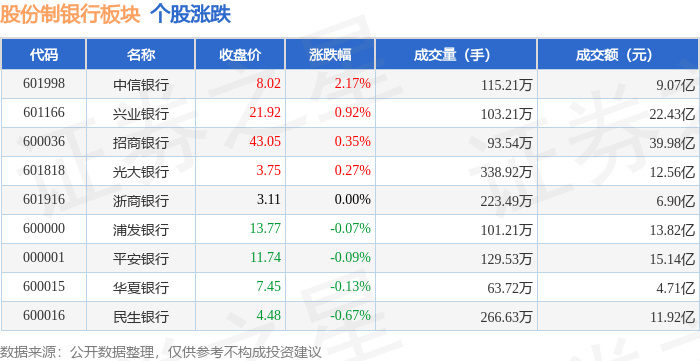
股份制银行板块9月4日涨0.46%,中信银行领涨,主力资金净流入2.24亿元
Zheng Xing Xing Ye Ri Bao· 2025-09-04 08:48
Core Insights - The banking sector saw a slight increase of 0.46% on September 4, with CITIC Bank leading the gains, while the Shanghai Composite Index fell by 1.25% and the Shenzhen Component Index dropped by 2.83% [1] Group 1: Market Performance - CITIC Bank closed at 8.02, up by 2.17%, with a trading volume of 1.15 million shares and a transaction value of 907 million [1] - Other notable banks included Industrial Bank, which rose by 0.92% to 21.92, and China Merchants Bank, which increased by 0.35% to 43.05 [1] - The overall trading volume and transaction values for various banks indicate mixed performance, with some banks experiencing slight declines [1] Group 2: Capital Flow - The banking sector experienced a net inflow of 224 million from institutional investors, while retail investors saw a net outflow of 190 million [1] - Specific banks like Shanghai Pudong Development Bank and China Minsheng Bank faced significant outflows from retail investors, indicating a shift in investor sentiment [2] - The data shows that while some banks attracted institutional investment, others struggled with outflows, reflecting varied investor confidence across the sector [2]


中信银行(00998) - 截至二零二五年八月三十一日止月份之股份发行人的证券变动月报表
2025-09-04 08:31
FF301 股份發行人及根據《上市規則》第十九B章上市的香港預託證券發行人的證券變動月報表 截至月份: 2025年8月31日 狀態: 新提交 致:香港交易及結算所有限公司 公司名稱: 中信銀行股份有限公司(「本行」) 呈交日期: 2025年9月4日 I. 法定/註冊股本變動 | 1. 股份分類 | 普通股 | 股份類別 | H | | | 於香港聯交所上市 (註1) | 是 | | | --- | --- | --- | --- | --- | --- | --- | --- | --- | | 證券代號 (如上市) | 00998 | 說明 | H股 | | | | | | | | | 法定/註冊股份數目 | | | 面值 | | 法定/註冊股本 | | | 上月底結存 | | | 14,882,162,977 | RMB | | 1 RMB | | 14,882,162,977 | | 增加 / 減少 (-) | | | 0 | | | RMB | | 0 | | 本月底結存 | | | 14,882,162,977 | RMB | | 1 RMB | | 14,882,162,977 | | 2. 股份 ...
银行研究框架及25H1业绩综述:营收及利润增速双双转正
GOLDEN SUN SECURITIES· 2025-09-04 06:14
Investment Rating - The report indicates a positive outlook for the banking industry, with overall revenue and net profit growth rates turning positive in the first half of 2025, at 1.0% and 0.8% respectively, showing improvements from the previous quarter [4]. Core Insights - The banking sector's net interest margin for the first half of 2025 is reported at 1.42%, a decrease of 10 basis points compared to the previous year, but the decline is narrowing due to improved cost management on the liability side [5]. - Non-interest income, particularly from fees and commissions, has increased by 3.1% year-on-year, driven by a recovery in wealth management and a more active market environment [5]. - The asset quality remains stable, with a non-performing loan ratio of 1.23% and a provision coverage ratio of 239%, indicating a solid credit environment [5]. Summary by Sections Financial Performance Overview - The overall revenue and net profit growth for listed banks in the first half of 2025 were 1.0% and 0.8%, respectively, with both metrics showing improvement from the first quarter [4][22]. - The total assets of listed banks reached 321.3 trillion yuan, growing by 6.35% year-to-date, with loans and advances totaling 179.4 trillion yuan, accounting for 55.84% of total assets [21][24]. Income Sources - Net interest income decreased by 1.3% year-on-year, but the decline rate has slowed, reflecting better management of funding costs [5]. - Fee and commission income grew by 3.1% year-on-year, benefiting from a recovering market and the gradual impact of regulatory changes [5]. - Other non-interest income saw a significant increase of 10.7%, primarily due to favorable market conditions in the bond market [5]. Asset Quality and Management - The non-performing loan ratio remained stable at 1.23%, with a provision coverage ratio of 239%, indicating a robust asset quality [5]. - The credit cost for the first half of 2025 was 0.81%, a decrease of 5 basis points year-on-year, suggesting manageable credit risks [5]. Loan Growth and Composition - Loan growth was primarily driven by corporate lending, with significant contributions from infrastructure and manufacturing sectors [20]. - Personal loan growth was weaker, with a year-on-year increase of only 3.6%, reflecting a cautious approach to consumer lending amid rising risks [20]. Investment and Market Conditions - The investment asset proportion decreased to 34% as banks adjusted their strategies in response to market volatility [20]. - The overall yield on bonds fluctuated significantly, prompting banks to engage in tactical trading to enhance returns [20].


中信银行副行长掌舵百信银行!上半年业绩双增之下如何迎新高
Nan Fang Du Shi Bao· 2025-09-04 06:05
Group 1 - The Beijing Financial Supervision Administration has approved the appointment of Xie Zhibin as the Chairman of Citic Baixin Bank, replacing the previous chairman Lv Tianguo who left due to work adjustments [2][3] - Xie Zhibin is currently the Vice President of Citic Bank and has held this position since June 2019, with additional roles including director at Citic Bank (Hong Kong) Investment Co., Ltd. and a council member of the Citic Reform and Development Research Foundation [3][6] - Citic Baixin Bank, established in September 2017, is the first independent legal entity direct bank in China, with a registered capital of 5.634 billion RMB and Citic Bank holding a 65.7% stake [3][5] Group 2 - Citic Baixin Bank has shown a fluctuating financial performance since its inception, with a peak net profit of 855 million RMB in 2023, followed by a decline of over 20% expected in 2024 [6] - In the first half of 2024, Citic Baixin Bank reported a revenue of 2.875 billion RMB, representing a year-on-year growth of 28.64%, and a net profit of 472 million RMB, with a growth of 1.66% [6]

私人银行半年新增15万高净值客户
21世纪经济报道· 2025-09-04 05:24
Core Viewpoint - The private banking sector has shown remarkable growth in the first half of 2025, becoming a standout area within the wealth management segment of banks, despite a complex economic environment [1]. Group 1: Growth Metrics - As of June 2025, the total number of private banking clients across 15 banks exceeded 1.63 million, with an increase of nearly 150,000 clients, representing a growth rate of over 10% [1]. - Major banks like Agricultural Bank, Bank of China, and China Construction Bank reported AUM exceeding 3 trillion yuan, with Agricultural Bank's AUM reaching 3.5 trillion yuan, a growth of 11.11% year-on-year [3]. - The AUM of Industrial Bank surpassed 1 trillion yuan for the first time, joining the "trillion club" among joint-stock banks [1][3]. Group 2: Client Quality and Strategy - Despite high growth in scale, the average asset per client has generally declined, indicating a shift from rapid expansion to a focus on deeper client engagement and service quality [4]. - Banks are increasingly targeting ultra-high-net-worth clients and enhancing services such as family trusts and retirement financial planning to differentiate themselves in a competitive market [1][5]. Group 3: Service Innovations - Private banks are moving beyond traditional product sales to more refined customer operations, focusing on precise segmentation and embedding services into clients' daily lives [6]. - For instance, China CITIC Bank has launched a dedicated service brand for ultra-high-net-worth clients, achieving a 40.96% increase in this segment [6]. - Family trusts have become a key area of focus, with several banks reporting significant growth in this service, such as Everbright Bank's family trust business growing by 56.12% year-on-year [7]. Group 4: Revenue Generation - The private banking sector is increasingly contributing to banks' intermediary income, with Beijing Bank reporting a 16.89% increase in product sales, directly boosting its intermediary income by 17.77% [9]. - Construction Bank's net income from fees and commissions reached 65.218 billion yuan in the first half of the year, reflecting a year-on-year growth of 4.02% [10].


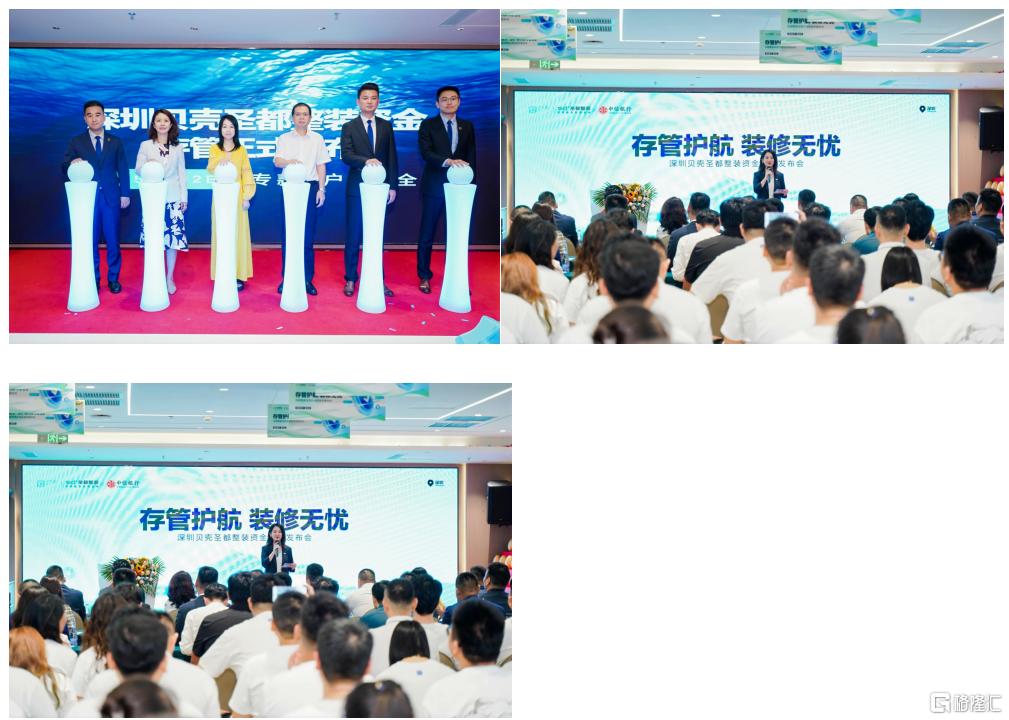
深圳贝壳圣都整装上线装修资金存管服务 保障消费者资金安全
Ge Long Hui· 2025-09-04 04:14
Core Viewpoint - The launch of the "funds custody" service by Shenzhen Beike Shendu aims to rebuild consumer trust in home decoration transactions through a three-party regulatory system involving customers, banks, and enterprises [1][5][15] Group 1: Funds Custody Mechanism - The funds custody service ensures that customer renovation payments are frozen in a personal bank account and only released in batches upon customer satisfaction at key project milestones [5][8] - The mechanism operates on the principle of "separation of interest and principal," ensuring that interest accrued during the freezing period belongs to the customer, thus safeguarding consumer rights [5][8] Group 2: Industry Challenges and Solutions - The traditional "pay first, then construct" model in the home decoration industry has led to risks such as fund misappropriation and quality issues, creating a "lose-lose" situation for consumers and enterprises [8][15] - The funds custody model enables a "pay after service" approach, marking a necessary shift from extensive expansion to quality competition in the industry [8][15] Group 3: Impact and Future Developments - The funds custody model has already been implemented in 15 cities, with over 15,000 households and more than 2 billion yuan in funds secured [11][15] - The company plans to enhance its service system and integrate the custody model with digital construction management to ensure transparency and traceability of funds [11][15] - The initiative signifies a transition in the home decoration industry from verbal commitments to institutional guarantees, potentially transforming the industry’s credit ecosystem [15][16]
中期分红队伍持续壮大
Jin Rong Shi Bao· 2025-09-04 03:03
Core Viewpoint - The recent announcements of interim dividend plans by A-share listed banks highlight a trend towards increased shareholder returns, with a total proposed dividend amount exceeding 200 billion yuan from major state-owned banks and several joint-stock banks [1][4]. Group 1: State-Owned Banks - Six major state-owned banks have announced their interim dividend plans for 2025, with a total proposed dividend amount exceeding 200 billion yuan [1]. - Industrial and Commercial Bank of China leads with a proposed dividend of 1.414 yuan per 10 shares, totaling 503.96 billion yuan [1]. - Other state-owned banks, including Agricultural Bank of China, Bank of China, China Construction Bank, Bank of Communications, and Postal Savings Bank, have proposed dividends of 418.23 billion yuan, 352.50 billion yuan, 486.05 billion yuan, 138.11 billion yuan, and 147.72 billion yuan respectively [1]. Group 2: Joint-Stock Banks - Several joint-stock banks, including China Merchants Bank, CITIC Bank, Minsheng Bank, Ping An Bank, and Huaxia Bank, have confirmed their interim dividend plans for 2025 [1][2]. - China Merchants Bank announced its first interim profit distribution plan since its listing, with a cash dividend amounting to 35% of its net profit attributable to ordinary shareholders for the first half of 2025 [1][2]. - CITIC Bank plans to increase its interim dividend payout ratio to 30.7%, enhancing investor return expectations [2]. Group 3: New Participants in Interim Dividends - New entrants to the interim dividend group include Ningbo Bank, Changsha Bank, Su Nong Bank, and Jiangyin Bank, indicating a growing trend among listed banks to adopt interim dividends [2][4]. - Su Nong Bank announced its first interim dividend plan, proposing a cash dividend of 0.9 yuan per 10 shares, totaling 1.82 billion yuan [2][3]. Group 4: Overall Market Trends - A total of 23 A-share listed banks implemented interim dividends in 2024, distributing over 250 billion yuan, with the number of banks participating expected to increase in 2025 [4]. - The push for interim dividends is seen as a response to regulatory guidance aimed at enhancing shareholder returns and stabilizing market expectations [5].

A股近六成上市银行上半年中间业务收入同比增长
Zheng Quan Ri Bao Zhi Sheng· 2025-09-03 16:40
Core Viewpoint - The intermediary business income of A-share listed banks in China has shown improvement in the first half of 2025, becoming a crucial area for banks to transform and develop amid narrowing net interest margins [1][4]. Group 1: Overall Performance - In the first half of 2025, the total net income from fees and commissions of 42 listed banks reached 409.53 billion yuan, an increase of 3.06% compared to the same period last year [1]. - Out of the 42 listed banks, 25 reported positive growth in net income from fees and commissions, with three banks experiencing growth rates exceeding 100% and nine banks exceeding 10% [2]. Group 2: Performance by Bank Type - Among the six major state-owned banks, Bank of China and China Construction Bank both saw their fee and commission income grow by over 4%, while Agricultural Bank of China and Postal Savings Bank of China reported growth exceeding 10% [2]. - In the joint-stock banks category, four out of nine banks reported positive growth in net income from fees and commissions, with CITIC Bank achieving 16.91 billion yuan (up 3.38%), Industrial Bank at 13.08 billion yuan (up 2.59%), Huaxia Bank at 3.10 billion yuan (up 2.55%), and Minsheng Bank at 9.69 billion yuan (up 0.41%) [2]. Group 3: Notable Performers - Some city commercial banks and rural commercial banks exhibited significant growth in their fee and commission income, with Changshu Bank reporting a remarkable increase of 637.77% to 142 million yuan, followed by Ruifeng Bank with a 274.07% increase to 54 million yuan, and Zhangjiagang Bank with a 140% increase to 61 million yuan [3]. Group 4: Future Outlook - Analysts predict that the growth trend in intermediary business income is likely to continue in the second half of 2025, driven by supportive macroeconomic policies and increasing demand for high-yield products among residents [4]. - The focus for banks will be on expanding non-interest income, particularly in wealth management and other light-capital businesses, to optimize their income structure [4][6].
金融中报观|银行零售业务梯队格局背后,谁在领跑,谁在补课
Bei Jing Shang Bao· 2025-09-03 14:17
Core Insights - The competitive landscape of retail banking in A-shares is becoming clearer as the 2025 mid-year reports are disclosed, revealing a distinct tiered structure in retail AUM (Assets Under Management) [1][2] - The first tier consists of major state-owned banks and China Merchants Bank, all exceeding 16 trillion yuan in retail AUM, while the second tier includes joint-stock banks and some leading city commercial banks [1][2] - The retail business performance is mixed, with many banks facing pressure on retail revenue and net profit, highlighting a structural issue of profit growth without revenue increase [1][6] Tiered Structure of Retail AUM - The first tier banks, including Industrial and Commercial Bank of China (ICBC) and Agricultural Bank of China (ABC), lead with AUM exceeding 16 trillion yuan, with ICBC at over 24 trillion yuan and ABC at 23.68 trillion yuan [2][3] - China Construction Bank (CCB) and Postal Savings Bank of China also show strong performance, with CCB managing over 22 trillion yuan and Postal Savings Bank at 17.67 trillion yuan [2] - China Merchants Bank, known as the "king of retail," has a retail AUM of 16.03 trillion yuan, reflecting a 7.39% increase from the previous year [2] Second Tier Performance - The second tier banks have retail AUM ranging from 1 trillion to 6 trillion yuan, with notable growth from banks like Bank of Communications at 5.79 trillion yuan and Industrial Bank at 5.52 trillion yuan [3] - Joint-stock banks are active in this tier, with CITIC Bank and Shanghai Pudong Development Bank also showing significant growth in retail AUM [3] Third Tier Characteristics - The third tier banks have retail AUM mostly below 1 trillion yuan, with Nanjing Bank and Shanghai Rural Commercial Bank showing notable growth rates of 14.25% and 3.99% respectively [4] - Regional banks are leveraging local advantages to deepen market penetration, but face challenges in competing with larger banks [5] Retail Profitability Challenges - The retail banking sector is undergoing significant adjustments, with a shift in customer demand towards diversified financial solutions, which raises the bar for product innovation and service customization [6] - Leading banks like ICBC and China Merchants Bank are showing resilience, with ICBC's net profit rising by 46.05% despite a slight revenue decline [6][7] - However, some banks, including ABC and Ping An Bank, are experiencing declines in both revenue and net profit, indicating a challenging environment [7] Asset Quality Concerns - The retail banking sector is facing challenges in asset quality, particularly in personal loans, with rising non-performing loan (NPL) ratios reported by several banks [9][10] - For instance, China Merchants Bank's retail loan NPL ratio increased to 1.04%, while Chongqing Rural Commercial Bank's rose to 2.04% [9] - Some banks, like Ping An Bank and Industrial Bank, have managed to improve their asset quality through refined risk management practices [10] Strategic Recommendations - Analysts suggest that banks, especially smaller ones, should focus on enhancing their support for small and micro enterprises and optimizing financial resource allocation to uncover new growth points [8] - There is a call for banks to improve their digital capabilities and customer experience to better compete with larger institutions [8]

