
KUAISHOU(01024)

Search documents
资金动向 | 北水狂买中国人寿6.72亿港元,中芯国际获连续5日净买入
Ge Long Hui· 2025-08-18 10:15
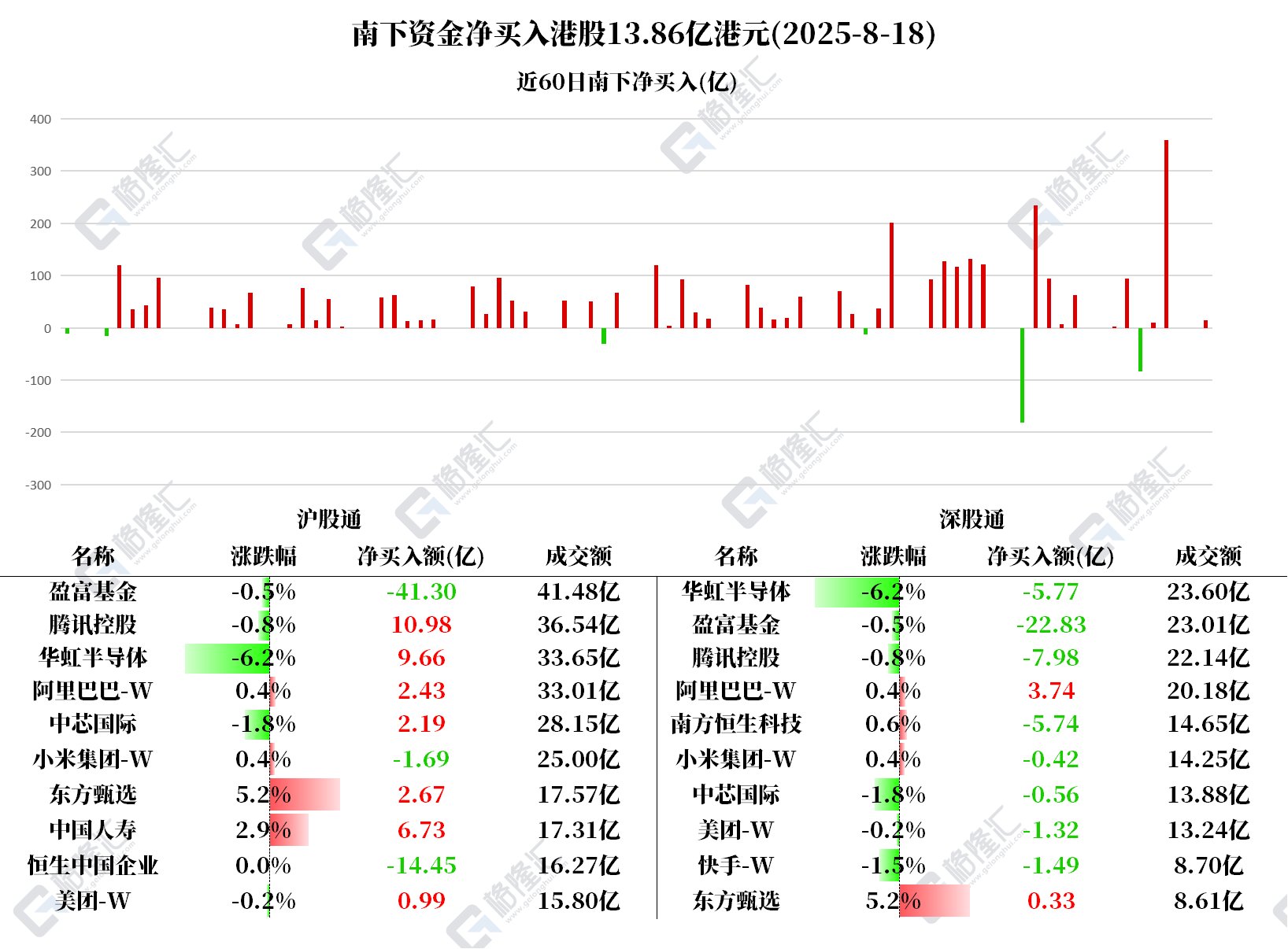
8月18日,南下资金净买入港股13.86亿港元。其中: 净买入中国人寿6.72亿港元、阿里巴巴-W 6.17亿港元、华虹半导体3.89亿港元、腾讯控股2.99亿港元、 东方甄选2.99亿港元、中芯国际1.62亿港元;净卖出盈富基金64.13亿港元、恒生中国企业14.45亿港元、 南方恒生科技5.73亿港元、小米集团-W 2.1亿港元、快手-W 1.49亿港元。 北水关注个股 中国人寿:据天眼查工商信息显示,近日,长沙聚财壹号股权投资基金合伙企业(有限合伙)成立,执 行事务合伙人为国寿置业投资管理有限公司,出资额8.01亿人民币,经营范围包括以私募基金从事股权 投资、投资管理、资产管理等活动。股权全景穿透图显示,该基金由财信吉祥人寿保险股份有限公司、 中国人寿旗下国寿置业投资管理有限公司共同出资。 据统计,南下资金已连续5日净买入中芯国际,共计10.3549亿港元;连续3日净买入阿里巴巴,共计 25.2673亿港元。 华虹半导体:中金发表研究报告指出,华虹半导体次季营收5.66亿美元,按年升18.3%,符合此前指引 的5.5至5.7亿美元区间;毛利率10.9%,按年升0.4个百分点,超出此前指引7%至9%;归母 ...




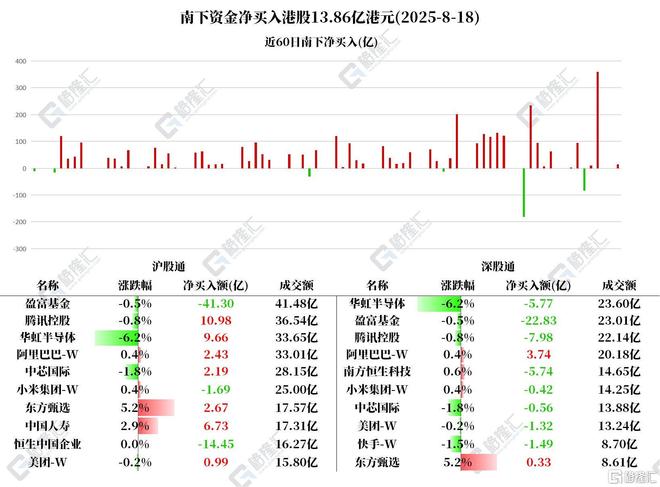
图解丨南下资金净买入港股13.8亿港元,加仓中国人寿、阿里
Ge Long Hui A P P· 2025-08-18 09:53
Group 1 - Southbound funds net bought Hong Kong stocks worth 1.386 billion HKD today [1] - The top net purchases included China Life (672 million HKD), Alibaba-W (617 million HKD), and Hua Hong Semiconductor (389 million HKD) [1] - Southbound funds have net bought SMIC for five consecutive days, totaling 1.03549 billion HKD, and Alibaba for three consecutive days, totaling 2.52673 billion HKD [1] Group 2 - The net sales included the Tracker Fund of Hong Kong (6.413 billion HKD), Hang Seng China Enterprises (1.445 billion HKD), and Southern Hang Seng Technology (573 million HKD) [1] - Notable stock performance changes included Tencent Holdings down 0.8% and Hua Hong Semiconductor down 6.2% [3] - China Life saw an increase of 2.9%, while Oriental Selection increased by 5.2% [3]


快手联手美团上线外卖入口,采用轻资产模式突围
Sou Hu Cai Jing· 2025-08-18 03:01
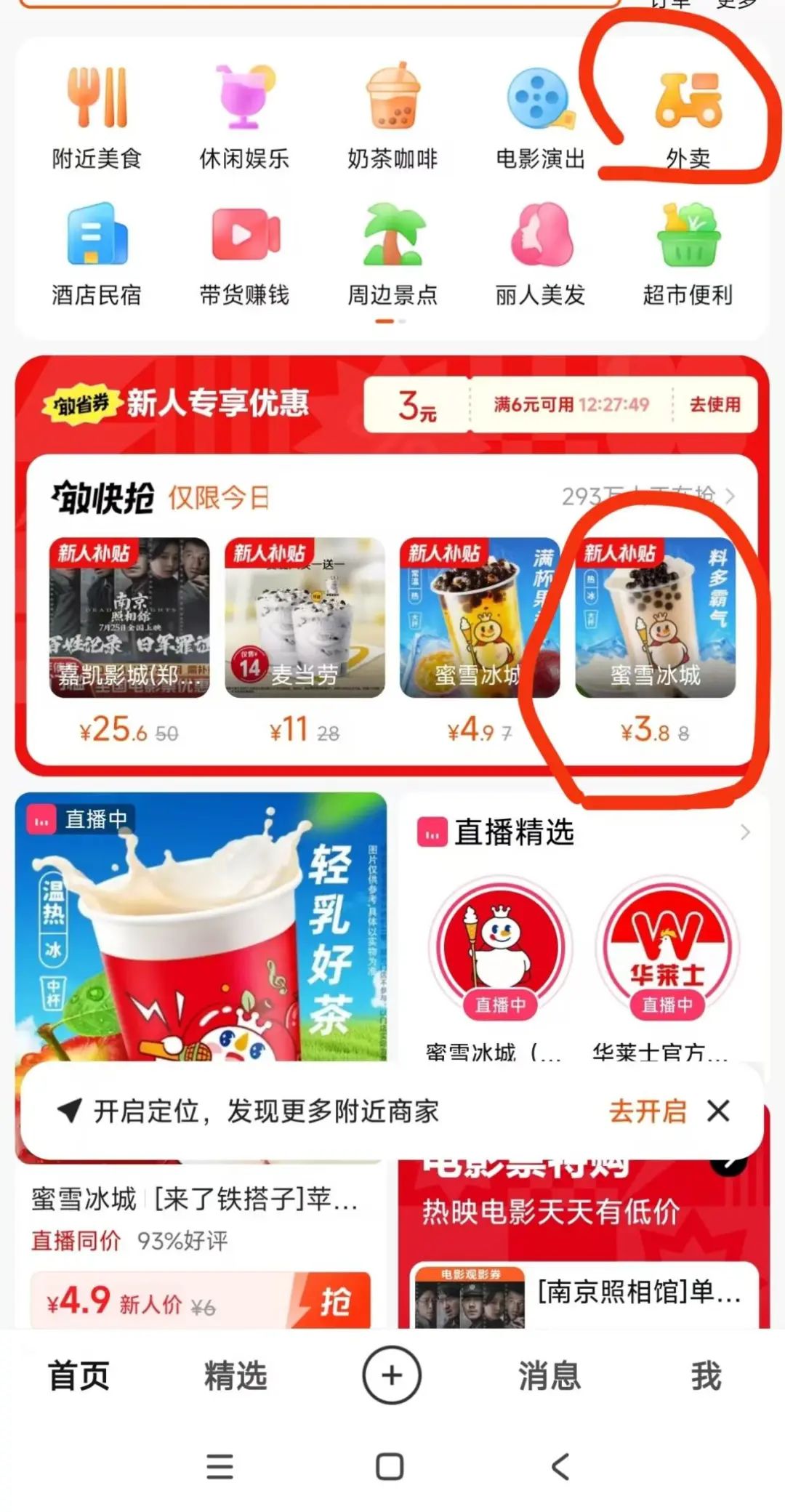
Core Viewpoint - Kuaishou is entering the food delivery market by launching an independent "takeout" section on its app, aiming to differentiate itself through a "Meituan supply chain + self-owned merchants" light asset model amid intense competition in the food delivery sector [2][3]. Company Strategy - Kuaishou's new takeout service relies on Meituan's merchant vouchers, requiring users to complete orders through Meituan's mini-program, with delivery handled by Meituan or third-party services [5][10]. - The company has previously explored local lifestyle services, partnering with various platforms and establishing a dedicated local lifestyle division in 2022 [6][8]. - Kuaishou's strategy includes a dual approach of leveraging Meituan's supply chain while also incorporating its own local merchants, with approximately 90% of products sourced from Meituan [10]. Market Context - The food delivery market is highly competitive, with major players like Meituan, Alibaba, and JD.com already established [2][9]. - Kuaishou's entry into this market comes as its core business faces growth challenges, particularly in live streaming and e-commerce, where GMV growth has significantly slowed [12][16]. Financial Performance - In 2024, Kuaishou reported revenue of 1268.98 billion yuan, an 11.83% year-on-year increase, with a net profit of 153.35 billion yuan, up 139.76% [13]. - The company's e-commerce GMV reached 1.39 trillion yuan in 2024, with growth rates dropping from 78% in 2021 to 17% in 2024, highlighting a stark contrast with Douyin's performance [16][17]. User Engagement - Kuaishou's daily active users reached 408 million by Q1 2025, with over 62% from new tier cities, providing a potential consumer base for its food delivery services [10]. - The number of users paying for local delivery services increased by over three times in Q2 2024, indicating a shift in user behavior towards food delivery [11]. Competitive Landscape - Kuaishou's cautious approach in the food delivery sector is influenced by the challenges faced by Douyin, which has struggled to establish a successful delivery model despite its initial efforts [9][20]. - The company aims to explore new growth avenues through its food delivery initiative, potentially alleviating pressures from declining growth in its core businesses [18].
快手的“叛逆”期到了
3 6 Ke· 2025-08-18 02:23
Core Viewpoint - Kuaishou has entered the food delivery market amidst a slowdown in competition among major players like Meituan, Taobao, and JD, which have called for a halt to chaotic competition [1][2][5]. Group 1: Market Dynamics - The food delivery war has entered a phase of reduced competition, with major platforms advocating for orderly practices [1][2]. - Kuaishou's entry into the food delivery space comes at a time when other platforms, such as Douyin, have explicitly stated they have no plans to develop their own delivery services [5][10]. - Kuaishou's food delivery feature acts as a link to third-party services rather than establishing its own delivery infrastructure, similar to previous collaborations with Meituan [5][7]. Group 2: User Engagement and Strategy - Kuaishou's decision to launch a food delivery service is driven by a need to retain user engagement as its growth rate slows [7][11]. - The platform aims to keep users within its ecosystem while they order food, contrasting with the strategies of e-commerce platforms that seek to attract users to their apps [15][17]. - Kuaishou's community culture and high user retention rates are seen as critical assets in this strategy [19][21]. Group 3: Financial Performance and Growth - Kuaishou's local life services have shown significant growth, with a reported GMV increase and a revenue growth of 200% year-on-year in Q1 2025 [24][25]. - Despite revenue growth, Kuaishou's core marketing projects have seen a decline in growth rates, indicating a need for diversification in revenue streams [28][29]. - The company is exploring various monetization avenues, including self-operated e-commerce and food delivery, to adapt to competitive pressures [30][32]. Group 4: Competitive Landscape - Other platforms like JD are also exploring new models in the food delivery space, such as opening their own delivery kitchens, which presents a competitive challenge to Kuaishou [33][36]. - Kuaishou's user demographics are more concentrated in specific regions, allowing for targeted strategies in food delivery that leverage local preferences [39][41]. - The integration of food delivery with Kuaishou's existing content and community features could enhance user interaction and retention [43][44].
智通港股通持股解析|8月18日




智通财经网· 2025-08-18 00:45
Core Insights - The top three companies by Hong Kong Stock Connect holding ratios are China Telecom (00728) at 74.74%, Green Power Environmental (01330) at 69.84%, and China Shenhua (01088) at 68.35% [1][2] - Xiaomi Group-W (01810), BYD Electronic (00285), and FIT HON TENG LIMITED (06088) saw the largest increases in holding amounts over the last five trading days, with increases of +1.15 billion, +0.825 billion, and +0.755 billion respectively [2][3] - Kuaishou-W (01024), Yingfu Fund (02800), and Anta Sports (02020) experienced the largest decreases in holding amounts, with reductions of -2.931 billion, -2.610 billion, and -0.968 billion respectively [2][3] Hong Kong Stock Connect Holding Ratios - China Telecom (00728) holds 10.374 billion shares, representing 74.74% of its total [1] - Green Power Environmental (01330) holds 0.282 billion shares, representing 69.84% of its total [1] - China Shenhua (01088) holds 2.309 billion shares, representing 68.35% of its total [1] Recent Increases in Holdings - Xiaomi Group-W (01810) saw an increase of +1.15 billion in holding amount, with a change of +21.752 million shares [2] - BYD Electronic (00285) increased by +0.825 billion, with a change of +20.4615 million shares [2] - FIT HON TENG LIMITED (06088) increased by +0.755 billion, with a change of +126.476 million shares [2] Recent Decreases in Holdings - Kuaishou-W (01024) experienced a decrease of -2.931 billion, with a change of -39.1843 million shares [3] - Yingfu Fund (02800) decreased by -2.610 billion, with a change of -101.155 million shares [3] - Anta Sports (02020) saw a decrease of -0.968 billion, with a change of -10.5343 million shares [3]
智通港股沽空统计|8月18日
智通财经网· 2025-08-18 00:27
Core Insights - The article highlights the top short-selling stocks in the market, focusing on their short-selling ratios, amounts, and deviation values [1][2][3] Short-Selling Ratios - The top three stocks by short-selling ratio are: - China Resources Beer-R (80291) at 100.00% - Bank of China Hong Kong-R (82388) at 88.69% - Kuaishou-WR (81024) at 80.08% [1][2] Short-Selling Amounts - The leading stocks by short-selling amount are: - Alibaba-SW (09988) with a short-selling amount of 2.949 billion - Tencent Holdings (00700) with 2.711 billion - Meituan-W (03690) with 2.333 billion [1][3] Deviation Values - The stocks with the highest deviation values are: - China Resources Beer-R (80291) at 51.62% - Kuaishou-WR (81024) at 43.86% - Bank of China Hong Kong-R (82388) at 39.84% [1][2][3]




快手可灵AI战略升级,盖坤身兼两职强化技术驱动
Sou Hu Cai Jing· 2025-08-16 10:50
Core Insights - Kuaishou has made significant organizational adjustments, enhancing the importance of Keling AI within the company [1] - The appointment of Gai Kun as the head of Keling AI's technology department indicates Kuaishou's commitment to a "technology-driven" strategy [1] - Keling AI has rapidly developed, iterating over 30 times in one year, with notable advancements in video model technology [3] Organizational Changes - Gai Kun, previously the head of Keling AI and community science line, will now report directly to Kuaishou's CEO Cheng Yixiao [1] - Zhang Di will no longer serve as the head of Keling AI's technology department, reflecting a shift in leadership roles [4] Technological Developments - Keling AI's video model was developed by Gai Kun's team, which has extensive experience in processing vast amounts of video content [3] - The Keling AI 2.1 model introduced new features, allowing users to customize video content, addressing several pain points in AI video generation [3] Commercialization Progress - Keling AI aims for "exponential growth" in revenue by 2025, with cumulative revenue exceeding 100 million yuan since its commercialization [4] - In the first three months of this year, Keling AI's revenue surpassed the total for the second half of 2024, with nearly 70% coming from paid subscriptions [4] Future Outlook - Gai Kun emphasizes the importance of model performance and targeting paid subscription members, which are key customers for leading video generation companies [4] - With Gai Kun's leadership, Kuaishou's competitiveness in the video model sector is expected to strengthen, aiming for a leading position in the global video AI market [4]
现在的金价压根不叫跌?不信你看看三国,那黄金还没米贵
Sou Hu Cai Jing· 2025-08-16 00:53
Group 1 - Recent fluctuations in international gold prices on the COMEX futures market have caused significant anxiety among global investors, with discussions around the topic reaching over 500 million views in a single day [1] - Professional institutions, such as Goldman Sachs, predict further declines in gold prices, intensifying the concerns of gold holders [3] - Historically, during chaotic periods like the Three Kingdoms era, gold prices fell significantly, indicating that in times of crisis, basic necessities like food took precedence over gold [7][8] Group 2 - The devaluation of gold during the Three Kingdoms period allowed various factions to accumulate wealth through the purchase of military supplies and recruitment, demonstrating that gold's value can shift dramatically based on context [10] - The game "Three Kingdoms: Looking for the Gods" allows players to experience the economic dynamics of the Three Kingdoms era, simulating resource production and trade [12][13] - The game has received positive feedback, with 90% player approval, and integrates historical details to enhance the gaming experience [15][19]

智通ADR统计 | 8月16日
智通财经网· 2025-08-15 23:53
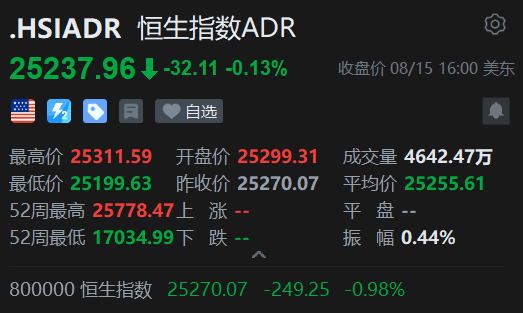
Market Overview - The Hang Seng Index (HSI) closed at 25,237.96, down by 32.11 points or 0.13% on August 15 [1] - The index reached a high of 25,311.59 and a low of 25,199.63 during the trading session [1] Major Blue-Chip Stocks Performance - HSBC Holdings closed at HKD 99.966, down 0.33% from the previous close [2] - Tencent Holdings closed at HKD 591.706, down 0.05% from the previous close [2] Stock Price Movements - Tencent Holdings (00700) increased by HKD 2.00, or 0.34%, to HKD 592.00 [3] - Alibaba Group (09988) decreased by HKD 3.70, or 3.04%, to HKD 118.10 [3] - China Construction Bank (00939) fell by HKD 0.18, or 2.26%, to HKD 7.80 [3] - HSBC Holdings (00005) decreased by HKD 0.10, or 0.10%, to HKD 100.30 [3] - Xiaomi Group (01810) dropped by HKD 0.35, or 0.66%, to HKD 52.85 [3] - AIA Group (01299) fell by HKD 1.95, or 2.54%, to HKD 74.95 [3] - Meituan (03690) decreased by HKD 2.70, or 2.17%, to HKD 121.70 [3] - NetEase (099999) dropped by HKD 7.60, or 3.66%, to HKD 200.20 [3] - Hong Kong Exchanges and Clearing (00388) increased by HKD 0.20, or 0.05%, to HKD 439.40 [3] - Industrial and Commercial Bank of China (01398) fell by HKD 0.19, or 3.09%, to HKD 5.96 [3] - Ping An Insurance (02318) decreased by HKD 0.30, or 0.52%, to HKD 57.60 [3] - BYD Company (01211) dropped by HKD 1.00, or 0.88%, to HKD 112.80 [3] - Bank of China (03988) fell by HKD 0.09, or 1.98%, to HKD 4.45 [3] - Kuaishou Technology (01024) decreased by HKD 0.40, or 0.53%, to HKD 74.80 [3] - Ctrip (09961) increased by HKD 1.80, or 0.37%, to HKD 489.00 [3] - Tencent Music (01698) decreased by HKD 0.90, or 0.89%, to HKD 99.90 [3] - BeiGene (06160) increased by HKD 6.50, or 3.51%, to HKD 191.50 [3]

快手组织架构调整,高级副总裁盖坤兼任可灵AI技术部负责人
Cai Jing Wang· 2025-08-15 13:48
Group 1 - Kuaishou announced an organizational restructuring on August 15, appointing senior vice president Gai Kun as the head of the Keling AI Technology Department, continuing to report to CEO Cheng Yixiao [1] - Gai Kun has a strong academic background with both undergraduate and doctoral degrees from Tsinghua University, specializing in recognition and intelligent systems [1] - Gai Kun joined Kuaishou in 2020, leading the technical layout of content understanding applications and recommendation models, driving innovation in algorithms, applications, and business models [1] Group 2 - In June 2024, Gai Kun's team launched the world's first user-accessible DiT video generation model, Keling AI [2] - Keling AI was upgraded to a first-level business unit in April 2023, enhancing its strategic position [2] - Since its launch, Keling AI has undergone over 30 iterations, serving more than 45 million users and generating over 200 million videos and 400 million images for over 20,000 enterprise clients [2] - In Q1 2025, Keling AI's revenue exceeded 150 million RMB, with an annualized revenue run rate surpassing 100 million USD as of March [2] - Monthly revenue for Keling AI exceeded 100 million RMB in both April and May [2]