BYD(01211)

Search documents
跨国车企,正拱手把电动车市场让给比亚迪们
Di Yi Cai Jing· 2026-03-19 09:47
Core Insights - Major multinational automakers have collectively announced a pause in their electrification transitions due to disappointing growth, resulting in nearly 500 billion yuan in losses for companies like Stellantis, Ford, General Motors, Honda, and Porsche by 2025 [2] - Despite the setbacks, the global automotive industry is moving towards electrification and smart technology, with the penetration rate of new energy vehicles expected to rise from 13% in 2022 to 23.5% by 2025 [2] - The automotive market is experiencing significant regional disparities, with China's new energy vehicle penetration expected to reach 45.5% by 2025, while the U.S. and Europe lag behind at 9.7% and 23.4%, respectively [3] Group 1: Market Dynamics - The U.S. market, despite being the third largest for new energy vehicles, has a low penetration rate due to weak policy support and limited infrastructure [3] - Changes in U.S. policy, such as rejoining the Paris Agreement, have influenced the strategies of major automakers like Honda and Ford, which primarily rely on the North American market [4] - The withdrawal of favorable policies under the Trump administration and the EU's abandonment of aggressive plans to ban gasoline and diesel cars have further complicated the situation for multinational automakers [4] Group 2: Competitive Landscape - By 2025, Honda's global electrification penetration is projected to be below 9%, while Ford's electric models have seen significant sales declines [4] - The imbalance between the pace of electric vehicle scaling and substantial R&D investments has led to increasing losses for multinational automakers, forcing them to revert to traditional combustion engine vehicles [4] - The market for hybrid electric vehicles (HEVs) remains strong, allowing traditional automakers to leverage their existing strengths in engine and transmission technology [4] Group 3: Future Challenges - The global penetration rate of new energy vehicles is projected to reach 23.6% by 2025, with significant growth in Europe and North America [5] - Multinational automakers face increasing competition from Chinese companies, which have advanced in battery technology and are expected to dominate the global market [5] - Chinese automakers have rapidly expanded their new energy vehicle offerings and are increasing exports, with projections showing a rise from 1.203 million units in 2023 to 2.615 million units by 2025 [6] Group 4: Strategic Responses - In response to competitive pressures, multinational automakers are seeking partnerships with Chinese companies to accelerate their electrification and smart technology initiatives [6] - Companies like Ford have acknowledged the competitive edge of Chinese manufacturers in terms of cost control and vehicle quality, indicating a potential shift in strategy [6] - The competitive landscape is shifting, with companies like BYD and Geely making significant strides in global sales rankings, highlighting the urgency for multinational automakers to adapt [7]



跨国车企,正拱手把电动车市场让给比亚迪们|琳机一动
Di Yi Cai Jing Zi Xun· 2026-03-19 07:06
Core Insights - Major multinational automakers have collectively announced a pause in their electrification transitions due to disappointing growth, resulting in significant financial losses totaling nearly 500 billion yuan for companies like Stellantis, Ford, General Motors, Honda, and Porsche by 2025 [1] - Despite the setbacks, the shift towards electrification and smart technology remains an irreversible trend in the global automotive industry, with the penetration rate of new energy vehicles (NEVs) expected to rise from 13% in 2022 to 23.5% by 2025 [1] - The disparity in NEV penetration rates across regions is stark, with China projected to reach 45.5% by 2025, while the U.S. and Europe lag at 9.7% and 23.4%, respectively, highlighting the impact of regional policies [1] Group 1: Market Dynamics - The U.S. market, despite being the third-largest for NEVs, has a low penetration rate due to weak policy support, inadequate infrastructure, and limited model availability, with only 59 NEV models sold in 2020 compared to 300 in China and 180 in Europe [2] - Changes in U.S. policy, such as rejoining the Paris Agreement and subsequent incentives for NEVs, initially benefited automakers like Honda and Ford, but the reversal of these policies has hindered their strategic progress [2] - By 2025, Honda's global electrification penetration is expected to be below 9%, while Ford's F-150 Lightning and Mustang Mach-E have seen sales drop by over 70% and 50%, respectively, indicating significant challenges for these companies [2] Group 2: Industry Challenges - The imbalance between the pace of electrification and substantial R&D investments has led to increasing losses for multinational automakers, forcing them to revert to traditional combustion engine strategies [3] - The hybrid electric vehicle (HEV) market remains viable, with significant demand, and traditional automakers can leverage their strengths in engine and transmission technologies to adapt more cost-effectively [3] - However, the choice to delay full electrification poses risks, as competition intensifies, particularly from Chinese automakers, which are rapidly advancing in the NEV sector [3] Group 3: Competitive Landscape - Chinese companies have gained a competitive edge in key technologies for NEVs, with their market share in global power battery installations expected to rise from 60.4% to 70.4% between 2022 and 2025 [4][5] - The number of NEV sub-brands in China has exceeded 50, and exports of Chinese NEVs are projected to double from 1.203 million to 2.615 million between 2023 and 2025, showcasing their growing global presence [5] - As traditional automakers revert to established practices, Chinese firms are advancing in smart technology, creating a robust ecosystem for intelligent vehicles, further widening the gap with multinational competitors [5] Group 4: Strategic Collaborations - To accelerate their electrification and smart technology goals, many multinational automakers are forming partnerships with Chinese NEV companies, such as Volkswagen's $700 million investment in Xpeng and Stellantis's collaboration with Leap Motor [6] - Chinese automakers like BYD and Geely have made significant strides, with BYD ranking fifth in global vehicle sales and Geely also entering the top ten, indicating a shift in the competitive landscape [6] - The ongoing transformation in the global automotive market is reshaping competitive dynamics, with multinational companies facing a narrowing window to adapt to the rapid advancements in NEVs [6]
2026年春季汽车行业投资策略:科技赋能下的换道再提速
Shenwan Hongyuan Securities· 2026-03-19 06:06
Core Conclusions - The automotive industry is expected to embrace technological advancements, with a limited impact from policy changes on demand, particularly in the mid-to-high-end segments, which are anticipated to see a significant recovery in demand [3] - The globalization of Chinese smart electric vehicles is underway, with overseas sales projected to approach 10 million units in five years, driven by engineering advantages [3] - Key players in the technology sector include Xiaopeng, NIO, and Li Auto, while established brands like BYD, Great Wall, and Geely are expected to lead the market [3] - The automotive parts sector represents a typical example of "high-end manufacturing" in China, with new applications in robotics, low-altitude economy, and AIDC becoming essential for growth [3] - The focus on robotics, low-altitude economy, and AIDC is expected to drive new industry directions, with significant developments anticipated by 2026 [3] - The trend of globalization remains a long-term growth path for excellent automotive parts companies, particularly in Europe, as domestic market saturation increases [3] - The automotive industry is undergoing dual transformations of electrification and AI integration, with AI expected to enhance driving, cabin, chassis, and power systems [3] Market Review - The automotive sector's performance has slightly lagged behind the CSI 300 index, with a cumulative increase of 0.5% from the end of 2025 to March 11, 2026 [11] - The automotive service, commercial freight, and parts sectors have shown notable growth, with increases of 6.21%, 3.84%, and 2.15% respectively [11] - The overall fund holding in the automotive sector increased to 3.29% in Q4 2025, with the parts sector contributing significantly to this growth [12] Vehicle Sector - The impact of policy changes on vehicle demand is limited, with a focus on technological advancements to drive growth [5] - The wholesale sales of passenger vehicles reached 30.06 million units in 2025, reflecting a year-on-year increase of 9.10%, while the first two months of 2026 saw a decline of 10.75% [18] - The penetration rate of new energy vehicles reached 51.50% in 2025, with a slight decrease to 45.25% in early 2026 [18] Parts Sector - The automotive parts sector is focusing on technological spillover and globalization, with strong horizontal expansion capabilities [3] - The sector is expected to benefit from shared resources and cost optimization through advanced manufacturing capabilities [3] AI Industry Trends - The automotive industry is entering the "Token era," where AI integration will redefine vehicle functionalities and consumer experiences [3] - The integration of AI in vehicles is expected to enhance user experience and operational efficiency, marking a significant shift in the industry [3]


宋Ultra EV预售价15.5万元起,比亚迪把“闪充”下探到主流SUV市场
Guan Cha Zhe Wang· 2026-03-19 05:48
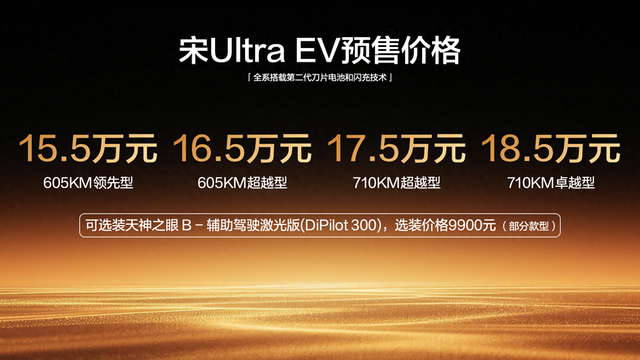
Core Viewpoint - BYD's new Song Ultra EV demonstrates the successful application of second-generation blade battery and fast-charging technology in mainstream vehicles, indicating that such advanced technology is not exclusive to high-end models [1][6]. Product Strategy - The Song Ultra EV is positioned as a B-class pure electric SUV with a pre-sale price range of 155,000 to 185,000 yuan [1]. - The vehicle's key selling point is its fast charging capability, which reduces uncertainty in long-distance travel for electric vehicles [3]. - Official data shows that the vehicle can charge from 10% to 70% in approximately 5 minutes and from 10% to 97% in about 9 minutes, even in low temperatures [3]. Performance and Features - The Song Ultra EV has a CLTC range of 710 kilometers, aiming to combine "long range + fast charging" to cater to both urban commuting and long-distance travel [5]. - It supports optional laser radar and is equipped with 27 sensors, featuring the "Tian Shen 5.0" driver assistance system for complex environments [5]. - The vehicle includes a smart damping body control system and safety features like the TBC high-speed blowout stability system [5]. Technical Advancements - The electric motor has a maximum power of 270 kW and a top speed of 210 km/h, with a wheelbase of 2840 mm designed for family use [5]. - The vehicle's configuration includes luxury features such as a queen passenger seat, seat ventilation, heating, massage functions, a 15.6-inch central control screen, and four-zone voice interaction [5]. Market Implications - The introduction of second-generation blade battery and fast-charging technology in mainstream models like the Song Ultra EV allows BYD to address the "charging anxiety" faced by consumers in the electric vehicle market [6]. - This technological advancement is expected to create a significant competitive edge in the highly competitive 150,000 yuan electric vehicle market, influencing consumer perceptions [6].
华尔街大空头罕见看多,中东王爷来救场,恒生科技可以布局了吗?
私募排排网· 2026-03-19 03:33
Core Viewpoint - The article discusses the recent performance of the Hang Seng Technology Index, highlighting significant adjustments and the potential for investment opportunities amidst market volatility [2][4]. Group 1: Recent Adjustments - The Hang Seng Technology Index has experienced two major adjustments since October 2025, with a maximum cumulative drawdown exceeding 25% [2][8]. - The first adjustment occurred from October 2, 2025, to November 21, 2025, driven by factors such as the U.S. government shutdown, hawkish signals from the Federal Reserve, and concerns over the profitability of AI cloud services [8]. - The second adjustment in February 2026 was attributed to intensified competition in internet consumption and regulatory pressures, impacting major tech platforms [8]. Group 2: Valuation Insights - As of March 17, 2026, the rolling price-to-earnings ratio (PE-TTM) of the Hang Seng Technology Index has dropped to approximately 20.93 times, indicating it is cheaper than 85% of the time since its inception [11][12]. - Comparatively, the dynamic PE of the ChiNext Index is around 41 times, and the NASDAQ is about 39 times, showing that the Hang Seng Technology Index is significantly undervalued [12]. - Michael Burry, known as the "big short" investor, suggests that the index's decline is more a result of sentiment and valuation compression rather than a collapse in the underlying fundamentals [14]. Group 3: Capital Flows - Domestic investors have been increasingly buying into the Hong Kong stock market, with net inflows from mainland investors reaching 1,298.6 billion RMB in 2025, significantly higher than the 747 billion RMB in 2024 [16][18]. - Since the October 2025 adjustment, mainland funds have predominantly been net buyers, with a record single-day net purchase of over 32.8 billion RMB on March 9, 2026 [18]. - International investors, influenced by geopolitical tensions, are also seeking refuge in Hong Kong stocks, enhancing market liquidity [20]. Group 4: AI Narrative - The Hang Seng Technology Index comprises 30 stocks across various sectors, including semiconductors, electric vehicles, and internet giants, which are facing both risks and opportunities from the AI narrative [22][25]. - Recent advancements in AI applications are prompting a reassessment of traditional internet companies, as they transition from high spending to monetization of AI technologies [25]. Group 5: Market Concerns - Despite positive indicators, there are concerns regarding profit pressures on companies like Meituan and Alibaba due to competition, which may impact their earnings [26]. - The rise of non-index giants like ByteDance is diverting user engagement and advertising revenue from traditional internet companies, posing growth challenges [27]. - Geopolitical issues, particularly in the Middle East, could affect global liquidity and inflation, impacting the performance of Hong Kong stocks [28]. Group 6: Investment Strategies - Given the current valuation, capital flow dynamics, and industry expectations, the Hang Seng Technology Index presents a favorable risk-reward profile for investors [29]. - For those unfamiliar with the Hong Kong market, investing through mutual funds that focus on Hong Kong stocks may be a viable strategy [29][30].





港股新能源车企股震荡走高,小米集团(01810.HK)涨超5%,奇瑞汽车(09973.HK)、比亚迪股份(01211.HK)、吉利汽车(00175.HK)、理想汽车(02015.HK)、赛力斯(09927.HK)等个股跟涨。
Jin Rong Jie· 2026-03-19 02:41
Group 1 - The core viewpoint of the article highlights a significant rise in the stock prices of electric vehicle companies in the Hong Kong market, with Xiaomi Group (01810.HK) increasing by over 5% [1] - Other notable companies that experienced stock price increases include Chery Automobile (09973.HK), BYD Company (01211.HK), Geely Automobile (00175.HK), Li Auto (02015.HK), and Seres (09927.HK) [1]



整车强势反弹-后市怎么看
2026-03-19 02:39
Summary of Conference Call Records Industry Overview - The automotive industry is experiencing a recovery in demand as of March 2026, with customer traffic nearing levels seen at the end of 2025, although still 10%-15% lower year-on-year [1][2] - The inventory pressure among leading new energy vehicle manufacturers is significant, with a combined inventory of approximately 900,000 units, and companies like BYD, Geely, and Leap Motor having inventory-to-sales ratios above 2.5 [1][3] Key Insights and Arguments - **BYD's Flash Charging Technology**: BYD's flash charging technology, which integrates "vehicle + charging pile + battery," is expected to drive monthly sales increases of 15,000 to 20,000 units for new models like the Yuan MAX [1][8] - **Xpeng's V2V22.0**: The launch of Xpeng's V2V22.0 has doubled store traffic, although order conversion rates still depend on word-of-mouth effects [1][2] - **Sales Forecasts**: Passenger car sales are expected to decline by over 10% in Q1 2026, with retail sales anticipated to remain flat or slightly decrease year-on-year due to purchasing power constraints [1][5] - **Export Trends**: Companies like SAIC, BYD, Chery, and Geely have competitive advantages in exports due to their own shipping fleets and established overseas channels [1][2] Market Dynamics - **Inventory Levels**: Major new energy manufacturers have high inventory levels, with BYD holding around 400,000 to 500,000 units, primarily in lower-end models. The inventory-to-sales ratio for BYD is expected to drop below 2.5 if March sales reach 220,000 to 250,000 units [3][4] - **Market Recovery Factors**: The recovery in the market is driven by local consumption subsidy policies and the impact of technology launch events, which have significantly increased customer traffic [2][3] - **Future Sales Expectations**: The overall passenger car market is expected to face challenges in Q1 2026, but a more vibrant market is anticipated in Q2 with numerous new product launches [5][6] Government Policies and Their Impact - The total amount for the 2026 consumer goods replacement subsidy is projected to be 250 billion yuan, which is expected to provide direct cash support for vehicle sales [6] - The extension of the personal consumption car loan interest subsidy policy may also support sales, but overall retail sales are expected to remain flat or slightly decrease [6] Competitive Landscape - **BYD vs. Geely**: BYD's rapid advancement in flash charging technology and ecosystem development is contrasted with Geely's slower progress in fast charging and energy supply networks [9][10] - **Emerging Players**: Companies like NIO and Leap Motor are highlighted as potential industry leaders due to their focus on core automotive manufacturing and competitive pricing strategies [14][15] Export Potential - **Leap Motor's Export Performance**: Leap Motor has shown strong export performance, with over 100,000 units exported, and has partnered with Stellantis for overseas expansion [15] Conclusion - The automotive industry is navigating a complex landscape of recovery, inventory management, and technological advancements, with significant implications for sales and market dynamics in 2026. The focus on new energy vehicles and competitive strategies will be crucial for companies aiming to capture market share in both domestic and international markets.
比亚迪闪充首个量产车型,方程豹钛3闪充版上市
Bei Jing Ri Bao Ke Hu Duan· 2026-03-19 02:33
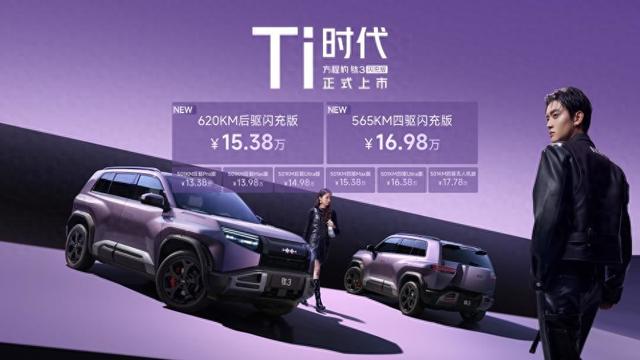
Group 1 - The core product launch is the Fangcheng Leopard Titanium 3 Flash Charge version, which offers two configurations: a rear-wheel drive version with a range of 620 kilometers and an all-wheel drive version with a range of 565 kilometers, priced between 153,800 to 169,800 yuan [1] - The Fangcheng Leopard Titanium series is the first mass-produced model featuring BYD's flash charging technology and will be the first to commence deliveries [1] - The first owners of the Titanium 3 Flash Charge version will enjoy 18 months of free flash charging [1] Group 2 - As of March 12, the number of BYD flash charging stations has rapidly increased to 4,597 [3] - The highly anticipated Titanium 7 EV Flash Charge version has also started pre-orders, with a price range of 220,000 to 250,000 yuan, offering an additional 6 months of free flash charging for early subscribers [3] - The Titanium 3 Flash Charge version features BYD's flash charging technology and second-generation blade battery, allowing it to charge from 10% to 70% in approximately 5 minutes and from 10% to 97% in about 9 minutes, with only a 3-minute increase in charging time at -30 degrees Celsius [3] Group 3 - The Titanium 3 Flash Charge version is built on the intelligent EVO+ platform and incorporates a layered laser-welded silicon carbide module and integrated thermal management for better energy efficiency [5] - It includes the iATS intelligent all-terrain recognition system, energy locks, stuck vehicle assistance, and various driving modes to handle different road conditions [5] - The vehicle features four major intelligent technologies, including BYD's "Tian Shen Eye" driver assistance system, active pre-sensing and cloud damping control system, exclusive AI smart cockpit, and smart ecosystem similar to the Titanium 7 [5] Group 4 - To meet personalized user demands, the Titanium 3 Flash Charge version introduces a new exterior color "Stardust Purple" and a new interior color "Gray-Blue Dual Tone," along with 14 customization options and 16 light customization options [7] - Comfort features include standard front seat ventilation and heating, double-layer soundproof glass, heated steering wheel, and rear privacy glass [7] - The all-wheel drive version is upgraded with additional features such as passenger seat memory and leg support, a compressor refrigerator, and a 14-speaker Dynaudio sound system [7]
中国车市用户忠诚度洞察报告(2026版):存量之争2.0时代,中国品牌由攻转”守”
腾易科技· 2026-03-19 01:21
Market Trends - The Chinese automotive market has transitioned into a "stock war" phase, with the proportion of vehicle replacement purchases rising from 32% in 2016 to over 75% by 2025[6] - Chinese brands' market share surged from around 30% before 2020 to nearly 65% by 2025, while the market share of new energy vehicles increased from less than 6% in 2020 to approximately 53% by 2025[6] Competitive Landscape - The dominance of foreign brands in the Chinese market, which held nearly 70% market share during the early stock war phase (2014-2019), has been challenged by the rapid rise of Chinese brands focusing on new energy vehicles[16] - By 2025, the sales volume of Chinese brands is expected to rise from 6 million to 15 million units, while foreign brands are projected to decline from 13 million to 8 million units[30] User Loyalty - User loyalty for Chinese brands has significantly improved, with loyalty rates rising from below 10% in 2019 to over 40% for brands like AITO in 2025[37] - In 2025, AITO leads the user loyalty rankings with a loyalty rate of 40.81%, followed by other Chinese brands like Lantu and NIO[41] Strategic Shifts - The shift towards new energy vehicles has been accelerated by the emergence of brands like Tesla and Wuling, which have captured significant market share from traditional fuel vehicles[23] - Chinese brands are increasingly focusing on high-end models and electric vehicles to attract users from foreign brands, with notable success in the market[30]

全球及中国汽车直线电机悬架行业研究分析报告(十五五规划)
QYResearch· 2026-03-19 01:08
Core Viewpoint - The automotive linear motor suspension system represents an advanced suspension technology that replaces traditional spring and damper mechanisms, offering direct control over wheel movement and significantly enhancing vehicle comfort, handling, and performance. This technology is particularly crucial for electric and autonomous vehicles, which require high precision and responsiveness in suspension systems. As the electrification and automation of vehicles continue to rise, linear motor suspension systems are expected to play a vital role in the future development of automotive technology [2]. Industry Overview - The global automotive linear motor suspension market is projected to reach $0.23 billion by 2025 and $0.37 billion by 2032, with a compound annual growth rate (CAGR) of 6.79% from 2026 to 2032. The sales volume is expected to grow from 6.57 thousand units to 19.36 thousand units during the same period, reflecting a CAGR of 15.49% [4]. Market Characteristics - The linear motor suspension industry is still in its early commercialization stage, with a relatively small overall market size and not yet in a large-scale adoption phase. However, revenue is steadily increasing, indicating that linear motor suspension is becoming an important technology direction for high-end intelligent chassis systems, transitioning from concept validation to small-scale applications in high-end models. The product pricing is decreasing as technology matures and supply chains improve, which is expected to drive broader adoption across more vehicle models [7][8]. Development Factors - The demand for linear motor suspension is driven by the increasing requirements for comfort, handling, and intelligent experience in electric vehicles. The technology aligns well with the high-end market's focus on both comfort and performance, providing a clear application entry point for the industry [11]. - The integration of intelligent chassis and software-defined vehicles is evolving, allowing suspension systems to transition from mechanical components to programmable execution systems. This trend enhances the compatibility of linear motor suspension with software upgrades and continuous functionality iterations [11]. - Improvements in core components and control technologies, such as power semiconductors and vehicle-grade sensors, are essential for the engineering and reliability of linear motor suspensions. The strengthening of local supply chains in motor, electronic control, and system integration will help reduce development cycles and overall costs [11]. Challenges - The high system cost and energy consumption of linear motor suspensions pose significant barriers to their adoption in mid-range vehicles. The need for high-performance motors and electronic control units increases the overall system cost compared to traditional suspension systems [12]. - The engineering complexity of linear motor suspensions requires deep integration with vehicle chassis, demanding high standards for platform architecture, body rigidity, and software calibration capabilities. This complexity increases development costs and time, making it challenging for manufacturers to adopt the technology [12]. - The long-term reliability of linear motor suspensions under extreme conditions remains uncertain, necessitating more real-world data to validate durability. This uncertainty may lead manufacturers to be cautious in their production decisions [12]. Entry Barriers - The high system-level technical barriers of linear motor suspensions require comprehensive capabilities in hardware, software, and system integration. New entrants must possess a deep understanding of electromagnetic design, structural design, and control algorithms to deliver a viable product [13][14].