
ICBC(01398)

Search documents
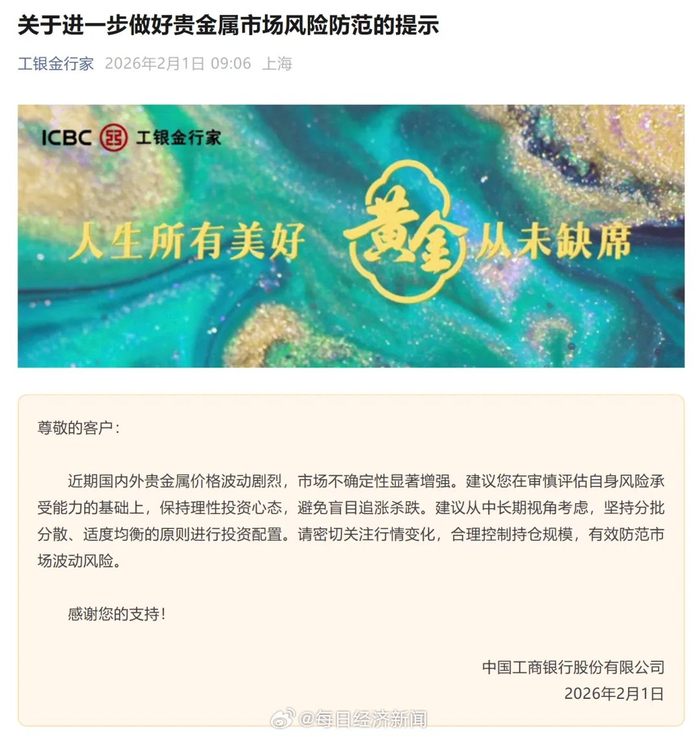
中国工商银行发布风险提示!此前五大行已分别调整贵金属相关业务并提示风险
Sou Hu Cai Jing· 2026-02-01 23:55
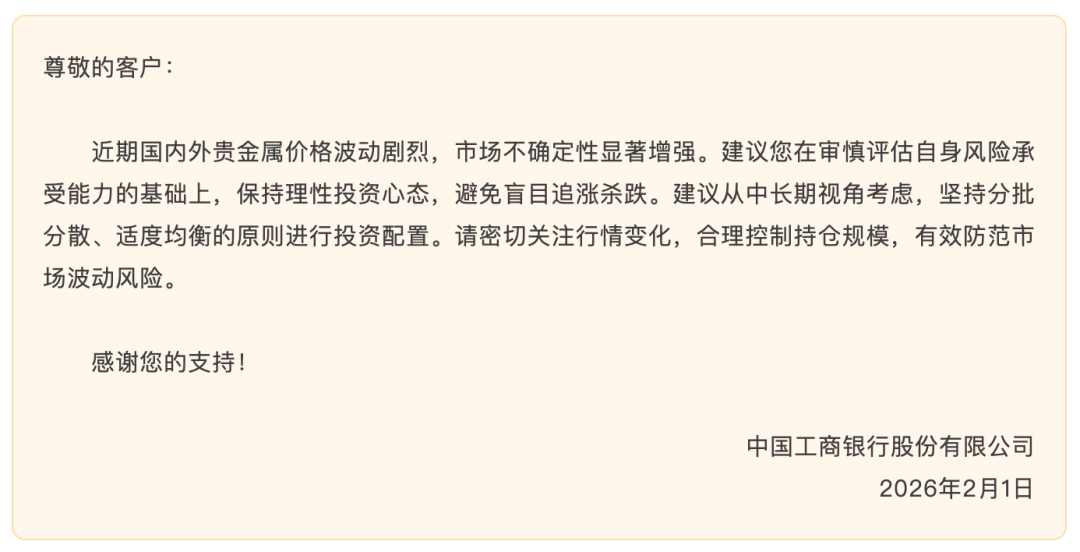
Group 1 - The Industrial and Commercial Bank of China (ICBC) issued a warning regarding the significant volatility in precious metal prices and the increased market uncertainty, advising investors to assess their risk tolerance and maintain a rational investment approach [1] - ICBC recommends a long-term perspective for investment, advocating for a strategy of gradual diversification and balanced allocation to mitigate risks associated with market fluctuations [1] - Other banks, including Agricultural Bank of China and Bank of China, have also implemented risk assessment requirements for personal clients engaging in precious metal transactions, emphasizing the need for careful financial planning [2] Group 2 - The Construction Bank announced an increase in the minimum amount for personal gold accumulation business to 1,500 yuan, effective from February 2, indicating a response to market conditions [2] - The Transportation Bank has introduced risk assessment requirements for clients starting from January 31, aligning with the trend of heightened scrutiny in precious metal trading [2]


金价大幅震荡!多家银行紧急发布公告
Sou Hu Cai Jing· 2026-02-01 23:14
Core Viewpoint - Several major Chinese banks have adjusted their gold accumulation business and issued risk warnings due to significant fluctuations in gold prices and increased market uncertainty [1][2][7]. Group 1: Bank Adjustments - Industrial and Commercial Bank of China (ICBC) has modified its gold accumulation business rules, implementing limit management for transactions on non-trading days starting February 7 [3]. - The minimum investment amount for ICBC's gold accumulation was raised from 1,000 yuan to 1,100 yuan as of January 8 [4]. - China Construction Bank increased the minimum investment amount for its gold accumulation business to 1,500 yuan starting February 2 [5]. - Agricultural Bank of China requires clients to complete a risk assessment and achieve at least a cautious rating to engage in gold accumulation activities starting January 30 [14]. Group 2: Risk Warnings - ICBC advises investors to assess their risk tolerance and maintain a rational investment approach, suggesting a diversified investment strategy [2]. - China Bank has highlighted the uncertainties in the precious metals market since 2026 and urges clients to manage their exposure to prevent potential losses [7]. - Bank of Communications has set restrictions on gold wallet transactions based on clients' risk assessment results, allowing only those with higher risk profiles to engage in all business activities [10].


政法骨干精准护航“政银企”对接
Xin Lang Cai Jing· 2026-02-01 22:24
本报讯(沈阳日报、沈报全媒体记者周贤忠)1月30日下午,市委政法委会同市法院、市检察院、市公 安局,依托沈阳中央法务区法治服务体系,组织金融审判、知识产权保护、公安经侦、民事执行等方面 业务骨干,在沈阳创新天地参加"政银企"对接活动(第二场)。 活动期间,各单位负责同志通过面对面交流、点对点对接,先后为中国银行、工商银行、邮储银行、民 生银行等金融机构及相关企业,解答了金融借款诉讼、金融犯罪防范等方面的法律问题,并发放了《法 官说法》《风险防范指引》等实用资料,为参与单位提供了"一站式""全链条"法治服务。参与此次活动 的政法机关表示,将以此次活动为契机,精准对接金融机构和企业法治需求,持续创新服务举措,不断 优化服务方式,提供更加优质、高效、精准的法治服务保障。 转自:沈阳日报 (来源:沈阳日报) ...


农银汇理基金管理有限公司旗下部分基金关于增加中国工商银行股份有限公司为代销机构的公告
Shang Hai Zheng Quan Bao· 2026-02-01 18:54
Group 1 - The core point of the announcement is that Agricultural Bank of China (ABC) will start offering sales services for certain funds managed by Agricultural Bank of China Asset Management Co., Ltd. (ABC Asset Management) from February 2, 2026 [1] - Investors will be able to perform subscription, redemption, and regular investment operations for selected funds through ABC, with fee discounts applicable based on the sales institution's promotional activities [1] - The announcement includes a list of applicable funds, although the specific details of the funds are not provided in the text [1] Group 2 - Investors are encouraged to consult ABC for further details regarding the fund offerings, with a customer service hotline and website provided for inquiries [1] - The announcement emphasizes the importance of reading the fund's contract, prospectus, and related legal documents to understand the investment characteristics and risks associated with the funds [1]
多家国有银行发布风险提示 调整黄金投资业务
Xin Lang Cai Jing· 2026-02-01 15:14
格隆汇2月1日|随着近期金价大幅震荡,工行、农行、中行、建行、交行等多家银行相继调整积存金相 关业务,并发布风险提示。 工商银行今日发布消息称,近期国内外贵金属价格波动剧烈,市场不确定性显着增强。建议投资者在审 慎评估自身风险承受能力的基础上,保持理性投资心态,避免盲目追涨杀跌,合理控制持仓规模,有效 防范市场波动风险。工行还公告,自2月7日起,在周末以及法定节假日等非上海黄金交易所交易日,该 行将对如意金积存业务进行限额管理,限额类型包括全量或单一客户单日积存/赎回上限、单笔积存或 赎回总量上限等,并进行动态设置,提金不受影响。 建设银行称,自2月2日上午9时10分起,个人黄金积存业务定期积存起点金额上调至1500元人民币。农 行建议投资者增强风险防范意识,基於自身财务状况和风险承受能力理性办理存金通黄金积存业务。 中国银行表示,2026年以来,贵金属市场的不确定性因素较多,价格大幅波动。提示各位客户做好市场 风险防范,基於自身财务状况和风险承受能力开展贵金属交易活动,合理控制贵金属持仓规模,防范贵 金属价格波动带来的资金损失风险。 ...
4800美元失守!金价暴跌12%,银行紧急上调门槛:全国掀起“买金卖金潮”
Sou Hu Cai Jing· 2026-02-01 13:50
Core Viewpoint - The recent sharp decline in gold prices, with futures dropping below $4,800 per ounce and spot gold experiencing a maximum daily drop of over 12%, is attributed to rising expectations of continued high interest rates from the Federal Reserve and a decrease in geopolitical tensions, leading to increased selling and buying activity in the market [2][7][9]. Group 1: Market Reactions - Gold prices experienced a significant drop, marking the largest decline in nearly 40 years, prompting a rush of buying and selling activity among consumers [2]. - Many banks, including major institutions like ICBC and CCB, have raised the minimum threshold for gold accumulation services to 1,500 yuan, indicating a response to the volatile market conditions [2][13]. - There is a noticeable increase in inquiries about physical gold, with some banks reporting tight inventory levels and requiring appointments for gold bar purchases [4][5]. Group 2: Factors Behind Price Decline - The primary catalyst for the gold price drop is the market's renewed expectation that the Federal Reserve may maintain high interest rates, increasing the opportunity cost of holding gold [7]. - A reduction in geopolitical tensions has led to a decrease in safe-haven demand for gold, contributing to the price decline as the market adjusts to these changes [9]. Group 3: Institutional Strategies - Institutional investors are employing a dual strategy with gold ETFs, holding both long positions and inverse ETFs or options to hedge against short-term risks, allowing them to capitalize on price volatility [11]. Group 4: Banking Sector Signals - The increase in the minimum threshold for gold accumulation services by banks serves as a significant risk warning, aimed at encouraging more cautious investment behavior among consumers [13]. Group 5: Consumer Guidance - Consumers are advised to avoid chasing price trends and to approach physical gold purchases gradually, as the high costs and low liquidity can lead to unfavorable outcomes in volatile markets [15][16]. - Monitoring changes in bank policies regarding gold accumulation and risk assessments is crucial for consumers to navigate the current market environment effectively [17].

金融风向标2026-W04:不一样的“开门红”
CMS· 2026-02-01 12:31
Investment Rating - The report maintains a positive outlook on the banking sector, indicating a potential for stabilization and improvement in operational pressures for banks in 2026 [2][5]. Core Insights - The banking sector has shown a "double opening red" phenomenon in both deposits and loans, with a structural difference in credit allocation. The signs of "deposit migration" are not significant, suggesting a stable deposit base [2][5]. - The total assets of the banking industry reached 471 trillion yuan by the end of 2025, reflecting an 8.0% year-on-year growth. Major banks, joint-stock banks, city commercial banks, and rural commercial banks reported asset growth rates of 11.0%, 4.7%, 9.7%, and 5.2%, respectively [3][14]. - The overall net interest margin is expected to decline further, but at a slower pace, indicating some relief in operational pressures. The banks have passed the phase of accelerated risk exposure and are nearing a "stock digestion period" [5][6]. Summary by Sections Regulatory Dynamics - The Financial Regulatory Bureau released data on the total assets and liabilities of the banking sector for 2025, showing a total asset growth of 8.0% year-on-year [3][14]. Industry Dynamics - Qingdao Bank and Xiamen Bank reported their 2025 performance, with Qingdao Bank achieving a net profit growth of 21.66% and an asset quality improvement, while Xiamen Bank also reported significant growth in total assets and loans [15][16]. Market Dynamics - The overall A-share market saw a decline of 1.59%, while the banking sector increased by 0.86%, indicating a defensive characteristic of the banking stocks [2][18]. Data Overview - The report highlights the central bank's net injection of 0.4 trillion yuan and the mixed movement of interest rates across different maturities, with short-term rates showing slight declines and long-term rates experiencing mixed trends [4][21][23].



澳门一酒店大堂78公斤黄金被连夜撤走?工作人员回应!关于金价震荡,多家银行紧急出手→
Sou Hu Cai Jing· 2026-02-01 11:15
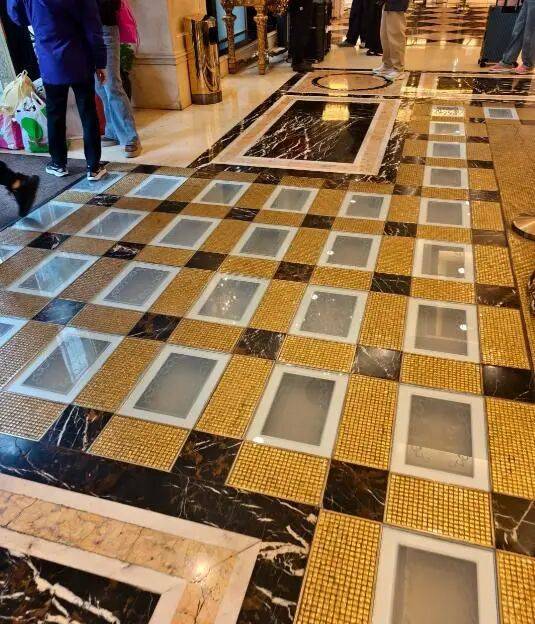
Group 1 - The iconic "Golden Avenue" at the Macau Emperor Entertainment Hotel has lost its 78 kilograms of gold embedded in the lobby floor tiles, raising suspicions among netizens about its removal by staff [1][3] - The gold, valued at over 85.8 million yuan based on the domestic gold price exceeding 1100 yuan per gram, was confirmed to have been removed for internal renovations, not due to gold price fluctuations [3][4] - The Macau Emperor Entertainment Hotel is owned by Emperor Entertainment Hotel Limited, and the "Golden Avenue" was made up of 78 individually numbered gold bars of Swiss 999.9 pure gold [4] Group 2 - Several major banks, including ICBC, ABC, BOC, CCB, and Bank of Communications, have adjusted their gold accumulation business in response to significant fluctuations in gold prices [5] - ICBC announced changes to its gold accumulation business rules, including a new minimum purchase amount of 1100 yuan and limits on transactions during non-trading days [6][9] - CCB raised the minimum amount for personal gold accumulation to 1500 yuan and advised customers to be aware of market risks due to increased volatility in precious metals [10][12] - Bank of Communications implemented restrictions on gold-related transactions based on customers' risk assessment results, allowing only certain profiles to engage in all business activities [13] - ABC required customers to complete a risk assessment before engaging in gold accumulation services, emphasizing the importance of risk awareness [15] - BOC highlighted the uncertainties in the precious metals market since 2026 and urged customers to manage their positions carefully to mitigate potential losses [15]
工行三连发贵金属风险提示,建议客户理性投资
Mei Ri Jing Ji Xin Wen· 2026-02-01 10:00
Core Viewpoint - The Industrial and Commercial Bank of China (ICBC) has issued a series of risk warnings regarding investments in precious metals due to significant price volatility and increased market uncertainty [1] Group 1: Risk Warnings - ICBC has released multiple risk alerts, emphasizing the recent dramatic fluctuations in domestic and international precious metal prices [1] - The bank advises clients to assess their risk tolerance carefully and maintain a rational investment mindset to avoid impulsive trading behaviors [1] Group 2: Investment Recommendations - ICBC recommends that investors adopt a medium to long-term perspective, focusing on a strategy of gradual, diversified, and balanced investment allocation [1] - Clients are encouraged to closely monitor market trends and manage their positions effectively to mitigate risks associated with market volatility [1]
六大行召开重要会议 多银行强调数智化
Zhong Guo Jing Ying Bao· 2026-02-01 09:28
中经记者 张漫游 北京报道 近日,工商银行、农业银行、中国银行、建设银行、交通银行、邮储银行六家国有大行陆续召开2026年 党建和经营(管理)工作会议,对2026年重点任务进行部署。 《中国经营报》记者梳理发现,2026年,4家国有银行明确要布局数智化发展,在2025年仅一家国有银 行提到数智化;同时2026年多家银行提出降本增效。 业内人士认为,这一变化折射出在经济增长模式深化调整、利率市场化持续推进、客户行为深度线上化 以及金融科技深刻演进的宏观背景下,中国银行业正从规模扩张驱动转向质量与效率驱动,科技与智能 正从辅助工具演变为重塑业务模式与核心竞争力的重要抓手。 从"数字化"到"数智化" 在2026年的重点工作部署中,数智化转型成为多家国有大行的核心发力点。其中,工商银行在"提升高 质量发展能级,展现服务现代化新担当"时提到,要"升级打造数智工行,增强数智化动能";建设银行 方面谈到,2026年要"加快推动集团数智化转型,持续提升企业级运营能力";交通银行方面强调"要深 入推进'人工智能+'行动,强化数智化思维、深化实践运用,通过AI技术重构业务流程、创新服务模 式";邮储银行方面指出,要"全面推进特色 ...