
LI AUTO-W(02015)

Search documents
理想汽车12月交付44246辆 全年交付量超150万
Feng Huang Wang· 2026-01-01 02:56
据介绍,截至2025年12月31日,理想汽车在全国已有548家零售中心,覆盖159个城市;理想汽车在全国 已投入使用3,907座理想超充站,拥有21,651个充电桩。 凤凰网科技讯1月1日,理想汽车公布了车辆交付数据。其中,12月份理想汽车交付新车44,246辆。2025 年第四季度,理想汽车交付109,194辆。截至2025年12月31日,理想汽车历史累计交付量为1,540,215 辆。 ...


理想汽车:2025年12月交付新车44246辆
Mei Ri Jing Ji Xin Wen· 2026-01-01 02:27
(文章来源:每日经济新闻) 每经AI快讯,2026年1月1日,理想汽车公布2025年12月交付数据。2025年12月,理想汽车交付新车 44,246辆。2025年第四季度,理想汽车交付109,194辆。截至2025年12月31日,理想汽车历史累计交付量 为1,540,215辆。 ...
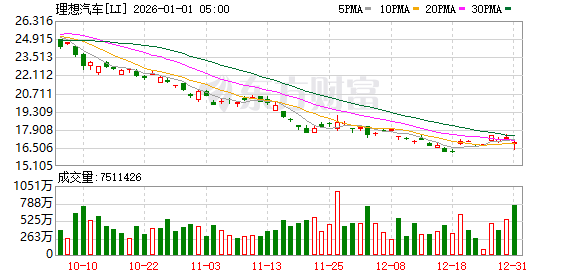
理想汽车:2025年12月交付44246辆
Zheng Quan Shi Bao Wang· 2026-01-01 02:20
人民财讯1月1日电,2026年1月1日,理想汽车公布2025年12月交付数据。2025年12月,理想汽车交付新 车44246辆。2025年第四季度,理想汽车交付10.92万辆。 ...
理想汽车:2025年12月交付新车44,246辆
Di Yi Cai Jing· 2026-01-01 02:18
(本文来自第一财经) 2026年1月1日,理想汽车公布2025年12月交付数据。2025年12月,理想汽车交付新车44,246辆。2025年 第四季度,理想汽车交付109,194辆。截至2025年12月31日,理想汽车历史累计交付量为1,540,215辆。 ...
Li Auto Inc. December 2025 Delivery Update
Globenewswire· 2026-01-01 02:00
Core Insights - Li Auto Inc. delivered 44,246 vehicles in December 2025, bringing total fourth-quarter deliveries to 109,194 and cumulative deliveries to 1,540,215 as of December 31, 2025 [1][2] Group 1: Deliveries and Market Expansion - In December 2025, Li Auto surpassed 1.5 million cumulative vehicle deliveries [2] - The company expanded its global presence by introducing models Li L9, Li L7, and Li L6 to Egypt, Kazakhstan, and Azerbaijan, marking its entry into Central Asia, the Caucasus, and Africa [2] Group 2: Retail and Service Infrastructure - As of December 31, 2025, Li Auto operated 548 retail stores across 159 cities and 561 servicing centers, along with authorized body and paint shops in 224 cities [3] - The company had 3,907 supercharging stations in operation, equipped with 21,651 charging stalls in China [3] Group 3: Company Overview - Li Auto is a leader in China's new energy vehicle market, focusing on designing, developing, manufacturing, and selling premium smart electric vehicles [4] - The company aims to create a mobile home and happiness through innovative products, technology, and business models, and is a pioneer in commercializing extended-range electric vehicles in China [4] - Li Auto's current model lineup includes a high-tech flagship family MPV, four Li L series extended-range electric SUVs, and two Li i series battery electric SUVs, with plans for further product expansion [4]
车企派人上门“抢电池”,何小鹏直言“跟电池厂商老板都喝过酒了”!
Xin Lang Cai Jing· 2025-12-31 12:21
Core Viewpoint - The supply of power batteries has eased by the end of 2025, but the shortage of energy storage batteries remains severe, leading to increased prices across the lithium battery supply chain [1][3][4]. Group 1: Battery Supply and Demand - Several car manufacturers have experienced delivery delays due to battery supply shortages, particularly affecting models like Li Auto's i6 and NIO's new ES8 [3][15]. - Reports indicate that from September to November 2025, some car companies sent personnel to battery manufacturers to secure battery supplies, highlighting the competitive nature of the market [3][17]. - The demand for power batteries surged during the traditional peak season, exacerbated by the need for manufacturers to stock up before year-end sales and the upcoming tax changes in 2026 [4][18]. Group 2: Energy Storage Battery Market - The energy storage battery market is facing a more severe shortage compared to power batteries, with many companies operating at full capacity and requiring prepayments for orders [5][19]. - The National Development and Reform Commission has set a target for new energy storage installations to reach 180 million kilowatts by 2027, which is expected to drive significant investment [5][19]. - Predictions indicate that global battery demand will exceed 2.5 TWh in 2026, with energy storage demand expected to grow by over 60% year-on-year [5][19]. Group 3: Price Trends in the Lithium Battery Supply Chain - The prices of lithium carbonate have surged, with futures exceeding 120,000 yuan per ton, marking a more than 100% increase from July's lows [6][22]. - The entire lithium battery supply chain is experiencing price increases, including key components like anode and cathode materials, separators, and copper foil [6][22]. - Companies are adjusting their pricing strategies in response to rising raw material costs, with some battery manufacturers announcing price hikes for their products [6][23]. Group 4: Company Performance and Strategic Partnerships - CATL's energy storage battery system revenue reached 28.4 billion yuan in the first half of 2025, accounting for nearly 16% of total revenue, with a gross margin of 25.52% [6][21]. - Major automotive companies are increasingly focusing on energy storage as a growth area, with BYD ranking third globally in energy storage system shipments [6][21]. - Strategic partnerships have been established between several car manufacturers and CATL, with agreements lasting up to 10 years to ensure stable supply chains [4][18].

汽车及汽车零部件行业研究:汽车行业2026 年投资策略:智能提速、格局再塑与全球化持续
SINOLINK SECURITIES· 2025-12-31 09:10
Investment Rating - The report maintains a positive outlook on the automotive industry, particularly focusing on globalization, intelligence, and high-end market opportunities [5]. Core Insights - The automotive industry is experiencing intensified competition in the domestic market while witnessing significant growth in new energy vehicle (NEV) exports [2][3]. - The overall vehicle sales are projected to remain stable in 2026, with a notable increase in NEV sales driven by favorable policies and consumer demand [4][5]. - The report emphasizes the importance of high-end vehicles and intelligent driving technologies as key growth areas for automotive companies [5][14]. Summary by Sections 1. 2025 Review: Intensified Domestic Competition, High Growth in NEV Exports - Total vehicle sales in China for January to November 2025 reached 20.45 million units, a year-on-year increase of 2.0% in retail and 11.2% in wholesale [2]. - Domestic sales showed slight growth, heavily influenced by policy changes, while exports surged, particularly in the NEV segment, which saw a 19% increase year-on-year [2][19]. - The NEV penetration rate reached 40.8% in exports, with significant contributions from plug-in hybrid vehicles [19]. 2. 2026 Outlook: Stability Expected, Acceleration in Globalization and Intelligence - Retail sales of passenger vehicles are expected to reach 22.03 million units in 2026, with NEVs projected to grow by 12% year-on-year [3][4]. - The high-end vehicle segment is anticipated to perform better due to a shift in consumer preferences and the increasing market share of domestic brands [4]. - NEV exports are expected to reach 6.73 million units, with a 34% increase in NEV exports alone, driven by improved product quality and market maturity [4]. 3. Investment Strategy: Favorable Opportunities in Globalization, Intelligence, and High-End Markets - The report highlights the potential for automotive companies that excel in international markets, high-end product offerings, and advanced intelligent driving technologies [5][13]. - Companies like BYD, Geely, and Li Auto are identified as key players likely to benefit from these trends due to their strong export capabilities and innovative products [5][13]. - The report also emphasizes the importance of the AI driving sector, predicting that leading companies will leverage their technological advancements to gain competitive advantages [14][15].


大摩:新车补贴政策调整有利高端车款销售 偏好理想汽车-W(02015)、蔚来-SW(09866)及中升控股(00881)
智通财经网· 2025-12-31 04:27
Core Viewpoint - Morgan Stanley reports that the National Development and Reform Commission announced the continuation of new car subsidy policies for next year, with subsidies of 20,000 RMB for new energy vehicles and 15,000 RMB for internal combustion engine vehicles, aligning with the bank's expectations [1] Group 1: Subsidy Policy Details - The new policy considers vehicle prices, indicating that subsidies for cars priced below 150,000 RMB will decrease year-on-year, while vehicles priced between 150,000 and 200,000 RMB will benefit the most from the incentives [1] - High-end vehicles will not be affected by the adjustments in the subsidy policy [1] Group 2: Company Preferences - The bank prefers companies that provide high-end vehicles, such as Li Auto (02015), NIO (09866), and companies collaborating with Huawei, which will also benefit high-end brand agents like Zhongsheng Holdings (00881) [1] Group 3: Market Outlook - Mass-market brands are expected to face greater headwinds due to reduced subsidies and a 5% increase in the purchase tax for new energy vehicles [1] - Suppliers such as Xingyu Automotive (601799.SH), Desay SV (002920.SZ), and Huayang Group (002906.SZ) are believed to benefit from exposure in the local market [1]


大摩:新车补贴政策调整有利高端车款销售 偏好理想汽车-W、蔚来-SW及中升控股
Zhi Tong Cai Jing· 2025-12-31 04:24
Core Viewpoint - The National Development and Reform Commission announced the continuation of new car subsidy policies for the next year, with subsidies of 20,000 RMB for new energy vehicles and 15,000 RMB for internal combustion engine vehicles, aligning with Morgan Stanley's expectations [1] Group 1: Policy Impact - The new policy considers vehicle prices, indicating that subsidies for cars priced below 150,000 RMB will decrease year-on-year, while vehicles priced between 150,000 and 200,000 RMB will benefit the most from the incentives [1] - High-end vehicles will not be affected by the adjustments in the subsidy policy [1] Group 2: Company Preferences - Morgan Stanley prefers companies that offer high-end vehicles, such as Li Auto (02015), NIO (09866), and companies collaborating with Huawei, which will also benefit high-end brand agents like Zhongsheng Holdings (00881) [1] Group 3: Market Challenges - Mass market brands are expected to face greater headwinds due to reduced subsidies and a 5% increase in the purchase tax for new energy vehicles [1] Group 4: Supplier Benefits - Suppliers such as Xingyu Automotive (601799.SH), Desay SV (002920.SZ), and Huayang Group (002906.SZ) are believed to benefit from their exposure in the local market [1]

理想汽车|写入《2025 汽车行业影响力年鉴》
Jing Ji Guan Cha Bao· 2025-12-30 11:23
Group 1 - The Chinese automotive industry is entering a new development stage as the "14th Five-Year Plan" concludes, with a focus on the impact of AI on technology paths and market structures [1] - AI is transitioning from a functional enhancement to a core capability that determines the upper limits of intelligence in the automotive sector, yet few companies have fully integrated systematic AI capabilities into mass production [1] - Li Auto is positioning itself with a clear path by unifying perception, understanding, and execution capabilities of intelligent assisted driving under a single AI architecture, moving towards AGI technology evolution [1] Group 2 - Li Auto is at the forefront of productizing edge AI, with initiatives like "Li Xiang Classmate" for multimodal interaction and the development of AI glasses Livis, extending AI capabilities beyond in-car systems [2] - The company's value this year lies in integrating AI as a core element, aligning assisted driving, cabin interaction, and edge products into a cohesive evolution logic, providing a benchmark for other automakers in the AI-driven competition [2] - Li Auto has been recognized in the "2025 Automotive Industry Influence Yearbook" as a representative automaker in the annual process of intelligentization due to its achievements in AI architecture integration and edge product implementation [2]