
PING AN OF CHINA(02318)

Search documents
【华创金融 徐康团队】平安再度增持国寿H,全年行业保费6.12万亿
Xin Lang Cai Jing· 2026-02-02 13:42
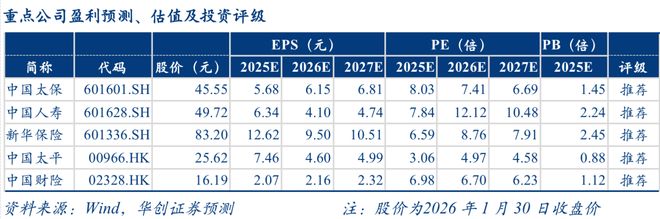
Market Performance - The insurance index increased by 5.55%, outperforming the market by 5.47 percentage points [1] - Individual insurance stocks showed mixed performance, with notable gains from Taiping (+9.96%), AIA (+8.79%), China Life (+8.73%), and others, while ZhongAn experienced a decline of -1.54% [1] Recent Developments - Ping An Life increased its stake in China Life by acquiring 11.891 million H-shares at an average price of HKD 32.0553 per share, totaling approximately HKD 381 million, raising its ownership from 8.98% to 9.14% [2] - Sunshine Life reduced its holdings in Huishang Bank by selling 11.694 million H-shares at an average price of HKD 3.2896 per share, involving funds of approximately HKD 38.4686 million, decreasing its stake from 7.92% to 6.93% [2] - China Life announced plans to establish a pension industry equity investment fund and a private fund in the Yangtze River Delta, with a total commitment of nearly CNY 12.5 billion [2] - The China Securities Regulatory Commission modified regulations to expand the types of strategic investors, including social security funds and commercial insurance funds, with a minimum shareholding requirement of 5% [2] Industry Projections - The insurance industry is projected to achieve a total premium income of CNY 6.12 trillion by 2025, with life insurance accounting for CNY 4.65 trillion and property insurance for CNY 1.47 trillion [3] Investment Recommendations - The report includes investment recommendations for several insurance companies, highlighting their expected earnings per share (EPS) and price-to-earnings (PE) ratios for 2025, with China Life and New China Life receiving a "recommended" rating [6]


中国平安(601318) - 中国平安H股公告
2026-02-02 09:45
股份發行人及根據《上市規則》第十九B章上市的香港預託證券發行人的證券變動月報表 截至月份: 2026年1月31日 狀態: 新提交 致:香港交易及結算所有限公司 公司名稱: 中国平安保险(集团)股份有限公司 呈交日期: 2026年2月2日 I. 法定/註冊股本變動 | 1. 股份分類 | 普通股 | 股份類別 | A | | | 於香港聯交所上市 (註1) | | 否 | | | --- | --- | --- | --- | --- | --- | --- | --- | --- | --- | | 證券代號 (如上市) | 601318 | 說明 | | | | | | | | | | | 法定/註冊股份數目 | | | 面值 | | | 法定/註冊股本 | | | 上月底結存 | | | 10,660,065,083 | RMB | | 1 | RMB | | 10,660,065,083 | | 增加 / 減少 (-) | | | | | | | RMB | | | | 本月底結存 | | | 10,660,065,083 | RMB | | | 1 RMB | | 10,660,065,083 | | ...
中国平安(02318) - 截至二零二六年一月三十一日止之股份发行人的证券变动月报表
2026-02-02 08:31
股份發行人及根據《上市規則》第十九B章上市的香港預託證券發行人的證券變動月報表 截至月份: 2026年1月31日 狀態: 新提交 致:香港交易及結算所有限公司 公司名稱: 中国平安保险(集团)股份有限公司 呈交日期: 2026年2月2日 I. 法定/註冊股本變動 | 1. 股份分類 | 普通股 | 股份類別 | A | | | 於香港聯交所上市 (註1) | | 否 | | | --- | --- | --- | --- | --- | --- | --- | --- | --- | --- | | 證券代號 (如上市) | 601318 | 說明 | | | | | | | | | | | 法定/註冊股份數目 | | | 面值 | | | 法定/註冊股本 | | | 上月底結存 | | | 10,660,065,083 | RMB | | 1 | RMB | | 10,660,065,083 | | 增加 / 減少 (-) | | | | | | | RMB | | | | 本月底結存 | | | 10,660,065,083 | RMB | | | 1 RMB | | 10,660,065,083 | | ...
智通AH统计|2月2日
智通财经网· 2026-02-02 08:18
Core Viewpoint - The report highlights the premium rates of AH shares, with Northeast Electric (00042), Sinopec Oilfield Service (01033), and Zhejiang Shibao (01057) leading in premium rates, while CATL (03750), China Merchants Bank (03968), and Heng Rui Medicine (01276) are at the bottom of the list [1] Premium Rate Rankings - The top three AH shares by premium rate are: - Northeast Electric (00042) with a premium rate of 864.29% - Sinopec Oilfield Service (01033) with a premium rate of 361.80% - Zhejiang Shibao (01057) with a premium rate of 345.22% [1] - The bottom three AH shares by premium rate are: - CATL (03750) with a premium rate of -14.10% - China Merchants Bank (03968) with a premium rate of -4.16% - Heng Rui Medicine (01276) with a premium rate of 0.99% [1] Deviation Value Rankings - The top three AH shares by deviation value are: - Sinopec Oilfield Service (01033) with a deviation value of 89.71% - Northeast Electric (00042) with a deviation value of 34.53% - Zhongwei New Materials (02579) with a deviation value of 25.28% [1] - The bottom three AH shares by deviation value are: - Zhejiang Shibao (01057) with a deviation value of -53.92% - Changfei Optical Fiber (06869) with a deviation value of -35.50% - Nanhua Futures (02691) with a deviation value of -30.81% [1] Additional Insights - The report includes detailed tables showing the premium rates and deviation values for various AH shares, indicating significant disparities in market valuations between H-shares and A-shares [2]

研报掘金丨东吴证券:维持中国平安“买入”评级,高股息+低估值凸显配置价值
Ge Long Hui· 2026-02-02 08:00
Core Viewpoint - China Ping An's bancassurance business is leading performance growth, with high dividends and low valuations highlighting its investment value [1] Group 1: Business Performance - The company has a stable and reliable dividend, with both A and H shares yielding around 4%, which is relatively high in the industry [1] - The bancassurance business is experiencing rapid growth, supported by deep collaboration with Ping An Bank and a high-quality team [1] - The market share of the "old seven" bancassurance companies is continuously increasing, indicating a positive outlook for Ping An's bancassurance business [1] Group 2: Investment Strategy - The company is expanding its partnerships with state-owned banks, leading joint-stock banks, and quality city commercial banks to enhance its network [1] - The asset allocation strategy is conservative, with controllable risks in real estate investments [1] - The company's stock price corresponds to 0.74x 2026E PEV, which is at the 43% and 72% percentile levels of the past ten and five years, respectively [1] Group 3: Future Outlook - The expected reforms in public fund management are likely to further highlight the company's high-weight characteristics, enhancing its investment value [1] - The rapid growth of the bancassurance business is anticipated to drive overall performance upward, with potential for valuation recovery [1] - The company maintains a "buy" rating based on these positive indicators [1]
非银金融行业周报:行业周报:战略投资者类型拟扩大,推动耐心资本与上市公司深度对接-20260202
GOLDEN SUN SECURITIES· 2026-02-02 06:36
Investment Rating - The report maintains an "Increase" rating for the non-bank financial sector [5] Core Insights - The China Securities Regulatory Commission (CSRC) is expanding the types of strategic investors to enhance long-term capital engagement with listed companies, including pension funds, insurance funds, and public funds [1][2] - The report highlights a stable regulatory environment for the insurance sector, with long-term benefits expected from trends in deposit migration and increasing demand for healthcare and retirement security [3] - The securities sector is experiencing heightened market risk appetite and active trading, benefiting both IT companies and brokerages [3] Summary by Sections Industry Dynamics - Non-bank financial, securities II, insurance II, and fintech indices experienced fluctuations of +1.04%, -0.69%, +5.50%, and -5.78% respectively, while the Shanghai Composite Index decreased by -0.44% [10] - China Life Insurance led the insurance sector with an increase of +8.73% [10] Insurance - Ping An Life increased its stake in China Life H shares by purchasing 11.891 million shares at an average price of 32.0553 HKD, raising its holding to 9.14% [14] - The registered capital of China Life Property Insurance has increased from 18.8 billion RMB to 27.8 billion RMB, a growth of approximately 48% [14] - As of December, the original premium income for property insurance reached 1,470.3 billion RMB, a year-on-year increase of 2.60%, while life insurance premiums reached 4,649.1 billion RMB, up 9.05% [15] Securities - The A-share market was active in 2025, with daily average trading volume of 2.08 trillion RMB, a year-on-year increase of 70.36% [24] - The number of IPO approvals surged by 109.43% year-on-year, with fundraising amounts increasing by 208.01% [24] - Listed brokerages that have released earnings forecasts expect a net profit growth of 59%-66% year-on-year [24] Investment Recommendations - The report suggests a positive outlook for the insurance sector, despite short-term pressures on capital and sentiment, due to long-term trends in liabilities and stable interest rates [3][37] - In the securities sector, the report recommends focusing on companies like China Ping An A/H, China Life H, Guotai Junan, and Huatai Securities [3][37]
中国平安-调研要点:依托稳健的集团战略与协同效应提升 ROE;AI 在有利环境中表现亮眼
2026-02-02 02:42
Summary of Ping An Insurance Group Co of China Ltd Conference Call Company Overview - **Company**: Ping An Insurance Group Co of China Ltd - **Industry**: Insurance and Financial Services - **Market Cap**: US$172.647 billion - **Stock Rating**: Overweight - **Price Target**: HK$89.00, representing a 22% upside from the closing price of HK$72.70 on January 30, 2026 Key Points Financial Performance and Outlook - **Return on Equity (ROE)**: Management targets an ROE above 15% over the medium term, supported by structural growth in Value of New Business (VNB) and improvements across subsidiaries [2][11] - **VNB Growth**: Expected to be driven by solid agency channel growth and strong performance in the banca channel, with a projected >20% VNB margin [2][17] - **Cost of Capital**: New business profit net of cost of capital is projected to increase from RMB 28.5 million in 2025 to RMB 58.8 million by 2027 [7] Strategic Initiatives - **Integrated Finance Strategy**: Ping An is leveraging its healthcare and senior care businesses to create strategic advantages, combining high-end senior care communities with home-based services [3][24] - **AI Adoption**: Ping An is recognized as a leader in AI, with full-stack capabilities that enhance productivity, risk control, and operational efficiency across its subsidiaries [4][30] Senior Care Business - **Differentiated Model**: Ping An offers both home-based services and premium senior care communities, targeting ultra-high-net-worth customers with specific needs [32][35] - **Community Development**: The ZHEN Living community in Shenzhen exemplifies the company's focus on high-quality facilities and services, catering to affluent seniors [33][36] Banking Operations - **Ping An Bank**: Expected to recover from previous drags on group operating profit after 2026, with improved revenue and profit growth driven by easing net interest margin (NIM) pressure and retail opportunities [5][41] - **Retail AUM Growth**: Anticipated double-digit growth in retail assets under management (AUM) in 2026, supported by a focus on wealth management and customized product offerings [43] Risks and Challenges - **Market Conditions**: Potential risks include volatile equity markets, low interest rates, and elevated asset risks, which could impact capital levels and dividend payouts [54][55] - **Credit Quality**: Management expects continued pressure on corporate loans, particularly in the property sector, but anticipates a decline in non-performing loans (NPLs) as risk digestion progresses [47][48] Conclusion - Ping An Insurance Group is positioned for sustained growth through its integrated finance strategy, strong AI capabilities, and differentiated senior care offerings. The company aims to improve its ROE and VNB growth while navigating potential market risks and challenges.
智通港股沽空统计|2月2日
智通财经网· 2026-02-02 00:23
Group 1 - The article highlights the top short-selling ratios for various companies, with JD Health-R, Anta Sports-R, and Lenovo Group-R leading the list at 100.00%, 89.98%, and 89.87% respectively [1][2] - The top three companies by short-selling amount are CSPC Pharmaceutical Group at 1.268 billion, Zijin Mining Group at 1.031 billion, and Xiaomi Group-W at 1.014 billion [1][2] - The highest deviation values in short-selling are recorded for Kuaishou-WR at 36.02%, Xiaomi Group-WR at 30.00%, and Heptagon Pharmaceuticals-B at 26.77% [1][2] Group 2 - The top ten short-selling ratios include JD Health-R at 100.00%, Anta Sports-R at 89.98%, and Lenovo Group-R at 89.87%, with Kuaishou-WR and Xiaomi Group-WR also featuring prominently [2] - The top ten short-selling amounts show CSPC Pharmaceutical Group leading with 1.268 billion, followed by Zijin Mining Group and Xiaomi Group-W [2] - The top ten deviation values indicate significant short-selling activity, particularly for Kuaishou-WR and Xiaomi Group-WR, suggesting potential volatility [2]


智通港股通资金流向统计(T+2)|2月2日
智通财经网· 2026-02-01 23:35
Core Insights - Tencent Holdings (00700), Pop Mart (09992), and China Life (02628) ranked as the top three stocks for net inflow of southbound funds, with net inflows of 1.207 billion, 742 million, and 566 million respectively [1] - The top three stocks for net outflow of southbound funds were the Yingfu Fund (02800), Alibaba-W (09988), and Zijin Mining (02899), with net outflows of -2.595 billion, -950 million, and -858 million respectively [1] - In terms of net inflow ratio, Southern East Selection (03441), China Traditional Chinese Medicine (00570), and Baiaosaitu-B (02315) led the market with ratios of 51.51%, 44.99%, and 44.77% respectively [1] Net Inflow Rankings - Tencent Holdings (00700) had a net inflow of 1.207 billion, representing a 7.63% increase, closing at 621.000 (+2.31%) [2] - Pop Mart (09992) saw a net inflow of 742 million, with a net inflow ratio of 14.21%, closing at 231.400 (+7.03%) [2] - China Life (02628) recorded a net inflow of 566 million, with a net inflow ratio of 16.39%, closing at 35.180 (+3.17%) [2] Net Outflow Rankings - Yingfu Fund (02800) experienced the highest net outflow of -2.595 billion, with a net outflow ratio of -7.92%, closing at 28.040 (+2.64%) [2] - Alibaba-W (09988) had a net outflow of -950 million, with a net outflow ratio of -5.41%, closing at 173.500 (+2.12%) [2] - Zijin Mining (02899) faced a net outflow of -858 million, with a net outflow ratio of -12.94%, closing at 44.760 (+3.13%) [2] Net Inflow Ratio Rankings - Southern East Selection (03441) led with a net inflow ratio of 51.51%, with a net inflow of 6.9271 million, closing at 11.410 (+1.42%) [3] - China Traditional Chinese Medicine (00570) followed with a net inflow ratio of 44.99%, with a net inflow of 42.7833 million, closing at 2.090 (-4.57%) [3] - Baiaosaitu-B (02315) had a net inflow ratio of 44.77%, with a net inflow of 44.5882 million, closing at 47.000 (+9.35%) [3] Net Outflow Ratio Rankings - Guangshen Railway (00525) had the highest net outflow ratio of -57.47%, with a net outflow of -8.3198 million, closing at 2.250 (+1.35%) [3] - Huaxin Building Materials (06655) followed with a net outflow ratio of -54.93%, with a net outflow of -26.9041 million, closing at 20.020 (+1.16%) [3] - Kunlun Energy (00135) recorded a net outflow ratio of -53.60%, with a net outflow of -100 million, closing at 8.020 (+0.88%) [3]





博泰车联拟与平安财险合作 重构智慧出行保险生态
Zhi Tong Cai Jing· 2026-02-01 23:30
Core Viewpoint - The collaboration between Botai Car Union and Ping An Property & Casualty Insurance aims to integrate technology, finance, automotive, and services to transform the insurance landscape in the smart mobility era [1] Group 1: Strategic Cooperation Details - The companies will create a new service paradigm by integrating AI and data while ensuring data security, leveraging their technological and insurance expertise to enhance user value and satisfaction [2] - They will build a leading safety ecosystem through the "car-insurance linkage" model, combining driving behavior risk perception with Ping An's customer operation system to inject technological momentum into the construction of a strong transportation nation [2] - The partnership will explore new dimensions in smart mobility services by integrating resources, providing one-stop travel solutions, and innovating embedded insurance financial products to foster a new ecosystem of technology empowerment and cross-industry collaboration [2]