China Life(02628)

Search documents
辽宁金融监管局同意泰康人寿辽宁沈阳沈洲支公司变更营业场所
Jin Tou Wang· 2025-11-14 05:38
二、泰康人寿保险有限责任公司应按照有关规定及时办理变更及许可证换领事宜。 2025年11月12日,辽宁金融监管局发布批复称,《泰康人寿保险有限责任公司辽宁分公司关于辽宁沈阳 沈洲支公司变更营业场所的请示》(泰康人寿辽发〔2025〕349号)收悉。经审核,现批复如下: 一、同意泰康人寿保险有限责任公司辽宁沈阳沈洲支公司将营业场所变更为:沈阳市沈河区青年大街1- 1号(1501)(2115单元)。 ...

2026年保险“开门红”大战再起
Mei Ri Shang Bao· 2025-11-13 22:42
Core Viewpoint - The insurance industry is gearing up for the 2026 "opening red" battle, with dividend insurance taking center stage as companies employ "hunger marketing" strategies to stimulate consumer purchases and lay a solid foundation for future performance [1][2][3] Group 1: Product Launches and Trends - Major insurance companies have accelerated the launch of new products, with significant offerings such as Xinhua Insurance's "Shengshi Glory Celebration Edition" whole life insurance and Ping An Life's "Ping An Yuxiang Jinyue (2026)" whole life insurance [2][3] - The structure of 2026 insurance products shows a marked shift, with dividend insurance becoming the dominant product, especially among large insurers who are focusing on it as a core business expansion strategy [2][3] - Notable innovations include China Life's "Xinhongfu Pension Annuity Insurance," which removes traditional age limits for policyholders, and Ping An's customizable features in its new products [2][3] Group 2: Sales Channels and Performance - The "reporting and banking integration" policy has led to tighter regulation of individual insurance channels, resulting in a significant decline in new individual policy premiums since September [4][5] - In contrast, the bancassurance channel has shown robust growth, with Ping An Life's new business value (NBV) increasing by 170.9% year-on-year, and other companies like Taikang Life and Xinhua Insurance also reporting substantial growth in this channel [4][5] - The bancassurance channel is expected to play a crucial role in the 2026 "opening red" campaign, driven by strong demand for stable wealth management products that align with the characteristics of dividend insurance [5] Group 3: Consumer Guidance and Market Dynamics - Industry experts emphasize the need for consumers to make rational decisions when purchasing dividend insurance, considering the inherent uncertainties in actual returns [6] - Consumers are advised to assess their risk gaps and understand key concepts such as guaranteed rates and historical dividend performance before making purchases [6] - The industry is encouraged to shift focus from short-term sales strategies to long-term sustainable development, emphasizing the importance of aligning asset-liability management and providing clear product structures to clients [6]

实探险企2026年“开门红”:主打产品生变 长期留客能力待检验
Zhong Guo Zheng Quan Bao· 2025-11-13 20:03
Core Insights - The insurance industry is launching the "开门红" (Opening Red) campaign for 2026, focusing on dividend insurance products despite a trend towards diminishing this marketing concept [1][3] - The main products promoted during this period are dividend insurance, which offers a guaranteed interest rate of 1.75% and a total return of at least 3.2% [1][2] Industry Trends - Multiple insurance companies are introducing dividend insurance products, including China Life, Xinhua Insurance, and Ping An Life, indicating a shift towards these products as a primary offering [2] - The design of dividend insurance, which combines guaranteed benefits with floating dividends, appeals to customers seeking asset appreciation in a low-interest environment [2] Marketing Strategies - Insurance companies are employing various strategies to attract customers during the "开门红" period, such as lowering the minimum investment threshold and offering higher returns [2] - Some companies are providing limited-time offers, with significant reductions in the minimum purchase amounts for certain products [2] Regulatory Environment - Regulatory bodies have expressed concern over potential sales misconduct during the "开门红" period, prompting guidelines to ensure ethical marketing practices [3] - The financial regulatory authority issued a notice in October 2023 to enhance management and promote stable development in the life insurance sector [3] Customer Engagement - The industry is shifting from short-term marketing tactics to a focus on long-term customer retention through improved service experiences [4] - Companies are encouraged to develop a comprehensive product system that meets customer needs throughout their life stages, integrating health management and retirement services [4]


中国人寿财险山东省分公司已完成1.7亿元秋粮赔款
Xin Hua Cai Jing· 2025-11-13 02:49
Core Viewpoint - China Life Property & Casualty Insurance Shandong Branch has effectively supported local farmers by expediting disaster compensation payments, totaling 144 million yuan for autumn grain losses, which is 37 days earlier than last year [1][2]. Group 1: Compensation and Support - As of November 11, the company has completed compensation payments of 144 million yuan and prepayments of 26.8 million yuan to 145,800 autumn grain farmers in Shandong Province [1]. - The company aims to ensure that compensation payments are made within 10 days once the assessment and agreement on the compensation amount are completed, which is nearly 40 working days faster than previous years [2]. Group 2: Disaster Response and Management - The company has established over 100 disaster relief and assessment teams across key insured counties in Shandong, optimizing the claims process and utilizing an integrated disaster prevention platform for real-time monitoring of crop conditions [2]. - Advanced technologies such as drones and satellite remote sensing are employed for precise damage assessment in affected areas, enhancing the efficiency and accuracy of claims processing [2]. Group 3: Future Plans and Innovations - The company plans to continue innovating and improving its service system and insurance solutions, positioning agricultural insurance as a crucial tool for disaster response and a stabilizer for increasing production and income [2].
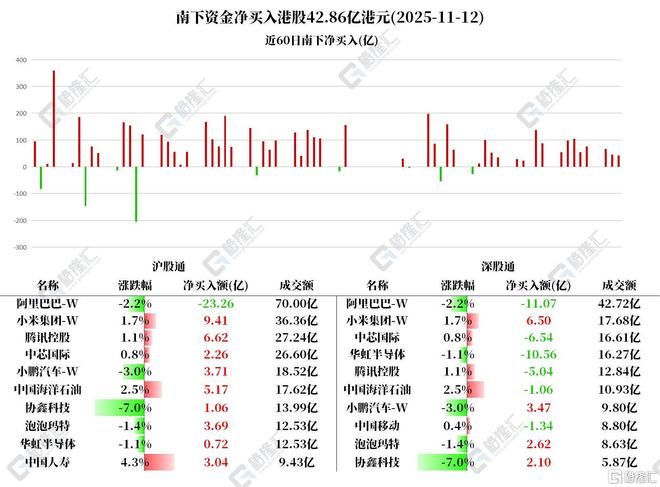
11月12日南向资金净买入42.86亿港元
Zheng Quan Shi Bao Wang· 2025-11-13 00:39
Core Viewpoint - The Hang Seng Index rose by 0.85% to close at 26,922.73 points on November 12, with a net inflow of HKD 4.286 billion through the southbound trading channel [1] Group 1: Market Activity - The total trading volume for the southbound trading on November 12 was HKD 105.405 billion, with a net buy of HKD 4.286 billion [1] - The Shanghai Stock Exchange's southbound trading accounted for HKD 66.456 billion in trading volume and a net buy of HKD 3.397 billion, while the Shenzhen Stock Exchange had HKD 38.949 billion in trading volume and a net buy of HKD 0.889 billion [1] Group 2: Active Stocks - Alibaba-W was the most actively traded stock on the Shanghai Stock Exchange with a trading volume of HKD 70.00 billion, but it experienced a net sell of HKD 23.26 billion, closing down by 2.24% [1][2] - Xiaomi Group-W followed with a trading volume of HKD 36.36 billion and a net buy of HKD 9.41 billion, closing up by 1.68% [1][2] - On the Shenzhen Stock Exchange, Alibaba-W also led with a trading volume of HKD 42.72 billion and a net sell of HKD 11.07 billion, closing down by 2.24% [2] - Other notable stocks included Tencent Holdings with a trading volume of HKD 27.24 billion and a net buy of HKD 6.18 billion, and SMIC with a trading volume of HKD 16.61 billion [2]





南向资金今日成交活跃股名单(11月12日)
Zheng Quan Shi Bao Wang· 2025-11-13 00:32
Group 1 - The Hang Seng Index rose by 0.85% on November 12, with a total southbound trading volume of HKD 105.4 billion, including HKD 54.8 billion in buy transactions and HKD 50.6 billion in sell transactions, resulting in a net inflow of HKD 4.3 billion [1] - The southbound trading through Stock Connect (Shenzhen) totaled HKD 38.9 billion, with buy transactions of HKD 19.9 billion and sell transactions of HKD 19.0 billion, leading to a net inflow of HKD 0.9 billion; while Stock Connect (Shanghai) had a total of HKD 66.5 billion, with buy transactions of HKD 34.9 billion and sell transactions of HKD 31.5 billion, resulting in a net inflow of HKD 3.4 billion [1] - Alibaba-W had the highest trading volume among southbound stocks, totaling HKD 112.72 billion, followed by Xiaomi Group-W and SMIC with HKD 54.04 billion and HKD 43.22 billion respectively [1] Group 2 - Xiaomi Group-W recorded the highest net inflow among stocks, with a net buy of HKD 15.92 billion, closing up by 1.68%; followed by XPeng Motors with a net buy of HKD 7.18 billion, and Pop Mart with a net buy of HKD 6.31 billion [1] - Conversely, Alibaba-W experienced the largest net outflow of HKD 34.34 billion, closing down by 2.24%; Huahong Semiconductor and SMIC also faced significant net outflows of HKD 9.85 billion and HKD 4.28 billion respectively [1] - Over a continuous period, Xiaomi Group-W saw a net inflow for 11 consecutive days, totaling HKD 81.36 billion, while China National Offshore Oil Corporation and Pop Mart had net inflows of HKD 28.21 billion and HKD 14.55 billion respectively [2]



分红险站上C位!险企抢跑2026年“开门红”
Guo Ji Jin Rong Bao· 2025-11-12 14:38
Core Viewpoint - The insurance industry is shifting towards dividend insurance products in response to a low interest rate environment, with major companies launching their 2026 "opening red" products focused on these offerings [1][2][4]. Product Trends - Major life insurance companies like China Life, Ping An Life, and Xinhua Insurance are prominently featuring dividend insurance in their new product launches for 2026 [2][3]. - From October 1, 2025, to November 12, 2025, 45 out of 98 new life insurance products were dividend-based, accounting for 45.9%, while 28 out of 57 new annuity products were also dividend-based, making up 49.1% [2]. Market Dynamics - The shift to dividend insurance is seen as a necessary response to the current low interest rate market and regulatory guidance aimed at reducing liabilities and restructuring the industry [2][4]. - Dividend insurance offers a combination of guaranteed returns and potential higher yields, making it more attractive than traditional fixed-income products in the current "asset scarcity" environment [3]. Challenges Ahead - The industry faces challenges in rebuilding trust due to past discrepancies between projected and actual dividend rates, necessitating greater transparency and stable operations from insurance companies [4]. - There is a need to enhance the professional capabilities of sales teams, as the complexity of dividend insurance requires a deeper understanding of asset allocation and risk disclosure [4]. - Balancing short-term performance pressures with the long-term nature of dividend insurance is crucial for success [4]. Investment Performance - Analysts predict that the investment capabilities of insurance companies will be a decisive factor in the competitive landscape of dividend insurance, with a projected investment return of over 6% for listed companies [5]. - The ability to manage asset-liability duration gaps remains a key focus for insurance asset management in a low interest rate environment [5]. Future Directions - The "opening red" marketing strategy needs to evolve from a product-driven approach to a customer-centric value creation model, emphasizing long-term relationships and comprehensive service offerings [6][7]. - Companies should leverage technology and data analytics for precise marketing and improved customer service, while also focusing on brand building and social responsibility to enhance competitiveness [7].
智通港股解盘 | 传闻引发光伏下跌 市场猛炒超跌次新消费股
Zhi Tong Cai Jing· 2025-11-12 12:23
Market Overview - Hong Kong stocks showed a positive trend, closing up 0.85% as bulls took control, indicating a lack of negative news is perceived as positive [1] - The U.S. House of Representatives is expected to vote on a compromise plan to end the longest government shutdown in U.S. history, which could restore funding to government agencies [1] - The ADP private sector employment report for October showed a decrease of 45,000 jobs, the largest drop in two and a half years, suggesting a cooling labor market and increasing expectations for a Fed rate cut in December [1] Sector Performance - The banking sector saw a rebound with major banks like Agricultural Bank of China reaching new highs, driven by long-term investments from insurance funds and public funds [1] - Consumer sectors are gaining traction, with companies like "Hushang Auntie" seeing a significant increase of nearly 29%, indicating a recovery in consumer sentiment [2] - Retail sales in Hong Kong are projected to rise by 4% year-on-year in October, benefiting retail rental stocks [3] Company Highlights - Baijie Shenzhou reported a 44.2% increase in total revenue for the first three quarters, driven by sales growth of its self-developed products [3] - Xiaomi announced a significant sales figure of over 29 billion yuan during the Double 11 shopping festival, indicating strong consumer demand [4] - The Ximangdu iron ore project, with reserves exceeding 4.4 billion tons, has commenced production, potentially altering the global iron ore supply landscape and benefiting companies like Maanshan Iron & Steel [5] Industry Developments - The Chinese commercial aerospace sector is set to advance with the upcoming maiden flight of the reusable rocket "Zhuque-3," which aims to reduce launch costs significantly [6] - The sportswear manufacturing sector is expected to see a recovery in demand, with Shenzhou International projecting a 15.3% increase in revenue for the first half of 2025 [7] - The company has expanded its overseas production capacity, with 53% of its garment output coming from international facilities, indicating a strategic shift towards globalization [8]

资金动向 | 北水净买入港股近43亿港元,减持阿里巴巴、华虹半导体
Xin Lang Cai Jing· 2025-11-12 11:57
Group 1: Market Activity - Southbound funds net bought Hong Kong stocks worth 4.286 billion HKD on November 12, with notable purchases including Xiaomi Group (1.592 billion HKD), Xpeng Motors (717 million HKD), and China National Offshore Oil Corporation (411 million HKD) [1] - Continuous net buying trends were observed for Xiaomi (81.3635 billion HKD over 11 days), CNOOC (28.2105 billion HKD over 4 days), and Pop Mart (14.5466 billion HKD over 3 days) [3] Group 2: Company Insights - Xiaomi reported a cumulative payment amount exceeding 29 billion HKD as of November 11, with Goldman Sachs maintaining a "Buy" rating and a 12-month target price of 56.5 HKD, citing its strong balance sheet and competitive advantages in the electric vehicle sector [4] - Morgan Stanley raised the target price for Xpeng Motors to 131 HKD, reflecting growth potential from new AI products and expected market sentiment improvement starting mid-2026 [4] - CNOOC's production cost is projected to be 29.56 USD per barrel in 2024, the lowest among major Chinese oil companies, indicating strong international competitiveness [4] Group 3: Company Developments - Alibaba is set to launch its first self-developed flagship AI glasses, Quark AI Glasses, on November 27, with pre-sales performing strongly during the "Double 11" shopping festival [5] - GCL-Poly Energy responded to market rumors regarding its storage platform, asserting that such claims are unfounded, while the China Photovoltaic Industry Association emphasized the importance of policy support in the solar industry [5]


2025前三季度寿险行业净利润增62%,但偿付能力充足率比年初下滑20个百分点,为什么?
13个精算师· 2025-11-12 11:05
Core Viewpoint - The life insurance industry has experienced a significant increase in net profit, reaching 462 billion yuan in the first three quarters of 2025, a year-on-year growth of 62%, marking a historical high. However, the comprehensive solvency adequacy ratio has dropped sharply to 204.1%, down 20 percentage points from the end of the previous year, indicating a divergence between profit growth and solvency pressure [1][3][5]. Group 1: Profit Growth Analysis - The substantial increase in net profit is attributed to the overall rise in the stock market, with many companies, including China Life and Ping An Life, adopting new accounting standards that significantly impact profit reporting [6][9]. - The new accounting standards classify most equity investments as financial assets measured at fair value through profit or loss (FVTPL), leading to higher volatility in reported profits compared to the old standards [7][8]. - The net profit growth is also influenced by a 15.8% increase in equity and a 19 basis point rise in the 10-year government bond yield, despite the 750-day moving average yield declining by 26 basis points [7][8]. Group 2: Solvency Adequacy Ratio Decline - The decline in the comprehensive solvency adequacy ratio is due to differences in reporting rules for solvency and financial statements, particularly regarding reserve liabilities [10][11]. - Many companies have reclassified held-to-maturity (HTM) assets to fair value through other comprehensive income (FVOCI), impacting their solvency calculations [11][12]. - The 10-year government bond yield has risen, but the 750-day moving average yield continues to decline, creating pressure on reserve requirements and increasing liabilities for insurance companies [13][15][19]. Group 3: Capital Requirements and Market Dynamics - The actual capital of the life insurance industry has only grown by 8% compared to the beginning of the year, while recognized liabilities have increased by 15%, leading to a decrease in the solvency adequacy ratio [24]. - The rise in stock prices has increased capital requirements due to the counter-cyclical adjustment mechanism, which raises capital requirements as equity values increase [21][25]. - The overall increase in capital requirements, particularly for equity risk, has outpaced the growth in actual capital, contributing to the decline in solvency adequacy [24][25].