
BANK COMM(03328)

Search documents
银行板块跌势扩大 农业银行等多股跌超5%
Xin Lang Cai Jing· 2026-03-23 06:33
Group 1 - The banking sector is experiencing a significant decline, with multiple stocks, including Agricultural Bank of China, Zhangjiagang Bank, and Xiamen Bank, dropping over 5% [1] - Other banks such as Industrial and Commercial Bank of China, Bank of Communications, and Postal Savings Bank of China have also seen declines exceeding 3% [1]



银行资负跟踪20260322:通胀预期下广谱资产流动性收敛,关注负反馈
GF SECURITIES· 2026-03-22 14:06
Investment Rating - The industry investment rating is "Buy" [2] Core Insights - The report highlights that under inflation expectations, broad asset liquidity may contract, and attention should be paid to negative feedback effects [1][14] - The central bank's operations have resulted in a net injection of 215.8 billion CNY, with liquidity in the interbank market remaining ample and funding rates slightly declining [14] - The report emphasizes the potential for liquidity-driven valuation expansion to slow down in the second quarter due to rising inflation expectations and external geopolitical conflicts affecting oil prices [14][16] Summary by Sections 1. Inflation Expectations and Asset Liquidity - The interbank liquidity is currently abundant, with funding rates showing a slight decline. As of March 20, R001 and R007 rates were 1.40% and 1.48%, respectively [14] - The central bank conducted 242.3 billion CNY in 7-day reverse repos, with a maturity of 1,765 billion CNY, and a net injection of 215.8 billion CNY was achieved [14] - The report anticipates that liquidity may face contraction in Q2, influenced by inflation recovery expectations and external factors [14] 2. Central Bank Dynamics and Market Rates - The central bank's operations are characterized by small adjustments, maintaining a stable liquidity environment [15] - The report notes that government bond yields have shown mixed movements, with 1Y and 3Y yields decreasing by 2.0bp and 2.5bp, while longer-term yields have increased [16] - The report suggests that the market should prepare for potential upward pressure on long-term interest rates as economic recovery and inflation expectations evolve [16] 3. Bank Financing Tracking - The report indicates that the issuance of interbank certificates of deposit (NCD) has seen a weighted average issuance rate of 1.53%, down by 2bp from the previous period [19] - The total outstanding amount of interbank certificates of deposit is 18.17 trillion CNY, with a negative net financing of 4.042 billion CNY this period [19] - The report highlights that there were no new issuances of commercial bank bonds during this period, with a total outstanding amount of 3.35 trillion CNY [20]



交通银行(601328) - 交通银行H股公告
2026-03-20 10:30
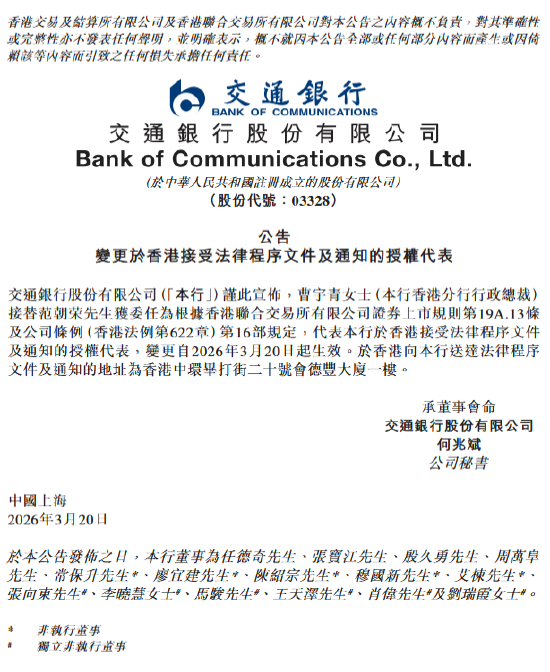
香港交易及結算所有限公司及香港聯合交易所有限公司對本公告之內容概不負責,對其準確性 或完整性亦不發表任何聲明,並明確表示,概不就因本公告全部或任何部分內容而產生或因倚 賴該等內容而引致之任何損失承擔任何責任。 中國上海 2026年3月20日 (於中華人民共和國註冊成立的股份有限公司) 於本公告發佈之日,本行董事為任德奇先生、張寶江先生、殷久勇先生、周萬阜 先生、常保升先生*、廖宜建先生*、陳紹宗先生*、穆國新先生*、艾棟先生*、 張向東先生 # 、李曉慧女士 # 、馬駿先生 # 、王天澤先生 # 、肖偉先生 # 及劉瑞霞女士 # 。 (股份代號:03328) 公告 變更於香港接受法律程序文件及通知的授權代表 交通銀行股份有限公司(「本行」)謹此宣佈,曹宇青女士(本行香港分行行政總裁) 接替范朝荣先生獲委任為根據香港聯合交易所有限公司證券上市規則第19A.13條 及公司條例(香港法例第622章)第16部規定,代表本行於香港接受法律程序文件 及通知的授權代表,變更自2026年3月20日起生效。於香港向本行送達法律程序 文件及通知的地址為香港中環畢打街二十號會德豐大廈一樓。 承董事會命 交通銀行股份有限公司 何兆斌 ...
交通银行:香港分行行政总裁曹宇青获委任为授权代表
Xin Lang Cai Jing· 2026-03-20 09:33
Group 1 - The core announcement is that Ms. Cao Yuqing has been appointed as the authorized representative of Bank of Communications in Hong Kong, effective from March 20, 2026, replacing Mr. Fan Zhaorong [1][3][4] - This appointment is in accordance with the Hong Kong Stock Exchange Listing Rules and the Companies Ordinance [1][4] - The address for serving legal documents and notices to the bank in Hong Kong is specified as 1/F, One International Finance Centre, 20, Central, Hong Kong [4]

交通银行(03328.HK):于香港接受法律程序文件及通知的授权代表变更为曹宇青
Ge Long Hui A P P· 2026-03-20 09:33
Group 1 - The core point of the article is the appointment of Cao Yuqing as the new authorized representative of Bank of Communications in Hong Kong, effective from March 20, 2026 [1] - Cao Yuqing will replace Fan Zhaorong in this role, which involves accepting legal documents and notifications on behalf of the bank in Hong Kong [1] - The address for serving legal documents to the bank in Hong Kong is specified as 1/F, Wheelock House, 20 Pedder Street, Central, Hong Kong [1]
交通银行(03328):曹宇青获委任为授权代表
智通财经网· 2026-03-20 09:25
Group 1 - The core point of the article is the appointment of Ms. Cao Yuqing as the authorized representative of the Bank of Communications in Hong Kong, effective from March 20, 2026, replacing Mr. Fan Zhaorong [1] Group 2 - Ms. Cao Yuqing is currently the Chief Executive Officer of the Bank's Hong Kong branch [1] - The appointment is in accordance with the Securities Listing Rules of the Hong Kong Stock Exchange and the Companies Ordinance (Cap. 622 of the Laws of Hong Kong) [1] - The change in representation is a procedural update for the bank regarding legal documents and notifications in Hong Kong [1]
交通银行(03328) - 公告变更於香港接受法律程序文件及通知的授权代表
2026-03-20 09:19
承董事會命 交通銀行股份有限公司 何兆斌 公司秘書 中國上海 2026年3月20日 香港交易及結算所有限公司及香港聯合交易所有限公司對本公告之內容概不負責,對其準確性 或完整性亦不發表任何聲明,並明確表示,概不就因本公告全部或任何部分內容而產生或因倚 賴該等內容而引致之任何損失承擔任何責任。 (股份代號:03328) 公告 變更於香港接受法律程序文件及通知的授權代表 交通銀行股份有限公司(「本行」)謹此宣佈,曹宇青女士(本行香港分行行政總裁) 接替范朝荣先生獲委任為根據香港聯合交易所有限公司證券上市規則第19A.13條 及公司條例(香港法例第622章)第16部規定,代表本行於香港接受法律程序文件 及通知的授權代表,變更自2026年3月20日起生效。於香港向本行送達法律程序 文件及通知的地址為香港中環畢打街二十號會德豐大廈一樓。 (於中華人民共和國註冊成立的股份有限公司) 於本公告發佈之日,本行董事為任德奇先生、張寶江先生、殷久勇先生、周萬阜 先生、常保升先生*、廖宜建先生*、陳紹宗先生*、穆國新先生*、艾棟先生*、 張向東先生 # 、李曉慧女士 # 、馬駿先生 # 、王天澤先生 # 、肖偉先生 # 及劉瑞霞女 ...
交通银行新增5个外呼电话号码并在3月23日开始使用
Xin Lang Cai Jing· 2026-03-20 07:02
Core Viewpoint - The announcement by Bank of Communications aims to enhance service efficiency and provide more professional personal loan account reminder services through the introduction of five new outbound phone numbers starting from March 23, 2026 [1]. Group 1 - The Bank of Communications has added five new outbound phone numbers for customer service [1]. - The new phone numbers are as follows: 02136348329, 02136348330, 02136348331, 02136348332, and 02136348333 [1]. - The new numbers do not support call-backs, and customers are advised to contact the customer service at 95559 for any inquiries [1].
守护“奔跑者”的钱袋子——交通银行海南省分行护航新就业群体金融安全
Zhong Guo Jin Rong Xin Xi Wang· 2026-03-20 03:11
Core Viewpoint - The "two drivers and two couriers" group, including truck drivers, ride-hailing drivers, couriers, and delivery workers, has become a significant force in China's new employment landscape, acting as vital support for urban operations [1] Group 1: Financial Education Initiatives - The Bank of Communications Hainan Branch conducted financial consumer rights protection education activities on March 15, 2026, focusing on the "two drivers and two couriers" group [1] - The bank set up a "care station" in Haikou, providing local beverages and care packages to support these urban workers [1] Group 2: Targeted Outreach Programs - The Haikou Xihai Coast Branch engaged with truck drivers at a logistics park, emphasizing the prevention of telecom fraud and rational borrowing, while offering personalized answers to common financial issues [2] - The Haikou Nanhai Branch interacted with ride-hailing drivers during a training session, using real-life examples to educate them on financial scenarios they frequently encounter [2] - The Sanya Jiyang Branch created a promotional service area for delivery workers, encouraging participation in an interactive game focused on financial consumer protection [2] - The Qionghai Branch introduced an interactive game for couriers that incorporated anti-fraud elements, enhancing their ability to recognize and avoid scams [2] Group 3: Ongoing Commitment to Financial Literacy - The Bank of Communications Hainan Branch emphasizes that financial consumer rights protection extends beyond March 15, aiming for continuous engagement throughout the year [3] - The bank is dedicated to addressing the financial needs of diverse customer groups and aims to bridge the gap in financial knowledge dissemination [3] - Future initiatives will focus on innovative promotional methods to provide warmer financial services, ensuring the safety of urban workers' assets and quality of life [3]
交通银行:全方位做好促消费 扩投资惠民生金融服务
Jin Rong Shi Bao· 2026-03-19 23:34
Group 1 - The meeting emphasized the importance of confidence and responsibility among all levels of the bank's party organizations and employees, focusing on serving the real economy and maintaining financial stability [1] - The meeting highlighted the need to understand and implement the essence of the "14th Five-Year Plan" and the "Government Work Report," with a focus on supporting the strategic priorities set by the central government [2] - The bank is encouraged to enhance its financial services to promote consumption, expand investment, and improve people's livelihoods, while also supporting the construction of a modern industrial system [1][2] Group 2 - The meeting called for a focus on the goals of economic and social development during the "14th Five-Year" period, aligning the bank's functions with national development strategies [2] - It was stressed that the bank should adopt a tailored approach based on local conditions and specific circumstances to identify key business areas and accelerate breakthroughs [2] - The bank is tasked with promoting a correct view of performance, ensuring that its actions reflect public welfare, scientific decision-making, and practical implementation [2] Group 3 - Recently, the bank held an expanded party committee meeting to convey and study the important speeches by General Secretary Xi Jinping during the National People's Congress and the spirit of the National People's Congress [3] - The meeting was chaired by the bank's party secretary and chairman, Ren Deqi, who emphasized the importance of implementing the discussed policies [3]