MEITUAN(03690)

Search documents
@美团骑手,2026第一笔社保补贴已到账
Chang Sha Wan Bao· 2026-02-05 00:24
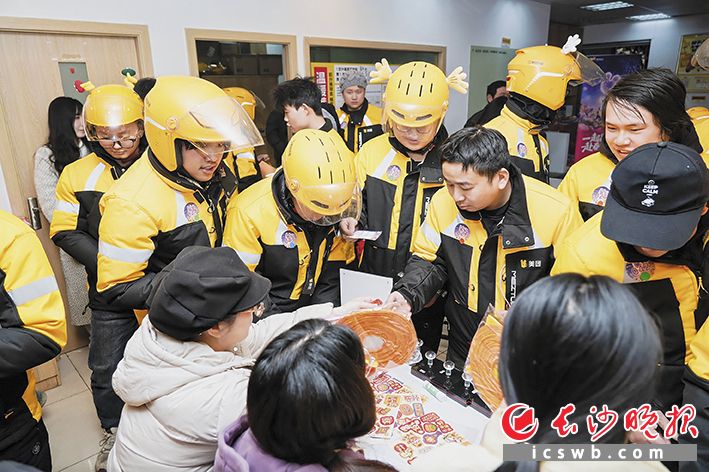
Core Viewpoint - The article highlights Meituan's efforts to support its delivery riders through various welfare programs, including social security subsidies and the establishment of "Rider Homes" to provide essential services and community support during the Spring Festival [3][6][8]. Group 1: Welfare Programs - Meituan has initiated a social security subsidy program for riders, with the first payment of 407.2 yuan received by riders, which can significantly alleviate their financial burdens [6]. - The company plans to open "Rider Homes" during the Spring Festival to provide meals, emergency supplies, and recreational activities for riders, enhancing their community experience [3][4]. - As of December 2025, Meituan aims to establish 1,000 "Rider Homes" across the country, with 204 already in operation, offering various services including vocational training and legal assistance [3][8]. Group 2: Safety and Insurance - Meituan has implemented a "work injury insurance" program for riders, covering approximately 16.68 million riders with a total premium of 2.56 billion yuan, ensuring comprehensive protection [7]. - The company has also launched a "serious illness care" plan, providing financial assistance to nearly 7,000 riders and their families, totaling over 200 million yuan in support [7]. - A multi-layered welfare protection system has been established, including basic and advanced benefits such as accident insurance, health care, and educational funds for riders' children [8]. Group 3: Community Engagement and Recognition - Meituan organized a Spring Festival celebration for riders, where outstanding riders were recognized for their contributions, fostering a sense of community and appreciation [4][5]. - The company actively engages with riders through feedback sessions to improve welfare programs and address their needs [8]. - Initiatives like the "No Running Red Lights" safety incentive program have been introduced, rewarding riders for safe driving practices, with over 400,000 participants [9].

智通港股沽空统计|2月5日
智通财经网· 2026-02-05 00:24
Group 1 - JD.com (SWR 89618) has the highest short-selling ratio at 85.52%, followed by AIA Group (R 81299) at 77.11% and Lenovo Group (R 80992) at 67.79% [1][2] - Tencent Holdings (00700) leads in short-selling amount with 2.709 billion yuan, followed by Pop Mart (09992) at 974 million yuan and Xiaomi Group (W 01810) at 793 million yuan [1][2] - Huatai Securities (06886) has the highest deviation value at 40.23%, followed by Tong Ren Tang Technologies (01666) at 35.46% and China Ship Leasing (03877) at 26.75% [1][2] Group 2 - The top ten short-selling ratios include JD.com at 85.52%, AIA Group at 77.11%, and Lenovo Group at 67.79% [2] - The top ten short-selling amounts show Tencent Holdings at 2.709 billion yuan, Pop Mart at 974 million yuan, and Xiaomi Group at 793 million yuan [2] - The top ten deviation values are led by Huatai Securities at 40.23%, followed by Tong Ren Tang Technologies at 35.46% and China Ship Leasing at 26.75% [2]


智通ADR统计 | 2月5日





智通财经网· 2026-02-04 22:19
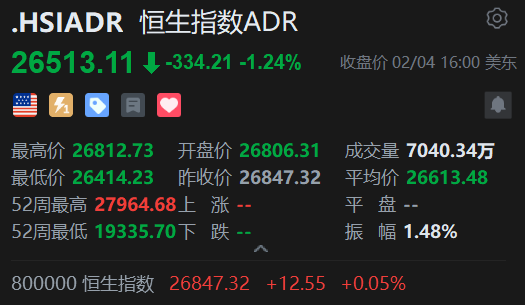
Market Overview - The Hang Seng Index (HSI) closed at 26,513.11, down by 334.21 points or 1.24% [1] - The index reached a high of 26,812.73 and a low of 26,414.23 during the trading session [1] - The trading volume was 70.4034 million shares, with an average price of 26,613.48 [1] Major Blue-Chip Stocks Performance - HSBC Holdings closed at HKD 139.704, up by 0.51% compared to the previous close [2][3] - Tencent Holdings closed at HKD 552.190, down by 1.04% compared to the previous close [2][3] - Alibaba Group (W) closed at HKD 159.500, down by 0.93% [3] - AIA Group closed at HKD 90.700, up by 1.40% [3] - Xiaomi Group (W) closed at HKD 33.960, down by 1.85% [3] - Meituan (W) closed at HKD 92.150, down by 1.13% [3] - China Ping An closed at HKD 72.050, up by 1.05% [3] ADR Performance - Tencent's ADR (TCEHY) was priced at USD 552.190, reflecting a decrease of 1.04% compared to its Hong Kong counterpart [3] - Alibaba's ADR (BABA) was priced at USD 155.411, down by 2.56% compared to its Hong Kong counterpart [3] - HSBC's ADR (HSBC) was priced at USD 139.704, up by 0.51% compared to its Hong Kong counterpart [3]
新潮年货“科味”浓 服务消费重体验 从电商年货节榜单看消费新趋势
Shang Hai Zheng Quan Bao· 2026-02-04 18:12
Core Insights - The upcoming Spring Festival is expected to see a surge in consumer demand, with e-commerce platforms leveraging technology and promotional activities to stimulate spending [1][3] Group 1: Consumer Trends - Smart technology products are becoming popular choices for New Year purchases, with significant sales increases in categories like home appliances, including a 121% rise in robot vacuum sales and a 114% increase in embedded steam oven sales [2] - A survey indicates that 45.6% of consumers prioritize gifts for parents and elders during their initial New Year shopping, focusing on health and safety [3] - The trend of "instant purchasing" is emerging, with consumers opting for immediate purchases rather than stockpiling goods [2] Group 2: Service Consumption - Traditional services such as haircuts and cleaning are experiencing high demand, with beauty services seeing a 78% increase in search volume for hair dyeing packages [4] - The home cleaning service sector is also booming, with a doubling of orders for routine cleaning services in major cities [4] Group 3: Technological Integration - E-commerce platforms are actively developing AI applications to enhance the shopping experience, such as Meituan's AI search feature and JD's AI New Year goods map [5] - AI is expected to play a significant role in personalized recommendations and inventory management, potentially transforming consumer engagement and operational efficiency [6] Group 4: Innovative Products and Promotions - New trends in gift-giving include blind box toys and culturally themed products, with 65.6% of consumers planning to purchase zodiac-themed gift boxes [7] - E-commerce platforms are implementing various promotional strategies, including discount coupons and live-streaming sales, to further boost consumer spending [7][8]

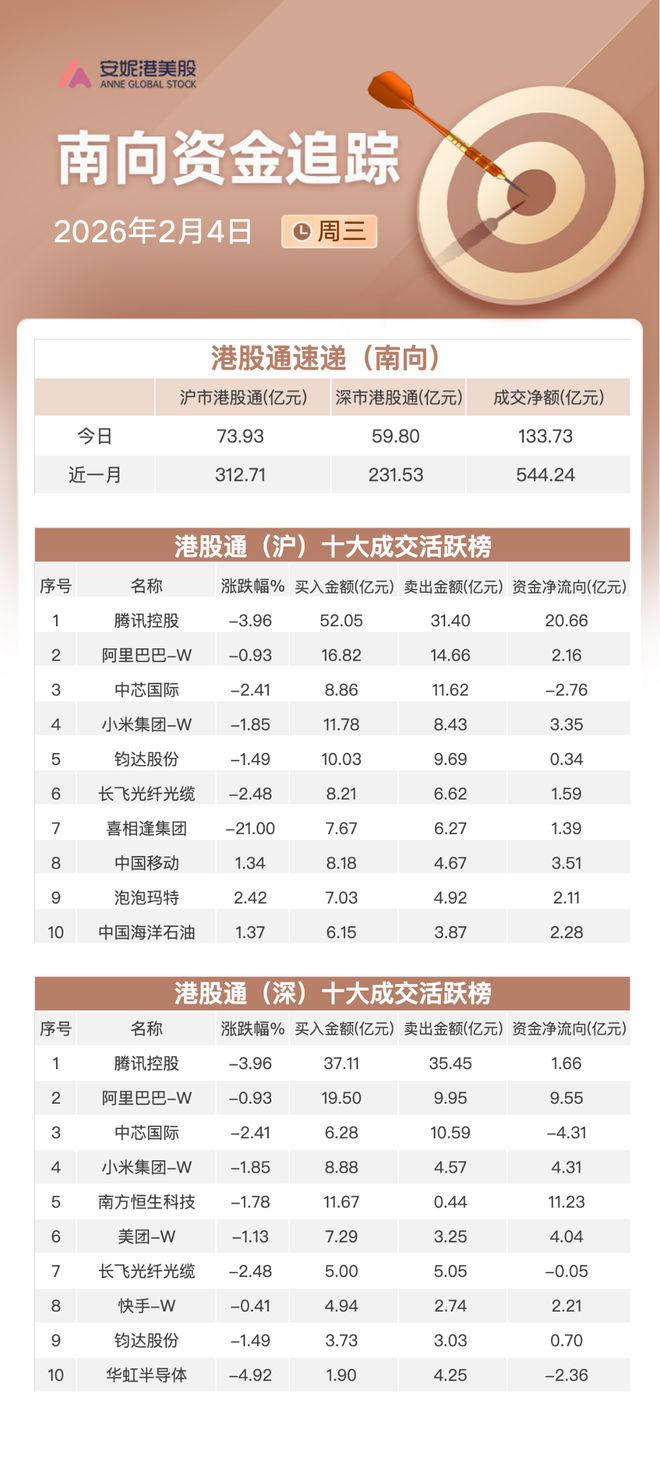
北水成交净买入133.73亿 大摩称市场过度担忧增值税传闻 北水继续抢筹科网股
Zhi Tong Cai Jing· 2026-02-04 14:43
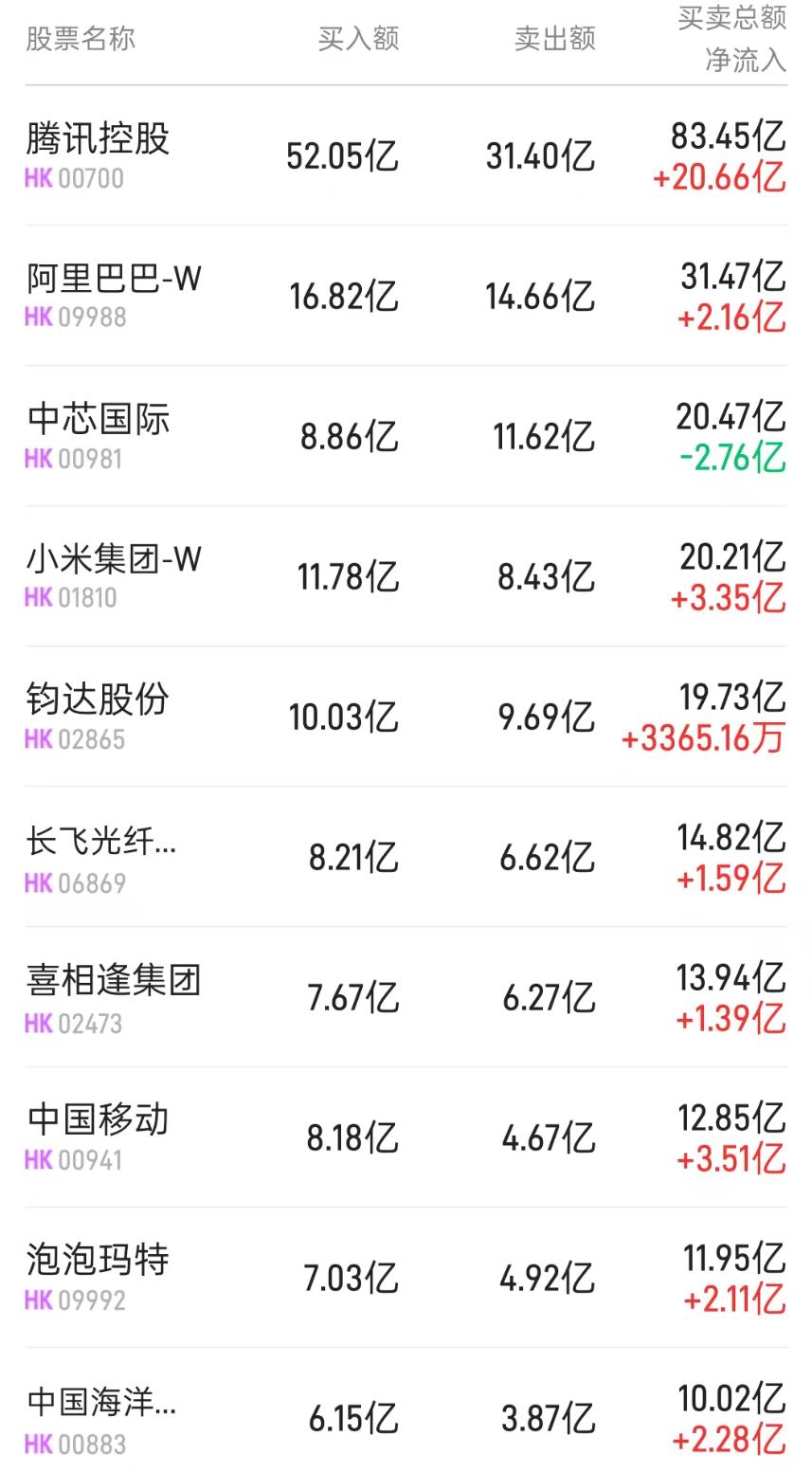
Group 1: Market Overview - On February 4, the Hong Kong stock market saw a net inflow of capital from Northbound trading amounting to HKD 133.73 billion, with HK Stock Connect (Shanghai) contributing HKD 73.93 billion and HK Stock Connect (Shenzhen) contributing HKD 59.8 billion [2] - The most net bought stocks included Tencent (00700), Alibaba-W (09988), and Southern Hang Seng Technology (03033), while the most net sold stocks were SMIC (00981) and Hua Hong Semiconductor (01347) [2][8] Group 2: Stock Performance - Tencent Holdings received a net inflow of HKD 20.66 billion, with a buy amount of HKD 52.05 billion and a sell amount of HKD 31.40 billion [3] - Alibaba-W had a net inflow of HKD 2.16 billion, with a buy amount of HKD 16.82 billion and a sell amount of HKD 14.66 billion [3] - SMIC experienced a net outflow of HKD 2.76 billion, with a buy amount of HKD 8.86 billion and a sell amount of HKD 11.62 billion [3] Group 3: Sector Insights - The telecommunications sector, including China Mobile, is facing pressure from an increase in value-added tax rates, which is expected to impact net profits by 2026 [7] - The optical fiber industry is experiencing a price increase trend, with expectations of continued price growth due to rising demand from telecom operators and pre-holiday stockpiling [7] - Xiaomi Group-W reported a net inflow of HKD 7.65 billion, attributed to strong electric vehicle deliveries and ongoing investments in AI and robotics [6] Group 4: Strategic Developments - Junda Co. (钧达股份) has signed a strategic cooperation framework agreement with Shangyi Optoelectronics to develop flexible perovskite technology for space applications [8] - Bubble Mart (泡泡玛特) announced plans to establish its European headquarters in London, with plans to open 27 new stores in the UK, creating over 150 jobs [7]

美团-W(03690):25Q4业绩前瞻:利润依然承压,中高客单价市占稳定
GF SECURITIES· 2026-02-04 11:47
Investment Rating - The investment rating for the company is "Buy" with a current price of 92.15 HKD and a target value of 133.47 HKD [3]. Core Insights - The report anticipates that the company's revenue for 2025 will reach 365.3 billion RMB, with an adjusted net profit loss of 22.5 billion RMB. The company is expected to maintain a strong operational barrier in the takeaway business, despite short-term profit pressures due to competition [6][13]. - The report highlights that the competition in the instant retail business is easing, with a projected order volume growth of 30% for flash purchases in Q4 2025. However, the takeaway business is expected to face continued competition, particularly in high-value orders [6][7][8]. Financial Forecast - Revenue projections for the company are as follows: - 2023: 276.74 billion RMB - 2024: 337.59 billion RMB (growth rate: 25.82%) - 2025: 365.32 billion RMB (growth rate: 8.21%) - 2026: 414.90 billion RMB (growth rate: 13.57%) - 2027: 467.34 billion RMB (growth rate: 12.64%) [6]. - The adjusted net profit forecast indicates losses for 2025 and 2026, with expected losses of 22.5 billion RMB and 7.2 billion RMB, respectively [6][13]. Business Segment Performance - Core local business revenue is projected to be 643.92 billion RMB in Q4 2025, with a year-over-year decline of 1.79% and an operational loss of 111.16 billion RMB [7][9]. - New business revenue is expected to reach 270.46 billion RMB in Q4 2025, reflecting an 18% year-over-year growth, although operational losses are projected at 42.78 billion RMB [8][9]. Valuation Methodology - The report employs a sum-of-the-parts (SOTP) valuation method, estimating the company's fair value at 133.47 HKD per share, based on contributions from various business segments including takeaway, in-store travel, flash purchases, and new businesses [13][14].
智通港股通活跃成交|2月4日
智通财经网· 2026-02-04 11:07
沪港通(南向)十大活跃成交公司 | 公司名称 | 成交金额 | 净买入额 | | --- | --- | --- | | 腾讯控股(00700) | 72.56 亿元 | +1.66 亿元 | | 阿里巴巴-W(09988) | 29.45 亿元 | +9.55 亿元 | | 中芯国际(00981) | 16.87 亿元 | -4.31 亿元 | | 小米集团-W(01810) | 13.46 亿元 | +4.31 亿元 | | 南方恒生科技(03033) | 12.11 亿元 | +11.23 亿元 | | 美团-W(03690) | 10.53 亿元 | +4.04 亿元 | | 长飞光纤光缆(06869) | 10.05 亿元 | -476.84 万元 | | 快手-W(01024) | 7.68 亿元 | +2.21 亿元 | | 钧达股份(02865) | 6.75 亿元 | +7011.29 万元 | | 华虹半导体(01347) | 6.15 亿元 | -2.36 亿元 | 智通财经APP获悉,2026年2月4日当天,腾讯控股(00700)、阿里巴巴-W(09988)、中芯国际(00981)位居 ...
净流入约134亿港元创近两周新高 大举加仓多只科技龙头




Xin Lang Cai Jing· 2026-02-04 10:45
来源:智通财经 智通财经2月4日讯(编辑 冯轶)据Wind数据显示,南向资金今日成交约1140.75亿港元,较前一日继续 缩量约123亿;约占今日恒指成交总额的39.97%,占比继续低于四成。 腾讯控股今日跌3.96%,资金前5日加仓458万股,短线保持流入趋势。 阿里巴巴-W今日跌0.93%,资金前5日减持792万股,短线仍以流出为主。 小米集团-W今日跌1.85%,资金前5日加仓4020万股,短线保持流入趋势。 美团-W今日跌1.13%,资金前5日减持410万股,但近两日连续回流。 但值得关注的是,南向资金今日大举净流入约133.73亿港元,创1月22日以来近两周新高。其中,沪港 股通净流入约73.93亿港元,而深港股通净流入约59.80亿港元。 且趋势上,南向资金已连续5个交易日保持流入,成为港股短线回调中的一股做多力量,累计买入 238.27亿港元。 个股方面,交易所数据显示,今日南向资金 大幅净买入:腾讯控股(0700.HK)22.31亿港元;阿里巴巴-W(09988.HK)11.71亿港元;小米集团- W(01810.HK)7.66亿港元;美团-W(03690.HK)4.04亿港元;中国移动(00 ...
北水动向|北水成交净买入133.73亿 大摩称市场过度担忧增值税传闻 北水继续抢筹科网股
智通财经网· 2026-02-04 10:13
Core Viewpoint - The Hong Kong stock market experienced significant net inflows from northbound capital, totaling HKD 133.73 billion, with major contributions from Tencent, Alibaba, and Southern Hang Seng Technology, while SMIC and Hua Hong Semiconductor faced the highest net outflows [1]. Group 1: Northbound Capital Inflows - Tencent Holdings (00700) received a net inflow of HKD 52.05 billion, with total trading volume of HKD 83.45 billion, reflecting a net increase of HKD 20.66 billion [2]. - Alibaba-W (09988) saw a net inflow of HKD 16.82 billion, with total trading volume of HKD 31.47 billion, resulting in a net increase of HKD 2.16 billion [2]. - Southern Hang Seng Technology (03033) attracted a net inflow of HKD 11.67 billion, contributing to the overall positive sentiment in the tech sector [4]. Group 2: Notable Net Outflows - SMIC (00981) experienced a net outflow of HKD 8.86 billion, with total trading volume of HKD 20.47 billion, indicating a net decrease of HKD 2.76 billion [2]. - Hua Hong Semiconductor (01347) faced a net outflow of HKD 1.90 billion, with total trading volume of HKD 6.15 billion, reflecting a significant decline [4]. Group 3: Sector Performance and Trends - The telecommunications sector, represented by China Mobile (00941), saw a net outflow of HKD 3.5 billion, attributed to anticipated pressure on net profits due to an increase in value-added tax rates [5]. - The optical fiber industry, led by Changfei Optical Fiber (06869), is experiencing a price increase trend, with expectations of continued growth driven by demand from telecom operators [6]. - Xiaomi Group (01810) reported a net inflow of HKD 7.65 billion, supported by strong electric vehicle delivery performance and ongoing investments in AI and robotics [5].
美团旅行:重庆酒店“春节提前订”增73% 春节00后预订单量增55%
Jing Ji Wang· 2026-02-04 09:03
Core Insights - The "Meituan Black Diamond Member Experience Officer" program has successfully launched in Chongqing, highlighting the city's appeal as a travel destination during the Spring Festival [2][3] - Chongqing's tourism bookings have seen significant growth, with a 32% year-on-year increase in Spring Festival cultural and tourism reservations, and a 73% increase in hotel bookings [2] - The program aims to enhance the hotel experience by integrating various cultural activities and local experiences, expanding the concept of "accommodation+" [6] Group 1: Tourism Growth - Chongqing's hotel bookings for the Spring Festival have surged, with high-end hotel night rates exceeding 800 yuan and a staggering 542% increase in bookings from "out-of-town tourists" [2] - The top ten sources of out-of-town visitors to Chongqing include major cities such as Beijing, Shanghai, and Guangzhou [2] - The demand for hotel bookings has increased significantly, with a 157% rise in early reservations for Marriott hotels in Chongqing [5] Group 2: Experience Integration - The "accommodation+" concept is being promoted, allowing guests to engage in various activities such as cocktail parties, opera performances, and local culinary experiences [3][6] - The program includes unique offerings like the "one meal seals the gods" dinner and packages that combine hotel stays with local cultural experiences [5] - The integration of local attractions, such as the drone light shows and scenic views from high-altitude hotels, enhances the overall visitor experience [5][6] Group 3: Demographic Trends - There is a notable increase in hotel bookings among younger travelers, with a 55% growth in reservations from the post-2000 generation [5] - The senior demographic (60 years and older) has also shown a significant increase in bookings, with a 79% rise in hotel reservations [5] - The trend indicates a shift towards more diverse travel experiences among different age groups, with a growing interest in cultural and local activities [6]