BANK OF CHINA(03988)

Search documents
中国银行业-评估工行、农行获政府注资的潜在影响-China Banks_ Assessing the potential impact of reported government capital injections for ICBC & ABC
2026-02-03 02:49
Summary of Conference Call Notes on China Banks (ICBC & ABC) Industry Overview - The focus is on the banking sector in China, specifically the two large state-owned banks: Industrial and Commercial Bank of China (ICBC) and Agricultural Bank of China (ABC) [1][2]. Key Points and Arguments Government Capital Injections - The Ministry of Finance (MoF) is reported to potentially issue Rmb 200 billion in bonds to insurance companies and inject Rmb 300 billion in capital into ICBC and ABC [1]. - In 2025, the MoF recapitalized four large banks with a total of Rmb 500 billion through special treasury bonds [1]. Impact of Capital Injection - The analysis suggests that the capital injection could lead to an estimated dilution of Earnings Per Share (EPS) by 4%-7% and Book Value Per Share (BVPS) by 0%-2% for ICBC and ABC [2][15][18]. - The Common Equity Tier 1 (CET1) ratio for both banks could increase by approximately 54 to 61 basis points [2][13]. Assumptions for Analysis - The analysis assumes an even distribution of the Rmb 300 billion capital injection, estimating Rmb 150 billion for each bank [3][9]. - The potential price-to-book (P/B) ratio post-recapitalization is expected to range between 0.7x and 1.0x, based on previous recapitalizations [3][11]. Growth and Dividend Sustainability - New capital is expected to help banks sustain growth and maintain dividends, especially if credit demand recovers in the second half of 2026 [4][5]. - ICBC and ABC could increase their dividend payout ratio by 1.2 to 2.3 percentage points to maintain flat dividends per share (DPS) without affecting risk-weighted asset (RWA) growth [5][20]. Sector Valuation and Dividend Outlook - The report indicates that if large banks can pay higher dividends, it may encourage other well-capitalized banks, such as China Merchants Bank (CMB), to increase their dividends, potentially driving up sector valuations [21][27]. - The probability of banks increasing their dividend payout ratio for FY2025 is considered low, but there is potential for increases in 2026 if revenue growth is achieved [21]. Risk Assessment - **Upside Risks**: Include higher dividend payout ratios due to the capital injection, better-than-expected profit growth, and stronger economic recovery [47][50]. - **Downside Risks**: Include lower-than-expected capital injections, higher asset growth impacting capital accumulation, and continued deterioration in asset quality [48][52]. Stock Recommendations - The report maintains a Neutral rating on ICBC and ABC due to uncertainties regarding the capital injection's size, timing, and valuation impacts [43]. - Preference is given to China Construction Bank (CCB) and Bank of China (BOC) for their solid balance sheets and completed capital replenishments, along with CMB for its potential dividend upside [43]. Additional Important Content - The risk buffer for the China banking system is projected to reach Rmb 15 trillion in 2025, an increase from previous years [22]. - The Texas ratio, which measures non-performing loans against tangible equity plus loan loss reserves, is expected to decrease from 26% in 2023 to 23% in 2025 [24]. This summary encapsulates the key insights and projections regarding the potential impact of government capital injections on ICBC and ABC, along with broader implications for the Chinese banking sector.

中国银行业_中国机遇论坛与金融调研核心要点China banks_ Key takeaways from China Opportunity Forum and the financial tour
2026-02-03 02:06
Summary of Key Points from the Conference Call Industry Overview - **Industry**: Chinese Banking Sector - **Key Takeaways**: The recent conference and financial tour indicated a net positive outlook for Chinese banks, with improved net profit growth rates driven by recovery in net interest income (NII), positive fee growth, and stable asset quality [2][5][6]. Core Insights - **Profit Growth**: Banks are experiencing improved net profit growth rates, with SOE banks expressing greater optimism compared to Joint Stock Banks (JSBs) regarding revenue and profit growth trajectories [2][5]. - **NII Recovery**: A recovery in NII is expected, with banks anticipating positive net interest income growth in 2026, although some JSBs expect a decline [5][6]. - **Loan Growth**: Moderate increases in new loan volumes are anticipated, primarily driven by corporate lending focused on infrastructure and technology [6]. - **Fee Income Divergence**: SOE banks expect robust fee income growth, while JSBs foresee only slight positive growth due to weak consumption and regulatory pressures [6]. - **Investment Income**: Banks are managing their investment portfolios actively, with unrealized gains providing a buffer against future income fluctuations [6]. Monetary Policy and Interest Rates - **Dovish Monetary Policy**: The monetary policy remains dovish, with expectations of further cuts to the Loan Prime Rate (LPR) and deposit rates [5]. - **Deposit Management**: Banks are focusing on managing high-rate time deposits maturing in 2026, with a projected retention rate of 90% due to clients' low risk appetite [5][6]. Asset Quality and Risk Management - **Stable Asset Quality**: Asset quality is expected to remain stable, with non-performing loan (NPL) formation having peaked, particularly in the property sector [6]. - **Retail Loan Risks**: Increased pressure on retail loan asset quality is noted, with some banks experiencing elevated NPL formation [6]. Future Outlook - **Profit Growth Expectations**: SOE banks expect positive net profit growth in 2026, driven by NII growth and cost control, while some banks remain cautious due to external macroeconomic factors [6]. - **Capital Management Review**: One bank is reviewing its capital management policy, considering the balance between CET1 ratio, dividend payout, and return on equity (ROE) [6]. Investment Strategy - **Insurance Sector Insights**: A leading insurance company plans to maintain a 30% allocation to equities for net new premiums in 2026, focusing on high-dividend stocks and Hong Kong equities [7]. Company Recommendations - **Top Picks**: Among SOE banks, the top picks include China Construction Bank (CCB-H), Bank of China (BOC-H), and Bank of Communications (Bocom-A/H) [2]. Additional Notes - **Market Performance**: While the banking sector is expected to see absolute share price upside in 2026, it may underperform the broader market [2].
国有大行部署2026年经营工作,重点聚焦何处?
Xin Lang Cai Jing· 2026-02-03 01:29
Core Viewpoint - The recent meetings of major state-owned banks in China emphasized "high-quality development" as a key theme for 2025 and outlined strategic focuses for 2026, including enhancing credit issuance and effectively managing risks in key areas [1][3][4]. Group 1: High-Quality Development - Several banks, including Agricultural Bank and China Bank, reported successful completion of their targets for 2025, indicating progress in high-quality development [1][3]. - The banks plan to focus on five major financial initiatives and prioritize credit issuance while managing risks effectively in 2026 [1][3]. Group 2: Service Focus - Agricultural Bank highlighted its commitment to serving the "three rural issues" as a priority, while China Bank aims to consolidate and expand its global advantages [5][6]. - Construction Bank emphasized the integration of commercial and investment banking, as well as public and private banking, to enhance service adaptability [7]. Group 3: Risk Management and Innovation - The banks are focusing on enhancing their risk management frameworks through digitalization and intelligent systems to address credit risks in key sectors like local government debt and real estate [10][11]. - Agricultural Bank and Industrial and Commercial Bank are both committed to increasing loan support in critical areas, including rural finance and consumer sectors [4][10]. Group 4: Reform and Efficiency - The banks are targeting reforms to improve customer and employee satisfaction, with a focus on enhancing operational efficiency and reducing costs [8]. - Postal Savings Bank aims to leverage strategic opportunities during the 14th Five-Year Plan period to enhance its service capabilities and achieve sustainable growth [7].


2026年经营部署如何“划重点”?六大行全扫描
Xin Lang Cai Jing· 2026-02-03 00:48
Core Viewpoint - The major banks in China are transitioning from the "14th Five-Year Plan" to the "15th Five-Year Plan," focusing on serving the real economy and preventing financial risks while adapting to their own development needs [1][2]. Group 1: Transition from "14th Five-Year Plan" to "15th Five-Year Plan" - In 2025, banks aimed to complete the "14th Five-Year Plan" with a focus on risk prevention and stable performance [1]. - For 2026, banks are shifting their focus to the "15th Five-Year Plan," with institutions like ICBC and Bank of Communications outlining their strategic plans for this new phase [1]. Group 2: Support for Key Areas - Banks are increasing loan disbursements and bond investments, particularly in areas like domestic demand expansion, technological innovation, and support for small and micro enterprises [2]. - Agricultural Bank of China emphasizes serving rural areas and has reported a continuous increase in county loans, exceeding 1 trillion yuan for four consecutive years, with a total balance surpassing 10 trillion yuan [2]. Group 3: Risk Prevention Strategies - Financial institutions are prioritizing risk prevention, particularly in local government debt and real estate sectors, with specific measures outlined by Agricultural Bank and China Construction Bank [4]. - China Bank is focusing on centralized credit risk management and proactive trend risk control to maintain asset quality [4]. Group 4: Digital Transformation - Digital transformation is a common focus among state-owned banks, with initiatives aimed at enhancing operational capabilities and integrating AI into business processes [5][6]. - Postal Savings Bank is advancing a comprehensive upgrade strategy that includes digitalization and aims to create a "second growth curve" [6]. Group 5: Shift from Scale Expansion to Value Creation - In 2026, banks are moving from a focus on scale expansion to value creation, with institutions like Postal Savings Bank emphasizing a shift from scale-driven to value-driven strategies [7]. - The consensus among banks is to improve efficiency and reduce costs through digital transformation, especially in a low-interest-rate environment [7].

房地产融资协调“白名单”机制两周年:主办银行制成核心
Feng Huang Wang· 2026-02-03 00:41
Group 1 - The core viewpoint of the article highlights the establishment and implementation of a coordinated financing mechanism for urban real estate, which aims to streamline financing processes and ensure that reasonable financing demands are met by banks [1][3] - The "white list" mechanism has been in place for two years, with the main bank system being recognized as a key component for real estate project financing, ensuring that information sharing among banks is improved and reducing the risk of over-lending [2][3] - Recent data indicates that while the financing support for "white list" projects has been significant, the growth rate of new loans has slowed down considerably compared to the initial year of implementation [4][5] Group 2 - As of the end of last year, banks in Beijing had provided loans totaling 215.6 billion yuan for 219 "white list" projects, while Hunan province reported 1,830.9 billion yuan in loans for 1,386 projects, demonstrating the effectiveness of the financing coordination mechanism [4][5] - The overall loan amount for "white list" projects exceeded 7 trillion yuan, supporting nearly 20 million housing units, but the growth in loan amounts has significantly decreased, with only 1.4 trillion yuan added in the last six months of the previous year [4][5] - The recent adjustments to the "white list" financing mechanism include allowing for a five-year extension on loans for qualifying projects, which aims to alleviate short-term repayment pressures for real estate companies while maintaining cautious lending practices for new projects [6][7]
最新!黄金与白银价格新高后剧烈波动 多家银行紧急调整!
Sou Hu Cai Jing· 2026-02-03 00:05
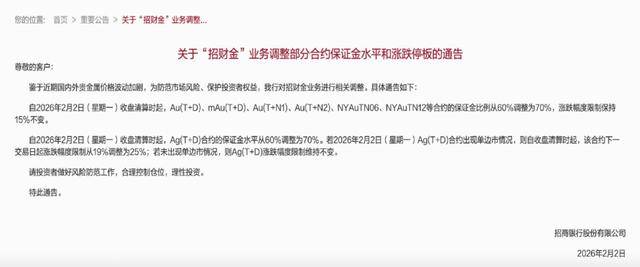
Core Viewpoint - Recent fluctuations in international gold and silver prices have prompted banks to adjust their operations and issue risk warnings to protect investors amid significant market volatility [1][2][4][5][6][7] Group 1: Market Fluctuations - On February 2, gold futures dropped below $4,500 per ounce, with silver prices experiencing a cumulative decline of approximately 40% from the peak on January 29, while gold prices fell by about 20% [1] - The recent volatility in precious metals is attributed to macroeconomic expectations, technical overbought conditions, and profit-taking by some investors, indicating a high volatility phase in the market [7] Group 2: Bank Responses - China Merchants Bank announced an increase in margin requirements for various gold and silver contracts from 60% to 70% to mitigate market risks [1] - The bank also suspended new account openings and new positions in its "Zhaocai Gold" business due to the changing market conditions [2] - Other banks, including Postal Savings Bank of China and Agricultural Bank of China, have issued similar warnings and adjusted their business practices to enhance risk management and protect client interests [2][4][5] Group 3: Risk Management Strategies - Banks are implementing a multi-layered approach to risk management, including increasing entry barriers, limiting leverage, and guiding rational investment behaviors [7] - The adjustments made by banks reflect a proactive stance in managing risks associated with precious metals trading, aiming to maintain market stability and protect investor interests [7]



智通ADR统计 | 2月3日
智通财经网· 2026-02-02 22:23
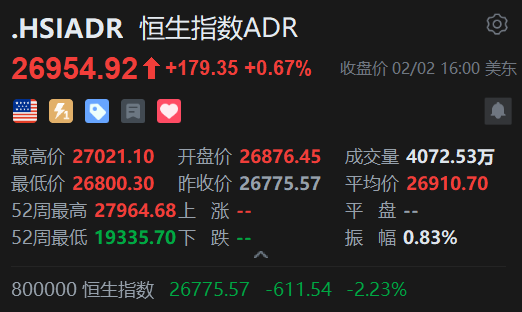
Market Overview - The Hang Seng Index (HSI) closed at 26,954.92, up by 179.35 points or 0.67% as of February 2, 16:00 Eastern Time [1] - The index reached a high of 27,021.10 and a low of 26,800.30 during the trading session, with a trading volume of 40.725 million shares [1] Major Blue-Chip Stocks Performance - HSBC Holdings closed at HKD 139.961, increasing by 3.91% compared to the Hong Kong close [2] - Tencent Holdings closed at HKD 595.694, down by 0.47% compared to the Hong Kong close [2] Stock Price Movements - Tencent Holdings: Latest price HKD 598.500, down by HKD 7.500 or 1.24% [3] - Alibaba Group: Latest price HKD 163.300, down by HKD 5.900 or 3.49% [3] - HSBC Holdings: Latest price HKD 134.700, down by HKD 1.900 or 1.39% [3] - AIA Group: Latest price HKD 89.050, down by HKD 1.300 or 1.44% [3] - Meituan: Latest price HKD 94.850, down by HKD 2.350 or 2.42% [3] - BYD Company: Latest price HKD 91.000, down by HKD 6.750 or 6.91% [3] - Kuaishou Technology: Latest price HKD 77.000, down by HKD 3.150 or 3.93% [3]





赛道边银行暗战:解码马拉松“金主”的生意经
Zhong Guo Zheng Quan Bao· 2026-02-02 20:45
Core Insights - The article discusses the strategic investment of banks in sponsoring marathon events, particularly the "2026 China Bank Yangzhou Half Marathon," highlighting the shift from mere brand exposure to building long-term customer relationships and integrating financial services into the health and wellness ecosystem [1][2][3]. Group 1: Strategic Investment in Marathons - Banks are increasingly becoming major sponsors of marathon events, viewing this as a strategic investment to reach potential customers and redefine the value of offline quality scenarios [1][2]. - The sponsorship allows banks to transform sports events into a foundation for long-term customer relationships and a "finance + health" service ecosystem [1][3]. - The characteristics of marathon participants align closely with the target demographics of banks' retail businesses, making these events a key opportunity for customer acquisition [2][3]. Group 2: Enhanced Customer Engagement - Through the China Bank App, runners can access specialized training courses and a range of exclusive benefits, showcasing a comprehensive approach to customer engagement [2]. - Banks are leveraging marathons to create multiple touchpoints with potential customers, enhancing interaction from registration to on-site services [3]. - The sponsorship of local events helps regional banks improve brand penetration and build emotional connections within the community [3][5]. Group 3: Challenges and Opportunities - While sponsorship provides brand exposure, the real challenge lies in converting event "traffic" into long-term customer retention amidst increasing competition and similar marketing strategies [4]. - Banks are encouraged to innovate their marketing approaches beyond conventional methods like commemorative cards and simple lotteries to improve return on investment [4]. - Future strategies should focus on full-chain operations, customer segmentation, and integrating technology to enhance the "sports + finance" ecosystem [5].
国有六大行密集强化黄金投资业务风险管控
Zheng Quan Ri Bao· 2026-02-02 16:43
Core Viewpoint - The recent volatility in gold prices has prompted major state-owned banks in China to adjust their gold-related business practices, enhancing risk management and guiding investors towards rational participation in the market [1][2][4]. Group 1: Adjustments by State-Owned Banks - Major state-owned banks, including ICBC, ABC, BOC, CCB, and others, have implemented changes to their gold-related business, including increasing entry thresholds, transaction limits, and risk assessment requirements [2][4]. - ICBC announced on February 1 that due to significant fluctuations in domestic and international precious metal prices, investors should maintain a rational investment mindset and avoid impulsive trading [2]. - CCB raised the minimum amount for personal gold accumulation to 1,500 yuan starting February 2, citing increased market risks [3]. Group 2: Market Analysis and Long-Term Value - Despite short-term price fluctuations, experts believe that gold and other precious metals still hold long-term investment value due to global risk aversion and changes in asset allocation logic [1][5]. - The precious metals market has shown an upward trend since 2026, with gold and silver performing particularly well, although recent price volatility has raised concerns about future market behavior [5]. - Analysts suggest that while short-term pressures may exist, long-term factors such as declining real interest rates and persistent inflation will continue to support gold prices [5][6]. Group 3: Investor Guidance - Investors are advised to focus on risk management, including understanding market volatility, monetary policy changes, and liquidity risks associated with investment products [6]. - It is emphasized that investors should assess their risk tolerance and avoid excessive leverage, choosing investment tools that align with their financial situations [6].
白银基金 最新公告!将进行合理重估
Mei Ri Jing Ji Xin Wen· 2026-02-02 16:10
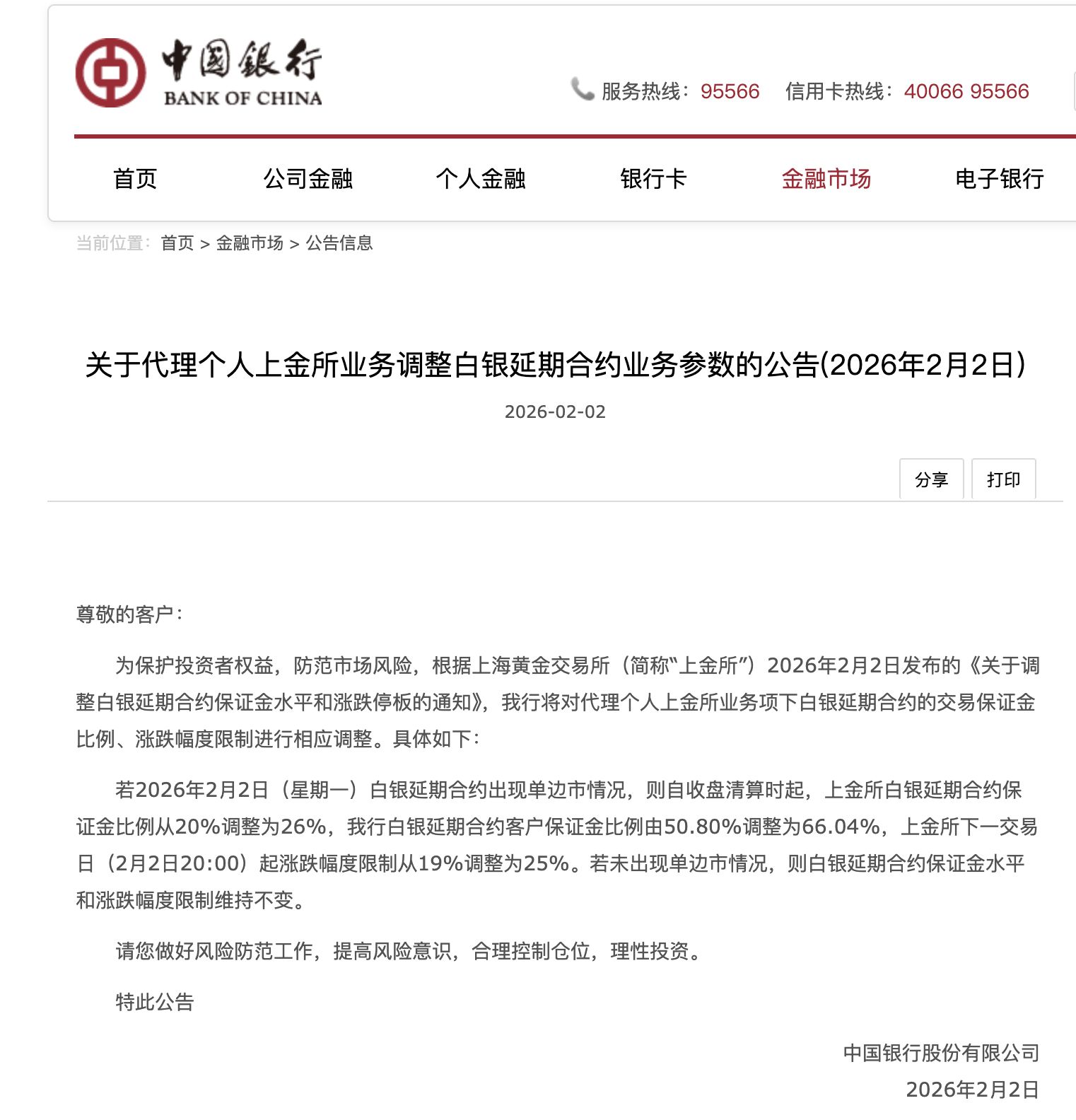
Group 1 - The announcement from Guotou Silver LOF indicates that Guotou Ruijin Fund Management Co., Ltd. will adjust the valuation of its silver futures contracts based on the price fluctuations in major international silver futures markets starting from February 2, 2026 [1] - The specific silver futures contracts affected include AG2604, AG2605, AG2606, AG2608, AG2610, and AG2612, with valuation adjustments being made relative to the previous trading day's prices at 3 PM Beijing time [1] - The company will revert to using settlement prices for valuation once the contracts demonstrate active market trading characteristics, without further announcements [1] Group 2 - On February 2, 2026, if a unilateral market condition occurs for silver forward contracts, the margin ratio for the Shanghai Gold Exchange (SGE) will increase from 20% to 26%, while the margin ratio for clients of the bank will rise from 50.80% to 66.04% [3][6] - The price fluctuation limit for the SGE silver forward contracts will be adjusted from 19% to 25% starting from 8 PM on February 2, 2026, if a unilateral market condition is observed [3][6] - If no unilateral market condition occurs, the margin levels and fluctuation limits will remain unchanged [3][6]