MICROSOFT(04338)

Search documents
OpenAI/微软争夺AGI控制权,重组谈判激烈,年底谈不成软银700亿或撤
3 6 Ke· 2025-08-28 07:02
Group 1 - OpenAI's restructuring negotiations with Microsoft are ongoing, focusing on control, certainty, and the future of AGI, which will impact Microsoft's stake value and SoftBank's $10 billion investment timeline [1][2][5] - OpenAI operates under a capped-profit structure, which has become a financing obstacle, limiting investor returns and hindering the potential for an IPO [2][3] - Microsoft has invested over $13 billion in OpenAI, securing exclusive technology collaboration and priority usage rights, but this has led to conflicts regarding profit distribution as key milestones approach [5][11] Group 2 - The current exclusive hosting of OpenAI's models on Microsoft Azure limits OpenAI's API expansion and compliance capabilities, leading to negotiations for potential multi-cloud arrangements [6][17] - Microsoft seeks access to OpenAI's core intellectual property, particularly the training methodologies behind its advanced models, which OpenAI aims to protect as trade secrets [8][10] - The existing contract allows OpenAI to cut off Microsoft's access to its IP upon achieving AGI, creating significant risk for Microsoft and uncertainty regarding its investment [11][13] Group 3 - A potential compromise may involve transitioning from a binary AGI cutoff to a tiered mechanism based on significant capability milestones, enhancing investment certainty for both parties [13][15] - Multi-cloud capabilities could provide OpenAI with greater bargaining power, especially with large clients, while also increasing competition among cloud providers [17][19] - Specific industries may prioritize compliance and deployment flexibility over Azure's integration, indicating a shift in market dynamics [16][18]


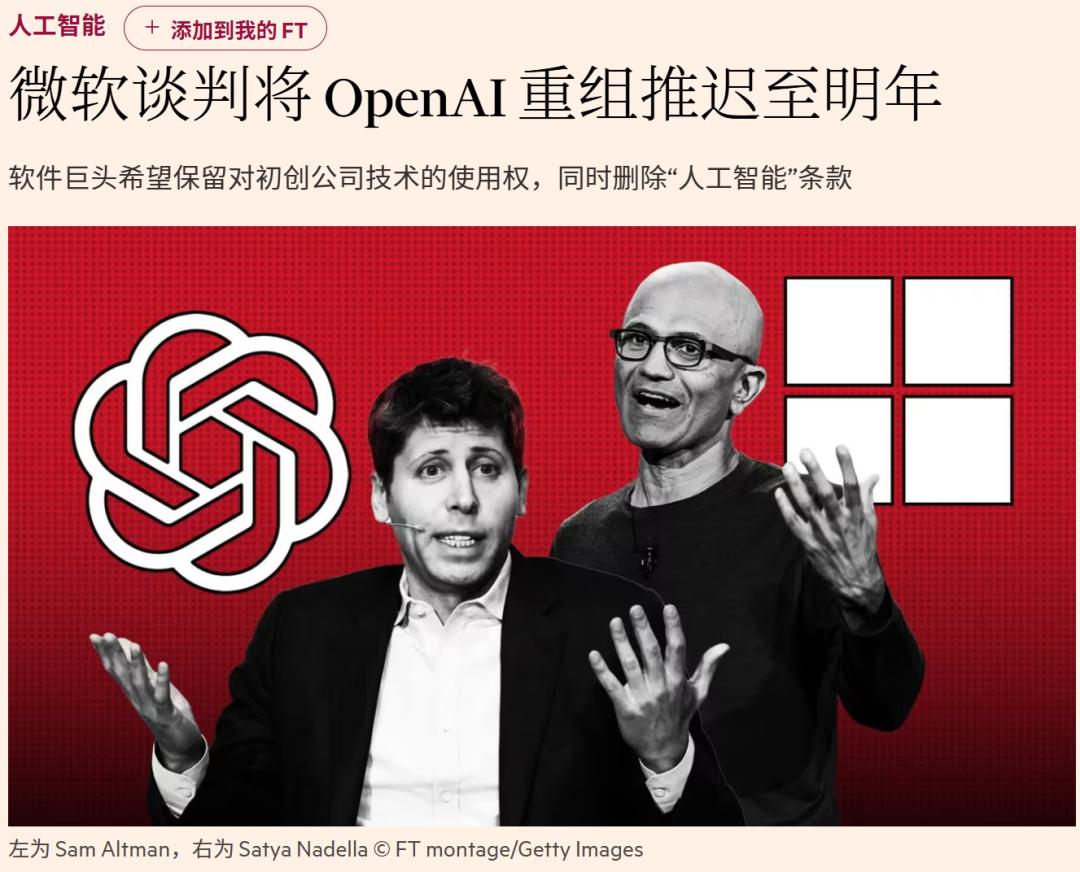
OpenAI重组或将推迟至明年,与微软谈判陷入关键分歧
Hua Er Jie Jian Wen· 2025-08-27 15:46
Core Viewpoint - OpenAI is facing delays in its restructuring plan due to unresolved disputes with Microsoft regarding a commercial contract that extends to 2030, which is critical for OpenAI's transition from a profit-sharing model to a stockholding model for investors [1][6]. Group 1: Negotiation Issues - The negotiations between OpenAI and Microsoft revolve around three key issues: API access rights, intellectual property (IP) access, and AGI clauses [2][3][4][5]. - OpenAI seeks to diversify its API access beyond Microsoft Azure, which currently accounts for approximately 25% of its annual revenue, while Microsoft is reluctant to relinquish its exclusive control [3]. - Microsoft desires insight into OpenAI's model training methods, which remains a contentious point in the negotiations [4]. - A special AGI clause allows OpenAI to sever Microsoft's access to its IP upon achieving AGI, a point of contention as Microsoft wishes to eliminate this uncertainty [5]. Group 2: Impact on Ownership and Financing - The resolution of these negotiation issues will directly affect Microsoft's potential ownership stake in OpenAI, which is projected to be between 30% and 35% depending on the outcome [6]. - OpenAI has raised over $13 billion from Microsoft to date, but the ownership percentage may fluctuate based on the negotiations [6]. - OpenAI's recent funding rounds have seen its valuation rise from $157 billion in October to $300 billion in March, with conditions that allow investors to withdraw if restructuring is not completed [8]. - If negotiations extend beyond the end of 2025, SoftBank may withdraw its commitment of $10 billion, posing a significant threat to OpenAI's financing plans [8]. - Despite internal governance challenges, OpenAI's market interest remains high, with expectations of a valuation reaching $500 billion and potential new investors showing interest [8].
突发!微软总裁办公室被“占领”
Guo Ji Jin Rong Bao· 2025-08-27 12:05
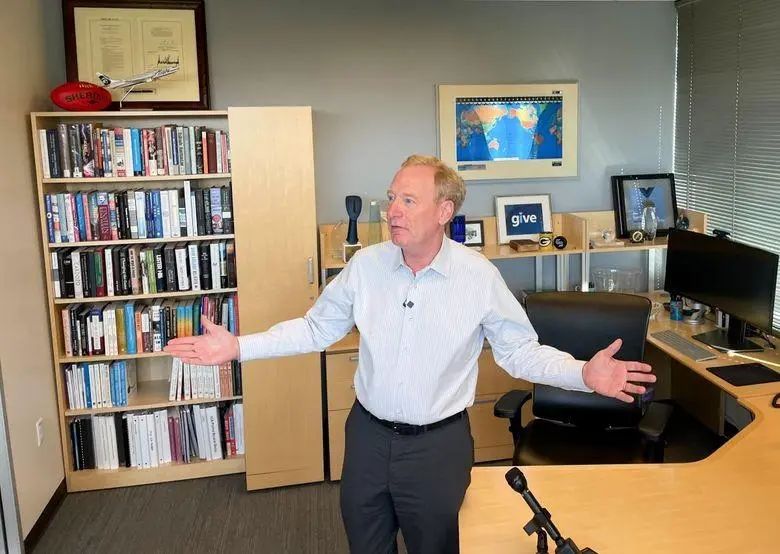
Group 1 - Protesters stormed Microsoft headquarters, occupying President Brad Smith's office to protest the company's collaboration with the Israeli government [1][3] - The protest group, named "Refuse Azure to Aid Apartheid," consists of current and former Microsoft employees opposing the company's technical support to Israel [3][6] - Seven individuals were arrested for illegal entry, resisting arrest, and obstructing law enforcement during the protest [3][6] Group 2 - The protest included the display of banners, one of which renamed the building to "Mai Ubeid Building" in memory of a software engineer killed during Israeli airstrikes in Gaza [3] - Microsoft President Brad Smith confirmed that two of the arrested individuals were Microsoft employees, stating their actions were against company policy [6] - Following the incident, Microsoft announced plans to enhance security measures at its facilities [6]
突发!抗议者占领微软总裁办公室
Huan Qiu Shi Bao· 2025-08-27 05:20
Group 1 - The core issue revolves around protests against Microsoft's collaboration with the Israeli government, specifically regarding its Azure cloud services [1][2] - A protest group named "Refuse Azure's Support for Apartheid" occupied the office of Microsoft's president, Brad Smith, demanding the company sever ties with Israel [1][2] - The protest resulted in the arrest of seven individuals, including two Microsoft employees, for illegal entry and obstruction of law enforcement [1][2] Group 2 - Brad Smith confirmed that the actions of the arrested employees did not align with company standards and indicated that further actions would be taken [2] - During the occupation, protesters allegedly set up makeshift listening devices in the office, raising security concerns [2] - This incident is part of a series of protests, with previous demonstrations occurring at the Microsoft campus, leading to additional arrests [2]
微软AI主管苏莱曼:应警示“AI精神分裂”引发的社会风险
Huan Qiu Wang· 2025-08-26 11:47
Core Insights - Mustafa Suleyman, head of Microsoft's AI division, emphasizes a human-centered approach to AI development, warning of potential ethical crises stemming from societal misconceptions about large language models (LLMs) [1][2] - Microsoft aims to create responsible AI tools, such as Copilot, that enhance human creativity rather than replace it, focusing on technology that serves human dignity and welfare [1] - Suleyman expresses concern over the phenomenon he terms "AI Schizophrenia," where people anthropomorphize AI, leading to a misunderstanding of its nature as a probabilistic tool [1][2] Group 1 - Suleyman highlights the importance of integrating "human warmth" into AI, promoting collaboration and societal trust [1] - The challenge lies in ensuring AI serves humanity without becoming a cold tool [1] - There is a growing trend of individuals attributing consciousness and rights to LLMs, which poses a risk to societal understanding [1] Group 2 - The emotional responses to AI, such as frustration over ChatGPT's refusal to answer or depression from misinformation, indicate a deeper social psychological crisis [2] - This cognitive dissonance may weaken human engagement in real relationships and blur accountability, as decisions may be wrongly attributed to AI rather than users [2] - Suleyman's background includes co-founding DeepMind and leading significant projects at Microsoft, including Copilot and Phi-3 [2]
微软发布免费公测版VM转换工具 VMware虚拟机可无缝迁移至Hyper-V平台
Huan Qiu Wang· 2025-08-26 11:47
Core Points - Microsoft has launched a free public beta version of the "VM Migration Tool" to assist enterprise users in efficiently migrating VMware virtual machines to Hyper-V based Windows Server environments [1][2] - The tool simplifies the migration process and lowers the technical barriers, providing a new solution for virtualization resource integration in hybrid cloud environments [1][2] Summary by Sections Product Features - Hyper-V, as a core component of Windows Server, has been continuously iterated to support features like Linux virtual machines and GPU acceleration [2] - The migration tool automates complex tasks such as disk format conversion and network configuration adaptation, reducing migration time from days to hours [2] - The tool currently supports an English interface and offers detailed migration logs and error diagnosis capabilities [2] Market Strategy - The release of the migration tool aligns with Microsoft's ongoing strategy to strengthen its hybrid cloud offerings [2] - By providing a free migration solution, Microsoft aims to demonstrate the openness of its technology ecosystem and capture a larger share of the virtualization market [2] - The integration of Azure cloud services with local Hyper-V environments is expected to make such tools a critical stepping stone for enterprises moving to the cloud [2]
微软、特斯拉跌约0.5%,热门中概股多数走高,阿里巴巴涨超3%,蔚来涨近6%
Sou Hu Cai Jing· 2025-08-26 06:27
Market Overview - US stock index futures are collectively down, with Dow Jones futures down 0.34%, S&P 500 futures down 0.33%, and Nasdaq 100 futures down 0.43% [1][2] - Last week, following Fed Chair Powell's speech at the Jackson Hole conference, the three major indices collectively rose, with the Dow Jones Industrial Average reaching a historical high [3] Company Performance - Microsoft and Tesla stocks fell approximately 0.5%, while popular Chinese stocks like Alibaba rose over 3% and NIO increased nearly 6% [2] - Pinduoduo reported Q2 adjusted net profit of 32.71 billion yuan, exceeding market expectations, with revenue of 103.98 billion yuan, a 7% increase year-over-year [7] Economic Indicators - The market currently anticipates an 83.3% probability of a 25 basis point rate cut in September, with potential cuts totaling between 50 to 75 basis points within the year [4] - The upcoming release of the July Personal Consumption Expenditures (PCE) price index is being closely monitored as it is a key inflation indicator for the Fed [5] Strategic Moves - Strategy purchased 3,081 bitcoins for $356.9 million, averaging $115,829 per bitcoin, bringing its total holdings to 632,457 bitcoins [6] - BeiGene announced a royalty purchase agreement with Royalty Pharma, agreeing to pay $885 million for rights to a monoclonal antibody's royalties outside of China [8] Technology Developments - Elon Musk announced the open-sourcing of Grok-2 and plans to open-source Grok-3 within approximately six months, highlighting competition from Chinese companies in the AI sector [9]

“耗时2年,我成功「戒掉」了Windows”,一位25年老IT人被微软逼走,彻底转投Linux
3 6 Ke· 2025-08-26 03:04
Core Viewpoint - The article discusses the growing dissatisfaction among users with Microsoft's Windows 11 due to its intrusive features and advertising practices, leading many, including developers and tech enthusiasts, to switch to Linux as their primary operating system [1][4]. Group 1: User Experience and Transition - The author shares a personal journey of transitioning from Windows to Linux after multiple failed attempts, ultimately driven by frustration with Windows 11's forced features and privacy invasions [1][4]. - After two years of using Linux, the author expresses satisfaction with the decision, despite acknowledging some drawbacks inherent to all operating systems [4][6]. Group 2: Industry Trends and User Rights - The article highlights a broader movement against corporate control in the tech industry, citing examples like the StopKillingGames campaign and the European Digital Markets Act aimed at protecting user rights [5]. - The concept of "right to repair" is gaining traction, challenging manufacturers who restrict repair options through intellectual property laws, indicating a shift towards user ownership and control [5]. Group 3: Philosophical Insights on Freedom - The author emphasizes that achieving true freedom requires effort, and the importance of ownership over products to avoid being manipulated by corporate practices [6][7]. - The article warns against the gradual erosion of user rights, comparing it to a "digital feudalism" where users end up with nothing while being told to be content [7]. Group 4: Call to Action - The author encourages users to resist corporate monopolies and support efforts that promote user rights and freedom, suggesting that Linux is becoming a viable alternative to Windows as more companies undermine user trust [8].

Github并入微软AI,是开源精神的终结吗?
Hu Xiu· 2025-08-25 23:02
Core Insights - Github CEO Thomas Dohmke announced his resignation on August 11, and Microsoft stated there would be no successor [1][11] - Following this, Github will be integrated into Microsoft's Core AI department, raising concerns about its independence [2][12] - Since its acquisition by Microsoft in 2018, Github has maintained its independent operations and open-source culture [4][16] Company Changes - Github will no longer operate independently; it will fully merge into the Core AI department established in January [12] - Julia Liuson, head of Microsoft's developer division, will oversee Github's revenue, engineering, and support [13] - Github's Chief Product Officer, Mario Rodriguez, will report to Asha Sharma, Vice President of Microsoft's AI platform [13] Developer Concerns - Developers are questioning whether Github can maintain its independence and open-source ethos under Microsoft's influence [5][20] - Concerns include potential alignment with Microsoft's Azure and AI strategies, and the possibility of monetizing previously free features [20] - There are fears that Microsoft may use uploaded code to train its AI models, impacting the community's trust [20] Historical Context - Github's history is rooted in the open-source movement, starting with the creation of Git by Linus Torvalds in 2005 [24][25] - Github became a popular platform for open-source projects and private repositories, attracting a wide range of developers [38][41] - Microsoft acquired Github for $7.5 billion in 2018, promising to maintain its independence and open nature [43][46] Future Implications - The integration into Microsoft's AI strategy suggests that Github's value may shift from being a code repository to an AI development tool [57] - The departure of the CEO symbolizes the end of an era for Github as a community-driven platform [68] - The future of Github will depend on whether it can continue to respect open-source principles and developer needs [71][72]

微软AI主管:AI应以人为本,设“安全围栏”防模仿人类
Sou Hu Cai Jing· 2025-08-25 14:23
Core Insights - Mustafa Suleyman, a leader in Microsoft's AI division, emphasizes the mission to leverage technology for a better world, focusing on creating safe and beneficial AI [1] - The current goal of Microsoft is to empower humanity through AI, particularly by developing Copilot as a responsible tool to enhance human creativity [1] - Suleyman envisions AI that deeply understands humanity and fosters trust and understanding among people [1] Challenges and Concerns - Suleyman highlights a troubling trend where many perceive large language models (LLMs) as conscious entities, advocating for their "rights" and "welfare," which he describes as "AI schizophrenia" [3] - He calls for the AI industry to proceed with a "human-centered" value system, emphasizing that AI should serve human needs rather than mimic humans [3] - The establishment of "safety fences" is deemed essential to define areas where AI should not operate, ensuring healthy development within a regulatory framework [3] Industry Reactions - External media, such as WindowsReport, echo Suleyman's concerns, noting strong user backlash when OpenAI discontinued the GPT-4o model, with users viewing AI models as companions [5] - OpenAI's CEO, Sam Altman, acknowledges the unprecedented emotional attachment users have to AI, warning of the potential self-destructive risks posed by powerful AI technologies [5]