
MICROSOFT(04338)

Search documents
意大利对微软启动调查
Ge Long Hui A P P· 2026-01-16 11:54
Core Viewpoint - The Italian Competition Authority has initiated two investigations into Microsoft's Activision Blizzard games, specifically "Diablo Immortal" and "Call of Duty," for alleged misleading and coercive sales practices [1] Group 1 - The investigations focus on the sales behavior of the two games, which are accused of being misleading and coercive [1]


微软、OpenAI错失与马斯克官司免于庭审的最后机会
Xin Lang Cai Jing· 2026-01-16 09:30
埃隆・马斯克指控称,山姆・奥特曼创立的人工智能公司 OpenAI 在接受软件巨头微软数十亿美元注 资、计划转型营利性运营后,背弃了其作为公益慈善机构的创始使命。目前,OpenAI 与微软未能就这 一诉讼案达成庭外和解,难逃庭审环节。 美国加利福尼亚州奥克兰市的一名联邦法官于周四驳回了 OpenAI 与微软提出的驳回马斯克诉讼请求的 动议,并下令该案移交陪审团审理,庭审定于今年 4 月下旬举行。马斯克曾于 2015 年协助奥特曼等人 创立 OpenAI,后又在 2023 年创办了自己的人工智能企业。 OpenAI 在一份声明中表示:"马斯克先生的诉讼毫无事实依据,这是他长期滋扰公司的一贯手段。我们 期待在庭审中证明这一点。同时,我们将继续致力于为 OpenAI 基金会提供支持,该基金会已是全球资 源最充足的非营利机构之一。" 美国联邦地区法院法官伊冯娜・冈萨雷斯・罗杰斯在判决书中指出,她拒绝驳回马斯克关于 OpenAI 违 反其作为慈善信托运营承诺的指控。 她在判决书中写道,尽管相关证据尚不明确,但马斯克声称,他对 OpenAI 的出资 "具有明确的慈善目 的,且附加了两项核心条件:一是 OpenAI 需坚持开 ...
Anthropic任命微软资深高管伊琳娜·戈斯为印度总经理
Ge Long Hui· 2026-01-16 06:12
Core Viewpoint - Anthropic has appointed Irina Ghose as the General Manager for India, marking a strategic move to expand its presence in a key market for artificial intelligence [1] Group 1: Company Developments - Irina Ghose, a former Microsoft executive with 24 years of experience at the company, will lead Anthropic's operations in India [1] - The company plans to open its first office in Bangalore in early 2026, supported by Alphabet's Google and Amazon [1] Group 2: Market Context - India is currently the second-largest market for Anthropic's AI chatbot, Claude, with significant usage in programming and technical applications [1] - The country has over one billion internet users, making it a competitive landscape for technology companies as demand for AI continues to grow [1]
微软:总部实地调研要点
2026-01-16 02:56
Summary of Microsoft Corp. (MSFT) Conference Call Company Overview - **Company**: Microsoft Corp. (MSFT) - **Market Cap**: $3.4 trillion - **Enterprise Value**: $3.4 trillion - **Industry**: Americas Software Key Takeaways 1. **AI Compute Cycle Management**: Microsoft is focusing on fungibility to navigate the AI compute cycle, addressing both supply constraints and potential excess supply, while also mitigating customer concentration risk [2][3] 2. **Capacity Planning**: The company emphasizes dynamic capacity planning, allowing for the allocation of compute resources across Azure customers, internal R&D, and first-party applications [2][3] 3. **Gross Margin Advantage**: Microsoft benefits from a partnership with OpenAI, enabling it to leverage models without incurring additional LLM API fees, which enhances its gross margin [2][3] 4. **Enterprise Conversations**: There has been a notable shift in enterprise discussions towards greater support for Copilot adoption compared to the previous year [2][3] 5. **EPS Growth Projection**: Microsoft is projected to achieve approximately $35 in EPS by FY30, indicating over 20% EPS growth [2][3] Financial Projections - **Revenue Growth**: Expected revenue growth from $281.7 billion in FY25 to $464.4 billion in FY28, reflecting a compound annual growth rate (CAGR) of approximately 20% [4][10] - **EBITDA Growth**: Projected EBITDA growth from $156.5 billion in FY25 to $279.4 billion in FY28 [4][10] - **EPS Growth**: EPS is expected to grow from $13.71 in FY25 to $23.35 in FY28 [4][10] - **Gross Margin**: Anticipated decline in gross margin from 68.8% in FY25 to 64.0% in FY28 [10] AI and Cloud Strategy 1. **AI Margins Improvement**: Microsoft expects AI margins to improve over time, with parallels drawn between the AI cycle and the early cloud cycle, initially characterized by high costs but improving with scale and efficiency [3][17] 2. **Role of LLMs**: Microsoft sees LLMs as the next abstraction layer, simplifying application logic and improving long-term unit economics [22][24] 3. **Azure Build-Out Strategy**: The company approaches Azure build-out through a supply-demand lens, with a focus on monetization profiles across workloads [25][30] 4. **Fungibility in Infrastructure**: Microsoft's infrastructure strategy is centered on maintaining fungibility across demand planning and data center design, allowing for flexibility in response to evolving demand signals [36][30] Copilot and Enterprise AI Adoption 1. **Shift in Customer Conversations**: Discussions around Copilot have evolved from "if" to "when" regarding adoption, indicating increased confidence among customers [38][39] 2. **Pricing Strategy**: Microsoft employs a value-based pricing approach for Copilot, with a lower-priced business SKU introduced to broaden adoption [40][39] 3. **Enterprise AI Adoption Trends**: There is a growing number of customers using AI, with deployments expanding significantly as familiarity with Copilot increases [38][39] Risks and Valuation - **Valuation**: The current price target is set at $655, based on a 32x P/E multiple of adjusted net income [43] - **Key Risks**: Potential risks include lower-than-expected revenue from the OpenAI partnership, longer ramp-up times for internal silicon, and shifts towards custom software impacting the applications business [43][44] Conclusion Microsoft is well-positioned to capitalize on the evolving AI landscape, with a strong focus on capacity planning, gross margin enhancement through strategic partnerships, and a growing enterprise AI adoption trend. The company's financial projections indicate robust growth, although it faces certain risks that could impact its performance.
数据中心背后民怨沸腾,微软给马斯克上了一课
3 6 Ke· 2026-01-16 01:45
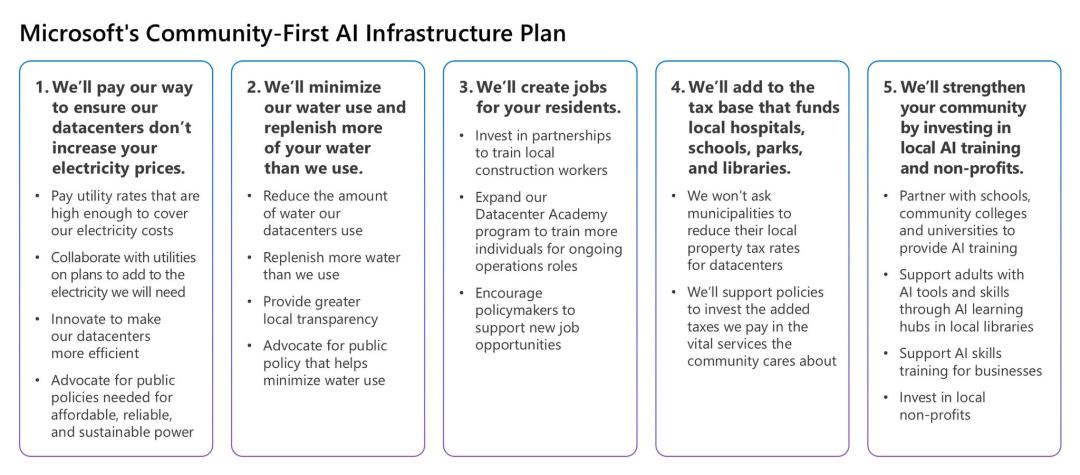
Core Viewpoint - Microsoft has introduced a "Community-First AI Infrastructure" plan, committing to responsible data center development that prioritizes community benefits over costs, aiming for a win-win between technological innovation and local employment [1][3][23]. Group 1: Microsoft's Commitments - Microsoft will not seek electricity subsidies or tax breaks, ensuring that local residents do not bear the costs of increased electricity prices due to data centers [2][23]. - The company promises to minimize water usage and replenish more water than it consumes, investing in local water systems [2][23]. - Microsoft aims to create job opportunities for local residents and enhance the tax base to support local services like hospitals and schools [2][23]. Group 2: Industry Context - The competition among major tech companies for data center investments is unprecedented, with projected capital expenditures reaching $400 billion by 2025, primarily for AI infrastructure [4][5]. - Data centers are expected to consume approximately 250 terawatt-hours (TWh) of electricity by 2026, increasing to 400-426 TWh by 2030, which will account for 6.7-12% of the total electricity consumption in the U.S. [5][7]. - The rapid growth in data center electricity consumption poses significant challenges to the U.S. energy system, with a projected total electricity consumption of 183 TWh by 2024 [4][5]. Group 3: Community Concerns - Local communities are increasingly concerned about the rising electricity prices and water resource depletion caused by data centers, with reports indicating a 267% increase in wholesale electricity prices in data center-heavy regions over five years [7][9]. - The disparity in resource consumption is stark, as communities near data centers face resource shortages while tech companies consume vast amounts of electricity and water [11][12]. - Employment opportunities created by data centers are often limited, with a typical facility requiring only 50 to 100 full-time employees after construction [8][12]. Group 4: Broader Implications - The current situation highlights the need for a new social contract between tech companies and communities, where the costs of resource consumption are shared more equitably [24][25]. - Microsoft’s commitments could serve as a model for other tech giants, emphasizing the importance of corporate responsibility in resource management and community engagement [23][25]. - The ongoing resistance from communities against data center projects indicates a growing demand for transparency and accountability from tech companies regarding their environmental and social impacts [22][25].




微软谷歌正在大力招「电工」
3 6 Ke· 2026-01-16 00:31
Core Insights - The tech giants are increasingly focusing on hiring talent in the energy sector to address power supply issues critical for AI development [1][3][11] Group 1: Hiring Trends - Since 2022, major tech companies have significantly increased their hiring in the energy sector, with a 34% year-on-year growth expected in 2024 [4] - Amazon leads with 605 new hires in energy roles, followed by Microsoft with over 570 and Google with around 340 [4] - Other companies like Apple and Nvidia have also added nearly 200 positions related to energy [4] Group 2: Talent Acquisition - Notable hires include Betsy Beck from Google, who has over 15 years of experience in the energy field [6] - Google recently recruited Eric Schubert, a former BP advisor, and Tyler Norris, recognized as a top climate figure, to strengthen its energy strategy [8][10] Group 3: Energy Supply Challenges - Microsoft CEO Satya Nadella emphasized that the lack of electricity is a more critical issue than the shortage of GPUs for AI development [11] - Elon Musk highlighted that energy supply bottlenecks are becoming the main constraint for AI, surpassing chip shortages [11] Group 4: Long-term Investments - Tech companies are making long-term investments in nuclear energy, with Meta partnering with various nuclear firms to support operations and capacity [13] - Companies like Helion and CFS are attracting investments from major tech players for fusion energy projects [17][18] Group 5: Energy Efficiency - Improving energy efficiency in data centers is another avenue being explored, which ties back to the need for skilled talent in the energy sector [19][20]

数据中心背后民怨沸腾,微软给马斯克上了一课|硅谷观察
Xin Lang Cai Jing· 2026-01-16 00:04
Core Viewpoint - Microsoft has introduced a "Community-First AI Infrastructure" plan, committing to responsible data center construction that prioritizes local community benefits over corporate subsidies and tax breaks [3][5][26]. Group 1: Microsoft's Commitments - Microsoft will not raise local electricity prices and will cover additional electricity costs incurred by data centers, rejecting local electricity subsidies [5][26]. - The company aims to reduce water usage through efficient cooling technologies and will invest in local water systems, ensuring that more water is returned to the community than consumed [5][26]. - Microsoft plans to create job opportunities for local residents and will enhance tax bases for local hospitals, schools, parks, and libraries, refusing any tax incentives [5][26]. Group 2: Industry Context - The competition among major tech companies for data center construction is unprecedented, with projected capital expenditures reaching $400 billion by 2025, primarily for AI infrastructure [7][8]. - Data centers are expected to consume approximately 183 terawatt-hours of electricity in 2024, accounting for 4.4% of the total U.S. electricity consumption, with projections indicating this could rise to 6.7-12% by 2030 [8][10]. - The rapid increase in electricity demand from data centers has not been matched by a significant rise in power generation, leading to potential electricity crises for residents [10][11]. Group 3: Community Concerns - Communities are facing significant challenges due to the resource demands of data centers, including rising electricity prices and water shortages, with wholesale electricity prices in data center-heavy areas increasing by up to 267% over five years [10][12]. - Employment opportunities created by data centers are often limited, with a typical large data center requiring only 50 to 100 full-time employees after construction [11][12]. - In Arizona, the contrast between resource-intensive data centers and nearby communities lacking basic utilities highlights the inequities created by tech investments [12][14]. Group 4: Broader Implications - The current model of tech companies benefiting disproportionately from AI advancements while local communities bear the costs is unsustainable and unjust [26][27]. - Microsoft's commitments could serve as a framework for the industry, emphasizing the need for tech companies to pay for resource consumption, create local jobs, and take environmental responsibility [27][28]. - The ongoing public demand for accountability from tech giants indicates a shift towards renegotiating the social contract between technology companies and the communities they impact [27][28].

摩根大通一线调研:微软领先所有人至少10光年,生态整合能力非常强大!
Hua Er Jie Jian Wen· 2026-01-15 16:22
Group 1 - Microsoft has established a significant advantage in cloud ecosystem integration, described by respondents as "leading all others by at least 10 light years" [1][2] - The comprehensive and collaborative product system of Microsoft is becoming the preferred platform for enterprises to scale AI and digital transformation [1][2] - Key trends in the software market over the next 12-18 months include a shift in AI project budgets from pilot scales of $250,000-$500,000 to production-level investments of $2.5 million-$5 million [1][2] Group 2 - IT spending decision-making has shifted from Chief Information Officers (CIOs) to Chief Financial Officers (CFOs), with a greater focus on measurable returns and investment cycles [1][4] - Data infrastructure companies like Databricks, Snowflake, and Datadog are benefiting from this transformation process [1][2] - The report highlights structural challenges in the industry, including scrutiny of reasoning costs and the need for repeatable, standardized use cases for AI project scaling [3][4] Group 3 - IT budgets are expected to stabilize without explosive growth by 2026, with a healthy pipeline noted [4] - Clients are increasingly focused on shorter cycles, ROI, and cash returns, marking a shift in IT spending review from CIOs to CFOs [4] - Investment in data infrastructure remains active, with clients recognizing the importance of data modernization and responding to existing gaps [4]
贝莱德与微软合作筹资125亿美元投资数据中心
Ge Long Hui A P P· 2026-01-15 16:09
格隆汇1月15日|贝莱德表示,作为与微软合作的一部分,已成功筹集125亿美元,以用于投资数据中心 及能源基础设施。是次集资令贝莱德更接近其于2024年宣布该项合作时所定下的300亿美元集资目标。 贝莱德行政总裁芬克于周四在公司公布第四季度业绩后与分析师的电话会议上表示,有关人工智能合作 项目持续吸引大量资金。 ...

维基百科运营方与微软、元宇宙平台公司达成人工智能内容训练合作协议
Xin Lang Cai Jing· 2026-01-15 10:35
Core Insights - Wikipedia has announced partnerships with major tech companies including Microsoft, Meta, and Amazon, marking a significant step in monetizing its content reliance by these firms [1][4] - The Wikimedia Foundation has signed agreements with several companies, including AI startups Perplexity and Mistral AI, in addition to existing partnerships [1][4] Industry Context - Wikipedia's content is crucial for training AI models, encompassing over 65 million entries in more than 300 languages, serving as a primary data source for tech giants developing generative AI chatbots and smart assistants [2][5] - The increasing demand for Wikipedia's free content for AI training has led to rising server demands and costs for the non-profit organization, which primarily relies on small public donations for funding [2][5] Business Model Evolution - The Wikimedia Foundation is promoting its enterprise service, which allows tech companies to pay for content training access and offers customized data services based on large-scale training needs [2][5] - Ryan Becker, president of Wikimedia Enterprise, emphasized the necessity for tech companies to financially support Wikipedia, recognizing the importance of transitioning from free access to commercial partnerships [6] Leadership Changes - The Wikimedia Foundation has appointed Bernadette Meehan, former U.S. ambassador to Chile, as the new CEO, effective January 20 [3][6]