MICROSOFT(04338)

Search documents
加码英伟达 AI 芯片,微软再签两笔合计超百亿美元云算力订单
Sou Hu Cai Jing· 2025-11-04 01:33
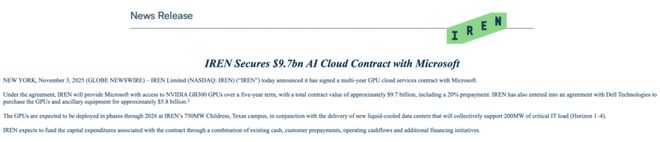
Core Insights - Microsoft has signed multi-year agreements with AI cloud service providers IREN and Lambda for NVIDIA AI chip computing power, with a total transaction value exceeding $10 billion [1] Group 1: Microsoft and IREN Agreement - IREN will provide Microsoft with a five-year usage right for NVIDIA GB300 GPUs, with a total contract value of approximately $9.7 billion, of which 20% is prepaid [1] - IREN has also entered into an agreement with Dell to purchase GPUs and related equipment for about $5.8 billion [1] - IREN plans to deploy 750MW capacity of GPUs at its Childress facility in Texas by 2026, along with a 200MW liquid-cooled data center for critical IT loads [1] Group 2: Microsoft and Lambda Agreement - Lambda will deploy AI infrastructure for Microsoft supported by thousands of NVIDIA GPUs, including NVIDIA GB300 NVL72 rack-level systems [1]



微软的“电力焦虑”:一场97亿美元的算力豪赌
Tai Mei Ti A P P· 2025-11-04 01:01
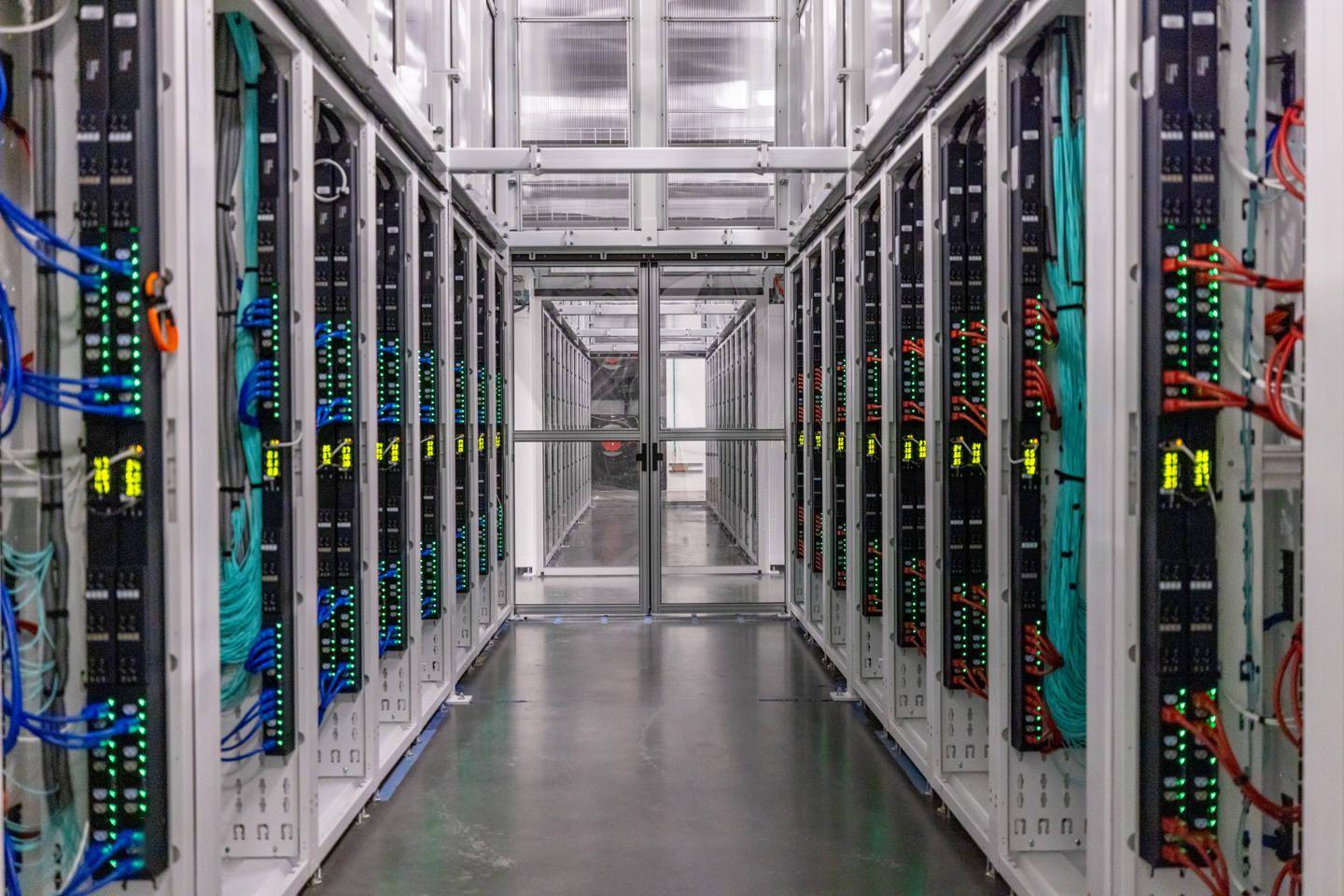
Core Insights - Microsoft has made a significant investment by signing a five-year contract worth $9.7 billion with Iris Energy (IREN) for GPU computing power, leading to a substantial increase in IREN's stock price [1][11] - The deal highlights Microsoft's strategy to address its infrastructure bottlenecks in AI, particularly in power supply and data center capabilities, rather than just focusing on GPU acquisition [2][4] - IREN is transitioning from a Bitcoin mining company to an AI cloud service provider, leveraging its existing infrastructure and clean energy resources [10][15] Investment Rationale - The partnership allows Microsoft to bypass lengthy approval processes and directly utilize IREN's existing facilities and clean energy, which is crucial for scaling AI operations [2][12] - Microsoft’s investment is seen as a response to real demand for computing power, contrasting with other tech companies that are criticized for their unclear spending strategies [6][9] - The collaboration is expected to enhance Microsoft's valuation stability as it focuses on tangible growth rather than speculative investments [9][15] Industry Trends - The energy supply is becoming a critical factor in the tech industry, with major companies like Microsoft, Google, and Amazon racing to secure renewable energy sources [11][14] - The shift towards nuclear energy is emerging as a potential solution to meet the growing power demands of data centers, with Microsoft exploring partnerships to develop nuclear power capabilities [12][14] - The trend indicates a transition from traditional cloud computing models to a more decentralized approach, where tech giants rely on independent operators for energy and computing resources [15][16] Company Positioning - Microsoft is positioning itself as a leader in the AI infrastructure space, moving from a software-centric model to one that integrates energy resources, thereby enhancing its competitive edge [15][16] - The investment in IREN signifies a strategic pivot towards building a self-sufficient energy and computing ecosystem, which could redefine the operational landscape for tech companies [15][16]
微软CEO称公司或重启招聘,员工需掌握AI协作技能
Mei Ri Jing Ji Xin Wen· 2025-11-04 00:46
Core Insights - Microsoft CEO Satya Nadella indicated that the company may restart hiring within the next year, contingent upon existing employees acquiring skills to collaborate with AI [1] - Employees will need to learn how to issue precise commands to AI, review and optimize AI outputs, and focus more on strategic decision-making, creative thinking, and solving complex problems [1] - Microsoft has heavily invested in AI over the past year and has conducted multiple rounds of layoffs, the most recent being in July, where approximately 9,000 employees were let go [1] - The current workforce of Microsoft stands at 219,000 employees [1]
科技巨头AI交易火热:微软加码投资阿联酋,亚马逊与OpenAI签下大单
Di Yi Cai Jing· 2025-11-04 00:46
Group 1 - Amazon has signed a $38 billion computing power supply agreement with OpenAI, highlighting the increasing collaboration between tech giants in the AI sector [1] - Microsoft plans to increase its investment in the UAE, aiming to raise its total investment in the region to $15.2 billion by 2030 [1] - Nvidia's market capitalization has surpassed $500 billion, making it the largest gainer in market value ahead of its earnings disclosure [1] Group 2 - Five out of the seven major tech companies reported earnings last week, drawing attention to capital expenditures related to AI and data center investments [1] - The recent announcements of significant deals indicate a growing trend of investment in AI technologies among leading tech firms [1]
科技巨头AI交易火热:微软落子阿联酋 亚马逊与OpenAI签下大单
Di Yi Cai Jing· 2025-11-04 00:33
Core Insights - Five of the seven major tech companies reported earnings last week, with significant attention on capital expenditures related to AI and data centers, leading to Nvidia's market value surpassing $500 billion [1] - Amazon announced a $38 billion computing power supply partnership with OpenAI, while Microsoft increased investments in the Middle East and signed a contract with cloud service provider IREN [1] Group 1: Microsoft Investments - Microsoft plans to increase its total investment in the UAE to $15.2 billion by 2030, including a $1.5 billion equity investment in AI company G42 and over $5.5 billion in capital expenditures for AI and cloud infrastructure [2] - Microsoft signed a $9.7 billion agreement with IREN to access new computing resources, utilizing Nvidia's GB300 chips to enhance data processing capabilities [2] - The company aims to double its data center capacity in the next two years to meet surging demand for cloud and computing services, with Q1 capital expenditures reaching a record nearly $35 billion, a 74% year-over-year increase [3] Group 2: IREN and Dell Technologies - IREN has reached a separate agreement with Dell Technologies to purchase new GPUs and related equipment for $5.8 billion, with phased deployment expected next year [3] - The rapid expansion of data centers is crucial for the AI boom, with major tech companies investing hundreds of billions to accommodate the needs of AI model training and operation [3] Group 3: Amazon and OpenAI Partnership - OpenAI signed a seven-year, $38 billion cloud service procurement agreement with Amazon, securing hundreds of thousands of Nvidia GPUs for AI model training and operation [5] - This partnership is a significant endorsement for Amazon Web Services (AWS), alleviating investor concerns about AWS lagging behind competitors like Microsoft and Google [5] - OpenAI's CEO stated the company is committed to investing $1.4 trillion to develop 30 GW of computing resources, which could power approximately 25 million U.S. households [5][6] Group 4: OpenAI's Future Plans - OpenAI aims to add 1 GW of computing power weekly, with each GW requiring over $40 billion in capital investment [6] - The company recently underwent a major restructuring to pave the way for an initial public offering (IPO), with a potential valuation of up to $1 trillion [6]

科技巨头AI交易火热:微软落子阿联酋,亚马逊与OpenAI签下大单
Di Yi Cai Jing· 2025-11-04 00:14
Core Insights - Five of the seven major tech companies reported earnings, with significant attention on capital expenditures related to AI and data centers, leading to Nvidia's market value surpassing $5 trillion [2] - Amazon announced a $38 billion cloud service agreement with OpenAI, while Microsoft is increasing its investment in the UAE and signing a $9.7 billion deal with IREN for computing resources [2][5] Group 1: Microsoft Investments - Microsoft plans to increase its total investment in the UAE to $15.2 billion by 2030, including a $1.5 billion equity investment in AI firm G42 and over $5.5 billion in capital expenditures for AI and cloud infrastructure [2] - The company signed a five-year agreement worth $9.7 billion with IREN to utilize Nvidia's GB300 chips, enhancing its data processing capabilities for AI services [2] - Microsoft aims to double its data center capacity in the next two years, with first-quarter capital expenditures reaching a record nearly $35 billion, a 74% year-over-year increase [4] Group 2: Amazon and OpenAI Collaboration - OpenAI signed a seven-year, $38 billion cloud service procurement agreement with Amazon, securing hundreds of thousands of Nvidia GPUs for AI model training and operation [5] - This partnership is seen as a significant endorsement of Amazon Web Services (AWS), alleviating investor concerns about AWS lagging behind competitors like Microsoft and Google [5] - OpenAI's CEO stated that the company is committed to investing $1.4 trillion to develop 30 GW of computing resources, which could power approximately 25 million U.S. households [5][6]
ADNOC与微软报告:AI对能源转型至关重要
Shang Wu Bu Wang Zhan· 2025-11-03 17:03
阿通社10月30日消息,阿布扎比国家石油公司(ADNOC)和微软联合发布的报告显示,88%的受访领导 者认为扩大AI应用对实现能源转型至关重要。近九成公司自2024年以来增加了对AI的投资,73%已在多 个业务部门部署AI。AI正被用于预测性维护、智能电网管理等能源领域。 (原标题:ADNOC与微软报告:AI对能源转型至关重要) ...
超千亿元!微软投资阿联酋!
Zheng Quan Shi Bao· 2025-11-03 15:26
Core Viewpoint - Microsoft plans to invest over $15.2 billion in the UAE from 2023 to 2029 to support the country's AI and cloud infrastructure development, highlighting global confidence in the UAE's economic vision for a diversified, knowledge-based economy [2][3]. Investment Details - The investment will be allocated to expanding AI and digital infrastructure, along with training and R&D programs to enhance local talent skills [3]. - Microsoft has already completed $7.3 billion of this investment by the end of 2023, with over $7.9 billion planned from 2026 to 2029, including more than $5.5 billion in capital expenditures for AI and cloud infrastructure [3]. Export Licenses and Collaborations - Microsoft has received export licenses to send advanced NVIDIA chips, including A100, H100, and H200 GPUs, to the UAE to support Azure's AI services [4]. - The company has established a global engineering development center and the Microsoft AI for Good lab in Abu Dhabi to promote responsible AI research and innovation [4]. Financial Performance - For the first fiscal quarter of 2026, Microsoft reported revenues of $77.673 billion, an 18% year-over-year increase, and a net profit of $27.747 billion, a 12% increase [5]. - The decline in net profit growth was attributed to a $3.086 billion impact from investments in OpenAI, affecting earnings per share by $0.41 [5]. Capital Expenditure Trends - Microsoft's capital expenditures surged to $34.9 billion in the first fiscal quarter, an increase of over $10 billion from the previous quarter, with expectations for higher growth rates in fiscal year 2026 compared to fiscal year 2025 [6]. - The company is expanding its AI capabilities significantly, planning to increase overall AI computing power by over 80% within the year and double the size of its data centers in the next two years [7].
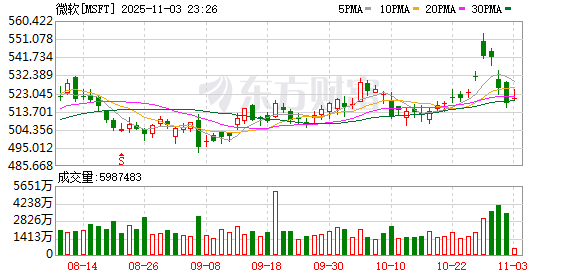
美股异动丨英伟达盘初涨超3% 据报微软获准向阿联酋出口最新款英伟达芯片
Ge Long Hui· 2025-11-03 15:08
Core Viewpoint - Nvidia's stock rose over 3% following the news that the U.S. has approved Microsoft's export of the latest Nvidia chips to the UAE, marking a significant development in the AI sector in the Middle East [1] Group 1: Company Developments - Microsoft has become the first company approved by the Trump administration to export Nvidia AI chips to the UAE, overcoming previous export restrictions imposed by the U.S. Department of Commerce [1] - Microsoft plans to increase its investment in the UAE from $7.3 billion over the past three years to $7.9 billion from 2026 to 2029, with $5.5 billion allocated for AI and cloud infrastructure capital expenditures [1] Group 2: Industry Context - The Middle East is emerging as a critical battleground in the global AI sector, with significant investments and developments taking place [1] - The approval for Microsoft to export high-performance Nvidia chips is seen as a pivotal moment for AI infrastructure development in the region [1]
微软豪掷79亿美元投资阿联酋AI企业G42,加速中东AI设施建设
Sou Hu Cai Jing· 2025-11-03 14:56
Core Insights - Microsoft has announced an expanded partnership with UAE-based AI company G42, planning to invest over $7.9 billion from early 2026 to the end of 2029 for AI cloud service infrastructure [1] - G42, established in 2018, has previously collaborated with Microsoft, including a $1.5 billion investment in 2024 to provide AI solutions in the Middle East, Central Asia, and Africa [1] - The current investment will allocate $5.5 billion for building AI and cloud service infrastructure and $2.4 billion for operational expenses and distribution costs [1] Investment Details - The total investment from Microsoft to G42 will exceed $7.9 billion, equivalent to approximately 562.83 billion RMB [1] - Of this investment, $5.5 billion (approximately 391.85 billion RMB) is designated for AI and cloud service infrastructure development [1] - The remaining $2.4 billion (approximately 170.99 billion RMB) will cover operational costs and distribution expenses [1] Technology and Capabilities - G42 is one of the few UAE companies that can obtain export licenses from the U.S. Department of Commerce, allowing Microsoft to introduce significant computing power to the UAE [2] - Microsoft has already brought in the equivalent of 21,500 NVIDIA A100 GPUs and received additional licenses for 60,400 A100 chip equivalents, enabling the delivery of advanced chips like GB300 [2] - The partnership aims to leverage this computing power to provide AI models from companies like OpenAI and Anthropic to local governments, startups, and users [2]