NIO(09866)

Search documents
蔚来换电迈过亿次里程碑 技术验证收官 迎规模化拐点
Zhong Guo Zheng Quan Bao· 2026-02-12 22:15
Core Insights - NIO has achieved a significant milestone by completing its 100 millionth battery swap service, marking a pivotal moment in the large-scale adoption of battery swapping in China [1][2] - The success of NIO's battery swapping model demonstrates its commercial viability and user value, reflecting the rapid development of charging and swapping infrastructure in the country [1][4] Group 1: Battery Swapping Achievements - As of the completion of the 100 million swaps, NIO has established 3,729 battery swap stations nationwide, including 1,020 on highways, creating a comprehensive network connecting over 550 cities [2] - NIO's daily battery swap volume has surpassed 100,000, with an average swap time of 0.8 seconds per vehicle, indicating a shift in user preference towards battery swapping as a primary energy replenishment method [2] - The completion of 100 million swaps has saved users approximately 83.41 million hours of charging time and reduced vehicle costs by over 26.3 billion yuan compared to traditional refueling [2][3] Group 2: Technological and Environmental Impact - Each battery swap includes a safety check of the vehicle's battery system, effectively addressing user concerns about battery degradation and safety [3] - The battery swapping model has contributed to a reduction of 1.7684 million tons of carbon dioxide emissions compared to equivalent gasoline vehicles, highlighting its environmental benefits [3] Group 3: Industry Transformation and Policy Support - The completion of 100 million swaps reflects the accelerated development of charging and swapping infrastructure, showcasing the deep integration of the new energy vehicle industry with the energy sector [4][5] - The Chinese government has established a dual charging and swapping infrastructure development direction, encouraging automakers to participate in building these networks, which has led to significant changes in the industry landscape [4][5] - The construction of charging and swapping infrastructure is becoming a core competitive advantage for automakers, transitioning them from vehicle manufacturers to mobility and energy service providers [6] Group 4: Future Prospects - NIO plans to continue expanding its battery swap network, with a goal of adding 1,000 new swap stations by the end of 2026, bringing the total to 4,600 [2] - The ongoing development of battery swapping technology and infrastructure is expected to support the high-quality growth of China's new energy vehicle industry and contribute to the country's energy transition goals [6]

蔚来换电迈过亿次里程碑技术验证收官 迎规模化拐点
Zhong Guo Zheng Quan Bao· 2026-02-12 20:27
Core Insights - NIO achieved its 100 millionth battery swap service on February 6, 2026, marking a significant milestone in the domestic battery swap model's transition from technical validation to large-scale adoption [1][2] - The completion of 100 million battery swaps demonstrates the commercial viability and user value of the battery swap model, reflecting the rapid development of charging and swapping infrastructure in China [1][3] Industry Developments - NIO has established 3,729 battery swap stations nationwide, including 1,020 along highways, creating a comprehensive network that connects over 550 cities [2][4] - The average daily battery swap volume has exceeded 100,000, with each swap taking approximately 0.8 seconds, indicating a shift in user preference towards battery swapping as a primary option for energy replenishment [2][3] User and Societal Benefits - The 100 million battery swaps have saved users approximately 83.41 million hours of charging time and reduced vehicle costs by over 26.3 billion yuan [3][4] - Each battery swap includes a safety check of the vehicle's battery system, effectively addressing user concerns about battery degradation and safety [3][5] - The battery swap model has contributed to a reduction of 1.7684 million tons of carbon dioxide emissions compared to equivalent gasoline vehicles, highlighting its environmental benefits [3][5] Technological and Infrastructure Investment - NIO has invested over 18 billion yuan in charging and swapping infrastructure, holding more than 2,100 related patents, which supports the continuous evolution of battery swap stations [3][6] - The company plans to add 1,000 new battery swap stations by the end of 2026, bringing the total to 4,600, and will initiate large-scale construction of its fifth-generation battery swap stations [2][6] Policy and Market Trends - The Chinese government has established a dual charging and swapping system as a development direction for energy replenishment, encouraging automakers to participate in infrastructure development [4][5] - The shift from relying on third-party operators for charging infrastructure to automakers building their own networks reflects the growing importance of charging and swapping networks as a core competitive advantage [4][6] Industry Transformation - The completion of 100 million battery swaps signifies a broader trend in the Chinese automotive industry, transitioning from merely manufacturing vehicles to building comprehensive energy networks [6] - The integration of battery swap networks with virtual power plants enhances energy efficiency and supports the transition towards a more sustainable energy system [5][6]
任泽平带你看前沿科技:2026研学计划
泽平宏观· 2026-02-12 16:06
Core Viewpoint - The article emphasizes the importance of practical learning experiences in cutting-edge technology sectors, highlighting the value of direct engagement with leading companies and experts to enhance investment insights and opportunities [12][24]. Schedule Overview - The schedule for 2025 includes visits to major technology companies such as Huawei, BYD, Tencent, and others, focusing on sectors like artificial intelligence, new energy, and biotechnology [23][24]. - Specific events are planned, including closed-door investment research meetings and thematic explorations in various cities, showcasing advancements in robotics, autonomous driving, and digital ecosystems [8][9][10]. Learning Experience - Participants will engage in deep explorations of technology companies, gaining insights into the full chain of technology development from laboratory to industrialization [12]. - The program includes face-to-face dialogues with founders and executives, providing critical insights into strategic decisions and industry disruptions [12]. Participant Feedback - Feedback from participants highlights the transformative impact of the program on their understanding of macroeconomic trends and investment strategies, emphasizing the importance of continuous learning and adaptation in a rapidly changing environment [46][47][48].






乘联分会:1月全国乘用车市场零售154.4万辆 新能源车渗透率为38.6%
智通财经网· 2026-02-12 06:41
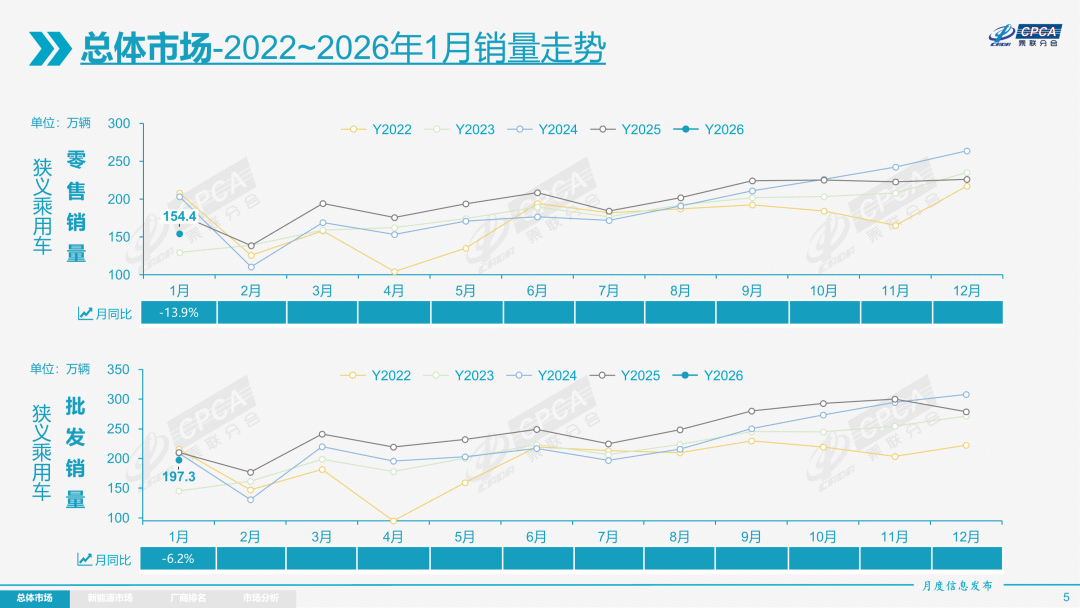
Core Insights - The overall retail sales of passenger cars in January decreased by 13.9% year-on-year, with a total of 1.544 million units sold. The retail sales of new energy vehicles (NEVs) reached 596,000 units, representing a penetration rate of 38.6%, down 3 percentage points from the previous year [1][11]. Retail Market Overview - In January, the retail sales of self-owned fuel passenger cars were 250,000 units, up 17% year-on-year, while self-owned NEVs sold 226,000 units, marking a significant increase of 115%. NEVs accounted for 47.5% of self-owned exports, indicating growing international influence [2]. - The retail sales of self-owned brands totaled 890,000 units, down 18% year-on-year, with a domestic market share of 57.5%, a decrease of 3.5 percentage points [2]. - Mainstream joint venture brands sold 470,000 units, down 4% year-on-year, with German brands increasing their market share to 19.8%, up 1.4 percentage points [2]. Production and Wholesale Analysis - In January, the production of passenger cars was 2.003 million units, down 4.4% year-on-year. The wholesale volume was 1.973 million units, a decrease of 6.2% year-on-year [4]. - The wholesale of self-owned brands was 1.326 million units, down 8%, while luxury car wholesale increased by 4% to 228,000 units [4]. - The overall wholesale landscape is changing, with some mid-tier companies showing strong performance, such as SAIC-GM-Wuling and NIO [4]. New Energy Vehicle Insights - The production of NEVs reached 938,000 units, a slight decrease of 0.6% year-on-year, while wholesale sales were 864,000 units, down 3.3% [5][6]. - NEV retail sales were 596,000 units, down 20% year-on-year, with conventional fuel vehicles selling 948,000 units, down 10% [7]. - NEV exports reached 286,000 units, a remarkable increase of 103.6%, accounting for 49.6% of total passenger car exports [11][12]. Market Trends and Future Outlook - The new energy vehicle market is expected to face challenges in February due to the impact of the Spring Festival, which may lead to lower sales volumes [16]. - The transition from merely selling cars to exporting entire industrial chains is anticipated, indicating a shift towards quality growth in the automotive export sector [17].



【月度分析】2026年1月份全国乘用车市场分析
乘联分会· 2026-02-12 06:06
Overall Market - In January 2026, the retail sales of passenger cars reached 1.544 million units, a year-on-year decrease of 13.9% [14] - The decline in retail sales is attributed to complex market factors and a historical pattern of fluctuating sales in January [14] - The end of the new energy vehicle purchase tax exemption in December 2025 has led to a recovery period for the new energy vehicle market, with some consumers having made purchases in December to take advantage of the policy [14] - January 2026 saw a significant increase in exports, with passenger car exports reaching 576,000 units, a year-on-year increase of 52.0% [16] - The production of passenger cars in January 2026 was 2.003 million units, a year-on-year decrease of 4.4% [16] - The wholesale volume for January 2026 was 1.973 million units, a year-on-year decrease of 6.2% [17] New Energy Market - In January 2026, retail sales of new energy vehicles (NEVs) totaled 596,000 units, down 20.0% year-on-year [18] - The penetration rate of NEVs in the domestic market was 38.6%, while the export penetration rate was 49.6% [15] - The production of NEVs reached 938,000 units, a slight decrease of 0.6% year-on-year [18] - The wholesale volume of NEVs was 864,000 units, down 3.3% year-on-year [18] - The export of NEVs reached 286,000 units, a significant increase of 103.6% year-on-year, accounting for 49.6% of total passenger car exports [22] Company Performance - BYD, Geely, and Chery are leading in the new energy vehicle market, with BYD's sales reaching 205,518 units in January 2026 [24] - The market share of domestic brands in the new energy sector is increasing, with a notable rise in the export of new energy vehicles to Europe and Southeast Asia [15][22] - The new energy vehicle market is characterized by a shift towards higher quality products, with an increase in the proportion of high-end NEVs [15] Market Outlook - February 2026 is expected to see lower sales due to the shorter working days caused by the extended Spring Festival holiday [27] - The market is anticipated to stabilize post-holiday, with potential recovery in the entry-level electric vehicle segment [28] - The overall sentiment in the consumer market remains cautious, influenced by high costs and economic factors [28]



小米车主遭特斯拉车主恶意别车、持续辱骂,「母亲吓得脸色发白」,小米发声;曝字节拟年产10万颗自研AI芯片;曝魅族手机业务即将解散
雷峰网· 2026-02-12 00:35
Group 1 - Xiaomi's legal department supports a car owner's rights after a road rage incident involving a Tesla driver, emphasizing the importance of protecting brand reputation and user rights [5][6][7] - ByteDance plans to produce 100,000 self-developed AI chips this year, with ambitions to increase production to 350,000, and is negotiating with Samsung for manufacturing [10][11] - Meizu's mobile phone business is reportedly facing dissolution, with indications of project halts and employee layoffs, although no large-scale layoffs have been confirmed yet [12][13] - Alibaba is increasing investments in Taobao's flash sales, with a focus on instant retail and a commitment to not worry about losses for the next three years [13][14] - TSMC reported a net profit of approximately 378.2 billion yuan for 2025, with plans for a capital budget of about 44.9 billion USD to expand production capacity [15][16] - Domestic AI models are rapidly evolving, with new releases from DeepSeek and Zhiyuan, indicating a competitive landscape in AI development [18][19] Group 2 - xAI, founded by Elon Musk, is experiencing significant personnel changes, with two co-founders leaving within 48 hours, raising concerns about the company's stability [40][41][42] - Amazon has received approval to deploy 4,500 satellites as part of its plan to compete with SpaceX, aiming to provide satellite internet services [42][43][44] - New regulations in the U.S. require that electric vehicle charging stations funded by federal money be 100% manufactured in the U.S., which may hinder the development of the charging network [45][46] - OpenAI is collaborating with Samsung and SK Hynix to establish data centers in South Korea, reflecting the growing demand for AI infrastructure [47] - BYD has surpassed Ford in global sales, achieving 4.6 million units sold, marking a significant milestone in the automotive industry [48]



蔚来2026年展望:季度盈利预期、新车发布与换电网络扩展
Jing Ji Guan Cha Wang· 2026-02-11 22:41
Core Viewpoint - NIO is experiencing significant developments in financial performance, new vehicle planning, and network construction, indicating a strategic push towards profitability and market expansion [1] Financial Performance - NIO is expected to achieve its first quarterly adjusted operating profit between 700 million to 1.2 billion yuan by February 5, 2026, with a goal of achieving full-year profitability on a Non-GAAP basis [2] Business Development - The company plans to launch at least three new models in 2026, including the flagship SUV ES9, the new ES7, and the Lido L80, to strengthen its presence in the high-end market [3] Project Advancement - CEO Li Bin announced plans to build 1,000 new battery swap stations in 2026, aiming to exceed a total of 4,600 stations by year-end to enhance user charging experience [4] Operational Status - In January 2026, NIO delivered 27,182 new vehicles, marking a year-on-year increase of 96.1%. The company plans to increase investment in smart driving, releasing three significant smart driving versions and promoting AI across its entire business chain [5] Financial Condition - As of the third quarter of 2025, NIO's debt-to-asset ratio stood at 89.2%, indicating ongoing financial pressure. On February 9, 2026, the company announced a recall of 246,229 vehicles, which may impact operations [6]
非农提振昙花一现,美股三大指数集体收跌,中国金龙指数跌0.65%
Feng Huang Wang· 2026-02-11 22:18
Economic Data - The U.S. added 130,000 jobs in January, significantly exceeding the market expectation of 55,000 [1] - The unemployment rate stands at 4.3%, slightly below the economists' forecast of 4.4% [1] - Job growth is primarily concentrated in the healthcare sector, which added 124,000 jobs, double the normal growth rate for 2025 [1] - There is a persistent downward revision in the labor market data, with the average monthly job addition for last year adjusted to only 15,000 [1] Company News - Apple is reportedly facing setbacks in the development of an upgraded version of Siri, which may delay the release of several anticipated AI features [3] - Meta has begun construction on a new data center in Lebanon, Indiana, with an investment exceeding $10 billion, aimed at enhancing its AI infrastructure [5] - Google is integrating AI shopping features into its search engine and Gemini chatbot, allowing consumers to purchase products directly through AI-driven answers [7] - T-Mobile anticipates service revenue to reach approximately $77 billion by 2026, with plans to achieve 18 to 19 million broadband users by 2030 [8] - Ancora Capital has increased its stake in Warner Bros. Discovery and plans to oppose the company's deal with Netflix regarding its production and streaming assets [9] - Kraft Heinz has paused its planned spin-off, focusing instead on improving company performance under the new CEO Steve Cahillane [10]


优信获蔚来资本等5000万美元融资 将推进二手车大卖场建设
Jing Ji Guan Cha Wang· 2026-02-11 17:50
Group 1 - The core viewpoint of the news is that the company has secured a $50 million investment from NIO Capital and PrestigeShine Investment Fund to support the establishment of 4 to 6 new warehouse-style used car superstores by 2026, facilitating business expansion [1] - The company has formed strategic partnerships with local governments in cities such as Tianjin, Guangzhou, and Yinchuan to advance the construction of these superstores [1] Group 2 - The company has a positive outlook for its Q4 2025 performance, expecting retail transaction volume to increase by over 110% year-on-year, with total revenue projected to be between 1.15 billion and 1.18 billion yuan [2] - Deutsche Bank initiated coverage on the company in December 2025, giving it a "Buy" rating and a 12-month target price of $4.5, indicating confidence in the long-term growth potential of its superstore model [3]
Will NIO's Recall Spark Broader Software Scrutiny in EVs?
ZACKS· 2026-02-11 17:00
Core Insights - NIO Inc. is recalling 246,229 electric vehicles due to a software issue that may impact safety, affecting models ES8, ES6, and EC6 [1][10] Group 1: Recall Details - The recall is one of the largest in China's auto industry, involving vehicles manufactured between March 16, 2018, and January 16, 2023, primarily built on the first-generation NT 1.0 software platform [3] - The software issue can cause the instrument cluster and central control screen to go black while driving, preventing drivers from seeing critical information such as speed and warning messages [2][10] Group 2: Remedial Actions - NIO plans to address most affected vehicles through over-the-air (OTA) software updates, allowing owners to avoid service center visits [4] - Vehicles with the latest software already installed will not require any updates, demonstrating the importance of software stability in modern electric vehicles [5][6] Group 3: Industry Context - The recall underscores the growing reliance on software for vehicle performance and safety in the electric vehicle sector [6] - Recent recalls by other major automakers, such as Toyota and Ford, highlight similar software and safety issues across the industry [7][8] Group 4: Financial Insights - NIO's shares have increased by 11% over the past six months, slightly below the industry's growth of 11.8% [9] - The company trades at a forward price-to-sales ratio of 0.51, which is below both the industry average and its own five-year average, indicating potential undervaluation [11]