NIO(09866)

Search documents
异动盘点0305 | 光通信概念股集体回暖,脑机接口概念股盘中拉升;美股AI应用软件股拉升,比特币概念股普涨
贝塔投资智库· 2026-03-05 04:02
Group 1: Pharmaceutical and Biotechnology Sector - Four Seasons Pharmaceutical (00460) saw a stock increase of 3.7% after receiving approval from the NMPA for its innovative drug, Pyrocilin Tablets, for treating HR+/HER2- advanced breast cancer [1] - Hengrui Medicine (01276) rose over 5% following the approval of a clinical trial for HRS-1780 Tablets aimed at treating primary hyperaldosteronism [3] - Mirxes-B (02629) experienced a stock surge of 10.86% after announcing a strategic partnership with Apollo Health to develop advanced cancer early detection solutions in India [3] - Cornerstone Pharmaceuticals-B (02616) increased by 12.37% after receiving FDA approval for its IND application for CS2009, a tri-specific antibody for advanced solid tumors [4] - Deciphera Pharmaceuticals-B (06996) rose 16.77% after signing an agreement with U.S. Biotech for the global development and commercialization of ATG-201, a dual-specific T-cell engager [5] Group 2: Automotive Sector - Automotive stocks showed a collective rebound, with XPeng Motors-W (09868) up 3.14% and NIO-SW (09866) up 3.43%, driven by news of BYD's upcoming launch of its second-generation blade battery and fast-charging technology [2] Group 3: Technology and Communication Sector - Optical communication stocks rallied, with Cambridge Technology (06166) up 8.7% after NVIDIA announced a $40 billion investment in optical technology through partnerships with Lumentum and Coherent [1] - Brain-computer interface stocks surged, with Nanjing Panda Electronics (00553) increasing by 24.64% following government reports emphasizing the development of future industries, including brain-computer interfaces [2] Group 4: Cryptocurrency Sector - Cryptocurrency-related stocks rebounded, with Okex Cloud Chain (01499) rising 15.89% as Bitcoin surpassed $72,000, driven by short-covering amid geopolitical concerns [5][6]


Nio Stock Climbs As Deliveries Top One Million Vehicles Milestone
Benzinga· 2026-03-04 16:24
Core Insights - Nio Inc. is experiencing a significant increase in stock price following robust delivery growth, alleviating concerns about demand in the electric vehicle market [1] Group 1: Delivery Performance - Nio delivered 20,797 vehicles in February 2026, marking a 57.6% increase year-over-year [2] - Year-to-date deliveries for 2026 reached 47,979 units, representing a 77.3% growth compared to the same period last year, pushing cumulative deliveries above 1.04 million vehicles [2] Group 2: Product Line Contributions - The premium smart EV lineup was the primary driver of February volumes, accounting for 15,159 units [3] - The ONVO brand contributed 2,981 vehicles, while the FIREFLY brand added 2,657 units [3] Group 3: Stock Performance - Over the past year, Nio's share price fluctuated between approximately $3.14 and $7.89, with recent consolidation around the $5 mark [4] - As of the latest publication, Nio shares were up 4.58% at $4.80 [6] Group 4: Earnings Expectations - Nio is expected to report earnings on March 10, with an estimated loss of 7 cents per share, an improvement from a previous loss of 43 cents [5][6] - Revenue estimates are projected at $4.61 billion, up from $2.70 billion [6]

【快讯】每日快讯(2026年3月4日)
乘联分会· 2026-03-04 08:48
Domestic News - Shenzhen has issued the "2026 Automobile Replacement and Update Subsidy Implementation Guidelines," providing a one-time subsidy of up to 15,000 yuan for consumers who purchase new energy vehicles or fuel vehicles with an engine size of 2.0 liters or less after selling their old cars [6] - Hainan Province and Baidu have signed a strategic cooperation agreement to establish a smart connected vehicle industry ecosystem, focusing on cross-border data flow and the construction of an international autonomous driving center [7] - Jiangxi Province has upgraded its automobile replacement subsidy, allowing consumers to receive up to 20,000 yuan for purchasing new energy vehicles after scrapping old cars, with subsidies based on a percentage of the new car's price [8][9] - Horizon Robotics has showcased its new production model, iCAR V27, featuring advanced driving assistance capabilities powered by its Horizon SuperDrive technology [10][11] - NIO's founder announced plans for the "Firefly" brand, including the deployment of fifth-generation battery swap stations and expansion into global markets [12] - Avita has commenced the first delivery of its Avita 07 model in Thailand, marking the brand's global expansion [13] - Zeekr has officially entered the Italian market, signing a dealership agreement and planning further European expansion [15][16] - The world's first "robot + car" 4S store has opened in Beijing, integrating robotics into the automotive service experience [17] International News - Renault Group will unveil its new "futuREady" strategy on March 10, aiming to shift from creating individual success stories to building a sustainable success system [18] - Skoda has invested 205 million euros to establish a battery assembly plant in the Czech Republic, becoming the largest electric vehicle battery system producer within the Volkswagen Group [19] - General Motors plans to expand its used car business through its online platform CarBravo, discontinuing a long-standing warranty program for used cars sold by dealers [20] - TE Connectivity has acquired the electric vehicle charging interface business from Phoenix Contact E-Mobility, enhancing its service capabilities for major automotive clients [21] Commercial Vehicles - Proton Automotive has completed a multi-hundred million yuan Series B financing round to accelerate its development in the new energy commercial vehicle sector [23] - Joyson Electronics is set to launch its L4 autonomous driving domain controller in low-speed unmanned logistics vehicles, marking a significant step in domestic L4 applications [24] - Changan Automobile has initiated a "Changan Pickup Entrepreneurial Season" campaign, offering various financial incentives to support small business owners [25] - Jiangling Motors' representative has proposed lifting the mandatory scrappage age limit for non-operating pickups, suggesting policy adjustments to align with trends in the pickup market [26][27]




NIO, XPeng & Li Auto Post Delivery Results for February
ZACKS· 2026-03-03 15:31
Delivery Results - NIO reported deliveries of 20,797 vehicles in February 2026, marking a 57.6% increase year over year, with cumulative deliveries reaching 1,045,571 vehicles as of February 28, 2026 [2][5] - XPeng delivered 15,256 vehicles in February 2026, a decrease from 30,453 units in February 2025, and initiated global deliveries of the new XPENG P7+ to 18 countries [3][5] - Li Auto delivered 26,421 vehicles in February 2026, a slight increase from 26,263 units in February 2025, with cumulative deliveries reaching 1,594,304 vehicles [4][5] Company Expansion - Li Auto expanded its retail presence to 539 stores across 160 cities and operated 548 servicing centers and authorized body and paint shops in 223 cities as of February 28, 2026 [4] - Li Auto also had 4,054 supercharging stations in operation throughout China, providing a total of 22,447 charging stalls [4]



港股新能源汽车股午后持续走低,零跑汽车(09863.HK)、小鹏汽车(09868.HK)跌超5%,蔚来-SW(09866.HK)跌4.7%,小米集团(01810.HK)、广汽集团(02238.HK)跌3.3%,理想汽车(02015.HK)跌1.7%。
Jin Rong Jie· 2026-03-03 05:12
Group 1 - The Hong Kong stock market for electric vehicle companies experienced a decline in the afternoon session, with significant drops in share prices for several key players [1] - Leap Motor (09863.HK) and Xpeng Motors (09868.HK) both fell over 5%, while NIO-SW (09866.HK) decreased by 4.7% [1] - Xiaomi Group (01810.HK) and GAC Group (02238.HK) saw a decline of 3.3%, and Li Auto (02015.HK) dropped by 1.7% [1]


神玑“单挑”英伟达:蔚来要赌AI时代算力话语权
2 1 Shi Ji Jing Ji Bao Dao· 2026-03-02 23:04
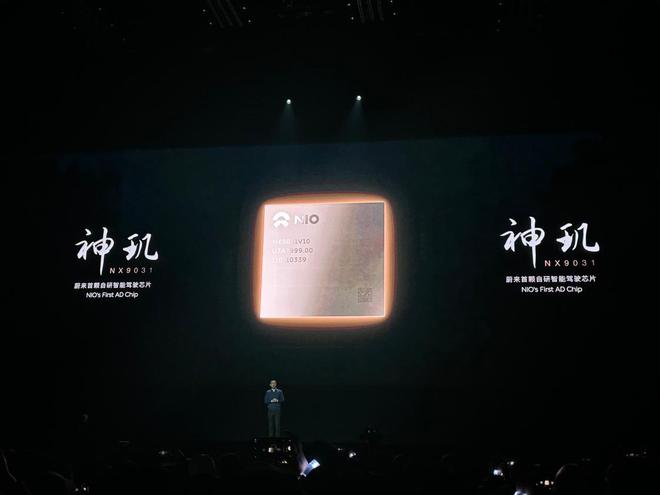
Core Insights - The automotive industry's shift towards "intelligentization" is accelerating, particularly in the chip sector, as evidenced by NIO's announcement of a successful financing round for its chip subsidiary, Anhui Shenji Technology Co., Ltd, raising over 2.2 billion RMB with a post-investment valuation nearing 10 billion RMB [1][11] - The financing round attracted a mix of local state-owned enterprises and industry capital, indicating strong confidence in the semiconductor sector and NIO's strategic direction in autonomous driving and embodied intelligence [1][2] - NIO retains a 62.7% stake in Anhui Shenji, while external investors hold 27.3%, with 10% allocated for management incentives, allowing NIO to maintain control over core technologies while alleviating financial pressure [1][3] Company Developments - Anhui Shenji's financing comes at a pivotal moment as the global supply chain is being reshaped and AI technology is rapidly advancing, positioning car-mounted chips as strategic assets for automakers [2][6] - The "Shenji NX9031" chip, the world's first mass-produced 5nm automotive-grade high-performance driving chip, exemplifies NIO's commitment to self-research and development, avoiding reliance on ARM's public licenses [3][4] - The NX9031 chip features over 50 billion transistors, a 32-core CPU architecture, and a self-developed ISP capable of processing 6.5G pixels per second, providing significant cost advantages and performance improvements for NIO vehicles [4][5] Industry Trends - The automotive industry is undergoing a transformation where AI capabilities and chip performance are becoming the core competitive advantages, moving beyond traditional vehicle components [8][9] - Major players in the automotive sector, including Xpeng and Li Auto, are also investing heavily in chip development, indicating a broader industry trend towards self-reliance in AI technology [7][10] - The successful financing of Anhui Shenji reflects a revaluation of technology investments in the automotive sector, highlighting the strong market demand for advanced semiconductor capabilities [11]
这个2月有点冷,国内车企销量洗牌
凤凰网财经· 2026-03-02 13:18
Core Viewpoint - The automotive market in February 2026 experienced a significant downturn, with all new energy vehicle manufacturers failing to exceed 30,000 units in monthly deliveries, marking a shift in market dynamics and highlighting the challenges faced by both new entrants and established brands [1][2]. Group 1: Sales Performance Overview - In February, BYD's sales reached 190,190 units, a 41% decline year-on-year, with domestic sales dropping to just over 90,000 units, indicating strong pressure from the seasonal downturn [4][5]. - Geely reported total sales of 206,160 units, showing a slight increase of 1% year-on-year, supported by a remarkable performance from its Zeekr brand, which saw a 70% increase in sales [6]. - Great Wall Motors sold 72,600 vehicles in February, down 7% year-on-year and 20% month-on-month, with 12,744 units being new energy vehicles [9]. Group 2: New Energy Vehicle Manufacturers - New energy vehicle manufacturers collectively faced significant challenges, with AITO and XPeng showing notable declines in sales, with AITO delivering approximately 18,000 units in February, a drop of nearly 50% from January [11]. - XPeng delivered 15,256 vehicles in February, reflecting a nearly 50% year-on-year decline and a 24% month-on-month drop, attributed to the aging of older models and product transition pains [12]. - In contrast, Li Auto delivered 26,421 vehicles, showing a slight year-on-year increase, while NIO achieved a substantial 57.6% year-on-year growth with 20,797 units delivered, driven by strong demand for its ES8 model [18][19]. Group 3: Market Dynamics and Future Outlook - The automotive market is experiencing a dual pressure of declining domestic demand and intense price competition, with over 20 brands, including BYD and Tesla, engaging in long-term low-interest promotions [23]. - Despite the challenges, opportunities exist in the form of decreasing battery costs and advancements in smart driving technology, which could enhance the penetration of new energy vehicles in the market [23]. - The export market is becoming increasingly vital for Chinese automotive brands, with BYD's exports exceeding 100,000 units in February, marking a potential shift in focus from domestic to international markets [5].




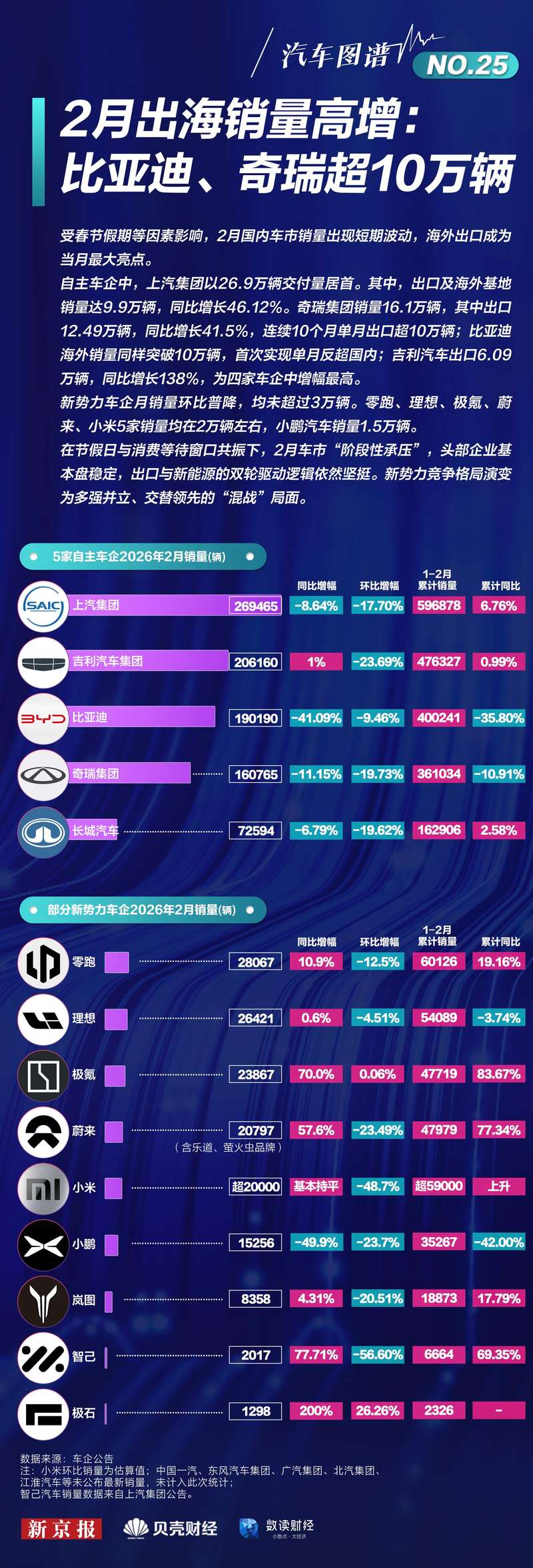
汽车图谱|2月出海销量高增:比亚迪、奇瑞超10万辆
Xin Jing Bao· 2026-03-02 12:48
Group 1 - The domestic car market in February experienced short-term fluctuations, but the positive trends of export growth and increasing penetration of new energy vehicles remain unchanged [1] - SAIC Motor led the industry with a delivery volume of 269,465 units, with exports and overseas sales reaching 99,000 units, a year-on-year increase of 46.12%, providing crucial support against domestic market volatility [1] - Chery Group's February sales reached 161,000 units, with exports accounting for 124,900 units, a year-on-year increase of 41.5%, marking ten consecutive months of single-month exports exceeding 100,000 units [1] Group 2 - New energy vehicle companies showed a mixed performance, with sales for Leap Motor, Li Auto, Zeekr, NIO, and Xiaomi around 20,000 units, while XPeng Motors sold 15,000 units [1] - The overall market pressure in February is viewed as a short-term fluctuation rather than a trend decline, with leading companies maintaining their fundamentals and the dual drivers of exports and new energy remaining strong [1] - The competitive landscape among new energy vehicle companies has evolved into a multi-stronghold scenario, characterized by alternating leadership [1] Group 3 - The release of subsequent policy benefits and the arrival of a new round of model cycles are expected to accelerate the recovery of the car market [2] - February sales data for major domestic car companies showed varying performance, with SAIC Motor's sales down 8.64% year-on-year, while BYD's sales dropped significantly by 41.09% [4] - New energy vehicle companies like Ideal and NIO reported year-on-year increases of 0.6% and 57.6%, respectively, while others like Xiaopeng and Lantu faced declines [4]

神玑单挑英伟达:蔚来拆分芯片业务,赌的是AI时代算力话语权
2 1 Shi Ji Jing Ji Bao Dao· 2026-03-02 10:56
Core Viewpoint - The automotive industry's shift towards "intelligentization" is accelerating, with a focus on chip technology as a critical battleground for competitive advantage in autonomous driving and AI applications [1][4]. Group 1: NIO's Strategic Moves - NIO's subsidiary, Anhui Shenqi Technology Co., Ltd., completed its first round of equity financing, raising over 2.2 billion RMB, with a post-investment valuation nearing 10 billion RMB [3]. - The financing will support the continued research and development of high-end, competitive chip products, aiding NIO's long-term strategy in autonomous driving and embodied intelligence [3][5]. - NIO retains a 62.7% stake in Shenqi, while external investors hold 27.3%, and 10% is held by management incentive entities, allowing NIO to maintain control over core technologies [3][6]. Group 2: Technological Advancements - The Shenqi NX9031 chip is the world's first mass-produced 5nm automotive-grade high-performance driving chip, showcasing significant technological advancements [6]. - The NX9031 features over 50 billion transistors, a 32-core CPU architecture, and a self-developed ISP capable of processing 6.5G pixels per second, with a latency of less than 5ms [7]. - NIO's strategy of self-research and development in chip technology aims to reduce costs significantly, with each vehicle potentially saving 10,000 RMB by replacing multiple purchased chips with a single self-developed chip [7]. Group 3: Industry Trends and Competition - The automotive industry is undergoing a transformation where AI technology is becoming essential, shifting from an optional to a mandatory focus for companies aiming to be leaders in the sector [9]. - Major players like Xpeng and Li Auto are restructuring their organizations to enhance their AI capabilities, indicating a broader trend of traditional automakers evolving into AI technology companies [9][10]. - The competition for AI chips is intensifying, as companies recognize that the core competitiveness of vehicles is shifting from traditional components to AI-driven capabilities [10][11]. Group 4: Future Prospects - The successful financing of Shenqi reflects a revaluation of technology investments in the automotive sector, emphasizing the importance of high-barrier, long-cycle technology [12]. - The ability of Shenqi to maintain stable supply to NIO while expanding into new markets, such as embodied robotics, will be crucial for its future success [12]. - The automotive AI competition is set to escalate in 2026, with NIO positioning itself at the forefront of this evolution through its advancements in chip technology [12].
涨价、出货量下调!存储芯片刺痛终端厂商
芯世相· 2026-03-02 08:10
Core Viewpoint - The article discusses the significant price increase in storage chips and its cascading effects on various terminal manufacturers, leading to a potential price hike across the smartphone and PC markets [3][5][27]. Group 1: Impact on Terminal Manufacturers - Major smartphone manufacturers, including Samsung and Apple, have already raised prices or are expected to do so due to increased storage chip costs, with Samsung's Galaxy S26 series seeing price increases of up to 1000 yuan per unit [8][9]. - Xiaomi has signed long-term supply agreements to mitigate cost pressures and has raised the price of its new model, the Xiaomi 17 Ultra, by 500 yuan due to increased memory costs [10][11]. - Honor is limiting the production of models priced below 2000 yuan, indicating a strategic shift in response to rising costs [12]. Group 2: Price Adjustments in the PC Sector - Lenovo has warned partners of upcoming price increases for commercial products due to ongoing memory chip shortages, urging them to place orders quickly [15][16]. - HP anticipates that the cost of storage and components will rise to 35% of its material costs, prompting price adjustments and product redesigns [17]. - Dell is expected to raise prices for commercial PCs by up to 30% in response to the rising costs of storage chips [18]. Group 3: Broader Market Trends - The overall cost of storage chips has surged, with traditional DRAM contract prices expected to rise by 90%-95% in the first quarter of 2026, impacting the pricing strategies of terminal manufacturers [27][29]. - The smartphone market is projected to see a decline in sales volume by at least 2% this year, marking a reversal from previous growth expectations due to rising costs [27]. - The automotive industry is also feeling the pressure, with predictions of a storage chip supply crisis in 2026, potentially affecting production rates [25]. Group 4: Supply Chain Dynamics - Terminal manufacturers are adjusting their strategies by shortening price quotation periods and seeking more reliable supply agreements to cope with rising costs [22][24]. - The competition for storage chips has intensified, with manufacturers needing to bid higher to secure supplies, further driving up prices [29]. - The article highlights a shift in focus towards high-margin products as manufacturers grapple with the dual pressures of rising costs and potential declines in sales volume [28][30].