BABA(09988)

Search documents
淘宝闪购连续第三年开展“春节不打烊”老年助餐行动
Huan Qiu Wang· 2026-02-14 07:15
Core Viewpoint - Taobao Flash Purchase has launched its "Spring Festival No Shutdown" elderly meal assistance initiative for the third consecutive year to address the dining difficulties faced by elderly individuals during the Spring Festival [1][3]. Group 1: Service Overview - The elderly meal assistance service has been systematically conducted for nearly three years, delivering meals to over 4,000 elderly individuals daily, with a cumulative service of over 1.1 million instances [3]. - During the Spring Festival, Taobao Flash Purchase collaborates with local civil affairs departments, community canteens, and charitable organizations to prepare and deliver special meal packages to elderly residents [3][4]. - In Beijing, partnerships with local restaurants have resulted in the preparation of exclusive meal packages for elderly individuals, ensuring they receive traditional dishes like dumplings on New Year's Eve [3][4]. Group 2: Technological Integration - In Shanghai, an "AI + Elderly Meal Assistance" pilot program has been initiated, allowing elderly individuals to place orders through voice commands using smart devices, enhancing accessibility for those less familiar with technology [4]. Group 3: Community Engagement and Support - Community canteens are actively participating in supporting delivery riders by providing discounted meal options, fostering a mutually beneficial relationship between the elderly assistance program and the riders [8]. - Taobao Flash Purchase is investing nearly 2 billion yuan to incentivize delivery riders during the Spring Festival, ensuring they receive additional compensation for their efforts [6]. Group 4: Rider Welfare and Recognition - Special care packages, including winter essentials and snacks, have been distributed to delivery riders to acknowledge their dedication to serving the elderly [10]. - The "familiar delivery" model is employed, where riders are assigned to specific elderly individuals, allowing them to monitor their well-being and respond to emergencies, thus becoming vital guardians in the elderly's home care [10].



都在等梁文锋:AI战事正酣梁文锋却静悄悄,有时候,越是平静,对手越是害怕
Xin Lang Cai Jing· 2026-02-14 07:13
Core Insights - The article discusses the intense competition among internet giants in the AI large model sector, highlighting the ambitions of companies to establish their AI applications as the primary traffic entry point [4][23] - DeepSeek, founded by Liang Wenfeng, emerged as a significant player in the AI landscape with its R1 model, which was launched at a surprisingly low cost, challenging the perception of high investment requirements for top-tier models [14][31] - Despite the competitive environment, DeepSeek has maintained a low profile, with recent updates suggesting a potential new model release, V4, but with no official confirmation [26][27] Industry Competition - Major companies are aggressively distributing cash incentives to attract users, with Tencent offering 1 billion yuan, Baidu 500 million yuan, and Alibaba 3 billion yuan, indicating a fierce battle for user engagement [25] - The launch of new models by ByteDance and Alibaba, including the 2.0 versions of their respective models, reflects a rapid evolution in AI capabilities and competition [8][25] - The article notes a peculiar competitive dynamic where companies are responding to each other's moves, creating a sense of mutual awareness in the market [8][25] DeepSeek's Position - DeepSeek's recent updates include an increase in context window length from 128K tokens to 1 million tokens, suggesting advancements in their technology [26] - The company continues to recruit talent despite a slowdown in hiring across the industry, indicating its commitment to innovation and development [27] - Liang Wenfeng's vision for DeepSeek is to lead in AI research and development, aiming to create a general-purpose AI that goes beyond existing models [31][32] User Engagement and Market Dynamics - The article emphasizes the importance of addressing user needs in the AI sector, with companies like DeepSeek beginning to focus on consumer-facing products [33] - The competition is framed as a quest to meet real user demands, which will determine the leading players in the AI landscape [36] - The article concludes that the current battle among internet giants is crucial for defining the next decade of internet order, highlighting the strategic significance of user engagement in AI applications [36]



恒生指数下跌1.72% 恒生科技指数下跌0.90%
Xin Hua Cai Jing· 2026-02-14 05:50
Market Overview - The Hong Kong stock market experienced a decline, with the Hang Seng Index falling by 1.72% to 26,567.12 points, the Hang Seng Tech Index down by 0.90% to 5,360.42 points, and the National Enterprises Index decreasing by 1.55% to 9,032.71 points [1] - The Hang Seng Index opened lower at 26,640.16 points, dropped by 392.38 points, and ultimately closed down by 465.42 points, with a total trading volume exceeding 257.5 billion HKD [1] - The southbound trading (Hong Kong Stock Connect) saw a net inflow of over 20.2 billion HKD [1] Sector Performance - Overall, sectors such as chips and department stores saw gains, while new consumption, new energy vehicles, and telecommunications had mixed results. Conversely, sectors like gold, non-ferrous metals, biomedicine, port transportation, technology, oil and gas, brokerage, and banking mostly experienced declines [1] Individual Stock Movements - Notable stock movements included Xiaomi Group increasing by 0.88%, AIA Group decreasing by 4.18%, Zijin Mining falling by 7.64%, Hong Kong Exchanges and Clearing down by 2.13%, and Semiconductor Manufacturing International Corporation rising by 0.79% [1] - Ctrip Group-S dropped by 2.10%, Pop Mart fell by 1.90%, while Tian Shu Zhi Xin surged by 14.59% and Zhi Pu increased by 20.65% [1] - China Construction Bank decreased by 1.49%, China Resources Land fell by 2.52%, and Lao Pu Gold dropped by 3.97%, while Guotai Junan International rose by 4.61% and China Petroleum & Chemical Corporation fell by 4.33% [1] Top Traded Stocks - The top three traded stocks included Tencent Holdings, which fell by 0.65% with a trading volume exceeding 14.2 billion HKD; Alibaba, down by 2.02% with over 10.8 billion HKD in transactions; and Meituan, which decreased by 3.18% with a trading volume of over 8.1 billion HKD [2]

百铲大战!阿里内测AI漫剧工具幻漫
Xin Lang Cai Jing· 2026-02-14 05:04
Core Viewpoint - Alibaba is currently testing an AI comic creation tool named "Huanman," which is expected to be released by the end of February [8]. Group 1: Product Overview - The "Huanman" tool is designed for creating comic dramas, allowing users to input titles, descriptions, and select visual styles [4]. - The tool covers the entire comic production workflow, from project creation to final video output [8]. Group 2: Market Context - The comic drama market is projected to reach approximately 20 billion yuan this year, primarily driven by AI models and tools [8]. - There are over 20 existing comic drama tools in the market, indicating a competitive landscape often referred to as the "Hundred Blades War" [10]. - The competition among AI comic tools is fundamentally a battle for token costs from cloud service providers, which will influence user experience and production processes [10].

2026年中国食品电子商务行业发展历程、产业链、交易规模、重点企业及趋势研判:消费者需求多样化推动食品电子商务发展,交易规模已突破万亿元[图]
Chan Ye Xin Xi Wang· 2026-02-14 01:39
Core Insights - The rapid development of information technology and the internet has led to the significant growth of e-commerce in various industries, particularly in the food sector, which is crucial for national economy and people's livelihoods [1] - The food e-commerce market in China is projected to grow from 130 billion yuan in 2016 to 1,279.4 billion yuan by 2025, with a compound annual growth rate (CAGR) of 28.93% [1] Group 1: Industry Overview - Food e-commerce, defined as the sale of food products through online platforms, has emerged as a new business model driven by technological advancements and improved living standards [4] - The operational models of food e-commerce include B2C (business-to-consumer), C2C (consumer-to-consumer), and O2O (online-to-offline) [4][5] - The industry has evolved through distinct phases: exploration (2005-2009), initiation (2009-2012), development (2012-2017), and maturity (2017-present) [6] Group 2: Market Dynamics - The food e-commerce sector has seen a rise in various product categories, including fresh food, imported food, snacks, health food, and baby food [5] - The increasing consumer preference for online food purchases is driven by convenience, product variety, and promotional offers, leading to a steady rise in online food sales penetration [1] - The logistics system's improvement has accelerated food delivery speeds, further enhancing the growth of food e-commerce [1] Group 3: Industry Structure - The food e-commerce industry participants can be categorized into four types: self-operated food e-commerce, vertical food e-commerce, comprehensive e-commerce platforms, and platform-based food e-commerce [9] - Major players in the market include JD Group, Alibaba Group, and various specialized food e-commerce platforms [2][3] Group 4: Future Trends - The future of food e-commerce will be driven by technology, enhancing user experience and integrating online and offline channels [11] - There will be a focus on sustainable practices and supply chain resilience, including green supply chain initiatives and collaboration with eco-friendly suppliers [12] - The industry will increasingly cater to specific consumer segments, offering customized products and health-oriented solutions [13]


春节红包超80亿,留存率或不足5%!究竟能换来多少“真用户”?
Xin Lang Cai Jing· 2026-02-14 01:37
Core Viewpoint - The upcoming Spring Festival will see a significant "red envelope war" among major internet companies, with total investments exceeding 8 billion yuan, and potential total funding reaching 10 billion yuan when including undisclosed amounts from various platforms [2][16]. Group 1: Investment Amounts and Strategies - Alibaba is investing 3 billion yuan through its Qianwen app, offering a 25 yuan free order card and incentives for new user referrals [3][14]. - JD.com is also contributing 3 billion yuan, providing shopping coupons and cash prizes, including a 50% discount on iPhones [3][14]. - Tencent is allocating 1 billion yuan for its Yuanbao app, focusing on social interaction and AI-driven features [3][14]. - Baidu is investing 500 million yuan in its Wenxin app, promoting card collection and AI-enhanced interactions [3][14]. - ByteDance's Douyin is contributing 300 million yuan, while the exact amount for its Doubao platform remains undisclosed [3][14]. - Kuaishou is investing 200 million yuan, utilizing various interactive features to engage users [3][14]. - Ant Group (Alipay) and Weibo have not disclosed their investment amounts but are participating in the red envelope activities [3][14]. Group 2: User Retention Concerns - Experts warn that relying solely on red envelopes may lead to low user retention rates, with 7-day retention below 20% and 30-day retention potentially dropping below 5% [8][21]. - The red envelope strategy addresses initial user engagement but fails to ensure long-term usage [8][21]. Group 3: Competitive Landscape and AI Integration - The competition is intensified by the emergence of generative AI technologies, with companies like Alibaba, Tencent, and Baidu leveraging their AI applications as key platforms for distributing red envelopes [6][16]. - The red envelope war reflects a shift in focus towards AI capabilities, with companies aiming to establish a competitive edge in the evolving digital landscape [6][16]. - ByteDance's Doubao is expected to benefit significantly from its collaboration with the Spring Festival Gala, potentially positioning it as a major winner in this year's competition [19].

Should You Buy Alibaba Stock Before Feb. 19?
The Motley Fool· 2026-02-14 01:33
Core Viewpoint - Alibaba Group's stock has shown significant recovery, but upcoming earnings report raises questions about sustaining momentum [1][2] Financial Performance - Alibaba's earnings have been inconsistent, missing estimates in three of the last four quarters, with the last beat occurring in the December quarter of the previous year [4] - In the first half of fiscal 2025, cloud revenue increased by 30% year over year, while e-commerce segments grew by 12% and 14% respectively; overall revenue rose by just 3% to nearly $70 billion [8] - The stock currently trades at a P/E ratio of 22, lower than Amazon's 28 and Sea Limited's 47, but higher than its P/E of 12 from last summer [9] Stock Performance - Alibaba's stock has rallied approximately 45% over the past year, with most gains occurring between late August and early October [5] - Current stock price is $155.68, with a market cap of $357 billion [6] Investor Sentiment - Investors are advised to be cautious about adding shares before the earnings report due to the company's mixed financial performance and history of earnings misses [10][11] - Despite improved outlook and double-digit growth in key segments, geopolitical concerns still linger, making competitors like Amazon potentially more attractive [11]
陆家嘴财经早餐2026年2月14日星期六
Sou Hu Cai Jing· 2026-02-14 01:14
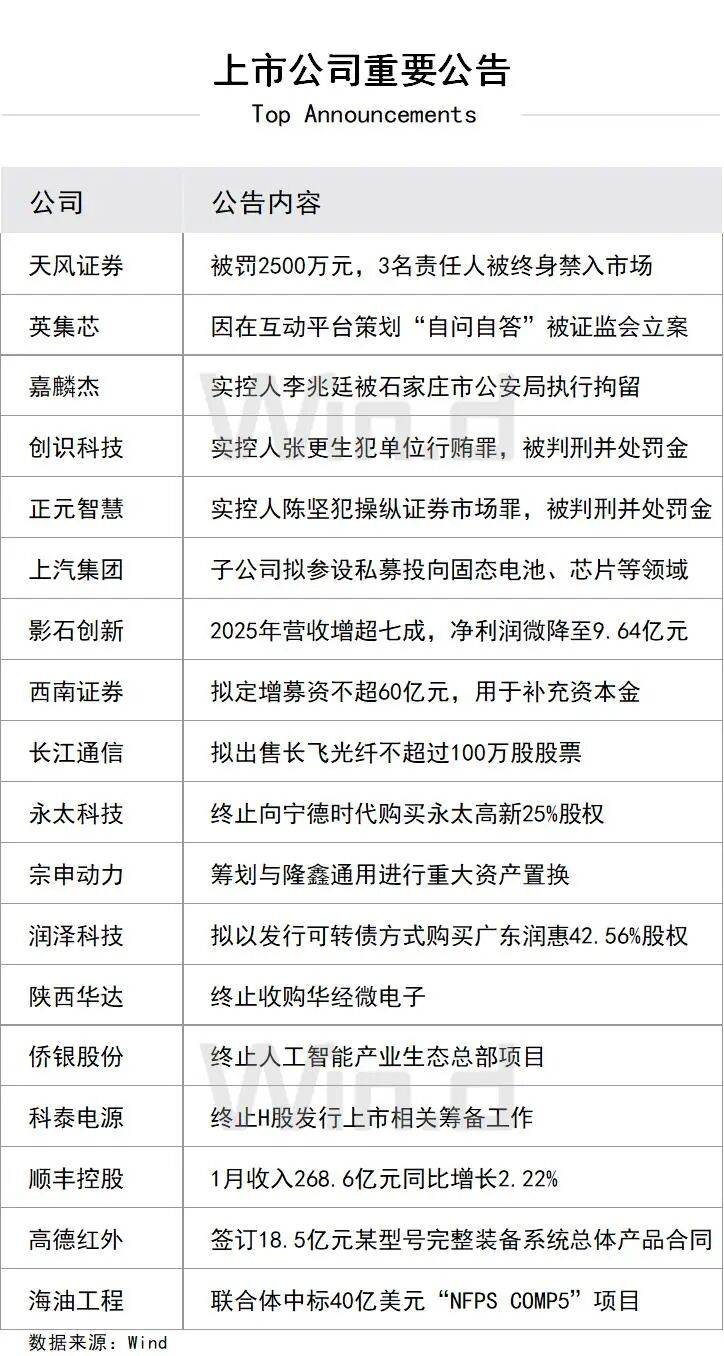
Financial Data - In January, China's social financing increased by 7.22 trillion yuan, up by 166.2 billion yuan year-on-year, while RMB loans rose by 4.71 trillion yuan, with a total balance of 276.62 trillion yuan, reflecting a year-on-year growth of 6.1% [1] - The weighted average interest rate for new corporate loans in January was approximately 3.2%, down by about 20 basis points year-on-year, while the rate for personal housing loans remained stable at 3.1% [3] - The M2 money supply grew by 9% year-on-year, and M1 increased by 4.9% [1] Real Estate Market - Data from the National Bureau of Statistics indicated that the month-on-month decline in second-hand housing prices in 70 cities narrowed, with first, second, and third-tier cities seeing reductions of 0.4, 0.2, and 0.1 percentage points respectively [1] - Year-on-year, new and second-hand housing prices in 70 major cities continued to decline, with the rate of decrease further widening [1] Stock Market Performance - The A-share market showed a positive trend in the post-Spring Festival period, with the Shanghai Composite Index rising by 4.85% in the first five trading days of 2024, marking the highest increase in nearly a decade [2] - The Shanghai Composite Index closed down by 1.26% at 4082.07 points on the last trading day before the Spring Festival, with a total market turnover of 2 trillion yuan [4] Regulatory Developments - The China Securities Regulatory Commission (CSRC) imposed strict penalties on Tianfeng Securities for illegal financing and information disclosure violations, with fines totaling 25 million yuan [4] - The State Administration for Market Regulation and the Ministry of Commerce announced enhanced supervision of cross-border e-commerce retail imports, focusing on recall regulations [3] Corporate News - Meituan projected a loss of over 23 billion yuan for the previous year, with continued losses expected in the first quarter of this year, primarily due to a significant decline in operating profit in its core local business segment [6] - The Hong Kong Stock Exchange is considering expanding the scope of confidentiality applications beyond technology and biotech sectors to include traditional industries [5]





央行开展万亿逆回购操作,国产大模型节前集体上新 | 财经日日评
吴晓波频道· 2026-02-14 00:39
Monetary Policy - The People's Bank of China conducted a 1 trillion yuan buyout reverse repurchase operation with a 6-month term, marking a net liquidity injection of 600 billion yuan for February, which is an increase of 300 billion yuan compared to the previous month [2][3] - The central bank's continued use of quantity-based tools indicates a reduced likelihood of interest rate cuts or reserve requirement ratio reductions in the short term [2][3] Real Estate Market - In January, new home prices in first-tier cities fell by 0.3% month-on-month, while second-tier cities saw a smaller decline of 0.2%, indicating a narrowing of price drops in these areas [4][5] - The overall trend shows an increase in cities with declining new home prices compared to late 2022, with the year-on-year decline in first-tier cities expanding to 2.1% [4][5] Automotive Industry - The State Administration for Market Regulation released guidelines to clarify legal risks in the automotive industry, aiming to promote healthy competition and compliance among manufacturers [6][7] - The guidelines address various pricing behaviors that could lead to legal issues, emphasizing the need for a clear competitive framework in the automotive sector [6][7] AI Industry - Anthropic raised $30 billion in its latest funding round, achieving a valuation of $380 billion, which is double its previous valuation [10][11] - The competition in the AI sector is intensifying, with major players like OpenAI and Anthropic attracting significant investments, indicating a growing interest in AI commercialization [10][11] Commodity Funds - Recent fluctuations in international oil prices have led to strict purchase limits on commodity funds, with some funds allowing purchases as low as 1 yuan [12] - The volatility in commodity markets has prompted fund companies to implement tighter risk control measures, reflecting a heightened speculative atmosphere [12] Stock Market - The A-share market experienced a decline, with the Shanghai Composite Index falling by 1.26% and trading volume decreasing by 161.8 billion yuan compared to the previous day [13][14] - The market is transitioning from an overheated phase to a more rational state, with the index seeking a new consolidation platform above 4000 points [14]

美股三大指数周线齐跌
财联社· 2026-02-14 00:39
Market Overview - The three major indices showed mixed performance, with the Dow Jones up 0.10% to 49,500.93 points, the S&P 500 up 0.05% to 6,836.17 points, and the Nasdaq down 0.22% to 22,546.67 points [3] - All three indices recorded weekly declines, with the S&P 500 down 1.4%, the Dow down 1.2%, and the Nasdaq down 2.1% [3] Economic Indicators - The U.S. Bureau of Labor Statistics reported that the January CPI rose 2.4% year-over-year and 0.2% month-over-month, both below market expectations [3] - The core CPI, excluding volatile food and energy prices, increased by 2.5% year-over-year and 0.3% month-over-month, aligning with market expectations [3] - Phil Blancato, Chief Market Strategist at Osaic, indicated that this data could pave the way for interest rate cuts and inflation control if the trend continues [3] Sector Performance - Concerns over AI disruption led to market sell-offs, affecting various sectors including software, real estate, trucking, and financial services [6] - Financial stocks such as Charles Schwab and Morgan Stanley fell by 10.8% and 4.9%, respectively, while software company Workday dropped 11% and commercial real estate firm CBRE fell 16% [6] - The media sector was also impacted, with Disney down approximately 3% and Netflix down 6% [7] Technology Stocks - Major tech stocks mostly declined, with Nvidia down 2.21%, Apple down 2.27%, Microsoft down 0.13%, Google down 1.06%, and Amazon down 0.41% [7] - Tesla saw a slight increase of 0.09%, while Oracle rose by 2.34% and Netflix increased by 1.33% [7] Chinese Stocks - The Nasdaq Golden Dragon China Index fell by 0.10%, with Alibaba down 1.89%, JD.com down 1.38%, and Pinduoduo up 0.06% [7] - NIO remained flat, while Xpeng rose by 1.36% and Li Auto fell by 1.81% [7]