
SMIC(688981)

Search documents
从锂电到AI,泉果旭源三年持有A三季报规模突破190亿,赵诣“两端配置”策略成效显著
Xin Lang Ji Jin· 2025-10-20 08:29
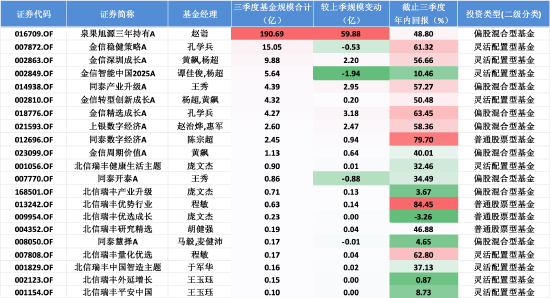
Core Insights - The core viewpoint of the article highlights the significant growth of the "Quanguo Xuyuan Three-Year Holding A" fund, which reached a scale of 19.069 billion yuan as of September 30, 2025, marking a quarterly increase of nearly 6 billion yuan, making it the largest among disclosed equity funds for the third quarter [1][2]. Fund Performance - The fund achieved a return of 43.10% over the past six months and 41.61% over the past year, ranking favorably among its peers, with a notable quarterly increase of 45.58% in Q3, outperforming the average of similar products and the CSI 300 index [2]. - Since its inception on October 18, 2022, the fund has delivered a total return of 1.80% and an annualized return of 0.60%, ranking 1980 out of 3209 in its category [4]. Investment Strategy - The fund manager, Zhao Yi, emphasized a "dual-end allocation" strategy to adapt to market changes, focusing on technology AI and sectors in recovery, particularly in new energy (especially the lithium battery supply chain) and military industry [5]. - In the AI sector, the fund is concentrated on three main lines: efficiency-enhancing internet companies like Meta, companies driven by new application scenarios such as Palantir, and cloud service providers like Microsoft [6]. - In the new energy sector, the fund is particularly focused on the lithium battery supply chain, noting a slowdown in fixed asset investment while demand remains high, leading to an improving supply-demand structure [6]. Portfolio Adjustments - The fund's top ten holdings include major companies such as Ningde Times, Tencent Holdings, and Enjie Co., with a total market value exceeding 12.877 billion yuan [9]. - Significant adjustments were made in the portfolio, with a notable reduction of 37.52% in holdings of Keda Li, while new additions included Tianqi Lithium and SMIC, indicating a continued focus on lithium materials and domestic semiconductor sectors [9]. Market Outlook - Zhao Yi expressed optimism about the long-term positive trend of the Chinese equity market, citing signs of easing in U.S. tariff policies and potential liquidity improvements, which could inject more momentum into the A-share market [9].





一场资产大洗牌开始了
投资界· 2025-10-20 08:01
Core Viewpoint - A global asset reshuffling is underway, with significant investments flowing into technology and gold, raising questions about whether this represents a wealth feast or a repeat of past market pitfalls [5]. Group 1: Gold Market Insights - As of October 15, COMEX gold prices surpassed $4,200 per ounce, marking a 54% increase year-to-date [6]. - The current gold bull market is driven by central banks, with gold's share in reserves surpassing U.S. Treasury bonds for the first time since 1996, indicating a strategic shift towards physical assets [8][10]. - China's foreign exchange reserves increased by $16.5 billion in September, with gold reserves rising by $29.4 billion, reflecting a 11.6% month-on-month growth, bringing gold's share in total reserves to 7.68%, the highest in a decade [10]. Group 2: Technology Sector Performance - The technology sector, particularly semiconductors, has seen remarkable growth, with companies like Semiconductor Manufacturing International Corporation and Cambricon Technologies experiencing stock price increases of 58.93% and 120.28%, respectively [11]. - The U.S. stock market has been on a tech bull run for three years, with the S&P 500 index rising 83% since October 2022, driven largely by major tech firms [11]. - AI investments are now contributing 40% to U.S. GDP growth, with major AI companies accounting for 80% of the stock market's growth [12]. Group 3: Market Dynamics and Contradictions - The simultaneous rise of gold and technology stocks is unusual, as gold typically serves as a safe haven while tech stocks are seen as riskier investments [14]. - The current economic environment features significant monetary easing, with expectations of further interest rate cuts, which has led to increased capital inflows into technology [18]. - The contrasting strategies of heavy investment in technology while maintaining gold as a hedge reflect a complex market sentiment, with institutions betting on both outcomes [19][24]. Group 4: Future Implications - The ongoing investment in technology is seen as a gamble on a new technological revolution, with the potential for either a successful AI-driven economic boom or a market correction leading to asset depreciation [20][23]. - Major investment firms, such as Harvard Management Company, are increasing their stakes in both tech giants and gold, indicating a dual strategy to navigate potential market volatility [24].





2025湾芯展收官,粤港澳大湾区半导体产业注入新动能
Zhong Guo Jing Ying Bao· 2025-10-20 07:33
Core Insights - The 2025 Bay Area Semiconductor Industry Ecological Expo concluded in Shenzhen, showcasing over 2,500 new products from various global companies, emphasizing the theme "Chip Enables Future Intelligent Creation" [1][2] - The event attracted participation from more than 20 countries and regions, featuring top semiconductor firms such as Applied Materials, KLA, and domestic leaders like SMIC and BYD, highlighting a comprehensive industry chain [1][2] Group 1 - The expo served as a platform for "technological breakthroughs," allowing domestic companies to present key achievements that challenge foreign monopolies [1] - Approximately 5,000 professional buyers from leading companies attended, including major players like Samsung and Foxconn, facilitating effective connections between domestic and international industry resources [2] - The event fostered a "dual approach" of innovation and market engagement, with many enterprises seeking solutions for technical challenges and new market demands [2] Group 2 - The participation of renowned companies from 27 countries and regions expanded the "friend circle" of the semiconductor industry in the Guangdong-Hong Kong-Macao Greater Bay Area [2] - The expo included targeted matchmaking services, enhancing collaboration on policy consultation, resource sharing, and capital investment among semiconductor hubs like Shanghai and Wuxi [2]





南向资金年内净流入额创历年同期之最,港股通科技ETF(159262)盘中涨超2%,机构:港股科技仍是行情主线
Sou Hu Cai Jing· 2025-10-20 05:32
Group 1 - The Hang Seng Index rose by 2.41% and the Hang Seng Tech Index increased by 3.21% on October 20, 2025, indicating positive market sentiment [1] - Southbound capital inflow has exceeded 1.1 trillion yuan this year, marking the highest net inflow for the same period in history, reflecting strong interest in the Hong Kong stock market [1] - The Federal Reserve hinted at a potential interest rate cut in October due to a deteriorating labor market, which could further enhance the attractiveness of Hong Kong stocks [1] Group 2 - Cathay Securities believes that the bullish trend for Hong Kong stocks will continue in the fourth quarter, driven by the benefits of AI narratives and the return of foreign capital due to potential interest rate cuts [2] - The technology sector in Hong Kong is expected to be the main focus of the market, with a shift from internet innovation to AI and hard technology innovation, supported by favorable policies and valuation recovery [2] - The Hong Kong Stock Connect Technology ETF has seen a significant increase, with a recent scale of 5.357 billion yuan and a net inflow of 85.52 million yuan, indicating strong investor interest [3] Group 3 - The Hong Kong Stock Connect Technology ETF closely tracks the Hang Seng Stock Connect Technology Index, focusing on TMT industries while excluding pharmaceuticals, automobiles, and home appliances [3] - Major holdings in the ETF include Alibaba, Tencent, and Xiaomi, which together account for nearly 45% of the total weight, highlighting the concentration of leading technology firms [3] - The ETF has achieved a recent high in shares at 4.706 billion, reflecting strong demand and investor confidence in the technology sector [3]

科创芯片ETF指数(588920)开盘涨1.62%,重仓股中芯国际涨1.74%,海光信息涨2.96%
Xin Lang Cai Jing· 2025-10-20 05:18
Core Viewpoint - The Sci-Tech Chip ETF Index (588920) opened with a gain of 1.62%, reaching 1.506 yuan, indicating positive market sentiment towards the semiconductor sector [1] Group 1: ETF Performance - The Sci-Tech Chip ETF Index (588920) has a benchmark performance based on the Shanghai Stock Exchange Sci-Tech Board Chip Index [1] - Since its establishment on July 16, 2025, the fund has achieved a return of 47.80% [1] - The fund's return over the past month is reported at 1.92% [1] Group 2: Major Holdings - Key stocks within the Sci-Tech Chip ETF Index include: - SMIC (中芯国际) with a gain of 1.74% [1] - Haiguang Information (海光信息) up by 2.96% [1] - Cambricon (寒武纪) increasing by 2.04% [1] - Lattice Technology (澜起科技) rising by 2.88% [1] - Zhongwei Company (中微公司) up by 2.33% [1] - Hu Silicon Industry (沪硅产业) gaining 1.83% [1] - Chipone (芯原股份) increasing by 3.41% [1] - Hengxuan Technology (恒玄科技) up by 1.98% [1] - Huahai Qingke (华海清科) rising by 1.96% [1] - Sitway (思特威) with the highest gain of 5.45% [1]


半导体龙头ETF(159665)开盘涨1.25%,重仓股中芯国际涨1.74%,海光信息涨2.96%
Xin Lang Cai Jing· 2025-10-20 04:46
Group 1 - The semiconductor leader ETF (159665) opened with a gain of 1.25%, priced at 1.775 yuan [1] - Key holdings in the ETF include: - SMIC up 1.74% - Haiguang Information up 2.96% - Cambrian up 2.04% - North Huachuang up 1.64% - OmniVision up 1.41% - Lattice Semiconductor up 2.88% - Zhongwei Company up 2.33% - Zhaoyi Innovation up 3.24% - Changdian Technology up 1.90% - Unisoc up 1.71% [1] - The ETF's performance benchmark is the National Securities Semiconductor Chip Index return, managed by ICBC Credit Suisse Asset Management Company, with a return of 75.25% since its establishment on December 22, 2022, and a return of 0.36% over the past month [1]
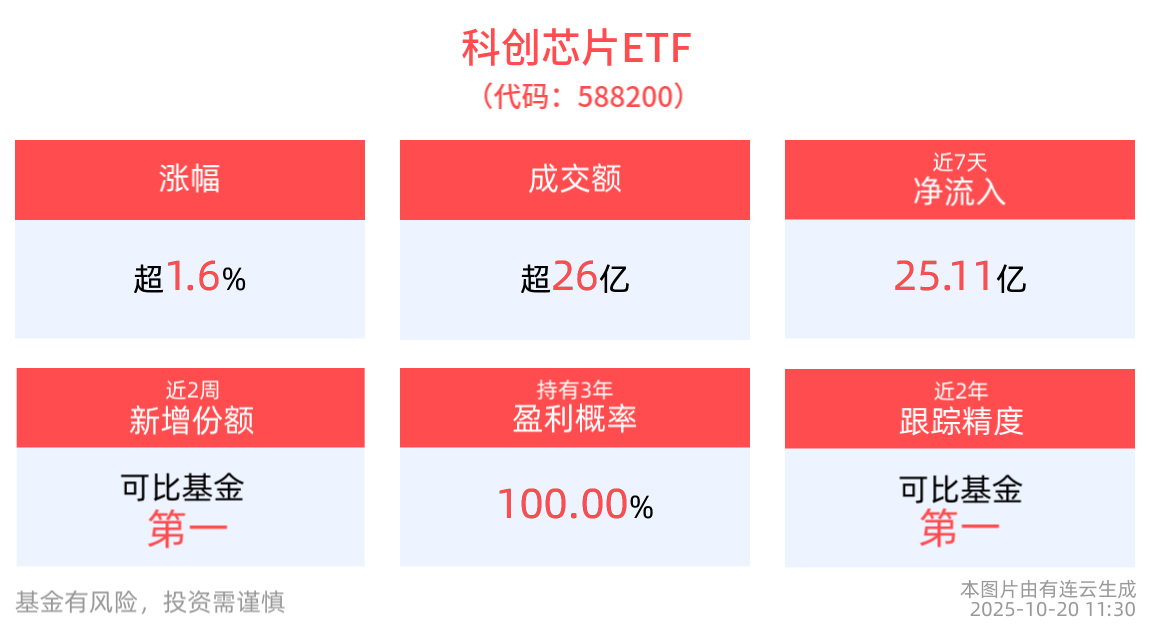
科创芯片ETF(588200)半日收涨1.69%,盘中最高涨超3%!机构:半导体设备行业2026年或迎来拐点
Sou Hu Cai Jing· 2025-10-20 04:16
Group 1: ETF Performance - The Sci-Tech Chip ETF has a turnover rate of 6.63% and a transaction volume of 2.604 billion yuan [3] - The latest scale of the Sci-Tech Chip ETF reached 38.493 billion yuan, ranking first among comparable funds [3] - In the past two weeks, the ETF's shares increased by 966 million, marking significant growth and leading among comparable funds [3] - Over the past seven trading days, the ETF recorded net inflows on five days, totaling 2.511 billion yuan [3] - As of October 17, the ETF's net value has risen by 130.66% over the past three years, ranking 16th out of 1890 index equity funds, placing it in the top 0.85% [3] - The highest monthly return since inception was 35.07%, with the longest consecutive monthly increase being four months and a maximum increase of 74.17% [3] - The average return during rising months is 9.90% [3] Group 2: Semiconductor Industry Insights - Nvidia's CEO stated that due to U.S. export controls, Nvidia's market share in China has dropped from 95% to 0%, indicating a complete exit from the Chinese market [4] - The global semiconductor industry is projected to grow from $631 billion in 2024 to over $1 trillion by 2030, with a CAGR of approximately 8% [4] - AI and High-Performance Computing (HPC) are expected to be the core drivers of this growth, with their share rising from 35% in 2025 to 48% in 2030 [4] - SEMI forecasts a 10% year-on-year increase in global wafer fabrication equipment (WFE) capital expenditure in 2026, reflecting strong growth in advanced process logic and memory capital expenditures driven by AI [4] - The semiconductor equipment industry may see a turning point in 2026, with advanced packaging equipment expected to reach a scale of $6.3 billion [4] Group 3: Top Weight Stocks - The top ten weighted stocks in the Shanghai Stock Exchange Sci-Tech Chip Index include: - Haiguang Information (10.22% weight, +1.77%) - Langqi Technology (10.15% weight, +1.80%) - SMIC (9.59% weight, +4.07%) - Cambricon (8.01% weight, -0.54%) - Zhongwei Company (6.80% weight, +1.59%) - Chipone (2.89% weight, +3.15%) - Hu Silicon Industry (2.63% weight, +0.65%) - Hengxuan Technology (2.50% weight, +1.21%) - Sitaiwei (2.46% weight, +6.16%) - Shenghai Qingke (2.39% weight, +1.20%) [6]


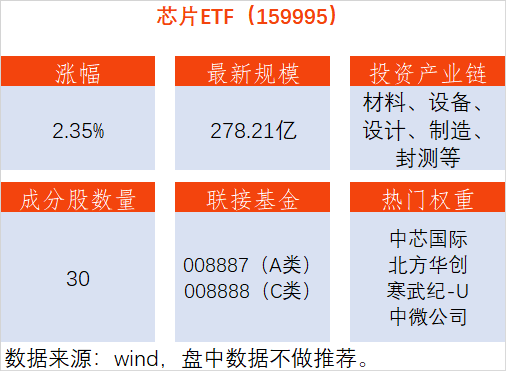
美光停供!芯片ETF(159995)上涨2.35%,士兰微涨停
Mei Ri Jing Ji Xin Wen· 2025-10-20 02:55
Group 1 - The A-share market saw a collective rise in the three major indices, with the Shanghai Composite Index increasing by 0.49%, driven by gains in sectors such as communication equipment, electronic components, and forestry, while precious metals and banking sectors experienced declines [1] - Chip technology stocks showed significant strength, with the chip ETF (159995) rising by 2.35% and notable increases in constituent stocks such as Silan Microelectronics up by 9.99%, China Resources Microelectronics up by 6.03%, and others [1] Group 2 - Micron Technology plans to cease supplying server chips to Chinese data centers, following a ban on its products in critical infrastructure in 2023, which has not allowed its business to recover [3] - Zheshang Securities views this event as a misunderstanding of market sentiment, suggesting that the impact on the market is minimal and instead indicates a worsening shortage in the storage industry, which is a positive signal for the sector [3] - The chip ETF (159995) tracks the Guozheng Chip Index, comprising 30 leading companies in the A-share chip industry across various segments, including materials, equipment, design, manufacturing, packaging, and testing [3]


数字经济ETF(560800)盘中涨2.62%,机构:国产算力芯片迎来国产创新窗口期
Xin Lang Cai Jing· 2025-10-20 02:53
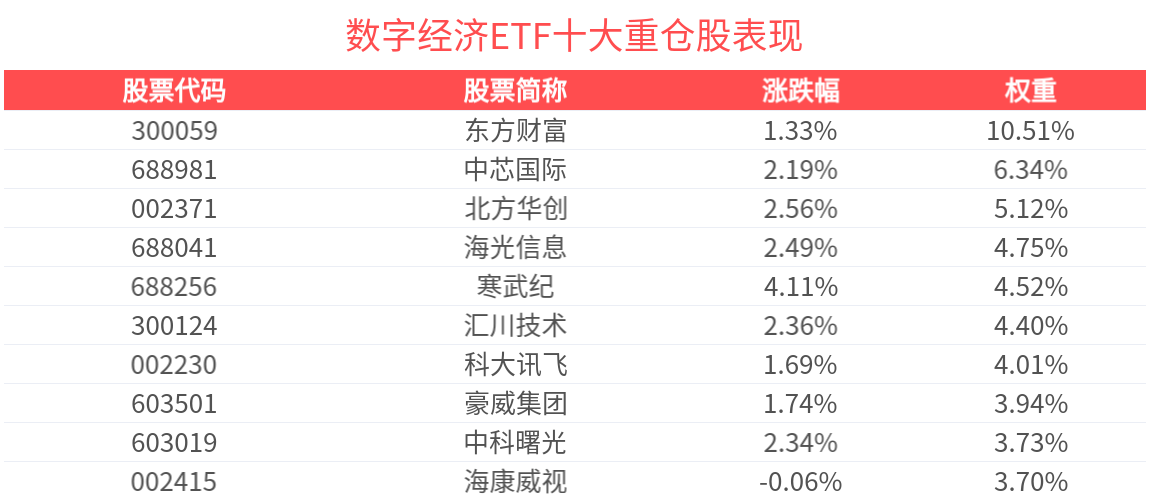
Core Insights - The China Securities Digital Economy Theme Index (931582) has seen a strong increase of 2.48% as of October 20, 2025, with notable gains in constituent stocks such as Silan Microelectronics (600460) up 9.99%, China Resources Microelectronics (688396) up 7.34%, and Zhaoyi Innovation (603986) up 6.32% [1] - The Digital Economy ETF (560800) also rose by 2.62%, with a trading volume of 9.77 million yuan and a turnover rate of 1.42% [1] - The index reflects the overall performance of listed companies involved in digital economy infrastructure and high digitalization applications [2] Market Performance - As of September 30, 2025, the top ten weighted stocks in the China Securities Digital Economy Theme Index accounted for 54.31% of the index, including Dongfang Wealth (300059), SMIC (688981), and Cambricon (688256) [2] - The performance of individual stocks within the index shows a range of increases, with Dongfang Wealth at 1.33% and SMIC at 2.19% [4] Industry Trends - The demand for HBM products is increasing due to the growing computational power needs of AI large models, leading to a shift from 8-layer to 12-layer stacking, which complicates testing processes [1] - Domestic computing chip manufacturers are experiencing a surge in innovation, with many launching self-developed AI chips, indicating a significant acceleration in the domestic supply chain [1]



美联储降息概率或提升,年内份额增超768%的港股科技50ETF(159750)反弹涨近3%
2 1 Shi Ji Jing Ji Bao Dao· 2025-10-20 02:47
Group 1 - The Hong Kong stock market indices experienced a collective rebound, with the China Concept Internet ETF (513220) rising over 3% and the Hong Kong Technology 50 ETF (159750) increasing by 2.81% [1] - The Hong Kong Technology 50 ETF (159750) has attracted over 554 million yuan in net inflows since September, with its latest scale surpassing 1.4 billion yuan and a year-to-date share increase of over 768% [1] - Major constituent stocks such as Alibaba-W, JD Group-SW, and Tencent Holdings saw gains exceeding 4%, while Xiaomi Group-W, Meituan-W, Kuaishou-W, and BYD Co. also experienced increases [1] Group 2 - According to GF Securities, the initiation of a new interest rate cut cycle by the Federal Reserve will benefit A/H assets, enhancing the allocation value of Chinese assets [2] - The Hong Kong Technology 50 ETF (159750) tracks the China Hong Kong Technology Index, which includes major companies like Alibaba-W, Tencent Holdings, and Xiaomi Group-W, covering various technology sectors such as new energy vehicles, smart driving, artificial intelligence, and semiconductors [2]
