
CMBC(600016)

Search documents
多家银行,密集提示!
券商中国· 2025-10-23 03:45
Core Viewpoint - Recent fluctuations in precious metal prices have led several banks to issue risk alerts and increase the investment threshold for gold accumulation products to above 1000 yuan [1][2]. Group 1: Market Trends - There has been a noticeable increase in the popularity of gold investments, with a rise in customer inquiries and purchases of related products [2]. - On October 21, Industrial Bank announced an adjustment to its gold accumulation business, raising the minimum purchase amount from 1000 yuan to 1200 yuan for monetary transactions, while maintaining a minimum of 1 gram for weight-based transactions [2]. - Similarly, Ping An Bank announced an increase in the minimum investment amount for its gold accumulation plan from 900 yuan to 1100 yuan, effective from October 24, 2025 [2]. Group 2: Risk Management - Banks are adjusting the minimum investment amounts in response to rapid increases in gold prices, which serves as a risk alert for investors [2][3]. - A number of banks, including China Construction Bank, have issued multiple risk warnings regarding gold prices since late September, with the latest warning on October 17 [2][3]. - Financial institutions are emphasizing the importance of risk awareness among clients, particularly regarding the non-refundable nature of gold products once sold [3]. Group 3: Market Dynamics - On October 21, the international precious metals market experienced significant adjustments, with notable declines in gold and silver prices due to various factors, including profit-taking and shifts in macroeconomic policy expectations [3]. - The global political, military, and economic landscape remains complex, suggesting that gold will continue to have strong safe-haven attributes, although high volatility in gold prices is expected [4].






利好引爆!刚刚,罕见涨停潮!
Zhong Guo Ji Jin Bao· 2025-10-23 02:44
Market Overview - On October 23, A-shares opened weakly with the three major indices declining, particularly the ChiNext Index which fell over 1% [1] - Over 4,200 stocks experienced declines, while local Shenzhen stocks and the coal sector showed strong performance [1] Shenzhen Local Stocks - Shenzhen local stocks opened significantly higher, with notable gainers including JianKaoYuan which hit a 20% limit up, and other stocks like ShenSaiGe, TeFa Information, and ShenWuA also reaching their upper limits [3][4] - JianKaoYuan's current price is 20.74 with a 20.02% increase, and its total market capitalization is 30 billion [4] Coal Sector Performance - The coal sector exhibited strong gains, with stocks such as ShanXi HeiMao, ZhengZhou Coal, and YunMei Energy hitting their upper limits [6][7] - The price of coking coal has been adjusted upwards by 80 yuan/ton in the Yan'an Huangling area, reflecting a positive market sentiment and tight supply-demand structure [8] Banking Sector Developments - The banking sector saw a rise, with Agricultural Bank of China increasing over 1%, marking a 15-day consecutive rise since September 25, with a cumulative increase of nearly 25% [9][10] - Agricultural Bank's total market capitalization is approaching 2.8 trillion [9] Policy and Future Outlook - Shenzhen has issued a notification regarding the "Shenzhen City Action Plan for Promoting High-Quality Development of Mergers and Acquisitions (2025-2027)", aiming for a total market capitalization of domestic and foreign listed companies to exceed 20 trillion by the end of 2027 [5] - Morgan Stanley anticipates that upcoming dividend distributions, stable interest rates, and structural financial policy tools will support a revaluation of Chinese banking stocks [12]





银行股逆市向上,银行ETF南方(512700)拉升涨超1%,冲击四连阳,银行板块防御属性持续彰显
Xin Lang Cai Jing· 2025-10-23 02:22
Core Viewpoint - The banking sector is showing strong defensive characteristics amid market adjustments, with expectations of seasonal performance improvements due to high dividends and low valuations [2] Group 1: Market Performance - As of October 23, 2025, the Bank ETF Southern (512700) rose by 1.13%, marking a four-day winning streak with a transaction volume of 33.92 million yuan [1] - The CSI Bank Index increased by 1.18%, with notable gains from Postal Savings Bank (up 4.36%), Industrial Bank (up 1.91%), and Agricultural Bank (up 1.85%) [1] - Over the past five trading days, the Bank ETF Southern (512700) experienced net inflows on four occasions [1] Group 2: Interest Rate Policy - Tianfeng Securities suggests that the likelihood of lowering the Loan Prime Rate (LPR) this year is low, as the primary goal of such a move is to stimulate credit demand, which may not be significant in Q4 [1] - The report indicates that the focus will likely shift towards fiscal subsidies and structural monetary policy tools as a form of "indirect interest rate reduction" [1] - The main challenge for banks in asset-liability management is the pressure of asset reallocation [1] Group 3: Investment Outlook - According to Everbright Securities, the banking sector's defensive attributes are highlighted by rising risk aversion due to renewed trade tensions, making it an attractive investment option [2] - Historical data shows that the banking sector has a 70% and 80% probability of generating absolute returns in November-December and January of the following year, respectively [2] - The upcoming Central Economic Work Conference is expected to reinforce policies aimed at stabilizing growth, further supporting the banking stocks' seasonal performance [2] Group 4: Index Composition - The Bank ETF Southern (512700) closely tracks the CSI Bank Index, which categorizes companies into various industry levels for comprehensive performance analysis [2] - The top ten weighted stocks in the index include China Merchants Bank, Industrial Bank, and Agricultural Bank among others [2]

银行ETF指数(512730)涨超1.1%,农行15连阳累涨近25%
Xin Lang Cai Jing· 2025-10-23 02:16
Group 1 - The China Securities Banking Index (399986) has shown a strong increase of 1.17%, with notable gains from Postal Savings Bank (4.19%), Industrial Bank (2.06%), and Minsheng Bank (1.98%) [1] - Agricultural Bank has experienced a significant rally, achieving a 25% increase since September 25, with a total market capitalization approaching 2.9 trillion [1] - According to Everbright Securities, the banking sector's "high dividend, low valuation" characteristics are becoming more prominent, suggesting a potential reallocation opportunity in the sector [1] Group 2 - As of September 30, 2025, the top ten weighted stocks in the China Securities Banking Index account for 64.6% of the index, including major banks such as China Merchants Bank and Industrial Bank [2]

银行业高质量发展不断迈进
Jin Rong Shi Bao· 2025-10-23 02:02
Core Insights - The Chinese banking industry has transitioned from a traditional model reliant on infrastructure and real estate to a new model focused on technology, industry, and finance, enhancing its comprehensive strength and achieving high-quality development during the "14th Five-Year Plan" period [1][2]. Group 1: Industry Growth and Structure - As of mid-2025, the total assets of banking financial institutions in China reached 467.3 trillion yuan, a year-on-year increase of 7.9%, with large commercial banks holding 204.2 trillion yuan, up 10.4% [2]. - China holds six positions in the top ten of the global 1,000 banks, with 143 Chinese banks listed overall, indicating a strong presence in the global banking sector [2]. - The banking sector is increasingly focusing on capital returns, asset quality, and operational efficiency rather than merely expanding asset and liability scales [3]. Group 2: Risk Management and Reform - Significant achievements have been made in risk prevention and resolution, with non-performing loan balances at 3.4 trillion yuan and a non-performing loan ratio of 1.49% as of mid-2025 [4]. - The capital adequacy ratio for commercial banks stands at 15.58%, with a provision coverage ratio of 211.97%, indicating a robust financial position [4]. - The number of high-risk small and medium-sized banks has significantly decreased, with some regions achieving "dynamic zero" for high-risk institutions [5]. Group 3: Digital Transformation - The banking sector is undergoing a transformation from digitization to intelligent finance, with significant investments in technology, totaling 125.46 billion yuan in 2024, a 2.15% increase from 2023 [6]. - The number of technology personnel in major banks has surpassed 100,000, reflecting a commitment to enhancing operational efficiency through digital means [6]. - The period has seen a historic breakthrough in inclusive finance, with the balance of loans to small and micro enterprises reaching 36 trillion yuan, 2.36 times that of the end of the "13th Five-Year Plan," with an average interest rate reduction of 2 percentage points [7].

依托百家网点 民生北分以金融活水滴灌首都小微企业发展
Bei Ke Cai Jing· 2025-10-23 01:09
Core Insights - The article highlights the critical role of Minsheng Bank in supporting small and micro enterprises, particularly in the competitive restaurant industry, through timely credit support that alleviates financial pressure and facilitates expansion and training [1][2]. Group 1: Support for Small and Micro Enterprises - Minsheng Bank positions itself as a "bank for private enterprises," focusing on inclusive finance as a core development direction, recognizing small and micro enterprises as important partners [1][2]. - The bank has established 100 branches in Beijing, deeply integrating into local communities and parks to create an effective network for supporting small and micro enterprises [1][2]. Group 2: Challenges in Inclusive Finance - The banking industry faces challenges in serving small and micro enterprises due to their weak risk resistance, lack of transparency, and insufficient creditworthiness [2][3]. - The dual challenge of "difficult loans for enterprises and difficult lending for banks" needs to be addressed by identifying and supporting quality small and micro enterprises [2][3]. Group 3: Innovative Financial Solutions - Minsheng Bank has launched various innovative products, such as the "Yichuang E-loan," which offers up to 10 million yuan with same-day approval, enhancing the financing experience for small and micro enterprises [5][6]. - The bank has also implemented a "quick interest subsidy channel" to facilitate the implementation of government subsidy policies, thereby improving access to financing for small enterprises [5][6]. Group 4: Comprehensive Service Approach - The bank has formed dedicated teams to provide customized financial solutions and has organized over 100 non-financial activities to enhance the service ecosystem for small and micro enterprises [6][7]. - By integrating financial and non-financial services, the bank aims to improve customer loyalty and overall profitability, contributing to the sustainable development of inclusive finance [6][7].
1.38亿元资金今日流出银行股
Zheng Quan Shi Bao Wang· 2025-10-22 09:33
| 代码 | 简称 | 今日涨跌幅(%) | 今日换手率(%) | 主力资金流量(万元) | | --- | --- | --- | --- | --- | | 600016 | 民生银行 | 0.75 | 1.74 | -21225.28 | | 600036 | 招商银行 | -0.07 | 0.27 | -19244.00 | | 601169 | 北京银行 | 0.88 | 1.15 | -8558.43 | | 002807 | 江阴银行 | 3.56 | 4.60 | -6997.26 | | 601009 | 南京银行 | 0.53 | 0.39 | -5740.50 | | 002142 | 宁波银行 | 0.04 | 0.37 | -4115.54 | | 601997 | 贵阳银行 | 0.67 | 0.92 | -3187.93 | | 601860 | 紫金银行 | 0.68 | 1.57 | -2790.18 | | 600015 | 华夏银行 | 1.46 | 0.58 | -2340.89 | | 601939 | 建设银行 | 0.97 | 1.21 | -2102.38 | ...

民生银行:金融“活水”精准滴灌 “脱核快贷”固链强基
Zhong Guo Zheng Quan Bao· 2025-10-22 08:35
Core Insights - The article highlights the persistent financing challenges faced by small and micro enterprises, particularly in sectors like medical devices, home decoration, and packaging, which are crucial for the stability of the supply chain and regional economies [1][4][8] Financing Challenges - Small and micro enterprises often encounter difficulties in securing timely financing due to traditional banking processes that are slow and require collateral, leading to missed business opportunities [2][3][4] - The seasonal and cyclical nature of demand in industries such as education and fast-moving consumer goods exacerbates the need for quick access to funds [3][4] Innovative Financing Solutions - Minsheng Bank has introduced the "Minsheng Quick Loan - Decoupled Model," which leverages financial technology to create a more open and intelligent risk control system, moving away from reliance on a single core enterprise for credit backing [5][6] - This model allows small enterprises to apply for loans through a mobile app, streamlining the process from application to disbursement, significantly improving financing efficiency [6][8] Industry-Specific Risk Control - The "Decoupled Quick Loan" model employs differentiated risk control strategies tailored to the specific characteristics of various industries, ensuring that financing solutions are relevant and effective [6][7] - For example, the model assesses the stability of partnerships and market responsiveness for medical device distributors, while focusing on brand recognition and seasonal sales patterns for home decoration suppliers [6][7] Collaborative Financing Ecosystem - The success of the "Decoupled Quick Loan" is supported by a broader financing coordination mechanism involving local governments and financial regulators, aimed at addressing the specific challenges faced by small enterprises [7][8] - This collaborative approach enhances information sharing and credit empowerment, facilitating targeted product and service innovations to meet the needs of small and micro enterprises [7][8] Positive Social Impact - Since its launch, the "Minsheng Quick Loan - Decoupled Model" has provided financing support to over 400 small enterprises in Shanghai, contributing to job stability and economic growth [8] - The model has proven effective in reaching small enterprises that traditional supply chain financing often overlooks, thereby fostering a more inclusive financial ecosystem [8]
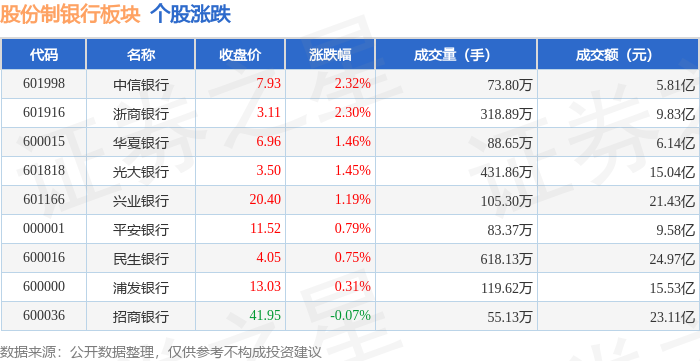
股份制银行板块10月22日涨0.78%,中信银行领涨,主力资金净流出3.55亿元
Zheng Xing Xing Ye Ri Bao· 2025-10-22 08:19
证券之星消息,10月22日股份制银行板块较上一交易日上涨0.78%,中信银行领涨。当日上证指数报收于3913.76,下跌0.07%。深证成指报收于 12996.61,下跌0.62%。股份制银行板块个股涨跌见下表: | 代码 | 名称 | 收盘价 | 涨跌幅 | 成交量(手) | 成交额(元) | | --- | --- | --- | --- | --- | --- | | 66109 | 中信银行 | 7.93 | 2.32% | 73.80万 | 5.81亿 | | 601916 | 浙商银行 | 3.11 | 2.30% | 318.89万 | 9.83亿 | | 600015 | 华夏银行 | 6.96 | 1.46% | 88.65万 | 6.14亿 | | 601818 | 光大银行 | 3.50 | 1.45% | 431.86万 | 15.04亿 | | 601166 | 兴业银行 | 20.40 | 1.19% | 105.30万 | 21.43亿 | | 000001 | 平安银行 | 11.52 | 0.79% | 83.37万 | 9.58亿 | | 600016 | 民生银行 | 4 ...




“脱核”模式破局,民生银行“反内卷”战略打造增长新范式
Sou Hu Cai Jing· 2025-10-22 06:48
Core Viewpoint - During the "14th Five-Year Plan" period, the complex international situation has prompted the banking industry in China to actively pursue transformation and high-quality development, with a focus on reform and innovation to enhance operational vitality [1]. Financial Performance - In the first half of the year, the bank achieved operating income of 72.384 billion yuan, an increase of 5.257 billion yuan, or 7.83% year-on-year [2]. - The net interest margin stood at 1.39%, up by 1 basis point year-on-year, supported by improved funding costs and growth in interest-earning assets [2]. - Non-interest income reached 23.181 billion yuan, a year-on-year increase of 4.636 billion yuan, or 25%, accounting for 32.03% of total operating income, up by 4.40 percentage points [3]. Business Strategy - The bank emphasizes a customer-centric approach, enhancing financial asset management and promoting non-interest income growth through transaction banking and investment trading [3]. - The bank is committed to optimizing its asset-liability structure and improving management levels to maintain stable net interest margins [2]. Risk Management - The bank has strengthened its risk preference transmission and improved its internal control management system, focusing on coordinated development of scale, structure, quality, efficiency, and safety [4]. - It has implemented proactive risk prevention measures and increased efforts in recovering non-performing assets to maintain overall asset quality stability [4]. Cross-Border Financial Services - The bank has developed a digitalized cross-border service ecosystem, offering solutions like "instant account crediting" and "integrated collection and payment" to enhance efficiency for export enterprises [7]. - In the first half of the year, the bank served over 24,000 small and micro foreign trade enterprises, a year-on-year increase of 12.49%, addressing diverse financial needs in the new foreign trade landscape [7]. Future Outlook - The bank aims to maintain strategic focus, deepen customer-centric operations, and avoid "involution" competition, while reinforcing customer management and optimizing asset-liability management to drive sustainable high-quality development [7].