CMBC(600016)

Search documents
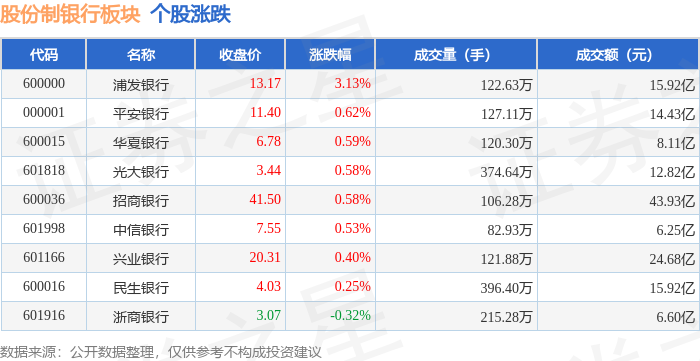
股份制银行板块10月15日涨0.72%,浦发银行领涨,主力资金净流入1.92亿元
Zheng Xing Xing Ye Ri Bao· 2025-10-15 08:37
从资金流向上来看,当日股份制银行板块主力资金净流入1.92亿元,游资资金净流入4288.04万元,散户 资金净流出2.35亿元。股份制银行板块个股资金流向见下表: 证券之星消息,10月15日股份制银行板块较上一交易日上涨0.72%,浦发银行领涨。当日上证指数报收 于3912.21,上涨1.22%。深证成指报收于13118.75,上涨1.73%。股份制银行板块个股涨跌见下表: | 代码 | 名称 | 收盘价 | 涨跌幅 | 成交量(手) | 成交额(元) | | --- | --- | --- | --- | --- | --- | | 600000 | 浦发银行 | 13.17 | 3.13% | 122.63万 | 15.92 Z | | 000001 | 平安银行 | 11.40 | 0.62% | 127.11万 | 14.43亿 | | 600015 | 华夏银行 | 6.78 | 0.59% | 120.30万 | 8.11亿 | | 601818 | 光大银行 | 3.44 | 0.58% | 374.64万 | 12.82亿 | | 600036 | 招商银行 | 41.50 | 0.58% | ...







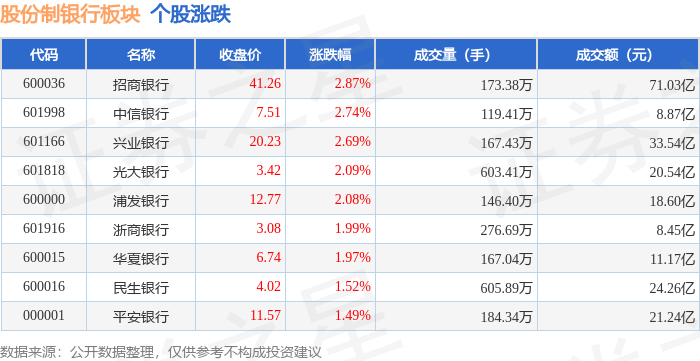
股份制银行板块10月14日涨2.41%,招商银行领涨,主力资金净流入1.47亿元
Zheng Xing Xing Ye Ri Bao· 2025-10-14 08:41
证券之星消息,10月14日股份制银行板块较上一交易日上涨2.41%,招商银行领涨。当日上证指数报收于3865.23,下跌0.62%。深证成指报收于 12895.11,下跌2.54%。股份制银行板块个股涨跌见下表: (产品代码: 159601) | 代码 | 名称 | 收盘价 | 涨跌幅 | 成交量(手) | 成交额(元) | | --- | --- | --- | --- | --- | --- | | 600036 | 指商银行 | 41.26 | 2.87% | 173.38万 | 71.03亿 | | 866100 | 中信银行 | 7.51 | 2.74% | 119.41万 | 8.87亿 | | 601166 | 兴业银行 | 20.23 | 2.69% | 167.43万 | 33.54Z | | 601818 | 光大银行 | 3.42 | 2.09% | 603.41万 | 20.54亿 | | 600000 | 浦发银行 | 12.77 | 2.08% | 146.40万 | 18.60亿 | | 601916 | 浙商银行 | 3.08 | 1.99% | 276.69万 | 8.45 ...

一心堂药业集团股份有限公司 关于控股子公司四川本草堂药业有限公司向银行申请 授信额度提供担保的进展公告
Zhong Guo Zheng Quan Bao - Zhong Zheng Wang· 2025-10-14 05:26
Summary of Key Points Core Viewpoint - The company has provided a joint liability guarantee for its subsidiary, Sichuan Bencao Tang Pharmaceutical Co., Ltd., which has a debt-to-asset ratio exceeding 70%, indicating potential risks associated with the guarantee [2][11]. Group 1: Guarantee Overview - The company approved a guarantee for Sichuan Bencao Tang to apply for a comprehensive credit limit of up to 1.368 billion RMB for financing needs [2][4]. - A maximum guarantee contract was signed with China Minsheng Bank Chengdu Branch, with the principal amount guaranteed being up to 100 million RMB [3][10]. Group 2: Subsidiary Information - Sichuan Bencao Tang Pharmaceutical Co., Ltd. is a wholly-owned subsidiary with a registered capital of 125 million RMB, established on August 16, 2004 [5][6]. - The company holds a 56% stake in Sichuan Bencao Tang, which is engaged in various pharmaceutical and healthcare-related activities [6][7]. Group 3: Guarantee Agreement Details - The guarantee covers the principal debt, interest, penalties, and all costs associated with enforcing the debt and guarantee rights [8]. - The guarantee period is three years from the maturity date of each debt under the main contract [9]. Group 4: Necessity and Reasonableness of Guarantee - The guarantee is deemed necessary for the subsidiary's daily operations, with other shareholders providing counter-guarantees [11]. - The subsidiary is considered to have a normal debt repayment capacity, and the risks associated with the guarantee are manageable [11]. Group 5: Cumulative External Guarantee Amount - After this guarantee, the total external guarantee amount by the company and its subsidiaries is 1.28227 billion RMB, with a total balance of 903.1863 million RMB, accounting for 11.80% of the company's audited net assets for 2024 [12].


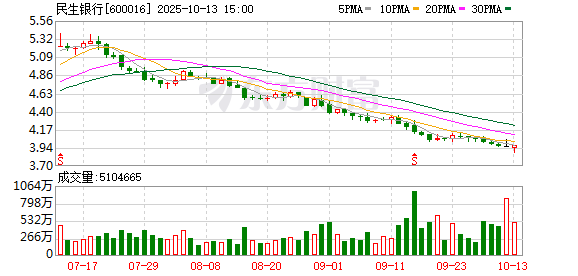
民生银行大宗交易成交130.68万元
Zheng Quan Shi Bao Wang· 2025-10-13 14:12
Core Insights - Minsheng Bank executed a block trade on October 13, with a volume of 330,000 shares and a transaction value of 1.3068 million yuan, at a price of 3.96 yuan per share [2][3] - The stock has seen a total of 8 block trades in the past three months, amounting to a total transaction value of 307 million yuan [2] - The closing price of Minsheng Bank on the same day was 3.96 yuan, reflecting a 0.25% increase, with a daily turnover rate of 1.44% and a total trading volume of 2.004 billion yuan [2] Trading Activity - The buyer of the block trade was Huatai Securities Co., Ltd. Headquarters, while the seller was Huatai Securities Co., Ltd. Taizhou Xinghua Yingwu Middle Road Securities Business Department [2][3] - In the last five days, the stock has experienced a cumulative decline of 2.22%, with a total net outflow of funds amounting to 1.0 billion yuan [2] - The latest margin financing balance for the stock is 6.455 billion yuan, which has increased by 443 million yuan, representing a growth of 7.37% over the past five days [3] Company Background - China Minsheng Bank Co., Ltd. was established on February 7, 1996, with a registered capital of 43.78241 billion yuan [3]
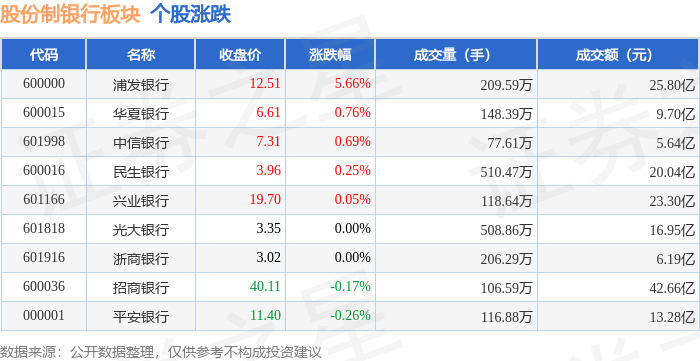
股份制银行板块10月13日涨0.86%,浦发银行领涨,主力资金净流出9484.54万元
Zheng Xing Xing Ye Ri Bao· 2025-10-13 12:45
| 代码 | 名称 | 收盘价 | 涨跌幅 | 成交量(手) | 成交额(元) | | --- | --- | --- | --- | --- | --- | | 600000 | 浦发银行 | 12.51 | 5.66% | 209.59万 | 25.80 乙 | | 600015 | 华夏银行 | 6.61 | 0.76% | 148.39万 | 9.70亿 | | 866109 | 中信银行 | 7.31 | 0.69% | 77.61万 | 5.64亿 | | 600016 | 民生银行 | 3.96 | 0.25% | 510.47万 | 20.04亿 | | 601166 | 兴业银行 | 19.70 | 0.05% | 118.64万 | 23.30 Z | | 601818 | 光大银行 | 3.35 | 0.00% | 508.86万 | 16.95 Z | | 601916 | 浙商银行 | 3.02 | 0.00% | 206.29万 | 6.19亿 | | 600036 | 招商银行 | 40.11 | -0.17% | 106.59万 | 42.66亿 | | 000001 | 平安 ...
首现国有大行关停信用卡App
21世纪经济报道· 2025-10-13 12:35
Core Viewpoint - The recent shutdown of credit card apps, particularly by major state-owned banks like Bank of China, reflects a broader trend in the banking industry towards consolidating digital services and reducing operational costs amid a shrinking credit card business [1][5][16]. Group 1: Credit Card App Shutdowns - Bank of China announced the gradual shutdown of its "Bountiful Life" app, migrating its functions to the main "Bank of China" app, which has drawn market attention [1][4]. - Several banks, including Shanghai Rural Commercial Bank and Beijing Rural Commercial Bank, have previously shut down their credit card apps, indicating a trend towards integrating these services into existing banking apps [5][6]. Group 2: Market Dynamics and User Engagement - The credit card app market is experiencing significant differentiation, with major state-owned banks and some joint-stock banks dominating user engagement metrics [7][8]. - As of June 2025, the top credit card apps by monthly active users include those from major banks, with Bank of China's "Bountiful Life" app ranking 13th with 1.5454 million active users, significantly lower than leading apps [7][8]. Group 3: Credit Card Loan Performance - State-owned banks maintain a strong position in credit card loan volumes, with China Construction Bank reporting a credit card loan scale of 1.0549 trillion yuan, the only bank exceeding 1 trillion yuan [9][10]. - Joint-stock banks also show robust performance, with China Merchants Bank's credit card loan balance reaching 924.49 billion yuan, accounting for 12.99% of its total loans [9][10]. Group 4: Digital Transformation and App Management - The closure of independent credit card apps is part of a broader strategy for centralized management of banking applications, as mandated by regulatory authorities to optimize user experience and reduce redundancy [16][17]. - Banks are increasingly focusing on comprehensive apps that integrate various financial services, moving away from multiple standalone apps to enhance operational efficiency and customer engagement [17].




民生银行今日大宗交易平价成交33万股,成交额130.68万元
Xin Lang Cai Jing· 2025-10-13 09:44
10月13日,民生银行大宗交易成交33万股,成交额130.68万元,占当日总成交额的0.07%,成交价3.96 元,较市场收盘价3.96元持平。 | 交易日期 | | 证券代码 | 成交价(元) 成交金额[万元) 成交量(*) 买入营业部 | | | 卖出营业部 | 是否为专场 | | --- | --- | --- | --- | --- | --- | --- | --- | | 025-10-13 | 民生银行 | 600016 | 3.96 130.68 | 33 | 会需还塑胶的有限 | 委會是需要求意識 | 超 | ...

账户变动免费提醒终结?多家银行门槛升至百元
Bei Ke Cai Jing· 2025-10-13 08:43
Core Viewpoint - Several banks in China have raised the threshold for transaction alert SMS notifications, encouraging customers to use mobile banking apps and online channels for notifications instead [1][2][4][5]. Summary by Sections Changes in SMS Notification Policy - Major banks, including state-owned and joint-stock banks, have increased the minimum amount for transaction alert SMS notifications to between 100 and 500 yuan [1][2]. - Guangdong Huaxing Bank announced it will stop sending SMS notifications for transactions below 500 yuan starting September 16, 2025 [2]. - Hubei Bank raised its SMS notification threshold to 100 yuan from the previous 10 yuan, effective March 27, 2025 [2]. - Bank of China will adjust its SMS notification threshold to 100 yuan for customers enjoying lifetime free SMS notifications starting April 17, 2025 [2]. - Minsheng Bank will discontinue certain SMS services for personal debit card accounts starting January 1, 2025 [3]. Digital Transformation and Cost Management - The adjustments are part of a broader digital transformation strategy, aiming to guide customers towards using mobile banking apps and online services for transaction alerts [5][9]. - Banks are facing pressure from narrowing net interest margins and are implementing cost control measures, including raising the SMS notification threshold [5][6]. - The increase in the threshold is seen as a way to optimize resource allocation, focusing on high-value customers and high-risk transactions [5][6]. Customer Impact and Alternatives - The changes are expected to have minimal impact on most customers, as they can still receive notifications through mobile banking apps or WeChat accounts for free [9][10]. - There is a concern that older customers may face challenges due to a lack of familiarity with digital tools, suggesting that banks should maintain low-threshold SMS services for this demographic [10]. - Customers are encouraged to utilize mobile banking features for transaction alerts and to regularly check account details to monitor for unusual transactions [10].
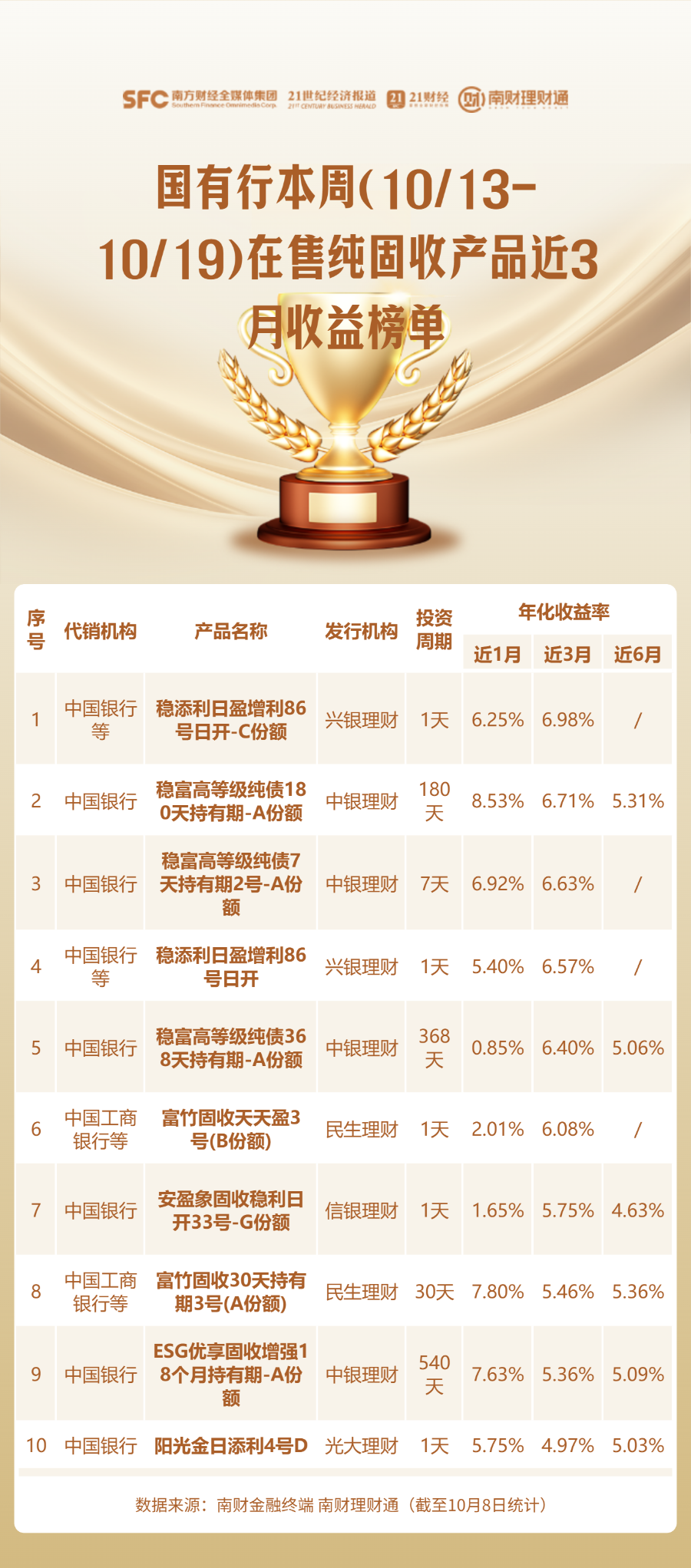
银行渠道本周在售纯固收理财产品榜单(10/13-10/19)
2 1 Shi Ji Jing Ji Bao Dao· 2025-10-13 01:16
Core Insights - The article discusses the diverse range of bank wealth management products available, emphasizing the need for investors to discern and select suitable options amidst similar-sounding and vaguely characterized products [1] - The South Finance Wealth Management team compiles a weekly performance ranking of wealth management products sold through various distribution channels, focusing on those with outstanding performance [1] - The ranking criteria include product type, specifically targeting pure fixed income, "fixed income plus," and mixed products, along with performance stability, requiring a minimum of three months of performance data [1] Product Performance Summary - The ranking showcases annualized performance over the past month, three months, and six months, sorted by the three-month annualized return to reflect multidimensional performance during recent market fluctuations [1] - The current focus is on pure fixed income products issued by wealth management companies, highlighting those available for investors through distribution channels [1] Distribution Institutions - A total of 28 distribution institutions are mentioned, including major banks such as Industrial and Commercial Bank of China, Bank of China, Agricultural Bank of China, and others [2] - The ranking's assessment of the "on-sale" status of wealth management products is based on their investment cycle, but actual availability may vary due to factors like sold-out quotas or differences in product listings for different customers [2] Performance Data - The article provides specific performance data for various wealth management products, including annualized returns and investment periods, with notable products listed from institutions like Bank of China and Minsheng Bank [5][7][10] - For instance, products from Bank of China show annualized returns ranging from 5.40% to 8.53% over different holding periods, indicating competitive performance in the current market [5][10]


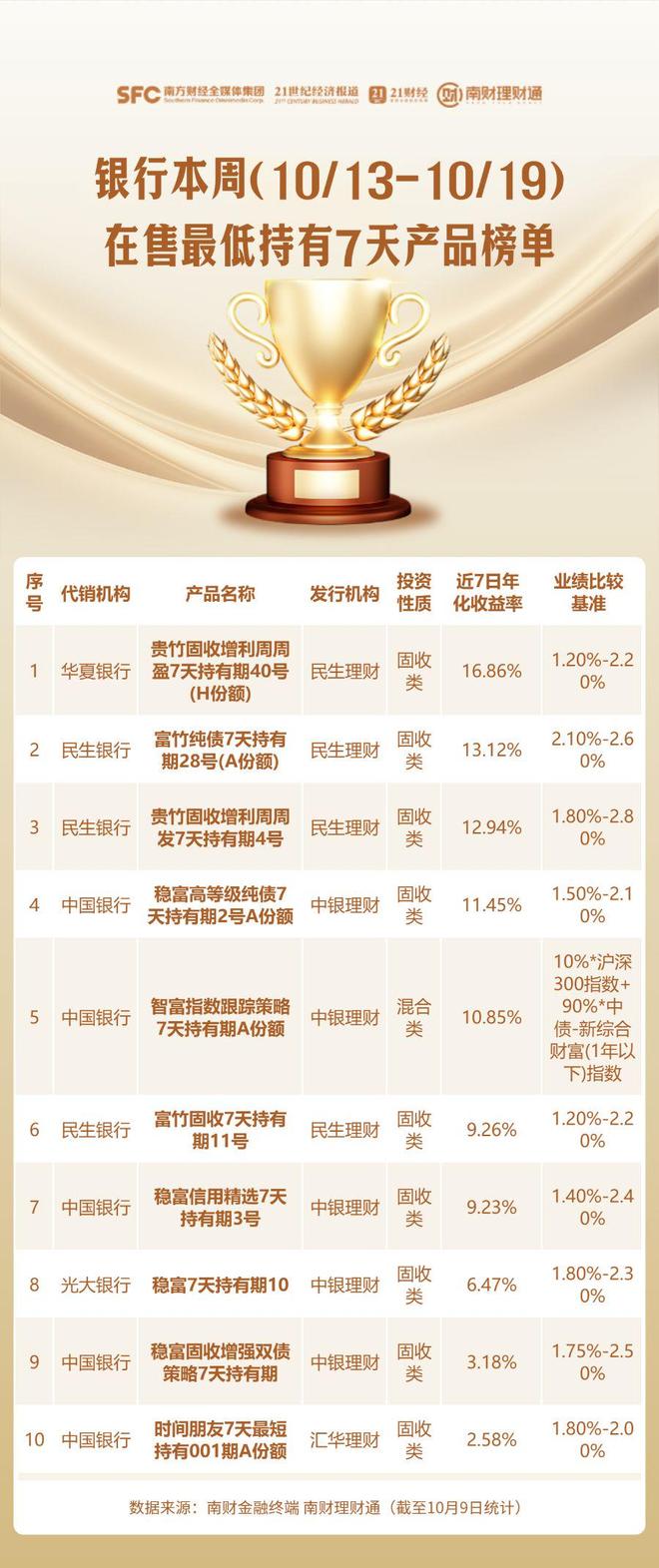
银行渠道本周在售最低持有期产品榜单(10/13-10/19)
2 1 Shi Ji Jing Ji Bao Dao· 2025-10-13 01:09
Core Insights - The article focuses on the performance of bank wealth management products with varying minimum holding periods, specifically highlighting the annualized returns of these products to assist investors in making informed choices [1][2]. Summary by Categories 7-Day Holding Period Products - The top-performing product is from Huaxia Bank, with an annualized return of 16.86% [4]. - Other notable products include: - Minsheng Bank's "Fuzhu Pure Bond" at 13.12% [4]. - Minsheng Bank's "Guizhu Fixed Income" at 12.94% [4]. - Bank of China’s "Stable Wealth High-Grade Pure Bond" at 11.45% [4]. 14-Day Holding Period Products - Minsheng Bank's "Guizhu Fixed Income" leads with a return of 13.71% [7]. - Other significant products include: - Minsheng Bank's "Fuzhu Pure Bond" at 10.97% [7]. - Bank of China's "Stable Wealth Fixed Income" at 9.67% [7]. 30-Day Holding Period Products - Minsheng Bank's "Fuzhu Pure Bond" has an annualized return of 9.51% [9]. - Other key products include: - Minsheng Bank's "Guizhu Fixed Income" at 8.99% [10]. - Bank of China's "Stable Wealth Preferred" at 7.13% [10]. 60-Day Holding Period Products - Bank of China's "Smart Wealth Index Tracking Strategy" tops the list with a return of 23.99% [12]. - Other notable products include: - Minsheng Bank's "Fuzhu Pure Bond" at 7.48% [12]. - Bank of China's "Stable Wealth Credit Selection" at 6.31% [12].