
Sinopec Corp.(600028)

Search documents
当2.8万亿能源巨无霸降临
经济观察报· 2026-01-18 05:54
Core Viewpoint - The restructuring of China Petroleum & Chemical Corporation (Sinopec) and China Aviation Oil (China National Aviation Fuel Group) aims to create a powerful national entity capable of competing with international energy giants, driven by the dual goals of carbon neutrality and supply chain autonomy [2][4][6]. Group 1: Restructuring Overview - The merger combines Sinopec's extensive refining capabilities with China Aviation Oil's nationwide airport network, creating a comprehensive supply chain from refinery to fuel pump [2][3]. - The restructuring is not merely a scale expansion but focuses on "professional integration" to enhance efficiency and cost competitiveness across the entire aviation fuel industry [4][5]. - A clear timeline and task requirements have been set by the State-owned Assets Supervision and Administration Commission (SASAC) to ensure effective integration and realization of synergies [6]. Group 2: Operational Changes - Following the announcement, both companies initiated immediate actions, including establishing daily information sharing mechanisms and forming joint teams to identify overlapping and complementary resources [8][9]. - The integration aims to streamline logistics and production planning, potentially optimizing supply chain efficiency by reducing intermediary steps [10][12]. - In regions with existing infrastructure, such as the Guangdong-Hong Kong-Macao Greater Bay Area, teams are conducting on-site assessments to create direct supply networks from refineries to airports [14]. Group 3: Market Impact on Midstream Players - The merger has raised concerns among midstream players, including small refining companies and independent traders, who fear losing market share as China Aviation Oil may prioritize Sinopec's supply [17][18]. - Some companies are exploring alliances with other large refiners to enhance their bargaining power and are reassessing direct supply options to airports [19][21]. - The restructuring is expected to lead to a market reshuffle, pushing smaller firms towards specialization and service-oriented business models [24]. Group 4: User Perspective - Major airlines are closely monitoring the restructuring, as aviation fuel costs represent over 30% of their total operating expenses [27]. - While the integration may enhance supply stability and reduce costs, airlines are concerned about diminished bargaining power against a unified supplier [28][29]. - Airlines are exploring alternative supply channels and considering sustainable aviation fuel (SAF) as a strategic component in future negotiations [32][33]. Group 5: Regulatory and Environmental Considerations - The new entity's dominance in the aviation fuel market raises concerns about potential anti-competitive practices, prompting expectations of regulatory scrutiny [35][36]. - The merger is anticipated to accelerate the aviation industry's transition to greener fuels, with both companies leveraging their respective strengths in SAF development and distribution [37][38]. - SASAC views this restructuring as a model for deeper state-owned enterprise reform, emphasizing the need for effective regulatory oversight to ensure fair competition and environmental responsibility [38].



国资委公开80多家央企负责人薪酬
Sou Hu Cai Jing· 2026-01-17 13:14
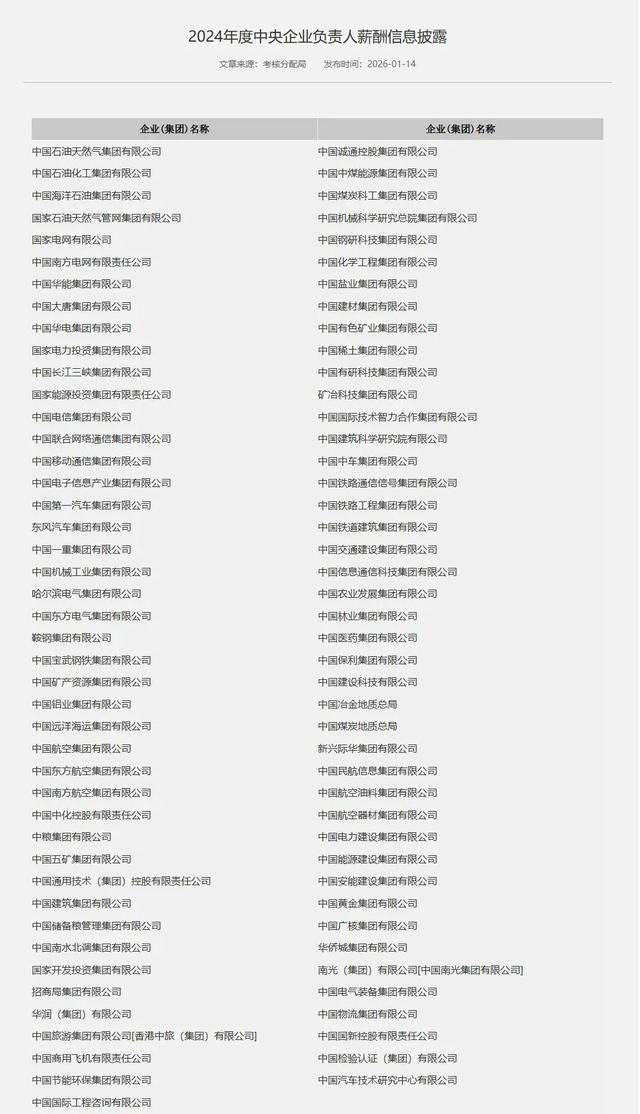
Core Viewpoint - The State-owned Assets Supervision and Administration Commission (SASAC) disclosed the salary information of over 80 central enterprise leaders for the year 2024, indicating a stable salary range without extreme high salaries, showcasing significant industry differentiation [1][5]. Group 1: Salary Disclosure - The disclosure of salary information is part of SASAC's ongoing efforts to enhance transparency in key areas and respond to public concerns [2]. - The overall salary of central enterprise leaders in 2024 remains within a stable range, characterized by "top leaders leading, median concentration, and low compliance," with no extreme high salary phenomena observed [5]. Group 2: Salary Rankings - The top tier of salaries is dominated by leaders from telecommunications and energy central enterprises, with China Mobile's former chairman Yang Jie leading with a pre-tax salary of 1.2582 million yuan, followed by China Telecom and China Unicom chairmen with salaries of 1.2160 million yuan and 1.2101 million yuan respectively [6]. - In the energy sector, PetroChina's chairman Dai Houliang and general manager Hou Qijun both have an annual salary of 978,500 yuan, ranking first among energy central enterprises [7]. - Other notable salaries include China Huaneng Group's chairman Wen Shugang at 961,700 yuan and State Power Investment Corporation's chairman Yu Bing at 953,700 yuan, both of whom are also in the top tier [8]. Group 3: Salary Distribution - The second tier includes core central enterprises in electricity, construction, and automotive industries, with notable figures such as State Grid's chairman Zhang Zhigang earning 735,000 yuan and China National Nuclear Corporation's chairman Yang Changli earning 930,000 yuan [15]. - The third tier consists of central enterprises with strong public welfare attributes, such as China Forestry Group's chairman Shan Zhongli and Overseas Chinese Town Group's chairman Zhang Zhenggao, both earning 438,500 yuan, which is below the average level for central enterprises [16]. Group 4: Salary Variability - Within the same industry, the salary differences among central enterprise executives are manageable, with the highest annual salary for energy central enterprise chairmen (PetroChina at 978,500 yuan) and the lowest (National Pipeline Network at 872,900 yuan) showing a difference of about 100,000 yuan [20].



供应过剩担忧下,美伊局势发酵驱动油价窄幅震荡
Minsheng Securities· 2026-01-17 09:09
Investment Rating - The report maintains a "Buy" rating for the following companies: China National Petroleum Corporation (PetroChina), China National Offshore Oil Corporation (CNOOC), Sinopec Limited, Zhongman Petroleum, and New Natural Gas [2][3]. Core Insights - The report highlights that geopolitical tensions, particularly between the US and Iran, are driving oil prices to fluctuate within a narrow range, with a slight increase observed in the past week. The market is currently facing concerns over supply surplus, which is expected to dominate oil price movements in the short term [7][10]. - The report suggests three main investment themes: 1. Focus on industry leaders with stable performance and high dividends, specifically PetroChina and Sinopec. 2. CNOOC is recommended due to its low production costs and consistent output growth, which enhances earnings certainty. 3. New Natural Gas and Zhongman Petroleum are highlighted for their growth potential in production, supported by domestic policies encouraging oil and gas exploration [12][13]. Summary by Sections 1. Weekly Insights - The report discusses the impact of the US-Iran situation on oil prices, noting a slight increase in Brent crude prices to $64.13 per barrel, up 1.25% week-on-week, and WTI prices at $59.44 per barrel, up 0.54% [11][12]. 2. Market Performance - As of January 16, the oil and petrochemical sector saw a slight decline of 0.4%, while the broader market (CSI 300) fell by 0.6%. The report notes that the petrochemical sector outperformed the CSI 300 index [15][17]. 3. Industry Dynamics - The report outlines various geopolitical events affecting oil supply, including disruptions in Kazakhstan and developments in Venezuela's oil production. It also mentions the expected oil production figures from Azerbaijan for 2025 [24][25]. 4. Company Performance - The report lists the top-performing companies in the petrochemical sector, with Bohai Chemical leading with a 15.54% increase, while Shengtong Energy experienced the largest decline at 14.94% [21][22]. 5. Oil and Gas Price Tracking - The report provides detailed tracking of oil and gas prices, indicating fluctuations in both futures and spot prices. For instance, NYMEX natural gas futures closed at $3.11 per million British thermal units, down 1.02% week-on-week [50][51].


中石化申请二甲苯液相异构化方法专利,提高对二甲苯选择性和收率
Sou Hu Cai Jing· 2026-01-17 04:39
Group 1 - The State Intellectual Property Office of China shows that Sinopec has applied for a patent titled "A Method for Liquid Phase Isomerization of Xylene," with publication number CN121318652A, and the application date is July 2024 [1] - The patent describes a method for liquid phase isomerization of xylene, which involves contacting carbon eight aromatic materials with a catalyst under hydrogen gas conditions, using a catalyst that includes ZSM-5 molecular sieve and transition metals [1] - The method can be conducted under relatively mild conditions, reducing the occurrence of side reactions, thereby improving the selectivity and yield of xylene [1] Group 2 - Sinopec, established in 2000 and located in Beijing, primarily engages in oil and gas extraction, with a registered capital of 12,173,968.9893 million RMB [1] - The company has invested in 269 enterprises, participated in 5,000 bidding projects, and holds 45 trademark records and 5,000 patent records, along with 41 administrative licenses [1] - Sinopec Shanghai Petrochemical Research Institute, established in 2022 in Shanghai, focuses on research and experimental development, with a registered capital of 49,800 million RMB [2] - The research institute has invested in 2 enterprises, participated in 2,710 bidding projects, and holds 861 patent records, along with 133 administrative licenses [2]
能源“巨无霸”启航
Jing Ji Guan Cha Wang· 2026-01-16 23:51
Core Viewpoint - The restructuring of China Petroleum & Chemical Corporation (Sinopec) and China Aviation Oil Holding Company (China Aviation Oil) aims to create a powerful entity in the energy sector, enhancing competitiveness on a global scale while aligning with China's dual carbon goals and ensuring supply chain autonomy [2][4]. Group 1: Restructuring Details - The restructuring announcement marks the beginning of a significant integration process, combining Sinopec's refining capabilities with China Aviation Oil's extensive airport network [2][3]. - A core principle of the restructuring is "professional integration," focusing on optimizing supply chain efficiency rather than merely expanding scale [3][4]. - Both companies have initiated the integration of production and procurement systems, forming working groups to streamline operations and enhance supply chain efficiency [2][5][6]. Group 2: Industry Impact - The restructuring is expected to shift competition in the aviation fuel market from channel-based competition to a comprehensive competition based on efficiency and cost across the entire supply chain [4][21]. - Smaller refining companies and independent traders are feeling pressure as the new entity may prioritize Sinopec's production capabilities, potentially reducing orders from these smaller players [13][19]. - Some companies are exploring partnerships or alliances to enhance their bargaining power in the evolving market landscape [13][19]. Group 3: User Perspective - Airlines are closely monitoring the restructuring, as aviation fuel costs represent over 30% of their total operating costs, and any changes in the supply chain could significantly impact their profitability [21][22]. - While the integration may enhance supply stability and reduce costs, airlines are concerned about their bargaining power being diminished due to the consolidation of suppliers [21][22]. - Airlines are also exploring alternative supply channels and considering sustainable aviation fuel (SAF) as a key variable in future negotiations [25][26]. Group 4: Regulatory Considerations - The new entity is expected to face scrutiny regarding market competition, with potential antitrust reviews to ensure fair practices and prevent monopolistic behaviors [27][28]. - The restructuring is seen as a critical step in China's broader state-owned enterprise reform, with success measured not just by financial metrics but by the optimization of the entire value chain [30][31].

中国石化申请高熔体强度聚丙烯制备方法专利,实现提质增效的目标
Sou Hu Cai Jing· 2026-01-16 11:22
Group 1 - The core point of the article is that China Petroleum & Chemical Corporation (Sinopec) and Sinopec Yangzi Petrochemical Company have applied for a patent for a method to produce high melt strength polypropylene, which aims to enhance production efficiency without increasing energy consumption or material costs [1][2] Group 2 - The patent application, published as CN121319282A, was filed on July 2024 and describes a multi-reactor polymerization process that incorporates a crosslinking agent in the final reactor, which is a gas-phase polymerization reactor [1] - The production method allows for the simultaneous achievement of high melt strength polypropylene, eliminating the need for secondary processing that was previously required for crosslinking modification [1] Group 3 - Sinopec, established in 2000 and headquartered in Beijing, primarily engages in oil and gas extraction, with a registered capital of approximately 121.74 billion RMB [1] - Sinopec has invested in 269 companies, participated in 5000 bidding projects, and holds 5000 patent records along with 45 trademark registrations [1] Group 4 - Sinopec Yangzi Petrochemical Company, founded in 2006 and located in Nanjing, focuses on oil, coal, and other fuel processing, with a registered capital of approximately 156.51 billion RMB [2] - The company has invested in 13 enterprises, participated in 5000 bidding projects, and holds 1030 patent records along with 20 trademark registrations [2]
炼化及贸易板块1月16日跌1.61%,泰山石油领跌,主力资金净流出2.26亿元
Zheng Xing Xing Ye Ri Bao· 2026-01-16 09:00
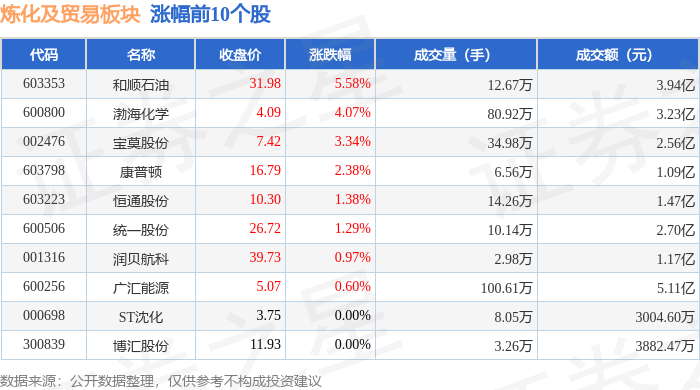
Market Overview - The refining and trading sector experienced a decline of 1.61% on January 16, with Taishan Petroleum leading the drop [1] - The Shanghai Composite Index closed at 4101.91, down 0.26%, while the Shenzhen Component Index closed at 14281.08, down 0.18% [1] Stock Performance - Notable gainers in the refining and trading sector included: - Heshun Petroleum (603353) with a closing price of 31.98, up 5.58% [1] - Bohai Chemical (600800) at 4.09, up 4.07% [1] - Baomo Co. (002476) at 7.42, up 3.34% [1] - Conversely, significant decliners included: - Taishan Petroleum (000554) at 6.84, down 3.39% [2] - Qixiang Tengda (002408) at 4.91, down 2.96% [2] - Tongkun Co. (601233) at 18.41, down 2.07% [2] Capital Flow - The refining and trading sector saw a net outflow of 226 million yuan from main funds, while speculative funds had a net inflow of 209 million yuan, and retail investors saw a net inflow of 17.16 million yuan [2] - Key stocks with significant capital flow included: - Baomo Co. (002476) with a main fund net inflow of 27.68 million yuan [3] - Guanghui Energy (600256) with a main fund net inflow of 25.49 million yuan [3] - Bohai Chemical (600800) with a main fund net inflow of 23.69 million yuan [3]


中国石化与佛瑞亚集团资本携手驱动中国氢能产业发展
Zhong Guo Qi Che Bao Wang· 2026-01-16 03:52
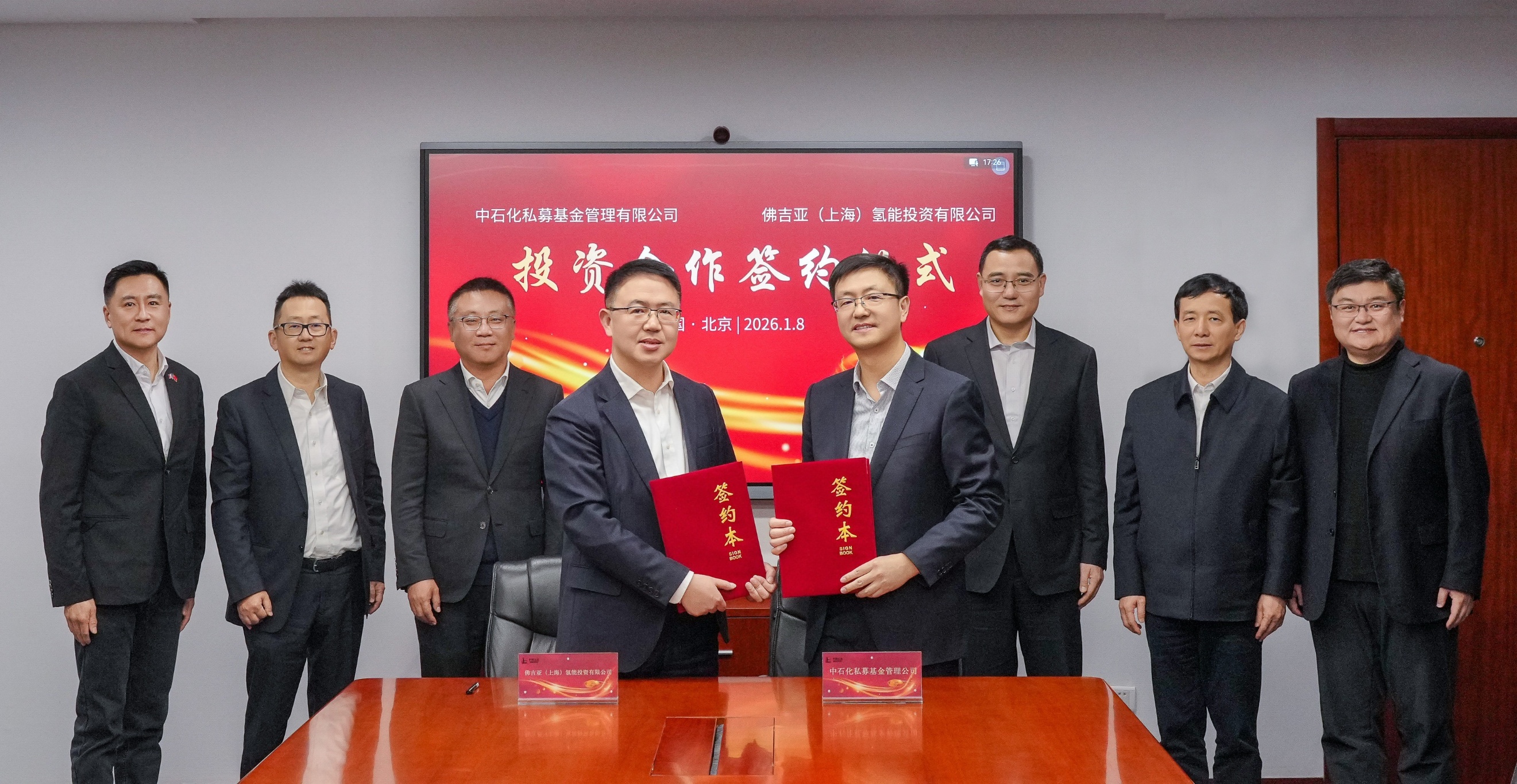
Group 1 - The strategic investment of 300 million RMB (approximately 40 million Euros) by Sinopec Capital through its private equity fund into Forvia's hydrogen investment arm in China highlights the commitment to optimizing the hydrogen market in China, which is experiencing rapid growth supported by government initiatives [1][3] - The partnership with Sinopec Capital is expected to enhance Forvia Hydrogen's market positioning and improve its capabilities in securing key government projects and industry collaboration [3][4] - Forvia aims to leverage this collaboration to create a clear roadmap for accelerated growth and value creation by optimizing its supply chain, including materials like carbon fiber and resin [3] Group 2 - Forvia's executives emphasized that this collaboration will help expand their market presence in China, improve cost competitiveness, and position them among global leaders in hydrogen solutions [4] - Sinopec Capital's leadership expressed a commitment to becoming the leading hydrogen company in China and aims to foster extensive equity investment collaborations with top global hydrogen enterprises [4] - The strategic investment is seen as a step towards promoting high-quality development in the global hydrogen industry through deep business cooperation between the two companies [4]
企地同心相助新疆群众
Zhong Guo Hua Gong Bao· 2026-01-16 03:01
Core Viewpoint - The company, Sinopec, has demonstrated its commitment to social responsibility by providing financial support for health insurance to impoverished residents in Xinjiang, showcasing a strong bond between the company and the local community [1][4]. Group 1: Company Actions - The Xinjiang project team of Sinopec initiated a fundraising campaign after discovering that over 50 local residents could not afford the "Huimin Bao" health insurance due to financial difficulties [2][3]. - Within two days, the project team raised 5,000 yuan to cover the insurance costs for these residents, ensuring that vulnerable groups could access necessary healthcare [3]. Group 2: Community Impact - The local government expressed gratitude for the company's actions, highlighting the positive impact on the community and the importance of such initiatives in alleviating poverty and supporting health [4]. - The project team views their efforts as part of their responsibility to the local population, emphasizing the importance of mutual support and community engagement in their operations [4].
中原塔里木90107井队“深地工程”夺标杆
Zhong Guo Hua Gong Bao· 2026-01-16 02:29
Core Viewpoint - Sinopec Northwest Oilfield's Tarim Branch's 90107 drilling team has been recognized as a benchmark in "deep earth engineering" by achieving the top ranking in the 2025 annual performance assessment for contracted commercial operations [1] Group 1: Performance Achievements - The 90107 drilling team has consistently participated in "deep earth engineering" projects, successfully completing three key wells, including SHZ4-7X, with depths exceeding 8000 meters in 2025 [1] - During the construction of the SHZ4-7X well, the team set a record with a drilling cycle of 59.62 days, marking the shortest construction period for a third-level structure well in the Shunbei area [1] - The SHBL2-1 well drilled by the team achieved a remarkable single-day drilling progress of 2121 meters during the second opening phase, setting the highest single-day advancement record in the Shunbei block [1]