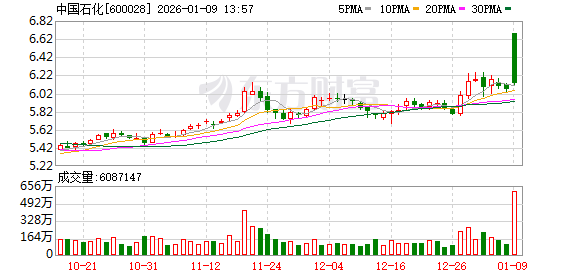
Sinopec Corp.(600028)

Search documents
3亿元!中国石化资本投资佛吉亚氢能
Sou Hu Cai Jing· 2026-01-09 07:25
Core Insights - China Petrochemical Corporation (Sinopec) has made a strategic investment of 300 million RMB (approximately 40 million Euros) in Faurécia (Shanghai) Hydrogen Investment Co., marking a significant step in the hydrogen energy sector [1] - The partnership aims to develop a mutually beneficial industrial ecosystem and enhance the high-quality development of the hydrogen energy industry [1] Investment Details - The investment is managed by Sinopec Capital through its hydrogen fund, which is the largest fund focused on the hydrogen industry chain in China [1] - Sinopec has invested in 13 companies across the hydrogen industry chain, including hydrogen production technology, fuel cells, and hydrogen station construction [1] Market Position and Growth - Faurécia Hydrogen is a leading provider of hydrogen solutions, offering storage solutions for various transportation and non-vehicle applications [2] - The company has obtained the first domestic production qualification for IV-type hydrogen storage bottles and is advancing the localization of its large-capacity IV-type hydrogen storage bottles [2] - The hydrogen industry has been elevated to a national priority in China, with hydrogen production expected to reach 36.5 million tons in 2024, a 3.5% increase from 2023 [2] Future Projections - By 2030, China aims to have 500,000 hydrogen fuel cell vehicles, with projections to exceed 1 million by 2035, supported by various government policies [3] - The collaboration with Sinopec Capital is expected to enhance Faurécia Hydrogen's market positioning and capabilities in securing key government projects [2][3] Strategic Goals - Sinopec aims to become the leading hydrogen company in China, leveraging its industrial chain to empower invested companies [3] - The partnership is expected to accelerate business growth for Faurécia Hydrogen and enhance its ability to provide innovative solutions in the Chinese market [3]

华泰证券:维持中国石化A/H“买入”评级 有望受益于重组后的一体化优势
Xin Lang Cai Jing· 2026-01-09 07:22
Core Viewpoint - The report from Huatai Securities indicates that the restructuring between Sinopec Group and China Aviation Oil, approved by the State Council, aims to integrate aviation fuel production and sales, enhance international competitiveness, and optimize the retail system for refined oil [1] Group 1: Restructuring Impact - If the restructuring is successfully implemented, it will streamline the aviation fuel supply chain and facilitate overseas aviation fuel trade [1] - The integration is expected to strengthen the international competitiveness of China's aviation fuel industry [1] Group 2: Company Benefits and Risks - Sinopec Limited is anticipated to benefit from the integrated supply chain, although it may face increased related-party transactions [1] - The refining and chemical sectors are expected to experience a rebound after reaching a profit low, leading to a potential recovery in company performance [1] Group 3: Investment Rating - The investment rating for Sinopec Limited is maintained at "Buy" for both A-shares and H-shares, with target prices set at 7.98 yuan and 6.26 HKD respectively [1]
FORVIA AND SINOPEC CAPITAL PARTNER TO ACCELERATE HYDROGEN GROWTH IN CHINA
Globenewswire· 2026-01-09 07:00
Core Insights - FORVIA has announced a minority investment in its hydrogen-focused subsidiary, FORVIA Hydrogen Solutions China, through a capital increase of RMB 300 million (approximately €40 million) with Sinopec Capital as a strategic partner [1][2] Group 1: Partnership and Strategic Positioning - The partnership with Sinopec Capital enhances FORVIA's position in the rapidly growing hydrogen market in China, which is supported by favorable government policies [2] - Sinopec Capital's involvement is expected to facilitate access to key government contracts and create industrial synergies for FORVIA Hydrogen Solutions [2][6] Group 2: Market Dynamics and Growth Potential - China's hydrogen energy sector is a national priority, integrated into the national energy management system, and aims to accelerate industrialization [3] - In 2024, China produced 36.5 million tons of hydrogen, a 3.5% increase from 2023, primarily for chemicals, with expanding applications in transport and steel [4] - China is the largest market for hydrogen fuel cell vehicles, with over 30,000 units sold and 559 refueling stations established, targeting 500,000 hydrogen vehicles by 2030 [4] Group 3: Value Creation and Future Outlook - The collaboration with Sinopec Capital is expected to create a clear roadmap for accelerated growth and value creation for FORVIA Hydrogen Solutions China through an optimized supply chain [5] - FORVIA aims to improve cost competitiveness and solidify its leadership in hydrogen solutions globally, contributing to China's energy transition [6][7] Group 4: FORVIA's Presence in China - As of December 2024, China accounts for 21% of FORVIA's global sales, approximately €5.9 billion, making it a strategic market for the company [8] - FORVIA operates 67 plants and 27 R&D centers in over 30 cities in China, employing more than 30,700 people, including 3,000 in R&D [8] - The company collaborates with over 40 international and Chinese OEMs, positioning itself as the 5th largest automotive supplier in China, where EV penetration is projected to reach 45% by 2030 [8]


FORVIA AND SINOPEC CAPITAL PARTNER TO ACCELERATE HYDROGEN GROWTH IN CHINA
Globenewswire· 2026-01-09 07:00
Core Insights - FORVIA has announced a minority investment in its hydrogen-focused subsidiary in China, FORVIA Hydrogen Solutions China, through a capital increase of RMB 300 million (approximately €40 million) with Sinopec Capital as a strategic partner [1][2] - The partnership aims to enhance FORVIA's position in the rapidly growing hydrogen market in China, which is supported by strong government policies [2][4] - China's hydrogen production reached 36.5 million tons in 2024, marking a 3.5% increase from 2023, with significant applications in chemicals, transport, and steel [4] Investment and Partnership - Sinopec Capital, a leader in China's hydrogen value chain, will provide industrial synergies and access to key government contracts for FORVIA Hydrogen Solutions China [2][6] - The collaboration is expected to accelerate growth and value creation through an optimized supply chain, including materials like carbon fiber and resins [5][6] Market Dynamics - The hydrogen energy sector is a national priority in China, integrated into the national energy management system alongside gasoline and natural gas [3] - China is the largest market for hydrogen fuel cell vehicles, with over 30,000 units sold and 559 refueling stations established [4] Strategic Goals - FORVIA aims to become a leader in hydrogen solutions globally and strengthen its position in China's energy transition through this partnership [6][7] - Sinopec Capital is committed to becoming 'China's No. 1 hydrogen company' and will pursue equity investment partnerships with leading hydrogen enterprises [7] FORVIA's Presence in China - As of December 2024, China accounted for 21% of FORVIA's global sales, totaling approximately €5.9 billion, making it a strategic market for the company [8] - FORVIA operates 67 plants and 27 R&D centers in China, employing over 30,700 people, including 3,000 in R&D [8]

大行评级|花旗:予中石化“买入”评级 中国油气行业首选股仍是中石油
Ge Long Hui· 2026-01-09 06:21
Core Viewpoint - Citigroup's research report indicates that Sinopec Group's restructuring with China Aviation Oil Group is expected to enhance Sinopec's development in aviation fuel and sustainable aviation fuel, benefiting its refining and sales business while alleviating the impact of declining structural demand for gasoline and diesel in China [1] Group 1: Restructuring and Strategic Implications - Sinopec's restructuring with China Aviation Oil Group is anticipated to strengthen its position in the aviation fuel sector [1] - The long-term demand growth for aviation fuel is considered resilient, prompting attention to potential synergies between Sinopec's aviation fuel business and China Aviation Oil [1] - It remains unclear whether Sinopec Group will absorb assets from China Aviation Oil Group or establish a new entity [1] Group 2: Market Position and Recommendations - Citigroup does not see an urgent need for Sinopec to restructure or inject assets at the listed company level [1] - The target price for Sinopec is set at HKD 5.2, with a "Buy" rating [1] - Citigroup's preferred stock in the Chinese oil and gas sector remains PetroChina, which is viewed positively for its strong dividend capability in a low oil price environment [1]

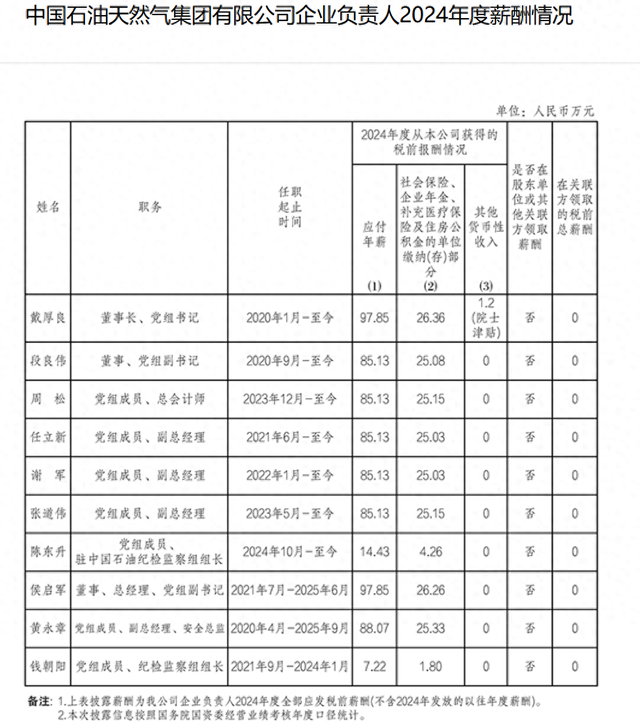
多家能源央企负责人2024年薪酬披露
Xin Lang Cai Jing· 2026-01-09 06:20
Summary of Key Points Core Viewpoint The recent disclosures from several major energy state-owned enterprises in China regarding the 2024 annual compensation of their executives reveal significant salary figures, reflecting the financial health and strategic priorities of these companies in the energy sector. Group 1: China National Petroleum Corporation (CNPC) - The chairman, Dai Houliang, received a pre-tax salary of 97.85 million RMB, with additional benefits totaling 26.36 million RMB [2] - Other executives, such as Duan Liangwei and Zhou Song, received pre-tax salaries of 85.13 million RMB, with similar additional benefits [2] - The total compensation for various executives includes social insurance, enterprise annuities, and supplementary medical insurance [2] Group 2: China Petroleum and Chemical Corporation (Sinopec) - Chairman Ma Qiansheng's pre-tax salary is reported at 93.55 million RMB, with additional benefits of 23.76 million RMB [3] - Other executives, including Zhang Shaofeng and Li Yonglin, received pre-tax salaries around 83 million RMB, with additional benefits in the range of 23 million RMB [3] - The compensation structure includes social insurance and other monetary income [3] Group 3: China National Offshore Oil Corporation (CNOOC) - Chairman Wang Dongjin's pre-tax salary is 96.69 million RMB, with additional benefits of 26.48 million RMB [5] - Other executives, such as Zhou Xinhai and Wang Rujia, received salaries between 80 million and 86 million RMB, with corresponding benefits [5] - The compensation details include social insurance and housing fund contributions [5] Group 4: China National Petroleum and Natural Gas Pipeline Group - Chairman Rong Wei's pre-tax salary is 87.29 million RMB, with additional benefits of 23.51 million RMB [7] - Other executives received salaries ranging from 6.55 million to 80.02 million RMB, with similar benefits [7] - The compensation includes social insurance and other monetary income [7] Group 5: China Huadian Corporation - Chairman Jiang Yi's pre-tax salary is reported at 96.11 million RMB, with additional benefits of 31.04 million RMB [12] - Other executives, including Ye Xiangdong and Zu Bin, received salaries around 86 million RMB, with substantial additional benefits [12] - The compensation structure includes social insurance and other monetary income [12] Group 6: China Huaneng Group - Chairman Wen Shugang's pre-tax salary is 96.17 million RMB, with additional benefits of 27 million RMB [9] - Other executives received salaries ranging from 40 million to 89 million RMB, with corresponding benefits [9] - The compensation includes social insurance and other monetary income [9] Group 7: China Datang Corporation - Chairman Zhong Yong's pre-tax salary is 92.21 million RMB, with additional benefits of 28.32 million RMB [11] - Other executives received salaries ranging from 6.9 million to 82.99 million RMB, with similar benefits [11] - The compensation structure includes social insurance and other monetary income [11] Group 8: China Longyuan Power Group - Chairman Liu Weiping's pre-tax salary is 61.15 million RMB, with additional benefits of 18.07 million RMB [15] - Other executives received salaries ranging from 45 million to 82 million RMB, with corresponding benefits [15] - The compensation includes social insurance and other monetary income [15] Group 9: Harbin Electric Corporation - Chairman Cao Zhishou's pre-tax salary is 79.11 million RMB, with additional benefits of 20.04 million RMB [17] - Other executives received salaries ranging from 17.80 million to 79.11 million RMB, with similar benefits [17] - The compensation structure includes social insurance and other monetary income [17]


2026央企重组“第一枪”,巨头崛起!
Zhong Guo Dian Li Bao· 2026-01-09 06:15
Core Viewpoint - The merger between Sinopec and China Aviation Oil marks a significant move in the energy sector, aiming to create a new giant in "green aviation fuel" while enhancing supply security and low-carbon competitiveness in the aviation industry [1][4]. Group 1: Merger Details - The merger was approved by the State Council on January 8, 2026, positioning Sinopec as the world's largest refining company and China Aviation Oil as Asia's largest aviation fuel service provider [1][2]. - China Aviation Oil has been involved in discussions regarding a merger since October 2025, with Sinopec identified as the potential acquirer of all its assets and operations [2][3]. - The merger is expected to streamline operations by reducing intermediaries and lowering supply costs, creating a strategic complementarity between the two companies [3][4]. Group 2: Market Context - The global aviation industry is experiencing a strong recovery, with aviation fuel demand projected to reach 389 million tons in 2025, a 3.9% increase year-on-year [2]. - By 2040, China's aviation fuel consumption is forecasted to grow from 3,928 million tons in 2024 to 7,500 million tons, highlighting the increasing demand for aviation fuel [3][4]. - The merger aims to enhance the competitiveness of China's aviation fuel sector, which currently faces challenges compared to integrated international oil companies like Shell and ExxonMobil [4][5]. Group 3: Green Transition - The merger is seen as a strategic move to strengthen the sustainable aviation fuel (SAF) industry, which is crucial for reducing carbon emissions in the aviation sector [5][6]. - Sinopec is recognized as a pioneer in SAF production in China, with its products already tested on domestic aircraft, offering a potential for over 50% reduction in carbon emissions compared to traditional aviation fuel [5][6]. - The collaboration between Sinopec and China Aviation Oil is expected to enhance R&D, industrialization, and international trade in SAF, promoting its adoption and continuous improvement [5][6].
2026年央企重组首单落地 中国石化“签手”中国航油
Ren Min Wang· 2026-01-09 05:57
Core Viewpoint - The restructuring of China Petroleum & Chemical Corporation (Sinopec) and China Aviation Oil Group (China Aviation Oil) is expected to enhance the competitiveness of China's aviation fuel industry and promote a green and low-carbon transition in the aviation sector [2][4]. Group 1: Company Overview - Sinopec is the world's largest refining company and China's largest aviation fuel producer, covering the entire energy industry chain including oil and gas exploration, refining, and equipment manufacturing [4]. - China Aviation Oil is Asia's largest integrated aviation fuel supply chain company, involved in procurement, transportation, storage, testing, sales, and refueling services [4]. Group 2: Strategic Implications - The merger is anticipated to lower aviation fuel supply costs and create a synergistic effect between refining and aviation fuel sectors, avoiding homogeneous competition [4][5]. - The restructuring aligns with the national strategy to optimize state-owned enterprises and enhance their core competitiveness, potentially leading to further professional integration across various sectors [5][6]. Group 3: Environmental Considerations - The partnership is expected to accelerate the commercialization of sustainable aviation fuel (SAF), aiding the aviation industry in achieving carbon reduction goals [5]. - The focus on low-carbon development in the civil aviation sector is increasingly important in response to global climate change, with SAF being a key measure for carbon emission reduction [4][5]. Group 4: Future Outlook - Future central enterprise restructuring will prioritize enhancing core competitive capabilities rather than merely increasing asset size, focusing on resilience and security in supply chains [6]. - The integration will likely delve into specific critical segments of the industry and high-end niche markets, fostering an open and collaborative industrial ecosystem [6].
“绿色航油”巨头崛起!中国石化、中国航油官宣重组
Zhong Guo Dian Li Bao· 2026-01-09 05:50
Core Viewpoint - The merger between China Petroleum & Chemical Corporation (Sinopec) and China Aviation Oil Group (China Aviation Oil) marks a significant strategic move in the energy sector, aiming to create a new giant in "green aviation fuel" while enhancing fuel supply security for the aviation industry and increasing low-carbon competitiveness in international markets [1][5][7]. Group 1: Merger Details - The merger was approved by the State Council and is seen as a collaboration between the world's largest refining company and Asia's largest aviation fuel service provider [1][3]. - China Aviation Oil is the largest integrated aviation fuel service provider in Asia, while Sinopec is the largest aviation fuel producer in China, covering various sectors including oil and gas, logistics, and aviation [3][4]. - The merger is expected to streamline operations and reduce costs by eliminating intermediaries, thus enhancing the efficiency of the entire supply chain from refining to distribution [4][6]. Group 2: Market Context - The global aviation industry is experiencing a strong recovery, with a projected demand for aviation fuel of 389 million tons in 2025, reflecting a year-on-year increase of 3.9% [3][4]. - By 2040, China's aviation fuel consumption is expected to grow from 39.28 million tons in 2024 to 75 million tons, indicating a significant increase in demand [4][6]. - The merger is a strategic response to the competitive landscape dominated by integrated oil and gas companies like Shell and ExxonMobil, which have established advantages in the aviation fuel market [6][7]. Group 3: Green Transition - The merger is positioned as a critical step towards enhancing the competitiveness of China's aviation fuel industry and promoting green transformation [5][7]. - Sustainable aviation fuel (SAF) is recognized as a key pathway for reducing carbon emissions in the aviation sector, with global SAF consumption projected to reach 1.8 million tons by 2030 [7]. - Sinopec is noted for being one of the first companies in China to produce SAF, which can reduce carbon emissions by over 50% compared to traditional aviation fuel [7][8]. Group 4: Strategic Implications - This merger is part of a broader initiative to optimize the layout of state-owned enterprises and concentrate state capital in critical industries related to national security and economic lifelines [8]. - The restructuring aligns with the strategic goals set forth by the State-owned Assets Supervision and Administration Commission (SASAC) to enhance the core functions and competitiveness of state-owned enterprises [8].
多家能源央企负责人2024年薪酬披露
中国能源报· 2026-01-09 05:43
Core Viewpoint - The article discusses the 2024 annual salary disclosures of executives from several major energy state-owned enterprises in China, highlighting the pre-tax remuneration and additional benefits for key personnel. Group 1: China National Petroleum Corporation (CNPC) - The chairman, Ma Yongsheng, has a pre-tax salary of 935,500 RMB, with additional social insurance and pension contributions totaling 237,600 RMB [3] - Other executives, such as Da Dong and Zhong Ren, also have salaries around 935,500 RMB and 842,000 RMB respectively, with similar additional benefits [3] Group 2: China Petroleum and Chemical Corporation (Sinopec) - Chairman Wang Dongjin's pre-tax salary is 966,900 RMB, with social insurance contributions of 264,800 RMB [5] - Other executives, including Zhou Xinhai and Wang Dehua, have salaries ranging from 289,200 RMB to 867,800 RMB, with similar additional benefits [5] Group 3: China National Offshore Oil Corporation (CNOOC) - Chairman Wang Dongjin earns 966,900 RMB, with social insurance contributions of 264,800 RMB [5] - Other executives have salaries from 14,510 RMB to 867,800 RMB, with additional benefits [5] Group 4: China Huaneng Group - Chairman Wen Shugang's pre-tax salary is 961,700 RMB, with social insurance contributions of 270,000 RMB [9] - Other executives, such as Zhang Wenfeng and Deng Jianling, have salaries ranging from 400,700 RMB to 860,000 RMB [9] Group 5: China Datang Corporation - Chairman Ren Jian's pre-tax salary is 922,100 RMB, with social insurance contributions of 283,200 RMB [11] - Other executives have salaries from 7,680 RMB to 824,900 RMB, with similar additional benefits [11] Group 6: China Huadian Corporation - Chairman Jiang Yi's pre-tax salary is 961,100 RMB, with social insurance contributions of 310,400 RMB [13] - Other executives have salaries ranging from 43,260 RMB to 865,000 RMB, with additional benefits [13] Group 7: China Longyuan Power Group - Chairman Liu Ming's pre-tax salary is 885,700 RMB, with social insurance contributions of 237,000 RMB [14] - Other executives have salaries from 7,250 RMB to 860,000 RMB, with similar additional benefits [14] Group 8: China Energy Investment Corporation - Chairman Yu Bing's pre-tax salary is 953,700 RMB, with social insurance contributions of 292,000 RMB [17] - Other executives have salaries ranging from 42,650 RMB to 850,000 RMB, with additional benefits [17] Group 9: China National Coal Group - Chairman Wang Shudong's pre-tax salary is 910,200 RMB, with social insurance contributions of 287,300 RMB [23] - Other executives have salaries from 15,170 RMB to 819,200 RMB, with similar additional benefits [23]