
Sinopec Corp.(600028)

Search documents
中国石化集团跟踪报告之五:两大石化集团实施战略重组,提升成品油、贸易全产业链竞争力
EBSCN· 2026-01-09 05:23
Investment Rating - The report maintains an "Accumulate" rating for the petrochemical industry [1] Core Views - The strategic restructuring between China Petroleum & Chemical Corporation (Sinopec) and China Aviation Oil Group aims to enhance the competitiveness of the refined oil and trade sectors across the entire industry chain [4][9] - Sinopec is recognized as the world's largest refining company and the second-largest chemical company, with a comprehensive business model that includes oil and gas, refining, chemicals, and finance [4] - The restructuring is aligned with the ongoing reforms in state-owned enterprises, focusing on optimizing the layout of state capital and enhancing core competitiveness [9] Summary by Sections Industry Overview - The global economic recovery faces challenges, with geopolitical risks rising and international oil prices fluctuating downwards, leading to significant supply-demand imbalances [4] - In 2024, Sinopec reported total revenue of 31,388 billion yuan, a decrease of 3.3% year-on-year, and a net profit of 578 billion yuan, down 13.0% year-on-year [4] Company Profiles - Sinopec operates four main business segments: oil and gas, refining and sales, chemicals and new materials, and capital and finance [4] - China Aviation Oil Group is the largest aviation fuel company in Asia, providing fuel supply services to 258 transport airports and 454 general airports across China [5][6] Strategic Developments - The merger will create a closed-loop industry chain for aviation kerosene, enhancing Sinopec's market power and reducing costs in the sales process [8] - The integration is expected to stabilize operations for China Aviation Oil Group by securing a reliable upstream supply from Sinopec [8] Investment Recommendations - The report suggests focusing on several companies under Sinopec, including: - Sinopec itself, as a leading integrated petrochemical enterprise [10] - Sinopec Engineering, leveraging platform advantages and overseas opportunities [10] - Sinopec Oilfield Services, benefiting from the oil service market [10] - Shanghai Petrochemical, with significant competitive advantages in refining [10] - Sinopec Mechanical, a quality supplier for oil and gas exploration equipment [10] - Sinopec Guande, exploring business transformation in logistics [10] - Taishan Petroleum, enhancing service platforms in refined oil distribution [10]

中国石化(600028):公司有望受益于重组后的一体化优势
HTSC· 2026-01-09 05:16
Investment Rating - The report maintains a "Buy" rating for both A and H shares of the company, with a target price of RMB 7.98 and HKD 6.26 respectively [6]. Core Insights - The proposed restructuring between Sinopec Group and China Aviation Oil is expected to enhance the competitiveness of China's aviation fuel industry by integrating aviation fuel production and sales, optimizing the retail system, and facilitating overseas trade [2][3]. - The demand for aviation fuel is anticipated to grow steadily due to the recovery in air travel and fleet expansion, which will support moderate growth in aviation fuel demand [3]. - The company is expected to benefit from the integration advantages post-restructuring, although it may face increased related-party transactions [3][4]. Summary by Sections Company Overview - Sinopec Group is the world's largest refining company and China's largest aviation fuel producer, with crude processing and aviation fuel production volumes of 186.4 million tons and 25.7 million tons respectively in the first three quarters of 2025, showing a year-on-year change of -2.2% and +6.5% [2]. Financial Forecasts - The net profit forecast for 2025 has been adjusted down to RMB 35.9 billion, a decrease of 2.3%. The net profit forecasts for 2026 and 2027 are maintained at RMB 46.3 billion and RMB 54.6 billion respectively, with corresponding EPS of RMB 0.30, 0.38, and 0.45 [4][10]. - The revenue for 2025 is projected to be RMB 297.3 billion, reflecting a year-on-year decline of 3.3% [10]. Valuation - The report assigns a price-to-earnings (P/E) ratio of 21.0x for A shares and 15.0x for H shares for 2026, based on the company's integrated advantages and transformation into new materials and non-oil businesses [4][11].
中石化取得有机膦化合物及阻燃纤维复合材料专利
Sou Hu Cai Jing· 2026-01-09 04:44
Group 1 - The State Intellectual Property Office of China has granted a patent to China Petroleum & Chemical Corporation for "Organic Phosphorus Compounds, Flame Retardant Fibers, Composite Material Compositions and Their Applications," with the announcement number CN119930690B and application date of November 2023 [1] - China Petroleum & Chemical Corporation, established in 2000 and based in Beijing, primarily engages in oil and gas extraction, with a registered capital of 12,173,968.9893 million RMB [1] - The company has invested in 268 enterprises, participated in 5,000 bidding projects, holds 45 trademark registrations, 5,000 patents, and possesses 41 administrative licenses [1] Group 2 - Sinopec Shanghai Petrochemical Company Limited, founded in 1993 and located in Shanghai, focuses on the oil, coal, and other fuel processing industries, with a registered capital of 1,054,261.75 million RMB [1] - The company has invested in 21 enterprises, engaged in 5,000 bidding projects, holds 51 trademark registrations, 1,352 patents, and has 12,791 administrative licenses [1]
美国欲驱逐中俄,独吞石油!中国在委内瑞拉有哪些重大项目?
Sou Hu Cai Jing· 2026-01-09 04:40
Group 1 - The core point of the article is that Trump has demanded Venezuela to sever all oil cooperation with China, Russia, Iran, and Cuba, aiming to transfer control of its oil resources to American capital [1] - China has significant investments in Venezuela, primarily through oil-for-loan agreements, which have facilitated large-scale oil development projects [1][3] - As of 2019, China's cumulative loans to Venezuela reached approximately $65 billion, with Venezuela repaying about $42 billion through oil, leaving a remaining debt of around $23 billion [1] Group 2 - China National Petroleum Corporation (CNPC) has invested over $30 billion in Venezuela, controlling major oil fields that account for 40% of Venezuela's total oil production [3] - Chinese companies have also constructed significant infrastructure in Venezuela, including power plants and refineries, with 60% of Venezuela's electricity supply coming from Chinese-built facilities [3][6] - The majority of infrastructure projects in Venezuela are contracted to Chinese companies, including telecommunications networks developed by ZTE and Huawei [6] Group 3 - Russia's involvement in Venezuela focuses on oil, natural gas, and gold extraction, while Iran has invested over $2 billion primarily in refining equipment and agricultural development [6] - Cuba provides labor to Venezuela, exchanging professionals for oil supplies, but China's investment and cooperation in Venezuela are unmatched by other countries [6][7] - The article suggests that regardless of future political changes in Venezuela, safeguarding Chinese investments and interests will be crucial to avoid scenarios similar to the Libyan conflict [7]



多领域亮点不断涌现 勾勒出经济高质量发展热力图景
Yang Shi Wang· 2026-01-09 04:27
《"人工智能+制造"专项行动实施意见》发布 工业和信息化部等八部门日前联合印发《"人工智能+制造"专项行动实施意见》,提出到2027年,中国人工智能关键核心技术实现安全可 靠供给,产业规模和赋能水平稳居世界前列,包括推出1000个高水平工业智能体,推广500个典型应用场景等。 央视网消息:通过数据看经济,透过经济看成就。新年伊始,多个领域亮点不断涌现,绘就高质量发展热力图景。 中国进出口银行最新数据显示,2025年,中国进出口银行新发放外贸领域贷款超1.2万亿元,全力支持外贸质升量稳。新发放制造业贷款 近8600亿元,重点支持了船舶与海洋工程装备、轨道交通装备、新材料、人形机器人等先进制造业。 商务部:以旧换新相关商品销售额达3.92万亿元 记者从商务部了解到,自2024年消费品以旧换新政策实施以来,相关商品销售额达3.92万亿元,惠及4.94亿人次。其中,汽车以旧换新超 1830万辆,家电以旧换新超1.92亿件,手机等数码产品购新超9100万部,牵引产业提质升级。 公安部:去年刑事案件立案数同比下降12.8% 公安部1月8日发布,2025年,全国公安机关共立刑事案件数同比下降12.8%,立案数再创本世纪以来 ...
FORVIA佛瑞亚集团与中国石化资本携手驱动中国氢能产业发展
Sou Hu Cai Jing· 2026-01-09 04:22
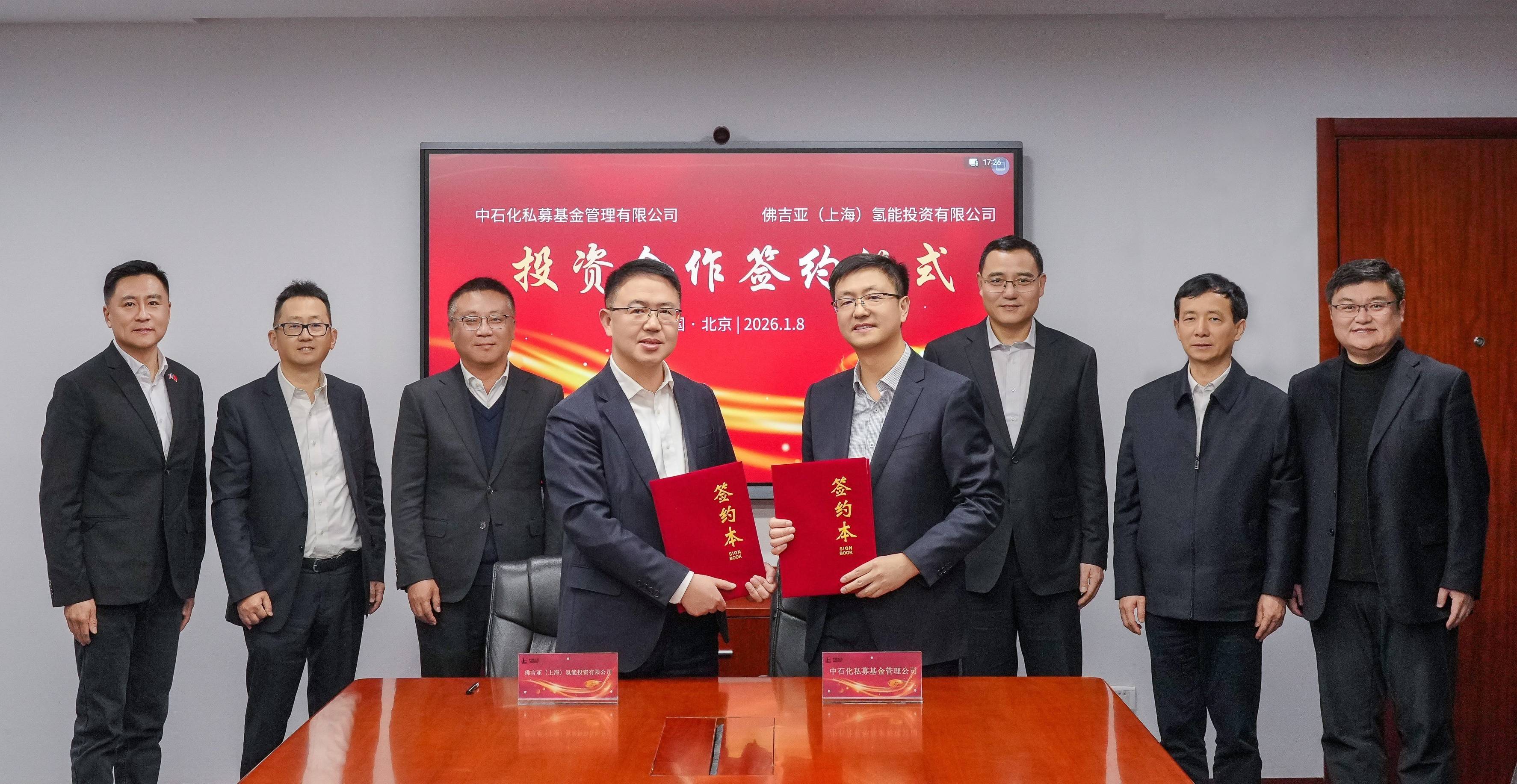
Core Viewpoint - FORVIA Group has announced a strategic investment of 300 million RMB (approximately 40 million Euros) from Sinopec Capital into its hydrogen energy subsidiary, enhancing its market positioning in China's rapidly growing hydrogen sector [1][4]. Group 1: Investment Details - Sinopec Capital, through its private equity management arm, is investing in FORVIA's hydrogen energy subsidiary, indicating a strong commitment to the hydrogen energy market [1][4]. - The hydrogen fund managed by Sinopec is the largest in China focused on the hydrogen industry chain, having invested in 13 hydrogen-related companies [4]. Group 2: Market Context - The hydrogen industry has been elevated to a national priority in China, alongside gasoline and natural gas, to accelerate its industrialization [5]. - China's hydrogen production is projected to reach 36.5 million tons in 2024, a 3.5% increase from 2023, with significant applications in the chemical industry and growing use in transportation and steel manufacturing [5]. - China remains the largest single market for hydrogen fuel cell vehicles, with cumulative sales exceeding 30,000 units and 559 hydrogen refueling stations established nationwide [5]. Group 3: Strategic Collaboration - The partnership with Sinopec Capital is expected to enhance FORVIA's supply chain optimization and accelerate growth and value creation in the hydrogen sector [6]. - Executives from FORVIA emphasize that this collaboration will strengthen their market position in China and enhance their ability to provide innovative solutions [6]. - Sinopec Capital aims to become the leading hydrogen company in China and plans to leverage this investment to foster deep business cooperation and promote high-quality development in the global hydrogen industry [6].
中国石化、中国航油官宣重组 机构:将重塑传统能源市场的竞争格局
2 1 Shi Ji Jing Ji Bao Dao· 2026-01-09 04:19
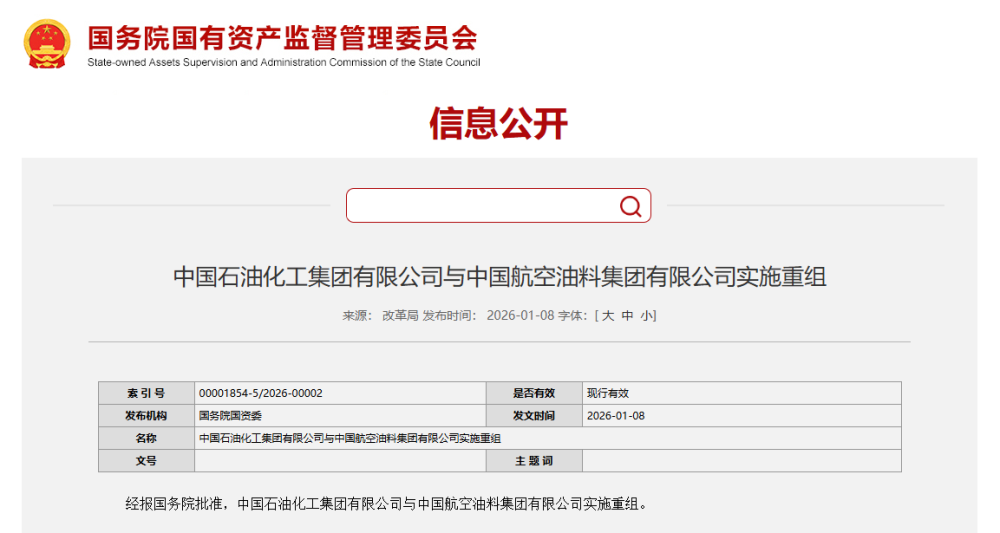
Core Viewpoint - The restructuring between China Petroleum & Chemical Corporation (Sinopec) and China Aviation Oil Group is approved by the State Council, aiming to enhance market competitiveness and achieve strategic synergies [1][4]. Group 1: Restructuring Details - The restructuring requires further procedures and approvals but is not expected to significantly impact the normal operations of the companies involved [4]. - China Aviation Oil Group is the largest aviation fuel service provider in Asia, serving 258 transport airports and 454 general airports, and has been listed in the Fortune Global 500 for 13 times since 2011 [4]. Group 2: Strategic Benefits - The merger is anticipated to create significant strategic complementarity and synergy, enhancing the overall market competitiveness of both companies [5]. - Sinopec can leverage China Aviation Oil Group's distribution network to expand its market share in aviation fuel and integrate production and sales [5]. - China Aviation Oil Group will gain more stable upstream resource supply, improving its bargaining power in the international aviation fuel market [5]. Group 3: Green Transition - The restructuring aligns with China's "dual carbon" goals, as the civil aviation sector is a key area for achieving these targets, with approximately 99% of carbon emissions from aviation coming from fuel consumption [5]. - Sinopec is focusing on the development of sustainable aviation fuel (SAF) as a critical path for emissions reduction, having made significant advancements in this area since 2014 [5][6]. - The collaboration is expected to reshape the competitive landscape of the traditional energy market and have a profound impact on the green transition of China's aviation industry [6].
开年首例央企重组大戏,为何花落中石化中航油合并?市场影响几何?
Xin Lang Cai Jing· 2026-01-09 04:16
Core Viewpoint - The restructuring of China Petroleum & Chemical Corporation (Sinopec) and China Aviation Oil Group (CAOG) marks a significant shift in the domestic aviation fuel market, creating a powerful entity that connects refining to airport fuel sales, thereby reshaping competition in the sector [1][3]. Group 1: Restructuring Details - The restructuring was approved by the State-owned Assets Supervision and Administration Commission (SASAC) and is the first major merger among oil and gas state-owned enterprises since the establishment of the National Oil and Gas Pipeline Group in December 2019 [1]. - Sinopec is the world's largest refining company and the second-largest chemical company, while CAOG is Asia's largest aviation fuel service provider [1][2]. Group 2: Market Implications - The merger is expected to reshape the competitive landscape of the domestic aviation fuel market, with CAOG gaining direct access to stable revenue streams from aviation fuel sales, while Sinopec strengthens its upstream supply chain [1][3]. - China's aviation fuel consumption is projected to grow significantly, with a 13% increase expected in 2024, reaching 39.28 million tons, and a forecast of 75 million tons by 2040 [3]. Group 3: Strategic Considerations - The merger aligns with global trends of vertical integration in the energy sector, enhancing the combined entity's strength in both upstream and downstream operations [4]. - The focus on sustainable aviation fuel (SAF) is critical, as it is seen as a key pathway for decarbonizing the aviation industry, with Sinopec being a pioneer in SAF production in China [5][6]. Group 4: Concerns and Challenges - There are concerns regarding market barriers that may arise from the merger, particularly for private SAF producers, as the new entity may leverage its integrated advantages to dominate the market [7]. - Other suppliers and airlines are apprehensive about potential reductions in market space and the impact on pricing power due to the consolidation of the largest supplier and distributor in the aviation fuel sector [7].
石油股早盘走高 国际油价反弹创两周新高 中国石化与中国航油官宣重组
Zhi Tong Cai Jing· 2026-01-09 04:14
Group 1 - Oil stocks rose in early trading, with Shanghai Petrochemical (00338) up 4.29% at HKD 1.46, CNOOC (00883) up 1.74% at HKD 21.04, PetroChina (00857) up 1.38% at HKD 8.08, CNOOC Services (601808) (02883) up 0.82% at HKD 7.38, and Sinopec (00386) up 0.43% at HKD 4.69 [1] - International oil prices rebounded on Thursday after two days of decline, with Brent crude oil rising by as much as 5%, reaching a two-week high [1] - A tanker heading to Russia was attacked by a drone in the Black Sea, and Iraq is moving towards nationalization of the West Qurna 2 oil field due to US sanctions on Russia's Lukoil [1] Group 2 - Iran is facing nationwide protests due to economic difficulties and has implemented internet restrictions [1] - On January 8, the State Council approved the restructuring of China National Petroleum Corporation (601857) and China Aviation Oil Group [1] - According to Everbright Securities, the merger between Sinopec Group (600028) and China Aviation Oil Group will enhance Sinopec's competitiveness in the refined oil business by integrating the entire industrial chain of aviation fuel production, sales, and refueling [1]

国投证券:化工龙头宣布重组 推动我国SAF走向大规模商用
智通财经网· 2026-01-09 04:13
Group 1 - The core viewpoint of the news is that the merger between Sinopec and China Aviation Oil aims to enhance technological research and development, industrialization capabilities, and supply chain efficiency in the Sustainable Aviation Fuel (SAF) sector, promoting high-quality development in the aviation industry and facilitating the transition from demonstration flights to large-scale commercial use of SAF in China [1][2] Group 2 - The merger is aligned with recent state-owned enterprise reforms focusing on core responsibilities and enhancing competitiveness through integration, aiming to optimize state capital allocation and avoid homogenized competition [2] - China Aviation Oil, as Asia's largest integrated aviation fuel service provider, and Sinopec, the world's largest refining company, will create a more robust supply chain and competitive advantage by merging their operations [2] Group 3 - The strategic significance of the merger lies in the strong recovery momentum of the aviation industry, with global jet fuel demand projected to reach 389 million tons by 2025, a year-on-year increase of 3.9%, and China's jet fuel consumption expected to grow from 39.28 million tons in 2024 to 75 million tons by 2040 [3] - The merger will allow Sinopec to establish a complete "refining-distribution" integration from crude oil refining to aircraft refueling, while China Aviation Oil will benefit from a more stable upstream supply, thus reducing costs and enhancing energy security for China's aviation sector [3]