
Sinopec Corp.(600028)

Search documents
港股异动 | 石油股早盘走高 国际油价反弹创两周新高 中国石化与中国航油官宣重组
智通财经网· 2026-01-09 04:04
Core Viewpoint - Oil stocks experienced an upward trend in early trading, driven by a rebound in international oil prices following two days of decline, with Brent crude oil reaching a two-week high [1] Group 1: Stock Performance - Shanghai Petrochemical Co. (00338) rose by 4.29% to HKD 1.46 [1] - CNOOC (00883) increased by 1.74% to HKD 21.04 [1] - PetroChina (00857) gained 1.38% to HKD 8.08 [1] - CNOOC Services (02883) saw a rise of 0.82% to HKD 7.38 [1] - Sinopec (00386) climbed 0.43% to HKD 4.69 [1] Group 2: Market Influences - International oil prices rebounded, with Brent crude oil experiencing a peak increase of 5% [1] - A drone attack on an oil tanker heading to Russia in the Black Sea contributed to market volatility [1] - Iraq is advancing the nationalization of the West Qurna 2 oil field due to U.S. sanctions on Russia's Lukoil [1] - Iran is facing nationwide protests due to economic difficulties, leading to an internet blackout [1] Group 3: Corporate Developments - On January 8, the restructuring of China Petroleum & Chemical Corporation and China Aviation Oil Group was approved by the State Council [1] - According to Everbright Securities, this merger will enhance the competitiveness of China Petrochemical Group's refined oil business by integrating the entire industrial chain of aviation fuel production, sales, and refueling [1] - Listed companies under China Petrochemical Group are expected to benefit from the integrated advantages of the entire industrial chain [1]




2026央企首单!中国石化与中国航油实施重组,石油ETF(561360)连续5日迎资金净流入
Mei Ri Jing Ji Xin Wen· 2026-01-09 03:59
Group 1 - The core point of the news is the restructuring between China Petroleum & Chemical Corporation (Sinopec) and China Aviation Oil Group, which has been approved by the State-owned Assets Supervision and Administration Commission of the State Council [1] - The oil and petrochemical, refining, and trading industries are expected to benefit from the sustained high volatility of international crude oil prices, with ongoing increases in global and domestic oil and gas capital expenditures [1] - The domestic strategy of increasing reserves and production is driving industry demand due to the rising dependence on foreign crude oil [1] Group 2 - High-tech barrier enterprises are anticipated to gain advantages in overseas markets, particularly in unconventional land oil and gas and offshore oil development, which are becoming new growth areas [1] - The oil price and energy security are expected to drive continued industry prosperity [1] - The oil ETF (561360) tracks the oil and gas industry index (H30198), which reflects the overall performance of listed companies in the oil and gas industry chain, providing an effective investment tool for investors focusing on the energy sector [1]
中国石化取得图像处理专利提升弱光环境识别能力
Sou Hu Cai Jing· 2026-01-09 03:51
Group 1 - The State Intellectual Property Office of China has granted a patent to China Petroleum & Chemical Corporation for a technology related to image processing, with the announcement number CN116993593B and application date in April 2022 [1] - China Petroleum & Chemical Corporation, established in 2000 and based in Beijing, primarily engages in oil and gas extraction, with a registered capital of 121,739.6893 million RMB [1] - The company has invested in 267 enterprises, participated in 5,000 bidding projects, holds 45 trademark registrations, and has 5,000 patent records, along with 41 administrative licenses [1] Group 2 - Sinopec (Dalian) Petroleum and Chemical Research Institute Co., Ltd., established in 2022 and located in Dalian, focuses on research and experimental development, with a registered capital of 3,384.5908 million RMB [1] - This research institute has invested in 1 enterprise, participated in 2,801 bidding projects, holds 5,000 patent records, and possesses 65 administrative licenses [1]
超2900只个股下跌
第一财经· 2026-01-09 03:48
2026.01. 09 本文字数:1506,阅读时长大约3分钟 作者 | 一财阿驴 11:31 A股午盘丨沪指半日涨0.3% 截至午盘,沪指涨0.3%,盘中一度站上4100点;深成指涨0.57%,创业板指涨0.1%,科创综指涨 0.56%。 | 代码 | 名称 | 两日图 | 现价 | 涨跌 | 涨跌幅 | | --- | --- | --- | --- | --- | --- | | 000001 | 上证指数 | win | 4095.33 | 12.35 | 0.30% | | 399001 | 深证成指 | may | 14038.46 | 78.98 | 0.57% | | 399006 | 创业板指 | Mark | 3305.48 | 3.18 | 0.10% | | 000680 | 科创综指 | port | 1776.42 | 9.85 | 0.56% | 盘面上,能源金属、商业航天、医保支付改革、AI应用、算力硬件题材活跃,光伏、半导体、保险板 块走弱。 | 板块名称 | 张鸣 | 涨速 | 涨停数 | | --- | --- | --- | --- | | 小金属 | +3.89% | ...


国新证券每日晨报-20260109
Guoxin Securities Co., Ltd· 2026-01-09 03:46
Domestic Market Overview - The domestic market experienced a slight decline with the Shanghai Composite Index closing at 4082.98 points, down 0.07%, and the Shenzhen Component Index at 13959.48 points, down 0.51% [1][5] - Among 30 sectors, 19 saw gains, with notable increases in defense, media, and real estate, while non-bank financials, non-ferrous metals, and banking sectors faced significant declines [1][5] - The total trading volume for the A-share market was approximately 282.63 billion yuan, showing a slight decrease from the previous day [1][5] Overseas Market Overview - The U.S. stock indices showed mixed results, with the Dow Jones rising by 0.55% and the Nasdaq falling by 0.44%, while Nvidia dropped over 2% [2][5] - Chinese concept stocks mostly rose, with Century Internet increasing by nearly 11% [2][5] Key News - China Petrochemical Corporation and China Aviation Oil Corporation are undergoing a merger, which is expected to enhance operational efficiencies and reduce supply costs in the aviation fuel sector [11][12][14] - Gold has reportedly surpassed U.S. Treasury bonds to become the world's largest reserve asset for the first time in 30 years, with a value of approximately 3.93 trillion USD compared to 3.88 trillion USD in U.S. bonds [10][17][18] - The Ministry of Industry and Information Technology convened a meeting to discuss the regulation of competition in the energy storage battery industry, aiming to address irrational competition and ensure sustainable development [19][20]
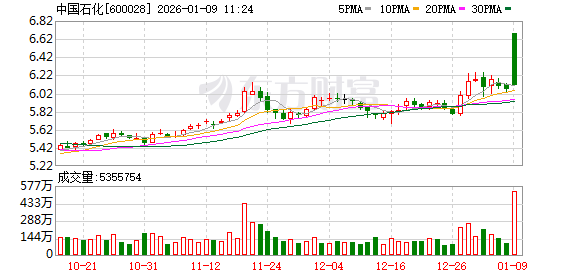
中国石化成交额创2024年10月9日以来新高
Zheng Quan Shi Bao Wang· 2026-01-09 03:24
数据宝统计,截至10:24,中国石化成交额26.56亿元,创2024年10月9日以来新高。最新股价上涨 1.15%,换手率0.45%。上一交易日该股全天成交额为6.47亿元。(数据宝) (文章来源:证券时报网) ...
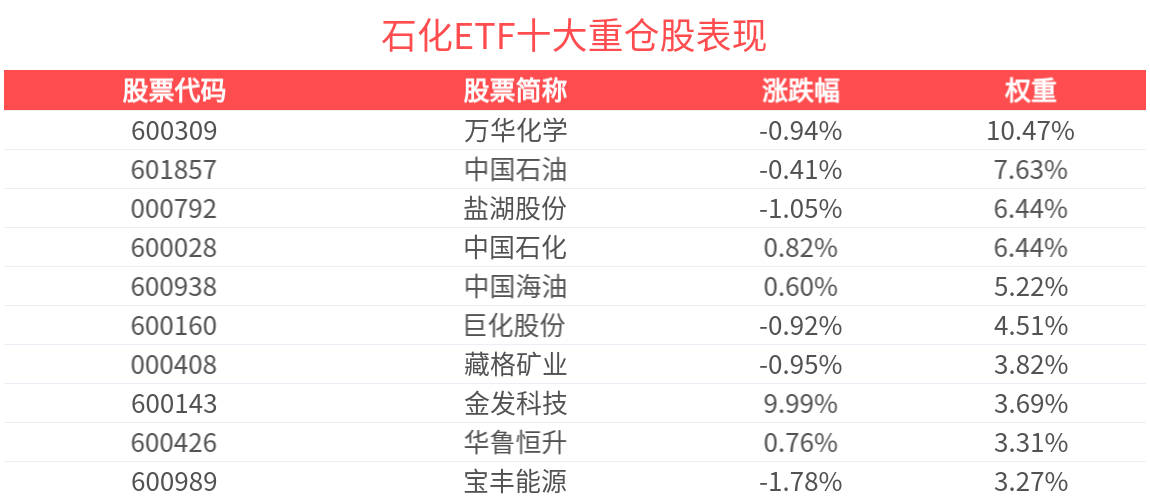
石化ETF(159731)近4个交易日内合计“吸金”超3235万元,资金低位布局特征显著
Sou Hu Cai Jing· 2026-01-09 03:23
石化ETF(159731),场外联接(华夏中证石化产业ETF发起式联接A:017855;华夏中证石化产业ETF发起式联接C:017856)。 以上内容与数据,与有连云立场无关,不构成投资建议。据此操作,风险自担。 | 股票代码 | 股票简称 | 涨跌幅 | 权重 | | --- | --- | --- | --- | | 600309 | 万华化学 | -0.94% | 10.47% | | 601857 | 中国石油 | -0.41% | 7.63% | | 000792 | 盐湖股份 | -1.05% | 6.44% | | 600028 | 中国石化 | 0.82% | 6.44% | | 600938 | 甲国海海 | 0.60% | 5.22% | | 600160 | 巨化股份 | -0.92% | 4.51% | | 000408 | 藏格矿业 | -0.95% | 3.82% | | 600143 | 金发科技 | 9.99% | 3.69% | | 600426 | 华鲁恒升 | 0.76% | 3.31% | | 600989 | 宝丰能源 | -1.78% | 3.27% | (以上所列 ...




中国石化取得基于优势频带增强的河道识别方法专利
Sou Hu Cai Jing· 2026-01-09 02:55
中石化石油物探技术研究院有限公司,成立于2022年,位于南京市,是一家以从事开采专业及辅助性活 动为主的企业。企业注册资本133611.989369万人民币。通过天眼查大数据分析,中石化石油物探技术 研究院有限公司共对外投资了2家企业,参与招投标项目502次,专利信息810条,此外企业还拥有行政 许可14个。 声明:市场有风险,投资需谨慎。本文为AI基于第三方数据生成,仅供参考,不构成个人投资建议。 来源:市场资讯 国家知识产权局信息显示,中国石油化工股份有限公司、中石化石油物探技术研究院有限公司取得一项 名为"基于优势频带增强的河道识别方法、装置、设备及介质"的专利,授权公告号CN120122180B,申 请日期为2023年12月。 天眼查资料显示,中国石油化工股份有限公司,成立于2000年,位于北京市,是一家以从事石油和天然 气开采业为主的企业。企业注册资本12173968.9893万人民币。通过天眼查大数据分析,中国石油化工 股份有限公司共对外投资了268家企业,参与招投标项目5000次,财产线索方面有商标信息45条,专利 信息5000条,此外企业还拥有行政许可41个。 ...
宏观日报:中游开工小幅回升-20260109
Hua Tai Qi Huo· 2026-01-09 02:41
Report Summary 1. Report Industry Investment Rating - Not provided in the given content 2. Core Viewpoint - Mid - stream construction starts have slightly increased. Upstream energy prices show a mixed trend with a slight decline in international crude oil and rising prices of certain non - ferrous metals. Mid - stream chemical and energy sectors see positive indicators, and downstream real estate and service industries show signs of recovery [1][3][4] 3. Summary by Related Catalogs A. Mid - stream and Upstream Industry Events - **Production Industry** - On January 8, Sinopec Group and China National Aviation Fuel Group were approved to restructure, which is expected to enhance the resilience of the aviation kerosene industry chain and improve competitiveness [1] - Four government departments held a symposium on the power and energy - storage battery industry to regulate competition order due to issues like blind construction and low - price competition [1] - **Service Industry** - OpenAI launched ChatGPT Health on January 8, indicating a large demand in the medical and health market as over 230 million people globally ask health - related questions weekly [2] B. Industry Overview - **Upstream** - **Energy**: International crude oil prices have slightly declined [3] - **Non - ferrous Metals**: Aluminum and nickel prices are rising [3] - **Mid - stream** - **Chemical**: PX and urea operating rates are at high levels [4] - **Energy**: Coal consumption of power plants has increased [4] - **Infrastructure**: Road asphalt construction starts are at a high level compared to the same period [4] - **Downstream** - **Real Estate**: The sales of commercial housing in first - and second - tier cities have increased [4] - **Service**: The number of domestic flights has increased [4] C. Key Industry Price Indicators | Industry | Indicator | Price (as of 1/8) | YoY Change | | --- | --- | --- | --- | | Agriculture | Corn (spot price) | 2248.6 yuan/ton | 0.00% | | | Eggs (spot price) | 6.7 yuan/kg | 3.89% | | | Palm oil (spot price) | 8600.0 yuan/ton | 1.42% | | | Cotton (spot price) | 15995.0 yuan/ton | 2.51% | | | Pork (average wholesale price) | 17.9 yuan/kg | 0.73% | | | Copper (spot price) | 102418.3 yuan/ton | 4.86% | | | Zinc (spot price) | 24158.0 yuan/ton | 3.79% | | Non - ferrous Metals | Aluminum (spot price) | 24031.7 yuan/ton | 8.28% | | | Nickel (spot price) | 149350.0 yuan/ton | 8.43% | | | Aluminum (spot price) | 17400.0 yuan/ton | 1.05% | | Ferrous Metals | Rebar (spot price) | 3255.0 yuan/ton | 0.55% | | | Iron ore (spot price) | 834.4 yuan/ton | 1.24% | | | Wire rod (spot price) | 3500.0 yuan/ton | 0.07% | | | Glass (spot price) | 12.8 yuan/sq.m | 0.63% | | Non - Metals | Natural rubber (spot price) | 15850.0 yuan/ton | 1.77% | | | China Plastics City Price Index | 756.3 | 0.48% | | Energy | WTI crude oil (spot price) | 56.0 dollars/barrel | - 3.38% | | | Brent crude oil (spot price) | 60.0 dollars/barrel | - 2.23% | | | Liquefied natural gas (spot price) | 3256.0 yuan/ton | - 1.39% | | | Coal price | 796.0 yuan/ton | - 0.25% | | | PTA (spot price) | 5089.3 yuan/ton | 0.13% | | Chemical | Polyethylene (spot price) | 6573.3 yuan/ton | 2.47% | | | Urea (spot price) | 1730.0 yuan/ton | 0.29% | | | Soda ash (spot price) | 1218.6 yuan/ton | - 0.58% | | | National cement price index | 135.6 | - 0.04% | | Real Estate | Building materials composite index | 116.3 points | 0.63% | | | National concrete price index | 90.4 points | 0.00% | [39]
中国石化取得均质化聚丙烯腈原丝及其制备方法专利
Sou Hu Cai Jing· 2026-01-09 02:36
Group 1 - The State Intellectual Property Office of China has granted a patent for "Homogenized Polyacrylonitrile Filament and Its Preparation Method" to China Petroleum & Chemical Corporation and Sinopec Shanghai Petrochemical Company Limited, with the announcement number CN116065254B and application date in October 2021 [1] - China Petroleum & Chemical Corporation, established in 2000 and based in Beijing, primarily engages in oil and gas extraction, with a registered capital of 121,739.6893 million RMB. The company has invested in 268 enterprises, participated in 5,000 bidding projects, holds 45 trademark records, 5,000 patent records, and possesses 41 administrative licenses [1] - Sinopec Shanghai Petrochemical Company Limited, founded in 1993 and located in Shanghai, focuses on oil, coal, and other fuel processing industries, with a registered capital of 105,426.175 million RMB. The company has invested in 21 enterprises, participated in 5,000 bidding projects, holds 51 trademark records, 1,352 patent records, and has 12,791 administrative licenses [1]
