
CM BANK(600036)

Search documents
“固收+”的突围 理财公司多元策略穿越周期
Zhong Guo Zheng Quan Bao· 2025-11-05 23:27
Core Insights - The "fixed income +" wealth management products are being heavily promoted by banks, with some products achieving annualized returns exceeding 10% in the past month, particularly those linked to gold strategies [1][2] - The consensus in the wealth management industry is shifting towards multi-asset and multi-strategy configurations to diversify risks and broaden sources of returns in the context of low interest rates and increased market volatility [1][4] Product Performance - A specific product from Xingyin Wealth Management reported an annualized return of 10.77% over the past month and 11.28% over the past three months, primarily based on fixed income assets with a small allocation to riskier assets linked to gold prices [2] - Another product from China Merchants Bank achieved an annualized return of over 9% in the past month, with a focus on high-rated bonds and flexible allocation to stocks, commodities, and alternative assets [3] Industry Trends - The investment management and portfolio configuration in the asset management industry face significant challenges, leading to a consensus on the need for multi-asset and multi-strategy approaches [3][4] - The introduction of low correlation assets such as gold and commodities is seen as essential for risk reduction and capturing investment opportunities across different asset classes [4][6] Risk and Return Dynamics - Many multi-asset multi-strategy "fixed income +" products have a higher risk rating (R3) compared to pure fixed income products, reflecting their greater exposure to market fluctuations [6] - The performance of these products is closely tied to market conditions, with some experiencing negative returns due to recent volatility in gold prices, while others have shown resilience during market downturns [6]


“固收+”的突围
Zhong Guo Zheng Quan Bao· 2025-11-05 20:08
Core Insights - The article highlights the increasing focus on "fixed income +" wealth management products by banks, with some products achieving annualized returns exceeding 10% in the past month, particularly those linked to gold strategies [1][2] - The consensus in the wealth management industry is shifting towards multi-asset and multi-strategy configurations to diversify risks and broaden sources of returns in a low-interest-rate environment [1][3] Group 1: Product Performance - A fixed income enhanced product from Xingyin Wealth Management reported an annualized return of 10.77% over the past month and 11.28% over the past three months, primarily linked to gold prices [1][2] - Another product from China Merchants Bank's Jia Yi series achieved an annualized return of over 9% in the past month and nearly 6% since inception, with a fixed income asset allocation of no less than 80% [2] Group 2: Industry Trends - The asset management industry is facing significant challenges, leading to a consensus on the need for multi-asset and multi-strategy approaches to enhance product performance stability and consistency [3] - The introduction of low-correlation assets such as gold and commodities is seen as essential for risk reduction and capturing investment opportunities across different asset classes [3][4] Group 3: Risk and Strategy - Many multi-asset multi-strategy "fixed income +" products have a higher risk rating (R3) compared to pure fixed income products, with expected returns varying significantly among different products [4] - The performance of these products is closely tied to market conditions, with some experiencing negative returns due to fluctuations in gold prices [4]
翻遍9家银行财报,我发现行业洗牌的秘密藏在这些数字里
凤凰网财经· 2025-11-05 13:27
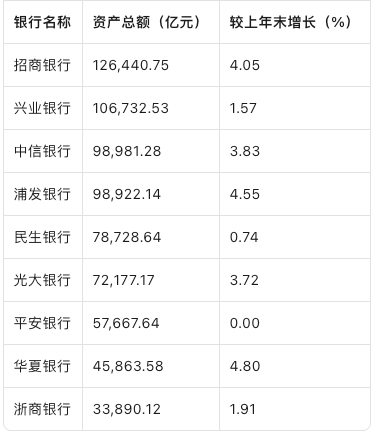
Core Viewpoint - The overall performance of the nine listed joint-stock banks in China showed a decline in both revenue and net profit for the first three quarters, indicating a challenging environment for the banking sector [2][5]. Group 1: Overall Performance - The nine joint-stock banks collectively achieved an operating income of 1.12 trillion yuan, a year-on-year decrease of 2.56%, and a net profit of 406.1 billion yuan, down nearly 1% year-on-year [2][5]. - There is a notable divergence in performance among the banks, with four banks experiencing declines in both revenue and profit, while others managed to achieve growth [2][5]. Group 2: Individual Bank Performance - As of the end of Q3, China Merchants Bank led with total assets of 12.64 trillion yuan, followed by Industrial Bank at 10.67 trillion yuan, with Shanghai Pudong Development Bank showing the fastest growth rate of 4.55% [3][4]. - Only Minsheng Bank and Shanghai Pudong Development Bank reported year-on-year revenue growth of 6.74% and 1.88%, respectively, while the remaining seven banks saw declines, with Ping An Bank experiencing the largest drop at 9.8% [7][8]. Group 3: Net Interest Income - Among the nine banks, only three reported an increase in net interest income, with China Merchants Bank leading at 160.04 billion yuan, a growth of 1.74% [11][12]. - The net interest margin pressure remains a common challenge, with most banks experiencing a decline in this metric, except for Minsheng Bank, which saw a slight increase [13][14]. Group 4: Asset Quality - Most banks reported a decrease in non-performing loan (NPL) ratios, with China Merchants Bank having the lowest at 0.94%, while the others ranged between 1% and 1.5% [15][16]. - The provision coverage ratio decreased for most banks, with Ping An Bank showing the largest decline of 21.11 percentage points [17]. Group 5: Future Outlook - The banks face challenges in narrowing net interest margins in a low-interest-rate environment, and the potential impact of "deposit migration" due to stock market recovery will test their adaptability [17].






翻遍9家银行财报,行业洗牌的秘密藏在这些数字里
Feng Huang Wang Cai Jing· 2025-11-05 13:19
Core Insights - The overall performance of the nine listed joint-stock banks in China showed a decline in both revenue and net profit for the first three quarters, with total operating income of 1.12 trillion yuan, down 2.56% year-on-year, and net profit of 406.1 billion yuan, down nearly 1% [1][4] Group 1: Performance Overview - Four banks experienced a decline in both revenue and net profit, while two banks, Minsheng Bank and Pudong Development Bank, achieved revenue growth [1][4] - Among the nine banks, only Pudong Development Bank reported both revenue and net profit growth, with a net profit increase of 10.21%, making it the leader in profit growth among joint-stock banks [5][11] Group 2: Asset Scale and Growth - As of the end of Q3, China Merchants Bank led with total assets of 12.64 trillion yuan, followed by Industrial Bank at 10.67 trillion yuan, with Pudong Development Bank showing the fastest growth rate of 4.55% [2][3] Group 3: Revenue and Profit Analysis - Revenue performance varied significantly, with only Minsheng Bank and Pudong Development Bank achieving positive year-on-year growth rates of 6.74% and 1.88%, respectively [4][5] - The largest revenue declines were observed in Ping An Bank and Everbright Bank, with decreases exceeding 6%, and Ping An Bank experiencing a 9.78% drop [4][5] Group 4: Net Interest Income and Margin - Net interest income showed a mixed performance, with only three banks reporting growth, while six banks saw declines, the largest drop being 8.25% at Ping An Bank [6][7] - The net interest margin pressure remains a challenge for all listed joint-stock banks, with only Minsheng Bank showing a slight increase in net interest margin [8] Group 5: Asset Quality - Most banks reported a decrease in non-performing loan (NPL) ratios, with China Merchants Bank having the lowest NPL ratio at 0.94% [9][10] - The provision coverage ratio declined for seven banks, with Ping An Bank experiencing the largest drop of 21.11 percentage points [10][11] Group 6: Future Outlook - The banks face challenges in narrowing net interest margins in a low-interest-rate environment, and the upcoming year-end performance will be critical for their strategies [11]
Ping An Asset Management Co., Ltd.增持招商银行620.95万股 每股作价约48.78港元
Zhi Tong Cai Jing· 2025-11-05 11:40
Group 1 - Ping An Asset Management Co., Ltd. increased its stake in China Merchants Bank (600036) by 6.2095 million shares at a price of HKD 48.7793 per share, totaling approximately HKD 303 million [1] - Following the increase, Ping An's total shareholding in China Merchants Bank is approximately 873 million shares, representing a holding percentage of 19.01% [1]
Ping An Asset Management Co., Ltd.增持招商银行(03968)620.95万股 每股作价约48.78港元
智通财经网· 2025-11-05 11:34
Core Viewpoint - Ping An Asset Management Co., Ltd. has increased its stake in China Merchants Bank, acquiring approximately 6.2095 million shares at a price of HKD 48.7793 per share, totaling around HKD 303 million, resulting in a new holding of approximately 873 million shares, representing 19.01% ownership [1] Summary by Category - **Investment Activity** - Ping An Asset Management Co., Ltd. has purchased 6.2095 million shares of China Merchants Bank at HKD 48.7793 per share [1] - The total investment amounts to approximately HKD 303 million [1] - **Ownership Structure** - Following the acquisition, Ping An's total shareholding in China Merchants Bank is approximately 873 million shares [1] - The new ownership percentage stands at 19.01% [1]
透视银行三季报:超30家净息差收窄 债市波动拖累非利息收入
Bei Ke Cai Jing· 2025-11-05 11:12
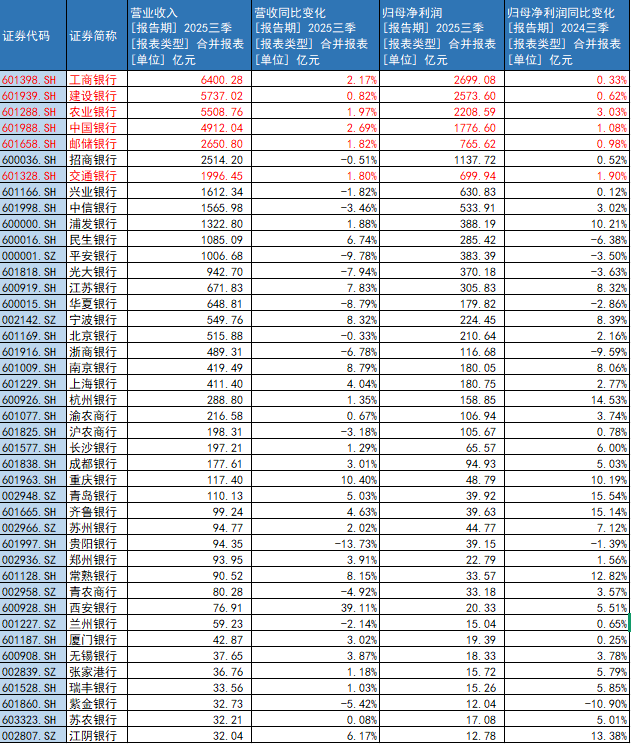
Core Insights - The overall performance of A-share listed banks in the first three quarters of the year is positive, with over 80% achieving year-on-year growth in net profit attributable to shareholders [2][3] - The growth in net profit is primarily driven by stable net interest income and improved asset quality, despite a decline in non-interest income due to bond market fluctuations [2][3] - The six major banks collectively reported over 1 trillion yuan in net profit, marking a significant milestone [3][4] Financial Performance - Among the 42 listed banks, 35 reported year-on-year growth in net profit, while only 7 experienced a decline [3][4] - The top four state-owned banks (Industrial and Commercial Bank of China, China Construction Bank, Agricultural Bank of China, and Bank of China) all achieved growth in both revenue and net profit [4][5] - Industrial and Commercial Bank of China led in revenue with 640.03 billion yuan, a 2.17% increase year-on-year, and a net profit growth of 0.33% [4][6] Non-Interest Income and Market Impact - Many banks faced a decline in non-interest income due to volatility in the bond market, with several banks reporting significant losses in fair value changes [9][10] - For instance, China Merchants Bank reported a fair value loss of 8.83 billion yuan, transitioning from profit to loss [10][12] - The decline in non-interest income is attributed to reduced earnings from bond and fund investments [10][13] Interest Income Trends - Some banks, particularly city commercial banks, saw substantial growth in interest income, with Xi'an Bank's interest income increasing over 60% [7][8] - Conversely, banks like Guiyang Bank and Capital Bank reported declines in interest income of 12.29% and 17.34%, respectively [8][9] Net Interest Margin - The overall net interest margin for listed banks has narrowed compared to the end of the previous year, although some banks have seen a recovery from the second quarter [16][20] - As of the end of the third quarter, Xi'an Bank's net interest margin was 1.79%, reflecting a 0.43% increase from the end of the previous year [16][17] - The stability of net interest margins in the fourth quarter will depend on the banks' ability to optimize their liability structures and find high-quality investment opportunities [20]





上市银行2025年三季报综述:盈利温和修复,利息与中收共振回暖
Ping An Securities· 2025-11-05 10:38
Investment Rating - The report maintains a "stronger than the market" rating for the banking sector [1][4]. Core Views - As of the end of October, 42 listed banks reported a 1.5% year-on-year increase in net profit for the first three quarters of 2025, an improvement of 0.7 percentage points compared to the first half of 2025 [4][9]. - The report highlights a continued recovery in profitability, driven by a rebound in interest income and non-interest income [4][10]. - The report anticipates that the positive signals from interest margin and non-interest income will persist into the fourth quarter of 2025, with a focus on the impact of policies aimed at reducing competition and the quality of retail assets [15][4]. Summary by Sections Profitability Analysis - The net interest income for the first three quarters of 2025 decreased by 0.6% year-on-year, while non-interest income from fees and commissions grew by 4.6% [10][6]. - The report notes that the profitability of individual banks varies, with some banks like Shanghai Pudong Development Bank and Agricultural Bank of China showing significant growth rates of 10.2% and 3.0% respectively [4][9]. Operational Breakdown - Total asset growth for the 42 listed banks was 9.3% year-on-year, with loan growth at 7.7% and deposit growth at 7.9% [22][4]. - The annualized net interest margin for the third quarter was stable at 1.36%, with a decrease in the cost of interest-bearing liabilities [4][6]. Investment Recommendations - The report suggests a shift towards reallocation rather than trading, emphasizing the importance of structural changes in funding flows that support valuation recovery in the banking sector [6][4]. - Specific banks such as Chengdu Bank, Jiangsu Bank, and Suzhou Bank are highlighted for their regional advantages and potential for continued profit growth [6][4].
11月5日投资时钟(399391)指数涨0.03%,成份股国城矿业(000688)领涨
Sou Hu Cai Jing· 2025-11-05 09:55
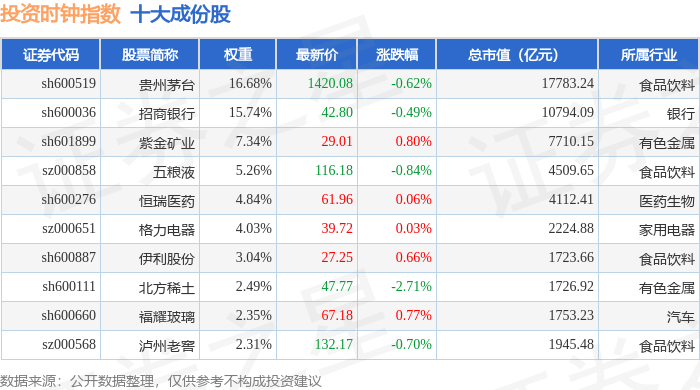
Market Overview - The Investment Clock Index (399391) closed at 3348.13 points, up 0.03%, with a trading volume of 78.792 billion yuan and a turnover rate of 0.81% [1] - Among the index constituents, 71 stocks rose while 28 stocks fell, with Guocheng Mining leading the gainers at a 9.42% increase and Dalian Shengya leading the decliners at a 9.99% decrease [1] Top Constituents - The top ten constituents of the Investment Clock Index are as follows: - Kweichow Moutai (sh600519) holds a weight of 16.68% and closed at 1420.08 yuan, down 0.62% with a market cap of 1778.324 billion yuan [1] - China Merchants Bank (sh600036) has a weight of 15.74%, closing at 42.80 yuan, down 0.49% with a market cap of 1079.409 billion yuan [1] - Yunnan Tin Company (sh601899) has a weight of 7.34%, closing at 29.01 yuan, up 0.80% with a market cap of 771.015 billion yuan [1] - Wuliangye Yibin (sz000858) has a weight of 5.26%, closing at 116.18 yuan, down 0.84% with a market cap of 450.965 billion yuan [1] - Hengrui Medicine (sh600276) has a weight of 4.84%, closing at 61.96 yuan, up 0.06% with a market cap of 411.241 billion yuan [1] - Gree Electric Appliances (sz000651) has a weight of 4.03%, closing at 39.72 yuan, up 0.03% with a market cap of 222.488 billion yuan [1] - Yili Industrial Group (sh600887) has a weight of 3.04%, closing at 27.25 yuan, up 0.66% with a market cap of 172.366 billion yuan [1] - Northern Rare Earth (sh600111) has a weight of 2.49%, closing at 47.77 yuan, down 2.71% with a market cap of 172.692 billion yuan [1] - Fuyao Glass (sh600660) has a weight of 2.35%, closing at 67.18 yuan, up 0.77% with a market cap of 175.323 billion yuan [1] - Jilin Chemical (sz000568) has a weight of 2.31%, closing at 132.17 yuan, down 0.70% with a market cap of 194.548 billion yuan [1] Capital Flow - The net outflow of main funds from the index constituents totaled 677 million yuan, while retail investors saw a net inflow of 708 million yuan [3] - Detailed capital flow for selected stocks includes: - China Zhongjin (601888) saw a main fund net inflow of 36.4 million yuan, while retail funds had a net outflow of 93.414 million yuan [3] - Jiangxi Copper (600362) had a main fund net inflow of 18.2 million yuan, with retail funds experiencing a net outflow of 70.3612 million yuan [3] - Weichai Power (000338) had a main fund net inflow of 13.5 million yuan, while retail funds had a net inflow of 1.60758 million yuan [3] - Giant Network (002558) had a main fund net inflow of 11.8 million yuan, with retail funds experiencing a net outflow of 65.0268 million yuan [3] - China Coal Energy (601898) had a main fund net inflow of 11.7 million yuan, while retail funds had a net outflow of 79.0666 million yuan [3]




招商银行南昌分行:为江西提供高质量金融服务
Zhong Guo Jin Rong Xin Xi Wang· 2025-11-05 09:21
Core Insights - The article highlights the commitment of China Merchants Bank Nanchang Branch to serve the local economy and community in Jiangxi, emphasizing a high-quality development model driven by strict management and innovation [1][2] Financial Performance - As of September 2025, the bank aims to exceed 100 billion yuan in loans and 140 billion yuan in deposits, contributing nearly 7.5 billion yuan in taxes and serving over 4.34 million personal clients and nearly 70,000 corporate clients [1] Sector-Specific Initiatives - The bank has established a "six specialized" mechanism to provide differentiated financial services to technology enterprises, achieving a technology finance loan balance of over 11.6 billion yuan, with an annual increase of nearly 3.2 billion yuan [2] - In green finance, the bank promotes various green loan products, achieving a green loan balance of over 8 billion yuan, with an annual increase of nearly 1.8 billion yuan [2] - The inclusive finance sector has seen a loan balance exceeding 23.3 billion yuan, with an annual increase of nearly 1.1 billion yuan [2] - The bank has enhanced its pension finance services, adding 15 corporate pension clients and over 70,000 individual pension clients [2] Support for Key Industries - The bank focuses on supporting five key industries: non-ferrous metals, electronic information, equipment manufacturing, new energy, and pharmaceuticals, with a target loan growth rate exceeding the average growth rate of corporate loans by 13.5 percentage points [3] - By 2025, the bank plans to provide over 10.7 billion yuan in loans to 12 key industrial chains, with a 17.6% year-on-year increase in loans to private enterprises [3] Rural Revitalization Efforts - The bank is actively supporting rural revitalization by addressing financing needs for energy projects in rural areas, with nearly 100 million yuan allocated for rural infrastructure loans and over 3 billion yuan for agriculture-related loans by 2025 [4] - The bank has established partnerships with several renewable energy companies and is involved in various community support projects, enhancing local economic development [4]