CM BANK(600036)

Search documents
中国银行业_股息主题尚未结束-China banks_ The dividend theme is not done yet
2025-09-23 02:34
Summary of the Conference Call on China Banks Industry Overview - The focus is on the **China banking sector**, particularly the performance and outlook of state-owned enterprises (SOEs) and joint-stock banks (JSBs) [10][11][12]. Key Points and Arguments 1. Positive Financial Trends - **2Q25 Results**: Revenue, pre-provision operating profit (PPoP), and net profits turned positive at **2%**, **3%**, and **3%** respectively, compared to negative figures in **1Q25** [10]. - **Fee Income Growth**: Non-interest income (NII) was a significant driver, with fee income increasing by **6% year-on-year** in **2Q25** [10]. 2. Performance Comparison - **SOE vs. JSB**: SOE banks outperformed JSBs with a revenue growth of **5% year-on-year** compared to flat growth for JSBs. SOE banks reported a **14%** increase in fee income [10]. - **Profit Growth**: All six SOE banks reported positive profit growth averaging **2%**, while JSBs showed divergence with some banks reporting negative growth [10]. 3. Dividend Yield and Market Positioning - **Attractive Dividend Yields**: The dividend yield of CSI 300 Banks is **4.3%**, outperforming the **10Y CGB yield** of approximately **1.8%** [10]. - **Potential Inflows**: A shift of **5 percentage points** of household assets from deposits to equities could lead to an inflow of approximately **Rmb 14 trillion**, representing about **15%** of the A-share tradable market [10]. 4. Individual Bank Performance - **CCB**: Reported the best quality print in **2Q25** with revenue and PPoP growth of **11%** and **14% year-on-year** respectively [10]. - **BOC**: Identified as a buying opportunity due to improving overseas asset quality and a muted impact from potential Fed rate cuts [10]. - **CMB**: Expected to benefit from improving retail sentiment, with a higher dividend yield than SOE banks [10]. 5. Valuation and Ratings - **Valuation Summary**: The report includes a detailed valuation summary of H-share and A-share banks, highlighting price-to-earnings (P/E) and price-to-book (P/B) ratios, along with dividend yields and return on equity (ROE) estimates for various banks [11][14]. 6. Regulatory Environment - **"China Value-Up" Initiatives**: Government initiatives aimed at enhancing investor returns and improving the quality of listed companies are expected to support the banking sector [25]. 7. Market Dynamics - **Asset Allocation Trends**: There is an expectation of continued household asset allocation into equities, particularly yield stocks, driven by improving yields in the equity market [27][30]. 8. Risks and Considerations - **Asset Quality Risks**: Ongoing assessments of property-related risks, local government financing vehicle (LGFV) risks, and overall debt risk in China are crucial for understanding the banking sector's stability [5]. Additional Important Insights - **Increasing Southbound Ownership**: H-share banks are seeing an increase in Southbound ownership, which provides solid support to share prices [48]. - **Dividend Spread Analysis**: The report discusses the potential upside in share prices if the dividend spread increases to **200 basis points** [53]. This summary encapsulates the key insights from the conference call regarding the performance, outlook, and strategic positioning of the China banking sector, highlighting both opportunities and risks.




招商银行大宗交易成交3.56亿元
Zheng Quan Shi Bao Wang· 2025-09-22 13:41
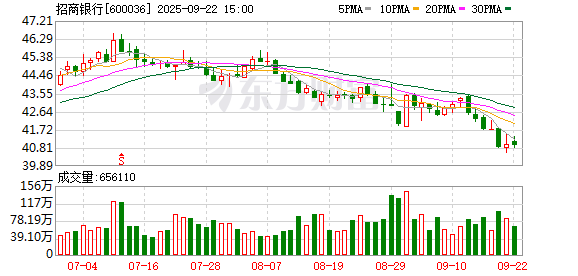
Group 1 - The core transaction on September 22 involved a block trade of 8.70 million shares of China Merchants Bank, with a transaction value of 356 million yuan and a price of 40.92 yuan per share [2][3] - Over the past three months, China Merchants Bank has recorded a total of 11 block trades, amounting to a cumulative transaction value of 5.101 billion yuan [2] - As of September 22, the closing price of China Merchants Bank was 40.92 yuan, reflecting a decrease of 0.20%, with a daily turnover rate of 0.32% and a total trading volume of 2.688 billion yuan [2] Group 2 - The latest margin financing balance for China Merchants Bank stands at 9.428 billion yuan, having increased by 400 million yuan, which is a growth of 4.43% over the past five days [3] - The registered capital of China Merchants Bank is approximately 25.22 billion yuan, and the bank was established on March 31, 1987 [3]


21独家|招商银行AIC最新进展:内聘已启动,争取年内成立
2 1 Shi Ji Jing Ji Bao Dao· 2025-09-22 13:31
Core Viewpoint - The establishment of bank-affiliated Asset Investment Companies (AICs) is accelerating, with 招银金融资产投资有限公司 (Zhaoyin AIC) aiming for completion by the end of the year [1][4]. Group 1: Company Structure and Recruitment - Zhaoyin AIC has initiated internal recruitment, primarily targeting candidates from 招银国际 (Zhaoyin International) and various departments within the bank, with a focus on those with over two years of experience [3][4]. - The recruitment process emphasizes the need for candidates with experience in debt-to-equity swaps and primary market investments, as these skills align closely with the AIC's core business [3][4]. - As of September 22, no external recruitment positions for Zhaoyin AIC have been posted on the bank's official website, indicating a focus on internal talent acquisition [4]. Group 2: Business Model and Market Position - Zhaoyin AIC's primary business will focus on debt-to-equity swaps and equity investments, leveraging high-quality projects from the parent bank's credit portfolio [4][5]. - The AIC model includes purchasing debt to convert into equity and investing in equity to repay existing debts, targeting enterprises that align with national policy and have strong asset quality [5][6]. - The AICs established by major banks have varying scales, with Zhaoyin AIC having the highest registered capital at 15 billion yuan, while others range from 14.5 billion to 27 billion yuan [6][7]. Group 3: Strategic Importance and Future Outlook - The establishment of AICs is seen as a strategic move to enhance comprehensive operational capabilities and support market-oriented debt-to-equity swaps and equity investment trials [7][8]. - Analysts suggest that the benefits of AICs extend beyond direct investment profits, potentially enhancing overall banking revenues through increased deposits, loans, and other intermediary services from technology clients [7][8]. - The entry of various banking institutions into the AIC space is expected to foster differentiated investment strategies, with some focusing on early-stage projects and others on mature enterprise value enhancement [8].
招商银行AIC最新进展:内聘已启动,争取年内成立
Xin Lang Cai Jing· 2025-09-22 13:29
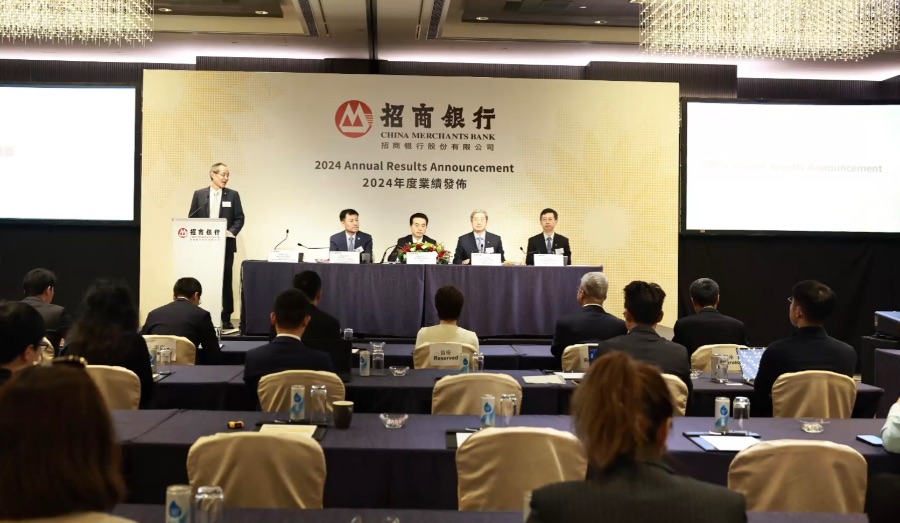
Group 1 - The banking financial asset investment companies (AIC) approved this year are accelerating their establishment efforts [1] - The internal recruitment for China Merchants Bank Financial Asset Investment Co., Ltd. (China Merchants AIC), approved in July, has commenced, with resumes currently in the screening stage [1] - The company is pushing forward with its preparation work, aiming for establishment by the end of the year [1]
一日售罄全靠托管人?第二批14只科创债ETF上市“定档”
Xin Lang Cai Jing· 2025-09-22 12:45
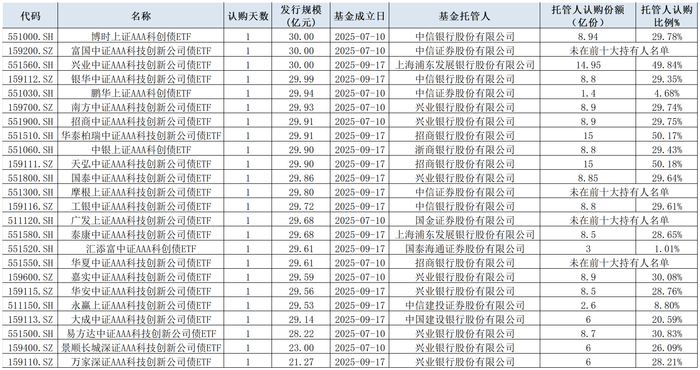
Core Points - The second batch of Sci-Tech Innovation Bond ETFs is set to be listed on September 24, with 14 ETFs collectively raising 69.773 billion yuan [1] - The first and second batches of Sci-Tech Innovation Bond ETFs experienced strong demand, with fundraising completed in one day [1] - Industrial banks, particularly Industrial Bank, have emerged as the largest custodians for these ETFs, managing eight of the funds [1][2] Fundraising and Custodian Details - A total of 24 Sci-Tech Innovation Bond ETFs have raised 69.773 billion yuan, with significant participation from institutional investors [1] - Industrial Bank is the custodian for eight ETFs, while China Merchants Bank, CITIC Bank, and CITIC Securities are custodians for three ETFs each [1][2] - Some custodians have made substantial investments, with one institution holding nearly 50% of certain ETFs [1][2] Investment Dynamics - The competition among custodians and shareholders is intensifying, with a focus on securing substantial institutional investments to achieve high fundraising targets [4] - The presence of strong custodians is crucial for the success of new ETFs, as they are expected to contribute significant capital [4] - Major fund companies are reducing management fees to attract more investments, with some lowering fees to the industry’s lowest levels [4][5] Cost Considerations - Fund companies face various costs beyond promotional expenses, including sales channel fees and operational costs, which impact profitability [5] - The need for ETFs to reach a scale of at least 10 billion yuan is emphasized to cover costs effectively under the current fee structure [5] - The liquidity of larger ETFs is expected to attract more capital, highlighting the importance of effective management strategies [5]



【招银研究】海外降息重启,国内股市回调——宏观与策略周度前瞻(2025.09.22-09.26)
招商银行研究· 2025-09-22 11:05
Group 1: Monetary Policy and Market Reactions - The Federal Reserve's interest rate cut has led to a mixed market response, with initial dovish sentiments followed by hawkish tones, resulting in a rebound in U.S. Treasury yields and fluctuations in the dollar [2] - U.S. stock valuations remain high, with corporate earnings showing strong performance, suggesting that future stock market gains will primarily come from earnings growth rather than valuation increases [2][8] - The yield curve has steepened significantly due to market expectations of Fed rate cuts and concerns over U.S. fiscal outlook and Fed independence, indicating potential for further steepening before reaching a peak [2] Group 2: Currency Outlook - The dollar is expected to maintain a volatile range between 95 and 103, influenced by interest rate differentials and the resilience of the U.S. economy [3] - The Chinese yuan may exhibit a strong trend in the short term, but could face disturbances from A-share declines and adjustments in U.S. rate cut expectations [3] Group 3: Chinese Economic Indicators - High-frequency data indicates a recovery in the real estate market, with new home sales in 30 major cities up by 9.8% year-on-year, while second-hand home sales increased by 29.8% [5] - External demand remains resilient, with container throughput at Chinese ports maintaining high levels, and export container freight rates showing a slight recovery [5] Group 4: Fiscal and Monetary Developments - August fiscal revenue showed a slight slowdown, with public budget revenue growth at 2.0%, while land sale revenues turned negative [6] - The People's Bank of China has adjusted its 14-day reverse repurchase operations to better reflect market conditions, indicating a shift towards more flexible liquidity management [7] Group 5: Market Strategies - The bond market is expected to experience weak fluctuations, with short-term bonds outperforming long-term ones, and a recommendation to hold mid-duration bonds while being cautious with long-duration investments [9][10] - In the A-share market, recent adjustments are seen as healthy, with a focus on maintaining liquidity and stability in capital markets, while technology growth stocks continue to perform strongly [10][11] - For Hong Kong stocks, a similar strategy is suggested, with dividend stocks as a stable base and growth sectors as aggressive positions, while monitoring for potential market volatility [11]

招商银行9月22日现1笔大宗交易 总成交金额3.56亿元 溢价率为0.00%
Xin Lang Cai Jing· 2025-09-22 10:07
炒股就看金麒麟分析师研报,权威,专业,及时,全面,助您挖掘潜力主题机会! 第1笔成交价格为40.92元,成交870.00万股,成交金额35,600.40万元,溢价率为0.00%,买方营业部为 华泰证券股份有限公司总部,卖方营业部为中信证券股份有限公司上海分公司。 进一步统计,近3个月内该股累计发生11笔大宗交易,合计成交金额为51.01亿元。该股近5个交易日累 计下跌3.08%,主力资金合计净流出16.3亿元。 责任编辑:小浪快报 9月22日,招商银行收跌0.20%,收盘价为40.92元,发生1笔大宗交易,合计成交量870万股,成交金额 3.56亿元。 ...
股份制银行板块9月22日跌0.63%,浦发银行领跌,主力资金净流入1.64亿元
Zheng Xing Xing Ye Ri Bao· 2025-09-22 08:47
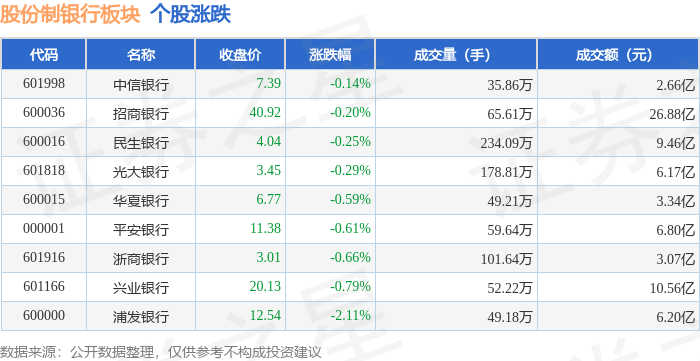
Market Performance - On September 22, the share price of the joint-stock bank sector fell by 0.63%, with Pudong Development Bank leading the decline [1] - The Shanghai Composite Index closed at 3828.58, up 0.22%, while the Shenzhen Component Index closed at 13157.97, up 0.67% [1] Individual Bank Performance - Citic Bank closed at 7.39, down 0.14% with a trading volume of 358,600 shares and a transaction value of 266 million yuan [1] - China Merchants Bank closed at 40.92, down 0.20% with a trading volume of 656,100 shares and a transaction value of 2.688 billion yuan [1] - Minsheng Bank closed at 4.04, down 0.25% with a trading volume of 2.3409 million shares and a transaction value of 946 million yuan [1] - Everbright Bank closed at 3.45, down 0.29% with a trading volume of 1.7881 million shares and a transaction value of 617 million yuan [1] - Huaxia Bank closed at 6.77, down 0.59% with a trading volume of 492,100 shares and a transaction value of 334 million yuan [1] - Ping An Bank closed at 11.38, down 0.61% with a trading volume of 596,400 shares and a transaction value of 680 million yuan [1] - Zhejiang Commercial Bank closed at 3.01, down 0.66% with a trading volume of 1.0164 million shares and a transaction value of 307 million yuan [1] - Industrial Bank closed at 20.13, down 0.79% with a trading volume of 522,200 shares and a transaction value of 1.056 billion yuan [1] - Pudong Development Bank closed at 12.54, down 2.11% with a trading volume of 491,800 shares and a transaction value of 620 million yuan [1] Capital Flow Analysis - The joint-stock bank sector experienced a net inflow of 164 million yuan from institutional investors, while retail investors saw a net inflow of 118 million yuan [1] - However, speculative funds had a net outflow of 282 million yuan [1] Detailed Capital Flow for Individual Banks - China Merchants Bank had a net inflow of 324 million yuan from institutional investors, but a net outflow of 214 million yuan from speculative funds [2] - Huaxia Bank saw a net outflow of 1.172 million yuan from institutional investors, but a net inflow of 385,400 yuan from speculative funds [2] - Citic Bank experienced a net outflow of 639,310 yuan from institutional investors and a net outflow of 176,290 yuan from speculative funds [2] - Industrial Bank had a net outflow of 1.297 million yuan from institutional investors and a net outflow of 36.539 million yuan from speculative funds [2] - Ping An Bank faced a net outflow of 1.862 million yuan from institutional investors, while retail investors contributed a net inflow of 1.607 million yuan [2] - Zhejiang Commercial Bank had a net outflow of 1.953 million yuan from institutional investors, but a net inflow of 1.398 million yuan from retail investors [2] - Everbright Bank saw a net outflow of 2.857 million yuan from institutional investors, with a net inflow of 4.665 million yuan from retail investors [2] - Pudong Development Bank had a net outflow of 3.323 million yuan from institutional investors, but a net inflow of 5.201 million yuan from retail investors [2] - Minsheng Bank experienced a net outflow of 4.007 million yuan from institutional investors, while retail investors contributed a net inflow of 4.548 million yuan [2]




银行业周报:银行板块整体下行-20250922
Bank of China Securities· 2025-09-22 08:40
Investment Rating - The report assigns an "Outperform" rating to the banking sector [1] Core Insights - The banking sector experienced a decline of 4.21% this week, marking the lowest performance across all industries [1][14] - Year-to-date, the banking sector has seen a growth of 3.30%, ranking 26th among all industries [1] - The report highlights investment opportunities in China Merchants Bank, Agricultural Bank of China, and Jiangsu Bank [1] Summary by Sections Banking Sector and Stock Performance - The A-share banking index fell by 4.09%, underperforming the Wind All A index by 3.91 percentage points [13] - Among 42 listed banks, only Qilu Bank saw an increase in stock price this week [2][17] - The average price-to-book (P/B) ratios for different types of banks are as follows: state-owned banks at 0.70X, joint-stock banks at 0.54X, city commercial banks at 0.63X, and rural commercial banks at 0.59X [2][17] Funding Price Situation - The People's Bank of China conducted a significant reverse repo operation, injecting 18,268 billion yuan into the market [3][29] - The overnight SHIBOR rate increased to 1.46%, up by 9 basis points from last week [3][32] - The average issuance rate for interbank certificates of deposit rose to 1.64%, an increase of 1 basis point [6][40] Bond Market Situation - Total bond market financing reached 23,465.1 billion yuan, with net financing of 8,512.8 billion yuan, an increase of 7,050.0 billion yuan from the previous week [4][45] - The issuance of financial bonds increased by 1,031.0 billion yuan, while the issuance of government bonds decreased [4][46] - The yield on 10-year government bonds rose to 1.88%, while the 1-year yield fell to 1.39% [5][50] Interbank Market Review - The interbank repo overnight rate (R001) increased to 1.50%, up by 10 basis points [3][32] - The trading volume for the week was 31.39 trillion yuan, a decrease of 1.74 trillion yuan from the previous week [3][32] Important News and Announcements - The report includes various charts and data visualizations that illustrate the performance of the banking sector and market conditions [12][18]

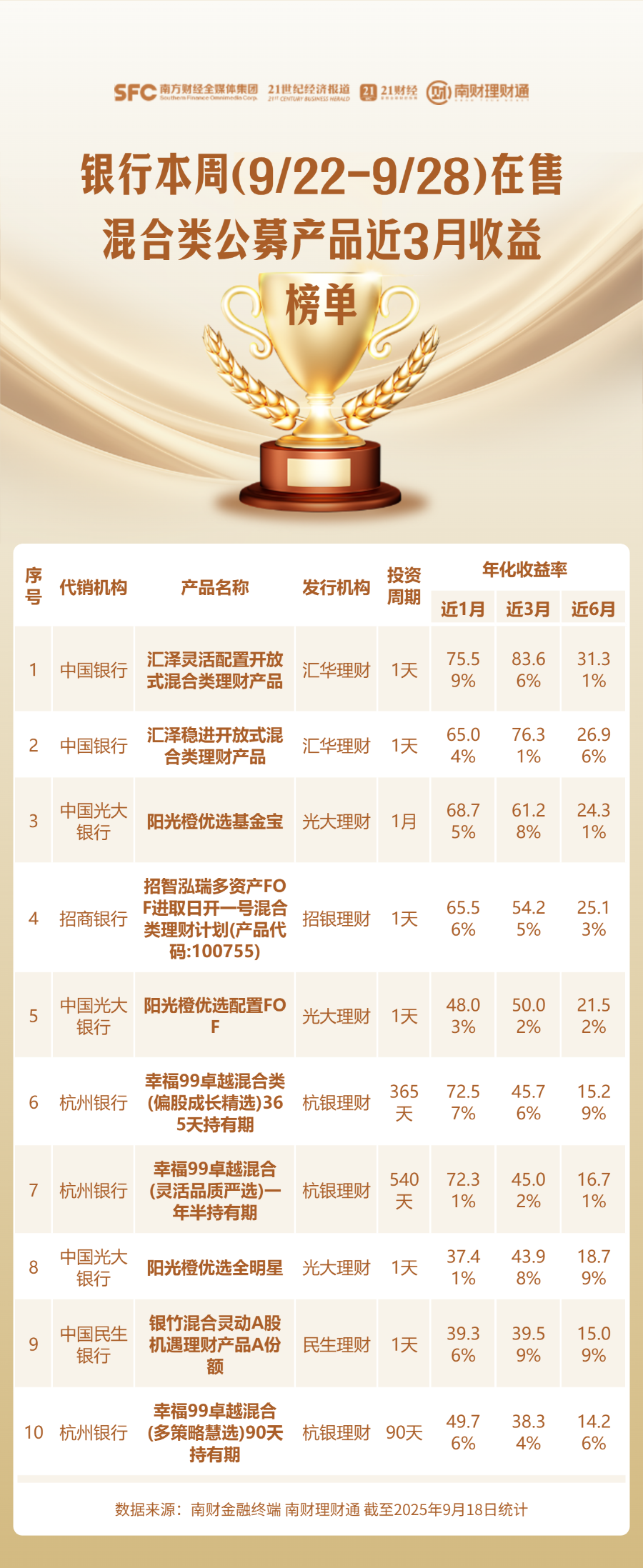
银行渠道本周在售混合类理财产品收益榜单(9/22-9/28)
2 1 Shi Ji Jing Ji Bao Dao· 2025-09-22 07:04
Core Viewpoint - The article discusses the challenges investors face in selecting bank wealth management products due to the overwhelming variety of similar-sounding products, and it aims to provide a performance ranking of these products to assist investors in making informed choices [1]. Group 1: Product Selection Criteria - The ranking of wealth management products is based on two main criteria: product type, focusing on pure fixed income, "fixed income plus," and mixed products, and performance stability, requiring products to have been established for at least three months to ensure sufficient performance data [1]. - The sample selection includes RMB public wealth management products, and the ranking reflects annualized performance over the past month, three months, and six months, sorted by the three-month annualized yield [1]. Group 2: Participating Institutions - A total of 28 distribution institutions are involved in the ranking, including major banks such as Industrial and Commercial Bank of China, Bank of China, Agricultural Bank of China, and others [2]. - The article notes that the "on sale" status of the products is based on investment cycle estimates, but actual availability may vary due to factors like sold-out quotas or differences in product listings for different customers [2]. Group 3: Performance Ranking Highlights - The article provides a performance ranking of various mixed wealth management products, highlighting specific products from banks like Bank of China and China Everbright Bank, with details on their annualized yields over different time frames [4]. - For instance, the top-ranked product from Bank of China has a three-month annualized yield of 9%, while other products show varying yields, indicating a competitive landscape among wealth management offerings [4].