GYLS(600059)

Search documents
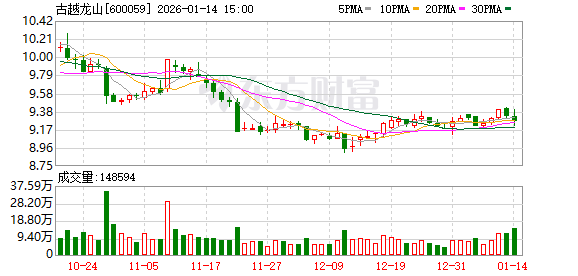
古越龙山今日大宗交易平价成交74.9万股,成交额700.32万元
Xin Lang Cai Jing· 2026-01-22 09:40
| 交易日期 证券简称 | | 壬券代码 | 成交价(元) 成交盒额(万元) 成交量(*) 买入营业部 | | | 美出营业部 | 是否为专场 | | --- | --- | --- | --- | --- | --- | --- | --- | | 026-01-22 | 古越龙山 | 600059 | 9.35 700.32 | 74.9 74.9 | 用膏渣膏反蓋酸份 | 哥喬想讀愛愛臉的 | Ka | 1月22日,古越龙山大宗交易成交74.9万股,成交额700.32万元,占当日总成交额的6.54%,成交价9.35 元,较市场收盘价9.35元持平。 ...



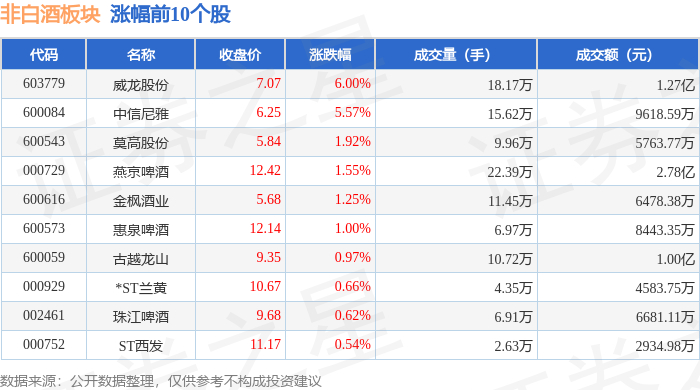
非白酒板块1月22日涨0.72%,威龙股份领涨,主力资金净流出1821.8万元
Zheng Xing Xing Ye Ri Bao· 2026-01-22 09:02
Core Viewpoint - The non-baijiu sector experienced a 0.72% increase on January 22, with Weilong Co., Ltd. leading the gains, while the Shanghai Composite Index rose by 0.14% and the Shenzhen Component Index increased by 0.5% [1] Group 1: Market Performance - The closing price of Weilong Co., Ltd. was 7.07, with a rise of 6.00% and a trading volume of 181,700 shares, amounting to a transaction value of 127 million yuan [1] - Other notable performers included CITIC Neya with a closing price of 6.25, up 5.57%, and Mogaoguan Co. at 5.84, up 1.92% [1] - The overall trading volume in the non-baijiu sector showed varied performance, with some stocks like Feike Beer and Jinfeng Wine also recording positive gains [1] Group 2: Capital Flow - The non-baijiu sector saw a net outflow of 18.218 million yuan from institutional investors and 35.8685 million yuan from retail investors, while there was a net inflow of 54.0864 million yuan from individual investors [2] - The capital flow data indicates that while institutional and speculative funds withdrew, retail investors were actively buying into the sector [2] Group 3: Individual Stock Analysis - Chongqing Beer experienced a net outflow of 16.9419 million yuan from institutional investors, while retail investors contributed a net inflow of 1.2597 million yuan [3] - Weilong Co., Ltd. had a net inflow of 14.4287 million yuan from institutional investors, but faced a net outflow of 1.19562 million yuan from retail investors [3] - Qingdao Beer saw a net inflow of 11.5279 million yuan from institutional investors, indicating strong institutional interest despite retail outflows [3]




黄酒从“江浙特产”到“全国潮饮”的进阶之路
Zheng Zhou Ri Bao· 2026-01-20 23:37
Core Insights - The yellow wine industry in China is experiencing a significant revival, with a notable increase in popularity among younger consumers and innovative product offerings [1][3][5] Industry Overview - The yellow wine sector is projected to achieve impressive results by 2025, with companies like Kuaijishan seeing a stock price increase of 90.15% in one year, making it a leader among liquor companies [1] - In 2024, there are nearly 800 yellow wine production enterprises in China, generating revenues of 20 billion yuan, a year-on-year growth of 5.26%, with a production volume of approximately 4 million tons, up 3.5% [2] Cultural and Consumer Trends - The resurgence of yellow wine is attributed to three key trends: the return of cultural value, the evolution of consumer demographics, and the explosion of the new beverage market [3][4] - The primary consumer base for yellow wine has shifted to younger generations, particularly those aged 25-30 and above, with a growing interest from the 18-24 age group [3] Product Innovation - Innovative products such as "one day one smoked sparkling yellow wine" and collaborations like "Yue Xiao Pi" between Guyue Longshan and China Resources Beer are redefining the market [5] - The introduction of low-alcohol, lightly sweet, and easy-to-drink products is aimed at attracting a broader audience, including younger consumers [5][6] Strategic Recommendations - To appeal to younger consumers, the industry must focus on brand expression, product form, and channel accessibility, utilizing modern marketing strategies and platforms [6][7] - The goal is to shift the perception of yellow wine from an "elderly drink" to a trendy beverage for all ages [6] Regional Development - The revival of yellow wine is not limited to traditional regions like Jiangsu and Zhejiang; new production hubs are emerging in Shanxi and Hubei, supported by local government policies [7] - In Shanxi, the establishment of a "yellow wine professional town" has led to a significant increase in production capacity and enterprise growth [7] Market Valuation and Future Outlook - The yellow wine industry is undergoing a value reassessment, with companies like Kuaijishan and Guyue Longshan trading at price-to-earnings ratios exceeding 35 times expected profits for 2026 [8] - The industry is expected to maintain sustainable growth if companies continue to invest in branding and focus on high-end and youthful market segments [8]

资本重新“酿”酒:黄酒能否讲出千亿故事
Jing Ji Guan Cha Bao· 2026-01-19 03:17
Core Viewpoint - The yellow wine sector is experiencing significant growth, with companies like Kuaijishan (601579) achieving remarkable stock price increases, while traditional liquor stocks are facing declines. The potential for the yellow wine industry to reach a market size of 100 billion is highlighted, driven by high-end, youthful, and nationwide strategies [1][2][12]. Group 1: Market Performance - Kuaijishan's stock surged by 90.15% in 2025, making it the top-performing liquor company, while major white liquor brands like Moutai and Wuliangye saw declines of -6.47% and -19.57% respectively [1][2]. - The yellow wine index recorded a 51.67% increase in the first five months of 2025, outperforming other liquor segments and popular concepts like humanoid robots and pet economy [1][2]. Group 2: Industry Dynamics - The market capitalization of Kuaijishan reached 9.86 billion, while Guyue Longshan (600059) was at 8.32 billion, still significantly lower than Moutai and Wuliangye [2]. - The yellow wine industry accounted for less than 2% of the total liquor market, with a production volume of approximately 4 million tons and sales of around 20 billion in 2024 [2][12]. Group 3: Strategic Changes - Kuaijishan and Guyue Longshan implemented significant price adjustments in April 2025, marking Kuaijishan's first major price increase since 2016, aimed at enhancing the industry's pricing structure [3][5]. - The sales revenue from mid-to-high-end products for Kuaijishan reached 1.065 billion in 2024, constituting 67.26% of its total revenue, while Guyue Longshan's mid-to-high-end sales were 1.398 billion, making up 73.36% [3][4]. Group 4: Consumer Trends - The consumer base for yellow wine is becoming increasingly younger, with 70% of users under 35 years old, indicating a shift in consumption patterns [4][5]. - The introduction of innovative products, such as sparkling yellow wine, has shown potential for breaking into new consumer markets, with significant sales growth during promotional events [4][6]. Group 5: Future Outlook - Analysts suggest that the yellow wine industry could realistically aim for a market size of 300 billion by 2025, with the potential for further growth if high-end products are successfully promoted [2][12]. - Despite the optimistic outlook, some analysts express caution, noting that achieving a 100 billion market size will require sustained innovation and the establishment of strong consumer scenarios [12][13].
资本重新“酿”酒:黄酒能否讲出千亿故事
经济观察报· 2026-01-18 05:54
Core Viewpoint - The article discusses the significant growth and potential of the Huangjiu (yellow wine) industry, highlighting a shift in investor interest from traditional Baijiu (white liquor) to Huangjiu, driven by successful high-end, youth-oriented, and national strategies by companies like Kuaijishan and Guyuelongshan [1][3][10]. Group 1: Market Performance - In 2025, Huangjiu stocks experienced a remarkable surge, with Kuaijishan (601579.SH) achieving a 90.15% increase, making it the top-performing liquor company for the year [2]. - The Huangjiu index saw a 51.67% increase in the first five months of 2025, outperforming other liquor segments and popular sectors like robotics and pet economy [2][3]. - As of January 16, 2026, Kuaijishan's market capitalization reached 9.86 billion, while Guyuelongshan's was 8.32 billion, still significantly lower than leading Baijiu companies [2]. Group 2: Industry Trends - The Huangjiu industry is projected to grow, with a market size expected to exceed 30 billion by 2025, up from approximately 20 billion in 2024 [3]. - The production of Huangjiu in China was around 4 million tons in 2024, with a 3.5% year-on-year increase [3]. - The market share of the top two Huangjiu companies increased from 14.9% in 2017 to 37.4% in 2023, indicating a consolidation in the industry [9]. Group 3: Strategic Shifts - Companies like Kuaijishan and Guyuelongshan have implemented price adjustments and high-end product strategies, with Kuaijishan's mid-to-high-end sales reaching 1.065 billion in 2024, accounting for 67.26% of its revenue [5][9]. - The introduction of innovative products, such as sparkling Huangjiu, has shown potential for attracting younger consumers, with 70% of buyers being under 35 years old [6][10]. - The entry of cross-industry players, such as Qingdao Beer acquiring a Huangjiu factory, indicates a growing interest in the Huangjiu market and its potential for complementary sales [7]. Group 4: Challenges and Opportunities - Despite the growth, Huangjiu faces challenges such as a limited consumer base and a lack of premium products in the mid-price range [12][13]. - Analysts suggest that for Huangjiu to reach a market size of 100 billion, it must overcome structural issues and establish strong consumer scenarios [15][16]. - The historical context shows that while Huangjiu has potential, it must innovate and create national-level products to compete effectively with Baijiu [16][17].
古越龙山:目前已出口至40余个国家和地区
Zheng Quan Ri Bao Wang· 2026-01-15 12:11
Core Viewpoint - Guyue Longshan, a leading Huangjiu brand, aims to establish itself as a world-class high-end liquor brand while promoting Chinese liquor culture globally [1] Group 1: Company Overview - Guyue Longshan has a 2500-year heritage of non-material cultural heritage brewing techniques [1] - The company is recognized as a "China Famous Trademark" and a "Chinese Time-honored Brand" [1] - It has exported its products to over 40 countries and regions [1] Group 2: International Expansion and Strategy - The company has established an overseas tasting hall in France to facilitate the international dissemination of Huangjiu culture [1] - Guyue Longshan's leadership is committed to exploring ways to adapt Huangjiu to global consumption scenarios [1] - The company plans to continuously deepen the cultural connotation and craftsmanship of Huangjiu in line with the rising trend of national culture [1] Group 3: Future Outlook - Guyue Longshan aims to steadily expand its international high-end channel layout [1] - The company is focused on promoting traditional liquor with Eastern charm to a broader international stage [1]
古越龙山:公司管理层始终对公司产品及黄酒产业发展充满坚定信心
Zheng Quan Ri Bao· 2026-01-15 11:42
Core Viewpoint - Guyue Longshan's innovative product "No High Low" Huangjiu has won the Excellent New Product Award in Zhejiang Province, marking a significant step in the company's strategy of "high-end and youth-oriented" development [2] Group 1: Product Innovation and Strategy - The company is committed to focusing on demand exploration and quality enhancement to drive market expansion for potential single products [2] - The management expresses strong confidence in the development of the company's products and the Huangjiu industry [2] Group 2: Smart Manufacturing - The company's smart factory is the first large-scale intelligent production base in the Huangjiu industry, prepared for potential explosive growth in product demand [2] - The factory features sufficient design capacity, efficient response through automation, and a complete dynamic adjustment and expansion mechanism [2] - The company ensures quality stability during the capacity release process through intelligent detection equipment [2]
古越龙山:未来公司将持续优化全媒体运营策略
Zheng Quan Ri Bao· 2026-01-15 11:41
Core Viewpoint - Guyue Longshan is exploring the feasibility of synchronizing content promotion based on existing promotional foundations and the needs of capital market information dissemination, aiming to enhance brand influence and market recognition [2] Group 1 - The company is considering differentiated content adaptation and efficient resource collaboration as part of its promotional strategy [2] - There is a focus on the necessity and implementation form of a special research group to align with operational needs and management efficiency [2] - The company aims to continuously optimize its all-media operation strategy, balancing the cultivation of young consumers with communication in the capital market [2]
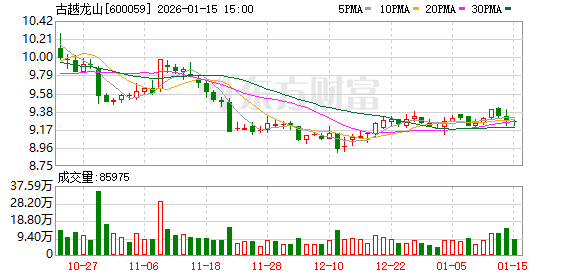
非白酒板块1月15日跌0.45%,会稽山领跌,主力资金净流出501.98万元
Zheng Xing Xing Ye Ri Bao· 2026-01-15 08:58
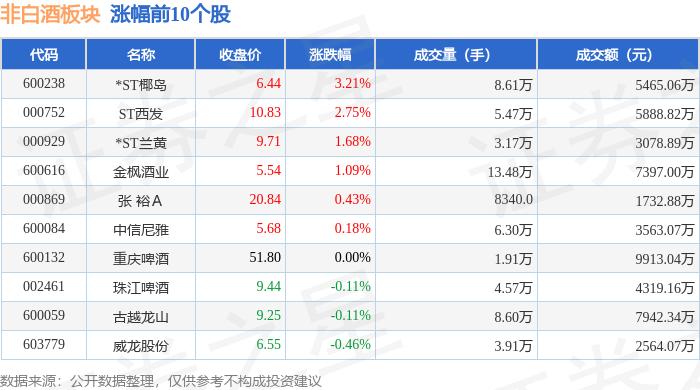
Market Overview - The non-white liquor sector experienced a decline of 0.45% on January 15, with Kuaijishan leading the drop [1] - The Shanghai Composite Index closed at 4112.6, down 0.33%, while the Shenzhen Component Index rose by 0.41% to 14306.73 [1] Stock Performance - Notable gainers in the non-white liquor sector included: - *ST Yedao: Closed at 6.44, up 3.21% with a trading volume of 86,100 shares and a turnover of 54.65 million yuan [1] - ST Xifa: Closed at 10.83, up 2.75% with a trading volume of 54,700 shares and a turnover of 58.89 million yuan [1] - *ST Lanhong: Closed at 9.71, up 1.68% with a trading volume of 31,700 shares and a turnover of 30.79 million yuan [1] - Conversely, Kuaijishan saw a decline of 2.25%, closing at 20.41 with a trading volume of 85,300 shares and a turnover of 175 million yuan [2] Capital Flow Analysis - The non-white liquor sector experienced a net outflow of 5.02 million yuan from institutional investors and 10.70 million yuan from retail investors, while retail investors saw a net inflow of 15.72 million yuan [2] - Key capital flows for selected stocks included: - Jinfeng Wine Industry: Net inflow of 11.50 million yuan from institutional investors, but a net outflow of 6.69 million yuan from retail investors [3] - *ST Yedao: Net inflow of 10.16 million yuan from institutional investors, with a net outflow of 6.46 million yuan from retail investors [3] - ST Xifa: Net inflow of 0.94 million yuan from retail investors, but a net outflow of 0.42 million yuan from institutional investors [3]


古越龙山:公司十分重视科技创新与产品研发
Zheng Quan Ri Bao· 2026-01-14 12:39
Core Viewpoint - The company emphasizes the importance of technological innovation and product development, highlighting its collaboration with Jiangnan University on the "Guyue Longshan Yeast No. 1" project as a significant achievement in technological innovation [2] Group 1: Technological Innovation - The company is actively promoting product innovation and upgrades based on market demand [2] - The collaboration with Jiangnan University is a key part of the company's technological innovation strategy [2] Group 2: Product Development - The company has developed a diverse range of products, including fruit liquor, herbal series liquor, glutinous rice whiskey, and craft lager [2] - Future industrialization plans will be advanced steadily based on market research and technical validation [2]