
Hisense V.T.(600060)

Search documents
2025全球消费电子十大头部品牌权威榜单:AI与绿色技术重塑格局
Sou Hu Cai Jing· 2025-09-15 11:33
Group 1: Industry Transformation - The global consumer electronics industry is undergoing a profound transformation driven by artificial intelligence (AI) and green technology, with a new landscape dominated by brands from China, the US, and South Korea [1][11] - The IFA 2025 and CES 2025 exhibitions highlighted that AI technology and sustainable development are the core competitive focuses for global consumer electronics brands [1] Group 2: Rise of Chinese Brands - The most significant change in the global consumer electronics landscape by 2025 is the collective rise of Chinese brands, with Huawei and Midea ranking in the top ten of the Brand Finance's global electronics brand value list [3] - Huawei's brand value reached $31.921 billion, growing by 2.7% year-on-year, and it has a 25% market share in the high-end European market [3] Group 3: Display Technology Competition - High-end display technology is becoming the most competitive arena, with various technological routes driving the industry into a critical phase of experience upgrades [4] - Hisense has achieved large-scale production of RGB-Mini LED TVs, setting a benchmark in the high-end display market with its U7S Pro series [4] Group 4: AI Integration - AI has fully integrated into consumer electronics, evolving from an additional feature to the core driving force of products [5] - Xiaomi's strategy covers over 1 billion connected devices globally, with a 52.6% year-on-year increase in Bluetooth earphone shipments in the first half of 2025 [5] Group 5: Green Technology Innovation - Green low-carbon technology has become a new battlefield for consumer electronics brands, with unprecedented emphasis on sustainable development at IFA 2025 [6] - Midea's AI ECO smart energy-saving solution achieves a 30% energy-saving effect, while TCL's ECORA™ technology promotes low-carbonization throughout the product lifecycle [6] Group 6: Global Brand Value Rankings - According to Brand Finance's 2025 global electronics brand value rankings, Apple, Samsung, and Huawei lead the market, with Apple valued at $574.51 billion, growing by 11.2% [7] - Midea's brand value is $8.723 billion, maintaining its position in the global top ten despite a slight decline [7] Group 7: Emerging Product Categories - 2025 is marked as the year of AI smart glasses, with projected sales reaching 55 million units by 2029 [8] - The CES 2025 showcased various AI companion robots, indicating a growing trend in this emerging category [9] Group 8: Technological Innovation Trends - The global consumer electronics industry is forming a tri-polar structure dominated by the US (Apple/NVIDIA), South Korea (Samsung), and China (Huawei/Xiaomi/Lenovo), with seven out of the top ten brands from these regions [10] - Chinese brands are breaking monopolies in fields like chips and robotics, with DJI holding over 70% of the global drone market [10]






消费电子巨头,为何集体上飞书?
3 6 Ke· 2025-09-15 11:13
Core Insights - Hisense has upgraded its collaboration platform to Feishu, enhancing management efficiency and employee feedback has been positive, particularly among younger staff who find it aligns with their expectations for effective tools [1][2] - The adoption of Feishu is part of a broader trend in the consumer electronics industry, with companies like Xiaomi, Anker, and Ecovacs also embracing new collaborative tools to integrate AI with organizational capabilities [2][3] - The shift to Feishu is driven by the need for improved organizational efficiency in a rapidly evolving and competitive landscape, where product cycles are shorter and collaboration is increasingly complex [3][4] Company-Specific Developments - Anker has reported significant improvements in efficiency since adopting Feishu, with over 400 million documents created in its knowledge base, enhancing cross-border collaboration and operational efficiency [4][5] - Other companies, such as SKG and Cowarobot, have also seen tangible benefits from using Feishu, including a 20% increase in delivery efficiency and a 30% improvement in decision-making processes [5][7] - Hisense's internal strategy focuses on eliminating inefficient meetings, utilizing AI to generate meeting minutes and task lists, thereby streamlining workflows [8][9] Industry Trends - The consumer electronics sector is increasingly recognizing the importance of organizational agility and learning capabilities, as traditional product parameter competition becomes insufficient [11][12] - The integration of AI into business processes is becoming essential for companies to maintain competitiveness and adapt to global market challenges [11][13] - The collective move towards Feishu among major players in the industry signifies a shift in how collaboration and innovation are approached, with a focus on creating a more efficient and responsive organizational structure [12][13]
消费电子巨头,为何集体上飞书?
36氪未来消费· 2025-09-15 11:11
Core Viewpoint - The article discusses the transition of Hisense to the collaboration tool Lark, highlighting its impact on organizational efficiency and employee productivity in the context of the consumer electronics industry [5][6][18]. Group 1: Hisense's Transition to Lark - Hisense's chairman mentioned that the switch to Lark has improved management efficiency through better information integration and collaboration [5]. - Employees have provided positive feedback, particularly noting enhanced meeting efficiency and streamlined processes [5][18]. - The integration of AI tools has allowed for automatic meeting minutes generation and task assignment, reducing inefficiencies [5][18]. Group 2: Industry Trends - Hisense's move is part of a broader trend in the consumer electronics sector, with companies like Xiaomi and Anker also adopting Lark to enhance collaboration and efficiency [6][8]. - The consumer electronics industry faces pressures such as shorter product cycles and complex collaboration, necessitating improved organizational efficiency [8][22]. - The adoption of Lark is seen as a strategic response to these challenges, enabling companies to better manage their operations and enhance product innovation [9][22]. Group 3: Benefits of Lark - Lark has been instrumental in breaking down silos within organizations, allowing for seamless communication and collaboration across departments [10][12]. - Companies like Anker have reported significant improvements in efficiency, with millions of documents and knowledge accumulated on the platform [11]. - The tool has facilitated real-time collaboration across different time zones and languages, which is crucial for companies operating globally [11][12]. Group 4: Future Implications - The article emphasizes that organizational agility and learning capabilities are becoming increasingly important in the consumer electronics industry [23]. - As companies expand globally and integrate AI into their operations, the need for effective collaboration tools like Lark will only grow [23][25]. - The successful implementation of Lark is expected to enhance not only employee experience but also product innovation and supply chain responsiveness [22][24].
黑色家电板块9月15日涨0.36%,创维数字领涨,主力资金净流入1.63亿元
Zheng Xing Xing Ye Ri Bao· 2025-09-15 08:42
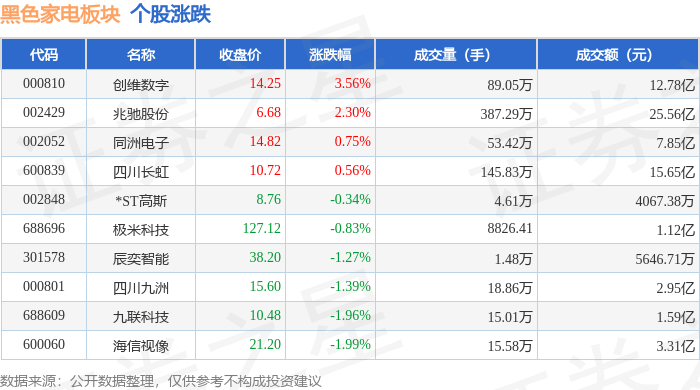
Market Overview - On September 15, the black home appliance sector rose by 0.36% compared to the previous trading day, with Skyworth Digital leading the gains [1] - The Shanghai Composite Index closed at 3860.5, down 0.26%, while the Shenzhen Component Index closed at 13005.77, up 0.63% [1] Stock Performance - Key stocks in the black home appliance sector showed varied performance: - Skyworth Digital (000810) closed at 14.25, up 3.56% with a trading volume of 890,500 shares and a turnover of 1.278 billion yuan - Non-Chi Co., Ltd. (002429) closed at 6.68, up 2.30% with a trading volume of 3.8729 million shares and a turnover of 2.556 billion yuan - Other notable stocks included Tongzhou Electronics (002052) at 14.82, up 0.75%, and Sichuan Changhong (600839) at 10.72, up 0.56% [1] Capital Flow - The black home appliance sector experienced a net inflow of 163 million yuan from institutional investors, while retail investors saw a net outflow of 1.02 billion yuan [1] - Detailed capital flow for key stocks indicated: - Non-Chi Co., Ltd. had a net inflow of 144 million yuan from institutional investors, while retail investors had a net outflow of 1.22 billion yuan [2] - Skyworth Digital saw a net inflow of 75.1 million yuan from institutional investors, with retail investors experiencing a net outflow of 36.73 million yuan [2] - Other stocks like Hisense Visual (600060) and ST Gauss (002848) also showed significant net outflows from retail investors [2]


家电行业8月月报及9月投资策略:业绩稳中有进相对估值底部-20250915
Guolian Minsheng Securities· 2025-09-15 08:28
Group 1 - The report highlights a stable performance in the home appliance industry, with a focus on the support for domestic demand through policies and the potential turning point in exports [5][6] - White goods are expected to maintain strong sales momentum, supported by the third batch of subsidies for trade-in programs, with leading companies like Midea Group, Haier Smart Home, Hisense Home Appliances, and Gree Electric showing robust financial performance [7][8] - The black goods segment benefits from domestic trade-in policies, with a steady increase in average prices and a projected stable growth in the global market size by 2025, recommending Hisense Visual and TCL Electronics as key players [7][8] Group 2 - The report indicates that the two-wheeler market will see accelerated growth due to national subsidies, with leading companies like Yadea Holdings expected to outperform the industry significantly [7] - The post-cycle segment shows improved operations, with a narrowing decline due to supportive policies in real estate, recommending companies like Robam Appliances and Vatti Corporation for investment [7] - The small appliance sector is experiencing a turnaround, with expectations for improved demand and market dynamics by 2025, highlighting companies like Ecovacs Robotics and Supor as potential investment opportunities [7] Group 3 - The report provides a market review for August, noting that the home appliance index increased by 4.73%, although it underperformed compared to the broader market indices [16][17] - The relative valuation of the home appliance sector is at a low point, with a PE ratio of 14.14 times, indicating potential investment value [17][18] - Key data tracking shows fluctuations in commodity prices, with copper and aluminum prices increasing year-on-year, while shipping rates have decreased [22][24]



海信在石家庄新设能源控股公司,注册资本7亿
Qi Cha Cha· 2025-09-15 06:04
Group 1 - The establishment of Shijiazhuang Hisense Energy Holding Co., Ltd. has been officially registered with a capital of 700 million RMB [1] - The legal representative of the new company is Shi Wenbo, indicating a structured leadership [1] - The company's business scope includes investment activities, manufacturing of mechanical and electrical equipment, and manufacturing of power distribution and control equipment [1] Group 2 - Hisense Group Co., Ltd. holds 100% ownership of the newly established energy holding company, reflecting its strategic investment direction [1]
海信视像跌2.03%,成交额1.74亿元,主力资金净流出791.41万元
Xin Lang Zheng Quan· 2025-09-15 05:43
Core Viewpoint - Hisense Visual's stock has experienced fluctuations, with a recent decline of 2.03% and a year-to-date increase of 11.18%, indicating volatility in market performance [1] Financial Performance - For the first half of 2025, Hisense Visual reported revenue of 27.23 billion yuan, a year-on-year increase of 6.95%, and a net profit attributable to shareholders of 1.06 billion yuan, up 26.59% [2] - Cumulative cash dividends since the company's A-share listing amount to 6.97 billion yuan, with 3.04 billion yuan distributed over the past three years [3] Shareholder Information - As of June 30, 2025, the number of shareholders increased by 6.22% to 32,800, while the average circulating shares per person decreased by 5.86% to 39,482 shares [2] - The top ten circulating shareholders include Hong Kong Central Clearing Limited, which holds 56.70 million shares, a decrease of 2.42 million shares from the previous period [3]
海信在石家庄新设能源控股公司 注册资本7亿元
Zheng Quan Shi Bao Wang· 2025-09-15 05:02
Group 1 - A new company, Shijiazhuang Hisense Energy Holdings Co., Ltd., has been established with a registered capital of 700 million yuan [1] - The legal representative of the new company is Shi Wenbo [1] - The company's business scope includes investment activities with self-owned funds, manufacturing of mechanical and electrical equipment, and manufacturing of power distribution and control equipment [1] Group 2 - The new company is wholly owned by Hisense Group Co., Ltd. [1]
海信在石家庄成立能源控股公司,注册资本7亿
Xin Lang Cai Jing· 2025-09-15 02:39
Group 1 - A new company, Shijiazhuang Hisense Energy Holding Co., Ltd., has been established with a registered capital of 700 million RMB [1] - The legal representative of the company is Shi Wenbo, indicating a structured leadership [1] - The company is fully owned by Hisense Group Co., Ltd., reflecting a strong backing from a well-known parent company [1] Group 2 - The business scope of the new company includes investment activities using its own funds, manufacturing of mechanical and electrical equipment, and manufacturing of power distribution and control equipment [1]
柏林国际消费电子展聚焦“智慧生活”
Jing Ji Ri Bao· 2025-09-12 21:58
Core Insights - The IFA 2025 showcased groundbreaking products and solutions focusing on artificial intelligence, sustainability, smart home technology, and advanced display technologies, reinforcing its status as a global tech trendsetter [1][6] - Chinese companies like TCL and Hisense competed alongside international brands, outlining a grand vision for future smart living [1][6] Company Highlights - **TCL**: Featured "Olympic-level" technology and sustainable development concepts, introducing the industry's first fourth-generation LCD TV Q10L Pro and the world's largest 115-inch QD-Mini LED TV. TCL's ECORA eco-friendly materials, made from recycled ceramics, exemplified its commitment to sustainability [2][6] - **Hisense**: Presented its latest achievements in smart living and energy management under the theme "AI Your Life," including the global debut of a 116-inch RGB-Mini LED TV and a 163-inch Micro LED screen. Hisense's AI-driven products in smart home management showcased significant growth, with overseas sales increasing by 2.8 times [3][4][6] - **Samsung**: Continued its leadership with an AIoT ecosystem, integrating devices like TVs and refrigerators for a seamless user experience. The latest Neo QLED 8K TV featured enhanced AI picture optimization technology [4][6] - **LG**: Launched a new generation of OLED evo TVs with AI audio-visual optimization and ultra-thin designs, while its ThinQ series appliances utilized AIoT for improved user interaction [5][6] - **Bosch**: Focused on smart home and sustainability themes, showcasing the upgraded Home Connect platform and energy-efficient appliances that comply with EU standards [5][6] Industry Trends - AI technology was a central theme throughout the exhibition, with various companies presenting AI-driven products that are reshaping the consumer electronics and home appliance sectors [6] - Sustainability emerged as a significant focus, with companies like TCL, Bosch, and LG demonstrating their commitment to green and low-carbon initiatives through innovative materials and energy-efficient products [6]