CNRE(600111)

Search documents
小金属板块1月7日涨3.14%,翔鹭钨业领涨,主力资金净流入15.43亿元
Zheng Xing Xing Ye Ri Bao· 2026-01-07 08:58
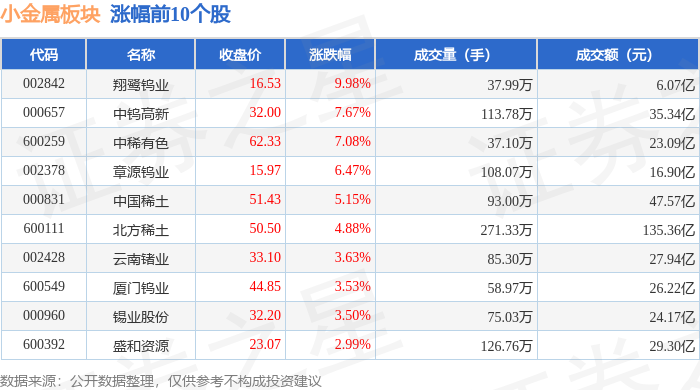
Group 1 - The small metals sector increased by 3.14% on January 7, with Xianglu Tungsten leading the gains [1] - The Shanghai Composite Index closed at 4085.77, up 0.05%, while the Shenzhen Component Index closed at 14030.56, up 0.06% [1] - Key stocks in the small metals sector showed significant price increases, with Xianglu Tungsten rising by 9.98% to a closing price of 16.53 [1] Group 2 - The small metals sector experienced a net inflow of 1.543 billion yuan from main funds, while retail investors saw a net outflow of 703 million yuan [2][3] - Notable stocks with significant main fund inflows include Northern Rare Earth with 647 million yuan and China Rare Earth with 468 million yuan [3] - Conversely, stocks like Western Materials and Tian Gong Co. faced declines, with Western Materials down by 3.86% [2]



A股,冲击4100点!利好来袭
Zhong Guo Ji Jin Bao· 2026-01-07 04:52
Market Overview - The A-share market saw all three major indices rise, with the Shanghai Composite Index reaching 4095.54 points, marking a 0.29% increase and a new 10-year high, supported by strong trading volume exceeding 1.8 trillion yuan [1][3]. Trading Volume and Stock Performance - The total trading volume in the Shanghai and Shenzhen markets reached 1.84 trillion yuan, an increase of 538 billion yuan compared to the previous trading day. Out of 2522 stocks, 88 hit the daily limit up, while 2773 stocks declined [3]. - The semiconductor, basic metals, pharmaceuticals, and coal sectors led the gains, with significant increases in stocks related to photolithography machines and rare earth concepts. Conversely, sectors like lithium battery electrolytes and financial technology experienced declines [3]. Sector Performance - The photolithography machine sector rose by 6.20%, while rare earth stocks increased by 5.76%. Other notable sectors included semiconductor equipment and basic metals, which also saw gains [4]. - In the Hong Kong market, the Hang Seng Index and related indices experienced a noticeable pullback, with declines exceeding 1%. Major stocks like Tencent and Alibaba fell by over 2% and 3%, respectively, while the biotechnology sector saw gains [5]. Rare Earth Sector - Rare earth permanent magnet stocks surged, with companies like Zhongxi Rare Earth hitting the daily limit up with a 10% increase, and China Rare Earth rising over 7% [6][7]. - Reports indicate that the Chinese government is considering tightening export license reviews for heavy rare earths, which could significantly impact Japan's economy due to its reliance on Chinese supplies for electric vehicle components [7]. Semiconductor Sector - The semiconductor sector continued its strong performance, with stocks related to semiconductor equipment, photolithography, and memory chips seeing significant increases. Companies like Nanda Optoelectronics and Chip Source Microelectronics recorded daily limit ups of 20% [8][9]. - Analysts predict that Samsung Electronics will report a 160% year-on-year increase in operating profit for Q4 2025, driven by a surge in demand for memory chips due to the AI boom [10]. Brain-Computer Interface Sector - Brain-computer interface stocks remained active, with companies like Meihao Medical achieving a daily limit up of 20%. Recent financing activities in the sector indicate strong investor interest, including significant investments from well-known international firms [11][12].



A股,冲击4100点!利好来袭!
中国基金报· 2026-01-07 04:17
【导读】上午A股三大指数集体大涨,半导体、稀土板块大涨,光刻机概念股领涨 中国基金报记者 张舟 大家好,今天是周三,基金君和你继续关注市场行情! 1月7日上午,A股三大股指集体上涨,沪指冲击4100点,再创10年来新高,市场量能强劲, 半日成交额超1.8万亿元。 截至午间收盘,沪指报4095.54点,涨0.29%,深证成指涨0.35%,创业板指涨0.41%。 | 最高: 4098.78 | 今开:4083.84 | 成交量: 4.32亿手 | 换手: 0. | | --- | --- | --- | --- | | 最低: 4075.70 | 昨收:4083.67 | 成交额:7617.22亿 | 量比: 1. | | 52周最高: 4098.78 | 上涨: 762 | 振幅: 0.57% | 平盘:74 | | 52周最低:3040.69 | 下跌:905 | 总市值: 66.86万亿 | | 沪深两市半日成交额达1.84万亿元,较上个交易日放量538亿元。 个股跌多涨少,全市场共 2522只个股上涨,88只个股涨停,2773只个股下跌。 上午,稀土永磁概念股强势拉升。 个股方面,中稀有色录得10cm涨停 ...

有色ETF基金(159880)涨超2%,稀土黄金双双上行
Sou Hu Cai Jing· 2026-01-07 03:50
Core Viewpoint - The rare earth and precious metals sectors are experiencing significant price increases, driven by supply constraints and strong demand, particularly in the context of China's regulatory measures and global economic conditions [1][2]. Group 1: Market Performance - The National Securities Nonferrous Metals Industry Index (399395) rose by 1.88%, with notable gains in individual stocks such as Rare Earth (600259) up 10.00%, Shengtun Mining (600711) up 9.01%, and Xingye Silver Tin (000426) up 7.57% [1]. - The Nonferrous ETF Fund (159880) increased by 2.01%, marking its fifth consecutive rise, with the latest price reported at 2.13 yuan [1]. Group 2: Supply and Demand Dynamics - On the supply side, domestic rare earth supply regulation is expected to smooth out the issuance of quotas, while overseas supply is projected to continue growing as new projects come online [2]. - Demand for rare earths is anticipated to remain strong, particularly from the electric vehicle sector and robotics, further emphasizing the scarcity of resources and potentially driving prices higher [2]. Group 3: Gold and Silver Market Insights - Global central banks continue to increase their gold holdings, which supports the ongoing bullish trend in gold prices, especially during periods of interest rate cuts [2]. - Silver ETF holdings are expected to rise significantly by 2025, driven by its financial attributes, which will likely contribute to an increase in silver prices [2]. Group 4: Index Composition - As of December 31, 2025, the top ten weighted stocks in the National Securities Nonferrous Metals Industry Index (399395) include Zijin Mining (601899), Luoyang Molybdenum (603993), and Northern Rare Earth (600111), collectively accounting for 51.65% of the index [3].





本周五非农就业数据或影响美联储短期政策,有色ETF基金(159880)涨超1%
Sou Hu Cai Jing· 2026-01-07 02:38
Group 1 - The core viewpoint indicates a strong performance in the non-ferrous metals sector, with the index rising by 1.08% and notable increases in individual stocks such as Rare Earth (up 7.25%) and Huayou Cobalt (up 6.25%) [1] - The non-ferrous ETF fund has also shown positive momentum, increasing by 1.01% and achieving five consecutive days of gains, with the latest price at 2.11 yuan [1] - The Federal Reserve's internal disagreements regarding future interest rate cuts are highlighted, with differing opinions on the appropriate path forward, particularly in light of upcoming employment data [1] Group 2 - Guojin Securities notes that the gold market is driven by both cyclical and structural bull market factors, with expectations of continued demand for gold ETFs due to overseas interest rate cuts and concerns over the U.S. dollar's credit [2] - The silver market is expected to see a mid-term upward trend, supported by stable supply and growing industrial demand, particularly in photovoltaic and electrical electronics sectors [2] - The lithium industry is experiencing a downward trend in capacity growth following a peak in capital expenditure, but ongoing investment in global energy storage may improve supply-demand dynamics [2] Group 3 - As of December 31, 2025, the top ten weighted stocks in the non-ferrous metals industry index account for 51.65% of the index, with significant players including Zijin Mining and Ganfeng Lithium [3]




北方稀土涨2.01%,成交额23.32亿元,主力资金净流出2080.24万元
Xin Lang Cai Jing· 2026-01-07 02:01
Core Viewpoint - Northern Rare Earth has shown a significant increase in stock price and revenue, indicating strong performance in the rare earth industry, with notable growth in both revenue and net profit year-on-year [1][2]. Group 1: Stock Performance - On January 7, Northern Rare Earth's stock rose by 2.01%, reaching 49.12 CNY per share, with a trading volume of 2.332 billion CNY and a turnover rate of 1.32% [1]. - Year-to-date, the stock price has increased by 6.50%, with a 7.32% rise over the last five trading days and a 4.11% increase over the last 20 days, although it has decreased by 14.91% over the past 60 days [1]. Group 2: Financial Performance - For the period from January to September 2025, Northern Rare Earth reported a revenue of 30.292 billion CNY, representing a year-on-year growth of 40.50%, and a net profit attributable to shareholders of 1.541 billion CNY, which is a remarkable increase of 280.27% [2]. Group 3: Shareholder Information - As of December 31, the number of shareholders for Northern Rare Earth was 653,300, a decrease of 2.80% from the previous period, while the average number of circulating shares per person increased by 2.88% to 5,533 shares [2]. - Cumulative cash dividends since the company's A-share listing amount to 5.358 billion CNY, with 994 million CNY distributed over the last three years [3]. - The top ten circulating shareholders include significant institutional investors, with notable changes in holdings, such as Hong Kong Central Clearing Limited reducing its stake by 58.33 million shares [3].
小金属板块1月6日涨4.31%,浩通科技领涨,主力资金净流入24.99亿元
Zheng Xing Xing Ye Ri Bao· 2026-01-06 08:56
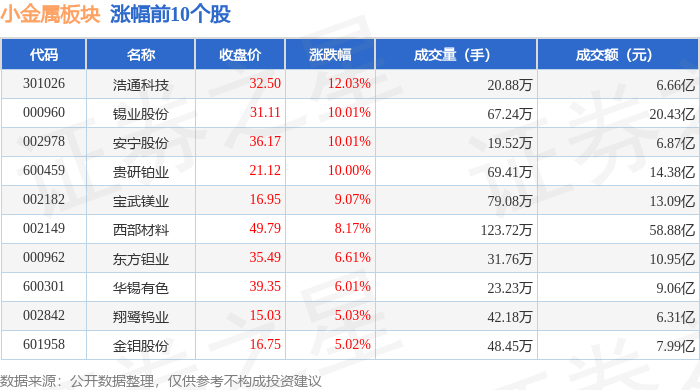
Group 1 - The small metals sector increased by 4.31% on January 6, with Haotong Technology leading the gains [1] - The Shanghai Composite Index closed at 4083.67, up 1.5%, while the Shenzhen Component Index closed at 14022.55, up 1.4% [1] - Key stocks in the small metals sector showed significant price increases, with Haotong Technology rising by 12.03% to a closing price of 32.50 [1] Group 2 - The main capital inflow in the small metals sector was 2.499 billion yuan, while retail investors experienced a net outflow of 1.745 billion yuan [1] - The trading volume for Haotong Technology was 208,800 shares, with a transaction value of 6.66 billion yuan [1] - Other notable stocks included Xiyang Co., which rose by 10.01% with a trading volume of 672,400 shares and a transaction value of 2.043 billion yuan [1]




铜铝价格持续上行!机构:金融、商品双属性支撑金属价格
Jin Rong Jie· 2026-01-06 05:20
Group 1 - The core viewpoint of the article highlights a significant positive performance in the non-ferrous metal sector, with companies like Anning Co., Xiyue Co. reaching their daily limit up, and others such as Huayou Cobalt, Hunan Silver, and China Aluminum also experiencing gains [1] - The non-ferrous mining ETF (159690) saw a 4.33% increase, with over 29 million yuan in trading volume and a net inflow of 33 million yuan over the past seven trading days [1] - According to CITIC Securities, industrial metal prices are influenced by both financial and commodity attributes, with the Federal Reserve entering a rate-cutting cycle and global copper and aluminum inventories at relatively low levels, indicating a potential recovery in demand driven by China's economic rebound and the new energy sector [1][20] Group 2 - The non-ferrous mining index has shown a historical performance with a total increase of 104.84% in 2025, compared to a 94.73% increase in the non-ferrous metal industry index, indicating a sharper rise relative to similar indices [1] - The non-ferrous mining index focuses on the upstream mining segment of the non-ferrous metal industry, with over 57% of its weight concentrated in copper, gold, and aluminum, which are strategically significant for both industrial development and financial markets [6] - The historical performance of the non-ferrous mining index over the past decade shows a cumulative increase of 172.62% with an annualized return of 10.87% and a Sharpe ratio of 0.49, indicating higher elasticity compared to similar indices [11][13]

金银铜上攻,铜价再创新高!紫金矿业涨超6%,市值突破1万亿!有色50ETF(159652)飙涨超4%,再创新高,盘中吸金超5000万元!
Xin Lang Cai Jing· 2026-01-06 02:56
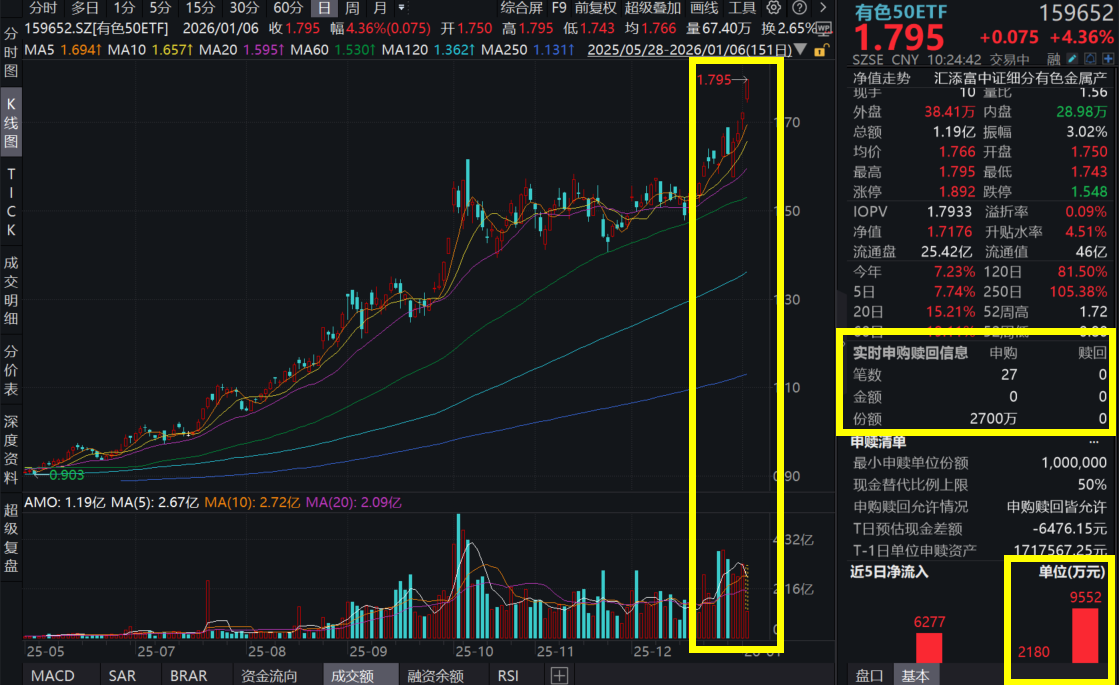
Group 1 - The A-share market continues to rise, with copper prices hitting new highs, leading to a strong opening in the non-ferrous sector [1] - The Non-ferrous 50 ETF (159652) has seen a significant increase of over 4%, reaching a new high since its listing, with strong capital inflow exceeding 50 million yuan [1] - Major non-ferrous stocks such as Zijin Mining and China Aluminum have shown substantial gains, with increases of 5.93% and 6.91% respectively [2] Group 2 - Geopolitical tensions have made precious metals a focal point, with COMEX gold rising by 3% and silver by over 7% [3] - The market is closely watching the upcoming U.S. non-farm payroll report, which is expected to provide guidance on the Federal Reserve's future monetary policy [3] - Supply disruptions in industrial metals are ongoing, with strikes and indefinite shutdowns reported in key mining operations [3] Group 3 - The outlook for the gold market in 2026 is optimistic, driven by expected monetary and fiscal easing from the Federal Reserve and ongoing inflationary pressures [4] - The copper market is influenced by both cyclical and structural factors, with a projected supply-demand gap of approximately 830,000 tons in 2026, leading to potential price increases [6] - The Non-ferrous 50 ETF (159652) is positioned to benefit from a comprehensive exposure to various metal sectors, including gold, copper, aluminum, lithium, and rare earths [5][9] Group 4 - The Non-ferrous 50 ETF (159652) has a leading "gold-copper content" of 45%, with significant representation in copper (31%) and gold (14%) [8] - The ETF's top five constituent stocks have a high concentration of 36%, indicating a strong focus on key strategic metals [9] - Since 2022, the Non-ferrous 50 ETF has outperformed peers with a cumulative return of 86.28%, driven by earnings rather than valuation expansion [13]
伦铜期货历史首次触及13000美元,有色ETF基金(159880)涨超1.6%
Sou Hu Cai Jing· 2026-01-06 02:13
Group 1 - The core viewpoint of the news highlights a strong performance in the non-ferrous metals sector, with the industry index rising by 1.94% and individual stocks like Huayou Cobalt and Zhongkuang Resources showing significant gains [1] - Huayou Cobalt is expected to achieve a net profit of 5.85 billion to 6.45 billion yuan for the fiscal year 2025, representing a year-on-year growth of 40.8% to 55.24% [1] - The overall upward trend in non-ferrous metals is attributed to rising geopolitical tensions and loose liquidity, with copper futures reaching a historic high of $13,000 per ton and aluminum prices surpassing $3,000 per ton for the first time in over three years [1] Group 2 - According to Fangzheng Securities, the short-term global copper inventory is expected to continue adjusting, with supply shortages in copper mines reinforcing the upward price trend [2] - The aluminum sector is anticipated to benefit from low alumina prices, leading to an expansion in profit margins, while the Federal Reserve's interest rate cuts may further support aluminum prices [2] - The report emphasizes the importance of supply-driven factors in cobalt pricing, particularly in relation to the Democratic Republic of Congo's efforts to secure pricing power [2] Group 3 - As of December 31, 2025, the top ten weighted stocks in the non-ferrous metals industry index account for 51.65% of the index, with major companies including Zijin Mining, Luoyang Molybdenum, and Huayou Cobalt [3]