Hengrui Pharma(600276)

Search documents
恒瑞医药(600276.SH):已回购791.88万股股份
Ge Long Hui A P P· 2025-11-03 08:44
格隆汇11月3日丨恒瑞医药(600276.SH)公布,截至2025年10月31日,公司通过上海证券交易所交易系统 以集中竞价交易方式回购股份791.88万股,已回购股份占公司总股本的比例为0.12%,购买的最高价为 人民币70.00元/股,最低价为人民币62.90元/股,已支付的总金额为人民币53,542.78万元(不含交易费 用)。 ...

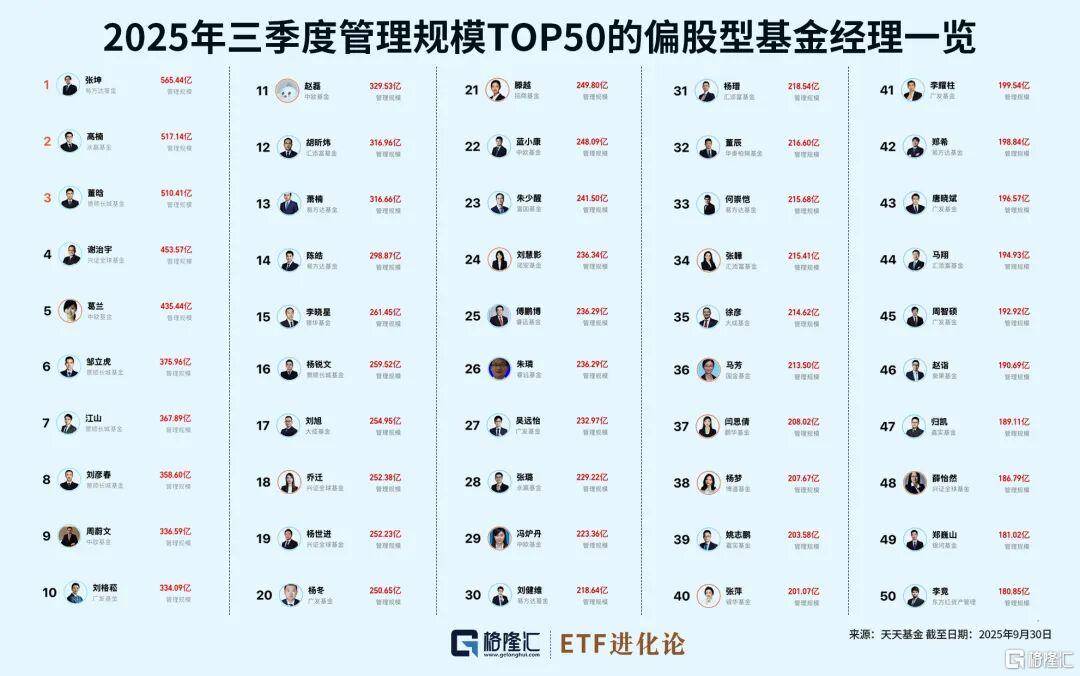
图解知名基金经理2025年三季度重仓股
Sou Hu Cai Jing· 2025-11-03 08:32
Group 1 - As of the end of Q3 2025, there are 40 equity fund managers with a management scale exceeding 20 billion yuan, with Zhang Kun leading at over 56.5 billion yuan [1] - The top 50 equity fund managers have a management scale ranging from approximately 20 billion yuan to over 56 billion yuan, indicating a competitive landscape in fund management [2] - The data shows a significant concentration of assets among the top fund managers, highlighting the importance of performance and reputation in attracting investments [2] Group 2 - The top holdings of well-known fund managers include major companies such as Tencent Holdings, Alibaba, and Kweichow Moutai, reflecting a focus on established market leaders [3][4][5] - Fund managers are actively adjusting their portfolios, with trends showing both increases and decreases in holdings across various sectors, particularly in pharmaceuticals and consumer goods [4][5][6] - The data indicates a trend of continuous reduction in holdings for several companies, suggesting a cautious approach by fund managers in the current market environment [5][6][7] Group 3 - The pharmaceutical sector is prominently featured in the top holdings of multiple fund managers, indicating strong interest and potential growth in this industry [4][6][7] - The consumer goods sector, particularly companies like Kweichow Moutai and Wuliangye, remains a significant focus for fund managers, reflecting ongoing consumer demand [5][10] - The technology and electronics sectors are also represented, with companies like Lixun Precision and Nidec showing up in various fund portfolios, indicating a diversification strategy [7][11][12]



恒瑞医药(600276):收入内生增速稳健 关注BD首付款落地节奏
Xin Lang Cai Jing· 2025-11-03 06:25
Core Viewpoint - The company reported a steady internal revenue growth in Q3, with expectations that the upfront payment from the collaboration with GSK will be confirmed in Q4, indicating that the revenue growth for Q3 aligns with expectations. The confirmed upfront payment from business development (BD) is expected to be relatively small, while innovative drug sales are anticipated to continue growing rapidly [2]. Financial Performance - For the first three quarters of 2025, the company achieved a revenue of 23.18 billion (up 14.9%) and a net profit attributable to shareholders of 5.75 billion (up 24.5%). The Q3 revenue was 7.43 billion (up 12.7%), with a net profit of 1.30 billion (up 9.5%) and a non-GAAP net profit of 1.32 billion (up 16.7%) [1]. - The gross profit margin for the first three quarters of 2025 was 86.2% (up 0.3 percentage points), with total period expense ratio at 58.3% (down 1.6 percentage points). The net profit margin was 24.8% (up 2.0 percentage points). In Q3, the gross profit margin was 85.5% (no change), with total period expense ratio at 65.4% (down 0.1 percentage points) and a net profit margin of 17.6% (down 0.5 percentage points) [3]. Profit Forecast and Investment Recommendation - The company is projected to achieve revenues of 34.44 billion, 39.05 billion, and 43.88 billion in 2025, 2026, and 2027, respectively, representing year-on-year growth of 23.1%, 13.4%, and 12.4%. The net profit attributable to shareholders is expected to be 9.18 billion, 10.70 billion, and 11.77 billion, with growth rates of 44.9%, 16.6%, and 10.0%, respectively. The corresponding price-to-earnings (PE) ratios are forecasted to be 45, 39, and 35 times [4].
恒瑞医药(600276):收入内生增速稳健,关注BD首付款落地节奏
China Post Securities· 2025-11-03 03:14
Investment Rating - The report maintains a "Buy" rating for the company, indicating an expected stock price increase of over 20% relative to the benchmark index within the next 6 to 12 months [2][14]. Core Insights - The company reported a revenue of 231.8 billion yuan for the first three quarters of 2025, reflecting a year-on-year growth of 14.9%. The net profit attributable to shareholders was 57.5 billion yuan, up 24.5% year-on-year [4][5]. - The third quarter of 2025 saw a revenue of 74.3 billion yuan, a 12.7% increase, with a net profit of 13.0 billion yuan, marking a 9.5% growth [4][5]. - The company is expected to confirm a collaboration payment from GSK in Q4, which is anticipated to contribute to revenue growth [5]. Financial Performance Summary - The gross profit margin for the first three quarters of 2025 was 86.2%, with a net profit margin of 24.8% [6]. - The company’s net profit margin for Q3 2025 was 17.6%, with a slight decrease of 0.5 percentage points compared to the previous quarter [6]. - The projected revenues for 2025, 2026, and 2027 are 344.4 billion yuan, 390.5 billion yuan, and 438.8 billion yuan, respectively, with corresponding net profits of 91.8 billion yuan, 107.0 billion yuan, and 117.7 billion yuan [7][10]. Earnings Forecast and Valuation Metrics - The expected earnings per share (EPS) for 2025, 2026, and 2027 are 1.38 yuan, 1.61 yuan, and 1.77 yuan, respectively [10][13]. - The price-to-earnings (P/E) ratios for the same years are projected to be 45, 39, and 35 times [7][10]. - The company is recognized as a leading innovative pharmaceutical enterprise in China, with a highly differentiated product matrix [7].
2025国家医保谈判收官日,高弹性港股通创新药ETF(520880)逆转冲高3%!基金经理:创新药行情可能再次启动
Xin Lang Ji Jin· 2025-11-03 03:02
Group 1 - The Hong Kong Stock Connect innovative drug sector experienced a significant rebound on November 3, with the innovative drug ETF (520880) showing a volatility of over 4.4% and a trading volume exceeding 500 million yuan, indicating strong bullish sentiment [1] - Key stocks such as Kangfang Biotech, Xiansheng Pharmaceutical, and Kangnuo Ya-B saw increases of nearly 6%, while other companies like Yuanda Pharmaceutical and Rongchang Biotech also experienced substantial gains [1] - The National Medical Insurance negotiation, which began on October 30, is expected to conclude with results announced in early December, introducing a new "commercial insurance innovative drug catalog" mechanism for the first time [1] Group 2 - Fund manager Feng Chen indicated that the innovative drug market could see a resurgence, suggesting that now may be a high-probability period for medium to long-term investments in innovative drugs [2] - The recent meeting between US and Chinese leaders has alleviated previous risks that suppressed the sector's performance, potentially allowing previously withdrawn funds to re-enter the market [2] - The current earnings season has shown strong performance from companies like Innovent Biologics and Hengrui Medicine, boosting confidence in the sector [2] Group 3 - The Hong Kong Stock Connect innovative drug ETF (520880) passively tracks the Hang Seng Hong Kong Stock Connect Innovative Drug Select Index, which focuses entirely on innovative drug R&D companies, with over 70% of its holdings in large-cap innovative drug leaders [3] - As of the end of September, the index has seen a year-to-date increase of 108.14%, outperforming other innovative drug indices [3] - The ETF has a fund size of 1.806 billion yuan and an average daily trading volume of 493 million yuan, making it the largest and most liquid ETF tracking this index [3]

创新药行情可能再次启动,当下处于高胜率区间
Xin Lang Ji Jin· 2025-11-03 02:18
Group 1 - The core viewpoint is that the innovative drug market may soon restart due to reduced geopolitical risks between China and the US, positive earnings reports from companies like Innovent Biologics and Hengrui Medicine, and supportive policies for innovative drugs [1][2] - Recent quarterly reports from the pharmaceutical sector have confirmed the performance of innovative drug companies, indicating a potential recovery in the market [1][2] - The innovative drug sector has experienced a correction since August 2025, which is considered sufficient in duration, with leading stocks entering an absolute return zone [1][2] Group 2 - In the medical device sector, leading companies are showing signs of performance turning points, and attention should be paid to their issuance in the Hong Kong stock market [2] - The current environment is viewed as a high-probability zone for medium to long-term investments in the biopharmaceutical sector, with recommendations for balanced allocations across different market segments [2] - The Hong Kong Stock Connect Innovative Drug ETF (520880) and its associated funds track the Hang Seng Hong Kong Stock Connect Innovative Drug Select Index, which includes leading innovative drug companies [2][3] Group 3 - The first drug ETF (562050) launched this year focuses on leading companies in the pharmaceutical sector, including chemical drugs, biological drugs, and traditional Chinese medicine [3] - The Medical ETF (512170) is the largest in its category, focusing on medical devices and services, with significant holdings in companies like Mindray Medical and Aier Eye Hospital [3] - These ETFs are becoming effective tools for investors to capture opportunities in the pharmaceutical and medical sectors, each with its specific focus [3]

医药生物行业跟踪周报:2025创新药医保谈判启动与调整到位,积极布局优质标的-20251102
Soochow Securities· 2025-11-02 14:05
Investment Rating - The report maintains an "Overweight" rating for the pharmaceutical and biotechnology industry [1]. Core Insights - The 2025 National Medical Insurance negotiation has commenced, with a focus on innovative drugs and a significant increase in the number and quality of applications for drugs outside the basic medical insurance directory [17][18]. - The report highlights a robust performance of the pharmaceutical sector, with the A-share pharmaceutical index showing a year-to-date increase of 21.1%, outperforming the CSI 300 index by 3.17% [4][9]. - The report emphasizes the long-term growth potential of China's innovative drug market, driven by a large patient pool, favorable policies, and a strong pipeline of innovative drugs [16]. Summary by Sections 1. Industry Performance - The A-share pharmaceutical index has increased by 1.31% this week and 21.1% year-to-date, with significant outperformance against the CSI 300 index [4][9]. - The Hang Seng Healthcare Index has shown a year-to-date increase of 73.53%, outperforming the Hang Seng Technology Index by 40.06% [4][9]. 2. R&D Progress and Company Dynamics - Pfizer has initiated two global Phase III clinical studies for PD-1/VEGF dual antibodies, targeting non-small cell lung cancer and colorectal cancer [4]. - The report notes that 310 generic names have passed the formal review for inclusion outside the basic medical insurance directory, marking a 24.5% increase from 2024 [18]. 3. Industry Insights and Regulatory Developments - The report ranks favored sub-industries as follows: innovative drugs > research services > CXO > traditional Chinese medicine > medical devices > pharmacies [10][12]. - The report identifies key companies to watch, including Innovent Biologics, BeiGene, and Hengrui Medicine, among others, for their strong clinical competitiveness [12][18]. 4. Market Review - The report indicates that the pharmaceutical sector's adjustment has narrowed, with some sub-industries experiencing slight rebounds [4][9]. - The report provides a detailed overview of stock performance, highlighting significant gainers and losers in the A-share and H-share markets [4][9].
公募基金医药持仓占比环比回落,后市有望震荡向上:医药生物行业跨市场周报(20251102)-20251102
EBSCN· 2025-11-02 08:48
Investment Rating - The report maintains a "Buy" rating for the pharmaceutical and biotechnology sector [4][5]. Core Viewpoints - The proportion of public fund holdings in the pharmaceutical sector has decreased quarter-on-quarter, but the market is expected to experience a rebound [2][23]. - The investment focus should increasingly emphasize the clinical value of pharmaceuticals, driven by domestic and international policy changes [3][34]. - The report highlights the potential for continuous valuation recovery and upward movement in the pharmaceutical sector due to the opening of the US interest rate cut cycle and advancements in domestic innovative drugs [2][35]. Summary by Sections Market Review - Last week, the pharmaceutical and biotechnology index rose by 1.31%, outperforming the CSI 300 index by 1.74 percentage points [1][17]. - The Hong Kong Hang Seng Medical Health Index fell by 0.11%, but still outperformed the Hang Seng Index by 1.97 percentage points [1][17]. Company Updates - Notable clinical application approvals include Shanghai Lai Shi's SR604 injection and YKYY013 injection from Yuekang Pharmaceutical [39]. - Ongoing clinical trials include HRS-8080 from Heng Rui Pharmaceutical and ICP-332 from Nuo Cheng Jian Hua, both in Phase III [39]. Investment Strategy - The report emphasizes a three-stage clinical value investment strategy: "0 to 1" for technological breakthroughs, "1 to 10" for clinical validation, and "10 to 100" for efficiency in the Chinese market [34][35]. - Key recommended companies include Innovent Biologics (H), Eifang Biologics-U, Tian Shi Li, WuXi AppTec (A+H), and Mindray Medical [36]. Fund Holdings - As of Q3 2025, the market value of public funds heavily invested in pharmaceuticals is 11.93%, down by 0.32 percentage points from the previous quarter [2][24]. - The top 20 stocks by market value show significant upward movement for companies like Rongchang Biologics and BeiGene (H) [2][30]. Financial Performance - The pharmaceutical manufacturing industry reported a revenue decline of 2.0% year-on-year for the first nine months of 2025, totaling 182.11 billion yuan [59]. - The report indicates a positive trend in the valuation of the pharmaceutical sector, with a steady recovery in PE ratios since Q1 2025 [34].

科技承压下的资金新选择,创新药开启上涨新周期?
Ge Long Hui· 2025-11-01 09:54
Core Viewpoint - The technology sector experienced significant declines, prompting a structural shift in market funds towards the innovative drug sector, which saw notable gains on the same day [1][3]. Group 1: Market Performance - The innovative drug sector rose by 3.91% amidst a downturn in the technology sector, successfully breaking through the 20-day moving average with increased trading volume, signaling positive market sentiment [3]. - The innovative drug sector had been in a downward trend since August but began to stabilize and form a bottom pattern in October [3]. Group 2: Multiple Sclerosis (MS) Market - The global market for MS drugs is projected to reach approximately $18.5 billion in 2024, with a significant portion of sales coming from third-generation products, particularly CD20 monoclonal antibodies [6]. - CD20 monoclonal antibodies are expected to account for over 60% of the MS drug sales in 2024, with the drug Ocrelizumab projected to generate sales of 7.64 billion yuan, reflecting a year-on-year growth of 7.4% [6]. Group 3: Chemical Pharmaceutical Industry - The global chemical pharmaceutical market grew from $1,038 billion in 2019 to $1,128 billion in 2023, with expectations to reach $1,156 billion in 2024 [10]. - In China, the chemical pharmaceutical market size was 883.9 billion yuan in 2022, with a year-on-year growth of 4.4%, projected to increase to 945 billion yuan by 2024 [10]. Group 4: Innovative Drug Sector Performance - In the first half of 2025, 21 A-share innovative drug companies reported revenues of 28.69 billion yuan, a year-on-year increase of 42%, while net losses narrowed significantly [11]. - The second quarter of 2025 saw these companies achieve revenues of 15.34 billion yuan, a 39% increase year-on-year, with net losses reduced by 97% [11][12]. Group 5: Future Outlook - Continued policy support for innovative drugs is expected to enhance performance, with an increase in product launches anticipated to drive revenue growth [15]. - The active business development (BD) transactions in the innovative drug sector in the first half of 2025 are expected to bolster the apparent performance of related companies [15].

从单药博弈到系统制胜:创新药投资的“能力锚”与“全球局”
雪球· 2025-11-01 03:55
Core Viewpoint - The essence of innovative drug investment is a "high risk, high return" probability game, focusing on the value realization cycle of potential blockbuster drugs [2] - The success of a single drug is merely a "probability event," while the "system capability" of a company is crucial for navigating cycles and enhancing success rates [2][3] Pipeline Worship Rejection - The value of a pipeline is ultimately defined by the company's capabilities, rather than the pipeline itself [4] - For small innovative drug companies, the core value is concentrated in 1-2 key pipelines, while for larger companies and MNCs, the match between "pipeline thickness" and "capability boundaries" is key to determining value [5] - The "false precision" of pipeline valuation is meaningless; the success rate of a drug from clinical trials to approval is only about 10% [6] Company and Platform Capabilities - Company capabilities serve as a "risk hedging tool" for pipelines, enhancing the success probability and value ceiling of drugs [7] - The core of a pipeline is "sustainability" rather than "quantity," as evidenced by the growth history of overseas MNCs [8] Chinese Characteristics of Capability - The "low cost + strong sales" model of companies like Heng Rui is a unique product of China's innovative drug industry stage, based on industry advantages [10] - The model's boundaries do not apply to overseas markets, where MNCs focus on breakthrough innovations and global sales platforms [11] Evolution of Capabilities - The direction of capability evolution is shifting from "cost advantages" to "innovation + integration," as the market landscape changes [12][13] Global Perspective on Big Pharma Logic - Comparing domestic and foreign MNCs clarifies the boundaries between "single drug competition" and "system victory," with both relying on system capabilities rather than single drug dependence [15][16] Investment Framework Upgrade - The complete framework for innovative drug investment should adapt to "stage matching + capability focus," recognizing the value of single drug competition while not idolizing pipelines [18] - For small innovative drug companies, the focus remains on "single drug value inflection points," while for large companies and MNCs, the emphasis is on "capability inflection points" [18] Incremental Options to Enhance Long-term Value - Three incremental options can significantly enhance investment elasticity: improvements in payment terms, overseas value realization, and merger integration [19] - Caution is advised against companies that focus solely on pipeline stories or lack clear capability boundaries for overseas expansion [19] Conclusion - The essence of innovative drug investment is balancing "probability and value," with small companies focusing on "single drug success" and large companies on "capability-driven success" [21] - The development of China's innovative drugs is transitioning from "single drug breakthroughs" to "system competition," with future winners being those that can upgrade local advantages to global innovation and integration capabilities [21]