
SD-GOLD(600547)

Search documents
金属、新材料行业周报:央行购金强化金价企稳预期,储能超预期支撑锂板块向上弹性-20251111
Shenwan Hongyuan Securities· 2025-11-11 02:45
Investment Rating - The report maintains a positive outlook on the metals and new materials industry, particularly highlighting the resilience of the lithium sector and the stability of gold prices due to central bank purchases [3][4]. Core Insights - The report indicates that the central bank's gold purchases are expected to support a stable gold price outlook, while the lithium sector shows unexpected strength, suggesting potential investment opportunities in these areas [3][4]. - The overall performance of the metals sector has been mixed, with significant year-to-date gains in various sub-sectors, particularly in energy metals and copper [10][5]. Weekly Market Review - The Shanghai Composite Index rose by 1.08%, while the Shenzhen Component increased by 0.19%. The non-ferrous metals index slightly declined by 0.04%, underperforming the CSI 300 by 0.86 percentage points [5][4]. - Year-to-date, the non-ferrous metals index has increased by 75.83%, outperforming the CSI 300 by 56.92 percentage points [5][9]. Price Changes - Industrial metals and precious metals saw varied price movements, with copper, aluminum, and lithium prices experiencing fluctuations. For instance, lithium carbonate prices decreased by 2.73% week-on-week [4][10]. - The report notes that the price of copper has decreased by 1.57% to $10,717 per ton, while aluminum prices have shown a slight increase of 1.22% [15][44]. Key Company Valuations - The report provides a detailed valuation of key companies in the metals sector, highlighting their stock prices, earnings per share (EPS), and price-to-earnings (PE) ratios. For example, Zijin Mining has a stock price of 30.17 yuan with a PE ratio of 38 [20]. - Other notable companies include Shandong Gold with a stock price of 35.21 yuan and a PE ratio of 70, and Huayou Cobalt with a stock price of 64.34 yuan and a PE ratio of 36 [20]. Supply and Demand Analysis - The report highlights that the supply of copper is tightening due to increased demand from the manufacturing sector, with the operating rates for copper products showing positive trends [29][4]. - In the aluminum sector, the report notes a decrease in the operating rates of downstream processing enterprises, indicating potential supply constraints in the future [44][45].



子公司需补税7.38亿元!山东黄金突发公告
Shen Zhen Shang Bao· 2025-11-11 02:43
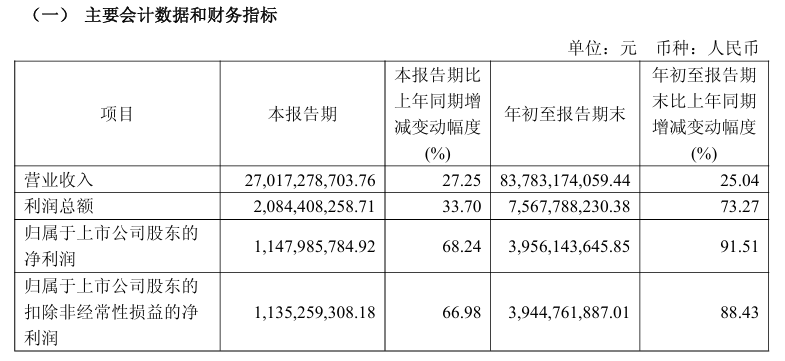
Core Viewpoint - Shandong Gold (600547) announced that its wholly-owned subsidiary, Laizhou Company, needs to pay back corporate income tax of 508 million yuan and late fees of 230 million yuan, totaling 738 million yuan due to tax treatment issues related to the transfer of mining rights from its former subsidiaries [1] Financial Performance - For the first three quarters of 2025, Shandong Gold achieved operating revenue of 83.78 billion yuan, a year-on-year increase of 25.0% [1] - The net profit attributable to shareholders reached 3.96 billion yuan, up 91.5% year-on-year [1] - The net profit excluding non-recurring gains and losses was 3.94 billion yuan, reflecting an 88.4% increase year-on-year [1] - The net operating cash flow amounted to 15.196 billion yuan, a growth of 49.1% year-on-year [1] - The earnings per share (EPS) on a fully diluted basis was 0.8582 yuan [1] Quarterly Performance - In the third quarter, the company reported operating revenue of 27.02 billion yuan, a year-on-year increase of 27.3% [1] - The net profit attributable to shareholders for the third quarter was 1.15 billion yuan, up 68.2% year-on-year [1] - The net profit excluding non-recurring gains and losses for the third quarter was 1.14 billion yuan, reflecting a 67.0% increase year-on-year [1] - The EPS for the third quarter was 0.249 yuan [1]

贵金属板块领涨



Di Yi Cai Jing Zi Xun· 2025-11-11 01:54
Core Viewpoint - The precious metals sector experienced a strong performance at the beginning of trading on November 11, with several companies showing significant gains [1] Group 1: Company Performance - Xiaocheng Technology and Hunan Silver both saw their stock prices increase by over 2% [1] - Other companies in the sector, including Zhongjin Gold, Sichuan Gold, Hunan Gold, Chifeng Gold, and Shandong Gold, also experienced upward movement in their stock prices [1]
贵金属板块盘初领涨
Mei Ri Jing Ji Xin Wen· 2025-11-11 01:49
Group 1 - The precious metals sector is leading the market gains, with notable increases in stocks such as Xiaocheng Technology and Hunan Silver, both rising over 2% [1] - Other companies in the sector, including Zhongjin Gold, Sichuan Gold, Hunan Gold, Chifeng Gold, and Shandong Gold, are also experiencing upward movement [1]
贵金属板块领涨
第一财经· 2025-11-11 01:46
Core Viewpoint - The precious metals sector experienced a strong performance at the beginning of trading on November 11, with notable gains in several companies [1] Company Performance - Xiaocheng Technology and Hunan Silver both saw their stock prices increase by over 2% [1] - Other companies in the sector, including Zhongjin Gold, Sichuan Gold, Hunan Gold, Chifeng Gold, and Shandong Gold, also followed suit with upward movements in their stock prices [1]
黄金现货重回4100!黄金股票ETF基金(159322)配置价值凸显
Sou Hu Cai Jing· 2025-11-11 01:39
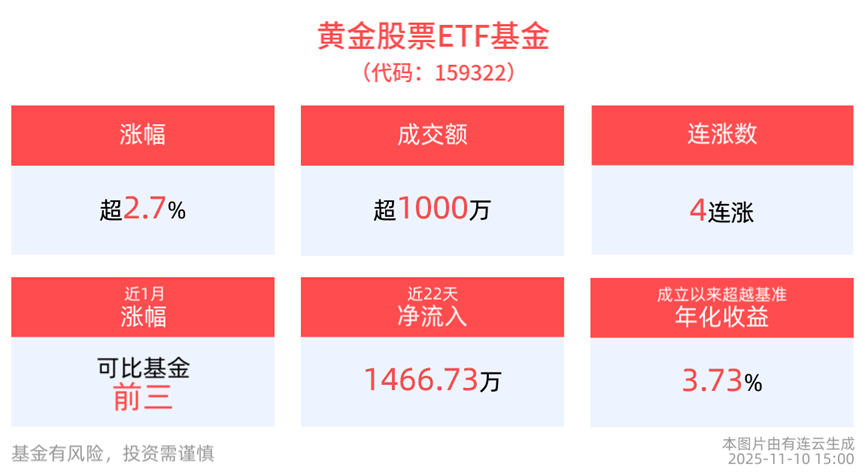
Group 1 - Spot gold has reached $4,100 per ounce for the first time since October 27, with a daily increase of approximately 2.5% [1] - J.P. Morgan Private Bank predicts that gold prices may exceed $5,000 per ounce next year, driven primarily by central bank purchases from emerging market economies [1] - By the end of 2026, gold prices could reach $5,200 to $5,300 per ounce, representing an increase of over 25% from current trading levels [1] Group 2 - As of November 10, 2025, the CSI Hong Kong-Shenzhen Gold Industry Stock Index has risen by 2.77%, with notable increases in constituent stocks such as ChaoHua Jewelry (up 7.62%) and Huayu Mining (up 7.16%) [3] - The gold stock ETF fund has achieved a four-day consecutive increase, with a latest price of 1.59 yuan and a one-week cumulative increase of 2.45% [3] - The trading volume for the gold stock ETF fund was active, with a turnover of 11.11% and a transaction value of 12.0096 million yuan on November 10 [3] Group 3 - The gold stock ETF fund has seen a net asset value increase of 42.46% over the past six months, ranking 646 out of 3866 index stock funds, placing it in the top 16.71% [4] - Since its inception, the gold stock ETF fund has recorded a maximum monthly return of 20.05% and an average monthly return of 9.45% [4] - The historical one-year profit probability for the gold stock ETF fund stands at 100% [4] Group 4 - As of November 7, 2025, the gold stock ETF fund has a Sharpe ratio of 1.74, ranking in the top 2 out of 6 comparable funds, indicating higher returns for the same level of risk [5] - The management fee for the gold stock ETF fund is 0.50%, and the custody fee is 0.10% [5] - The CSI Hong Kong-Shenzhen Gold Industry Stock Index includes 50 large-cap companies involved in gold mining, refining, and sales, reflecting the overall performance of the gold industry in the mainland and Hong Kong markets [5]


山东黄金(600547)11月10日主力资金净买入1.56亿元
Sou Hu Cai Jing· 2025-11-11 00:30
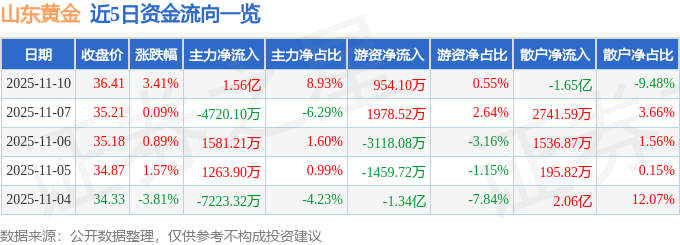
Core Viewpoint - Shandong Gold (600547) shows a positive performance with a closing price of 36.41 yuan, up 3.41% as of November 10, 2025, indicating strong market interest and potential growth opportunities [1]. Financial Performance - For the first three quarters of 2025, Shandong Gold reported a main revenue of 837.83 billion yuan, a year-on-year increase of 25.04% - The net profit attributable to shareholders reached 39.56 billion yuan, up 91.51% year-on-year, while the net profit after deducting non-recurring gains and losses was 39.45 billion yuan, an increase of 88.43% [3]. - In Q3 2025, the company achieved a single-quarter main revenue of 270.17 billion yuan, a 27.25% increase year-on-year, and a net profit of 11.48 billion yuan, up 68.24% year-on-year [3]. Market Activity - On November 10, 2025, the net inflow of main funds was 156 million yuan, accounting for 8.93% of the total transaction amount, while retail investors experienced a net outflow of 1.65 billion yuan, representing 9.48% of the total [1]. - Over the past five days, the stock has seen fluctuations in fund flows, with notable changes in both institutional and retail investor activities [1][2]. Company Metrics and Industry Ranking - Shandong Gold's total market capitalization stands at 1678.48 billion yuan, with a net asset value of 637.38 billion yuan and a net profit of 39.56 billion yuan, ranking first in its industry [3]. - The company's price-to-earnings ratio is 31.82, which is lower than the industry average of 44.45, indicating a potentially attractive valuation [3]. Institutional Ratings - In the last 90 days, 13 institutions have rated Shandong Gold, with 11 buy ratings and 2 hold ratings, suggesting strong institutional confidence in the stock [4]. - The average target price set by institutions is 38.52 yuan, indicating potential upside from the current trading price [4].
盘前必读丨促进民间投资发展打出政策组合拳;美股强劲反弹英伟达涨超5%
Di Yi Cai Jing· 2025-11-10 23:30
Market Overview - The A-share market is expected to experience a balanced market style, with the Shanghai Composite Index likely consolidating around the 4000-point level [1][9]. - The long-term positive trend of the A-share market remains unchanged, with attention on themes such as anti-involution and dividends during sector rotations [9]. Economic Policies - The State Council has issued measures to promote private investment, including 13 targeted policy initiatives aimed at encouraging private capital participation in key sectors like railways and nuclear power [5]. - The National Development and Reform Commission and the National Energy Administration have released guidelines to enhance the consumption and regulation of renewable energy, aiming for a multi-layered system by 2030 [6]. Corporate Developments - Ganfeng Lithium has made significant progress in developing the PPGS lithium salt lake project in collaboration with LAR [9]. - A major asset sale by Wingtech Technology has been completed, although some payments remain outstanding [9]. - Shandong Gold's subsidiary is required to pay back taxes amounting to 738 million yuan, which is expected to impact the company's net profit for 2025 by 230 million yuan [8]. Stock Market Movements - The U.S. stock market saw significant gains, with the Dow Jones Industrial Average rising by 0.81%, the Nasdaq by 2.27%, and the S&P 500 by 1.54% [4]. - Notable technology stocks performed well, with Nvidia increasing by 5.8% and Google by 3.9% [4]. Commodity Prices - International oil prices have risen, with WTI crude oil increasing by 0.64% to $60.13 per barrel and Brent crude by 0.68% to $64.06 per barrel [4]. - Gold prices surged, with COMEX gold futures for November delivery rising by 2.81% to $4111.80 per ounce [4].






【公告精选】*ST元成拟被终止上市;山东黄金子公司需补缴税款及滞纳金7.38亿元
Sou Hu Cai Jing· 2025-11-10 15:58
Key Points - *ST Yuancheng received a notice regarding the proposed termination of its stock listing [1] - Zhongji Xuchuang plans to issue H-shares and list on the Hong Kong Stock Exchange [2] - Baiwei Storage's H-share filing materials have been accepted by the China Securities Regulatory Commission [3] - Mindray Medical has submitted an H-share listing application to the Hong Kong Stock Exchange [4] - Tianji Co. is promoting the industrialization of lithium sulfide material preparation patents [5] - *ST Yuanshang confirmed that there is no undisclosed significant information [6] - Shannon Chip Innovation noted reports of rising storage chip prices but stated that its fundamentals have not changed significantly [7] - Sichuan Jinding clarified that its associate company does not engage in space computing-related businesses [8] - Demingli is planning refinancing, with no significant changes in the operating environment [9] - Chengxing Co. warned of potential irrational speculation risks regarding its stock price [10] - Shandong Gold's wholly-owned subsidiary needs to pay back taxes and late fees amounting to 738 million yuan, expected to impact net profit by 230 million yuan [11] Mergers and Acquisitions - Lingzhi Software intends to acquire 100% of Kaimiride's equity, with stock resuming trading on November 11 [12] - Victory Co. plans to acquire gas-related assets from its controlling shareholder, with stock resuming trading on November 11 [13] Shareholding Changes & Buybacks - *ST Kaixin's actual controller plans to transfer 5% of the company's shares [14] - Litong Electronics' actual controller and executives plan to reduce their holdings by up to 3.03% [15] - Mingchen Health's actual controller and executives plan to reduce their holdings by up to 3.27% [16] - Sanmei Co.'s actual controller plans to reduce holdings by up to 3% [17] - Huayang Intelligent's Fosun Weiying plans to reduce holdings by up to 5% [18] - Huading Co.'s Hangzhou Yuejun plans to reduce holdings by up to 3% [19] Contract Awards - Zhongbei Communication signed a comprehensive service framework agreement worth 1 billion yuan [20] - State Grid Information Technology's subsidiaries collectively won a 1.318 billion yuan procurement project from the State Grid [21] - Digital Government's wholly-owned subsidiary jointly won a 109 million yuan smart water project [22] Other Developments - Shangtai Technology plans to invest 4.07 billion yuan to build a project with an annual production capacity of 200,000 tons of lithium-ion battery anode materials [24] - Chaoying Electronics plans to invest approximately 1.468 billion yuan in Thailand to expand AI computing high-end printed circuit board production [24] - Bojun Technology's wholly-owned subsidiary plans to invest 1 billion yuan to establish an automotive parts production base [24]


子公司注销“埋雷”,7亿补缴谁来担责?山东黄金内控漏洞频发
Zhong Guo Neng Yuan Wang· 2025-11-10 15:03
Core Viewpoint - Shandong Gold (600547.SH) announced a tax payment of 738 million yuan due to unpaid corporate income tax and late fees, which is expected to impact the company's net profit attributable to shareholders by 230 million yuan in 2025 [1][4]. Tax Payment Details - The tax payment of 508 million yuan is related to tax issues from the transfer of exploration rights by a former wholly-owned subsidiary during 2021-2022, which was deemed not compliant with special tax treatment requirements [1]. - The late fee of 230 million yuan will be classified as a non-recurring item, affecting the company's net profit for 2025 [4]. Financial Impact - The total tax payment and late fees will not affect the current net profit attributable to shareholders, as the corporate income tax will be recorded as deferred tax assets [3][2]. - The late fee represents approximately 5.8% of Shandong Gold's net profit of 3.956 billion yuan for the first three quarters of 2025, indicating a significant impact on annual performance [4]. Compliance Challenges - This is not the first compliance challenge for Shandong Gold, as its subsidiary was fined 45,000 yuan for failing to eliminate safety hazards at a mine [5]. - The company has faced increased penalty expenses, with a reported 5.1506 million yuan in fines for the first half of 2025, a 53.33% increase year-on-year [6]. Operational Issues - Investigations revealed that the company had not properly reported safety incidents, including fatal accidents, and faced issues with its franchise operations not being properly registered [6][7].