
FYG,FUYAO GLASS(600660)

Search documents
福耀玻璃盘中创历史新高
Zheng Quan Shi Bao Wang· 2025-08-21 02:08
(文章来源:证券时报网) 两融数据显示,该股最新(8月20日)两融余额为22.95亿元,其中,融资余额为22.82亿元,近10日增加 2.20亿元,环比增长10.69%。 机构评级来看,近10日共有4家机构对该股进行评级,预计目标价最高的是华泰证券,8月20日华泰证券 发布的研报给予公司目标价为76.08元。 公司发布的半年报数据显示,上半年公司共实现营业收入214.47亿元,同比增长16.94%,实现净利润 48.05亿元,同比增长37.33%,基本每股收益为1.8400元,加权平均净资产收益率13.18%。(数据宝) 福耀玻璃股价创出历史新高,截至9:35,该股上涨3.67%,股价报63.60元,成交量1466.93万股,成交金 额9.28亿元,换手率0.73%,该股最新A股总市值达1273.90亿元,该股A股流通市值1273.90亿元。 证券时报·数据宝统计显示,福耀玻璃所属的汽车行业,目前整体涨幅为0.24%,行业内,目前股价上涨 的有112只,涨幅居前的有成飞集成、南方精工、秦安股份等,涨幅分别为10.00%、5.79%、4.55%。股 价下跌的有169只,跌幅居前的有潍柴重机、全柴动力、腾龙股份等 ...


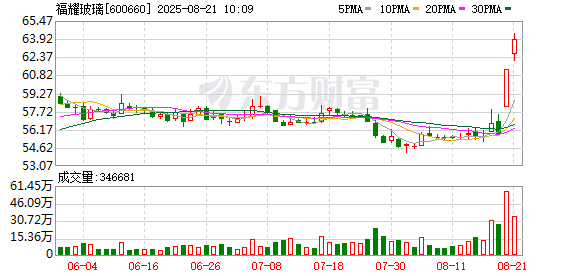
福耀玻璃涨超3%,股价再创新高
Mei Ri Jing Ji Xin Wen· 2025-08-21 01:47
Group 1 - Fuyao Glass has seen a stock price increase of 3.8%, reaching 63.7 yuan per share, marking a new all-time high [1] - The company's total market capitalization has surpassed 166 billion yuan [1]
福耀玻璃股价创新高
Di Yi Cai Jing· 2025-08-21 01:44
Core Viewpoint - Fuyao Glass has seen a stock price increase of 2.05%, reaching a new high of 62.61 CNY per share, with a total market capitalization surpassing 163.396 billion CNY and a trading volume of 111 million CNY [1] Company Summary - Fuyao Glass's stock price has achieved a new record high of 62.61 CNY per share [1] - The company's total market capitalization has exceeded 163.396 billion CNY [1] - The trading volume for the day reached 111 million CNY [1]
Slay 全场!中证红利质量ETF(159209)领涨两市红利类ETF,福耀玻璃10CM封板
Sou Hu Cai Jing· 2025-08-21 01:29
Group 1 - The core viewpoint highlights the strong performance of the market, particularly the China Securities Dividend Quality ETF (159209), which has seen continuous net inflows for eight days, totaling approximately 20 million, indicating investor preference for high-quality dividend indices [1] - Fuyao Glass, a leading global automotive glass company, reported better-than-expected financial results for the first half of 2025, with revenue of 21.447 billion, a year-on-year increase of 16.94%, and net profit attributable to shareholders of 4.805 billion, up 37.33% [1] - Among 41 A-share automotive parts companies that have disclosed financial reports, Fuyao Glass ranks second in net profit for the first half of the year, with a growth rate significantly higher than the median growth rate of 18% for the disclosed companies [1] Group 2 - The China Securities Dividend Quality ETF (159209) tracks the CSI All Share Dividend Quality Index, which selects 50 companies with stable dividends, high dividend yields, and strong earnings sustainability, reflecting the overall performance of companies with strong dividend and profitability characteristics [2] - The ETF employs a "dividend + quality" dual-factor screening mechanism to identify high-quality enterprises with both "undervalued" and "high-quality" characteristics, aligning with Warren Buffett's value investment philosophy of investing in excellent companies at reasonable prices [2] - The product design features a cost structure of "0.15% + 0.05%", which is the lowest in the market, providing a significant cost advantage for long-term holders, and a monthly assessment dividend mechanism to better meet investors' cash flow needs [2]

西部证券晨会纪要-20250821
Western Securities· 2025-08-21 01:20
Group 1: Electric Equipment - Haopeng Technology - The company achieved revenue of 2.763 billion yuan in H1 2025, a year-on-year increase of 19.29% [6] - The net profit attributable to shareholders was 97 million yuan, up 252.49% year-on-year, with a non-recurring net profit of 80 million yuan, increasing by 366.27% [6] - The company expects net profits of 259 million, 387 million, and 503 million yuan for 2025-2027, representing year-on-year growth of 183.9%, 49.3%, and 30.0% respectively [8] Group 2: Non-Banking Financial - Hong Kong Stock Exchange - The company reported a revenue of 14.076 billion HKD and a net profit of 8.519 billion HKD in H1 2025, reflecting year-on-year increases of 33% and 39% respectively [10] - The average daily trading volume in the Hong Kong stock market reached approximately 240.2 billion HKD, a year-on-year increase of 117.6% [11] - The company is expected to achieve a net profit of 16.623 billion HKD in 2025, with a price-to-earnings ratio of 33.6 times based on the closing price on August 20 [12] Group 3: Nonferrous Metals - Jinli Permanent Magnet - The company achieved revenue of approximately 3.507 billion yuan in H1 2025, a year-on-year increase of 4.33%, with a net profit of 305 million yuan, up 154.81% [17] - Domestic sales revenue was 2.994 billion yuan, increasing by 8.17%, while overseas sales revenue was 513 million yuan, down 13.58% [17] - The company expects EPS of 0.47, 0.59, and 0.72 yuan for 2025-2027, with corresponding price-to-book ratios of 5.1, 4.6, and 4.1 [19] Group 4: Agriculture, Forestry, Animal Husbandry, and Fishery - Lihua Co., Ltd. - The company reported revenue of 8.353 billion yuan and a net profit of 149 million yuan in H1 2025, with a year-on-year increase of 7.02% but a decrease in net profit by 74.10% [21] - The chicken business revenue was 635 million yuan, down 6.76% year-on-year, while the pig business revenue was 1.947 billion yuan, up 117.65% [22] - The company expects net profits of 586 million, 1.474 billion, and 1.942 billion yuan for 2025-2027, with a year-on-year change of -61.5%, +151.5%, and +31.8% respectively [23] Group 5: Non-Banking Financial - Ruida Futures - The company achieved total revenue of 1.047 billion yuan and a net profit of 228 million yuan in H1 2025, with year-on-year increases of 4.49% and 66.49% respectively [26] - The asset management business saw a revenue increase of 223.83% to 121 million yuan, driven by product scale expansion and investment returns [26] - The company is expected to achieve a net profit of 423 million yuan in 2025, reflecting a year-on-year increase of 10.5% [28] Group 6: Steel - Hualing Steel - The company reported revenue of 62.794 billion yuan in H1 2025, a year-on-year decrease of 17.02%, while net profit increased by 31.31% to 1.748 billion yuan [29] - The company’s high-end products accounted for 68.5% of total sales, with a focus on product structure optimization [30] - The company expects EPS of 0.44, 0.51, and 0.55 yuan for 2025-2027, with corresponding price-to-earnings ratios of 13, 11, and 10 [31] Group 7: Automotive - Yixin Group - The company achieved total revenue of 5.452 billion yuan and a net profit of 549 million yuan in H1 2025, with year-on-year increases of 22% and 33.93% respectively [33] - The financing total reached 32.7 billion yuan, with a significant contribution from financial technology services, which saw a revenue increase of 124% [34] - The company is expected to achieve a net profit of 1.143 billion yuan in 2025, reflecting a year-on-year increase of 41.2% [35] Group 8: Automotive - Fuyao Glass - The company reported revenue of 21.45 billion yuan and a net profit of 4.8 billion yuan in H1 2025, with year-on-year increases of 16.9% and 37.3% respectively [36] - The company’s gross margin improved to 37.1%, with a net margin of 22.4% [37] - The company expects revenue growth of 15% annually from 2025 to 2027, with net profits of 9.3 billion, 10.6 billion, and 12.4 billion yuan [38] Group 9: Nonferrous Metals - Bowei Alloy - The company achieved revenue of 10.221 billion yuan and a net profit of 676 million yuan in H1 2025, with year-on-year increases of 15.21% and 6.05% respectively [40] - The new materials segment generated revenue of 7.935 billion yuan, up 23.83%, while the renewable energy segment saw a revenue decrease of 10.10% [41] - The company expects EPS of 1.97, 2.05, and 2.21 yuan for 2025-2027, with corresponding price-to-earnings ratios of 13.4, 12.9, and 11.9 [42]




Gangtise投研日报 | 2025-08-21
Sou Hu Cai Jing· 2025-08-21 01:14
Group 1: Market Trends - The global health supplement market is projected to reach $132.4 billion in 2023, with China's market size at 224 billion yuan, driven by aging population and new consumption trends [5][6] - The demand for health supplements is experiencing rigid growth due to aging, while new consumption trends are expanding market channels, with online sales accounting for 58% of the market [6][7] - The pet supplement market is emerging as a new growth point, with a market size of 1.6 billion yuan, indicating significant development potential [8] Group 2: Alcohol Industry Insights - The white liquor market is expected to face challenges during the Mid-Autumn Festival, with total sales potentially declining by 10% to 20% and total revenue possibly dropping over 30% [9] - Inventory turnover days in the white liquor industry have increased by 15 to 20 days year-on-year, indicating pressure on companies due to rising inventory levels [10] - Different liquor companies are adopting varied strategies, with some launching new products to cater to diverse consumer needs, reflecting a competitive market landscape [11] Group 3: Banking Sector Developments - The M1 growth rate reached 5.6% in July 2025, indicating increased liquidity among residents, while the proportion of time deposits is declining due to falling housing prices [13] - Government policies are optimizing credit structures and promoting economic growth to avoid recession, impacting the financial market [14] - A-share market returns are surpassing fixed income products, leading to a shift of funds towards the stock market, influenced by a weaker dollar [15][16] Group 4: Company Performance Highlights - Xian Da Co. reported a revenue of 1.423 billion yuan for the first half of 2025, a year-on-year increase of 11.82%, with net profit reaching 136 million yuan, up 2,561.58% [20] - Jie Jie Microelectronics achieved a revenue of 1.601 billion yuan, a 26.77% increase, with net profit of 247 million yuan, up 15.35% [21] - Fuyao Glass reported a revenue of 21.447 billion yuan, a 16.94% increase, with net profit growing by 37.33% to 4.805 billion yuan [23]





145股获券商买入评级 云天化目标涨幅达53.88%
Di Yi Cai Jing· 2025-08-21 00:35
Group 1 - A total of 145 stocks received buy ratings from brokerages as of August 20, with 39 stocks announcing target prices [1] - Based on the highest target prices, Yuntianhua, Meihua Biological, and Naxinwei ranked highest in target price increase, with expected increases of 53.88%, 48.92%, and 41.96% respectively [1] - Out of the rated stocks, 138 maintained their ratings, while 7 received their first ratings [1] Group 2 - 29 stocks attracted attention from multiple brokerages, with Jibite, Beixin Building Materials, and Fuyao Glass receiving the most ratings, at 6, 4, and 4 brokerages respectively [1] - The sectors with the highest number of stocks receiving buy ratings include Materials II, Semiconductors and Semiconductor Production Equipment, and Food, Beverage, and Tobacco, with 46, 13, and 12 stocks respectively [1]


福耀玻璃2025年中报简析:营收净利润同比双双增长,公司应收账款体量较大
Zheng Quan Zhi Xing· 2025-08-20 23:07
据证券之星公开数据整理,近期福耀玻璃(600660)发布2025年中报。截至本报告期末,公司营业总收 入214.47亿元,同比上升16.95%,归母净利润48.05亿元,同比上升37.33%。按单季度数据看,第二季 度营业总收入115.37亿元,同比上升21.39%,第二季度归母净利润27.75亿元,同比上升31.47%。本报 告期福耀玻璃公司应收账款体量较大,当期应收账款占最新年报归母净利润比达110.54%。 本次业绩公布的各项数据指标表现尚佳。其中,毛利率37.06%,同比增3.4%,净利率22.42%,同比增 17.4%,销售费用、管理费用、财务费用总计12.83亿元,三费占营收比5.98%,同比减28.38%,每股净 资产13.66元,同比增12.72%,每股经营性现金流2.05元,同比增61.02%,每股收益1.84元,同比增 37.31% 财务报表中对有大幅变动的财务项目的原因说明如下: 短期借款变动幅度为55.56%,原因:经营规模扩大融资需求增加以及融资结构变动。 长期借款变动幅度为-41.27%,原因:一年内将要到期偿还的长期借款增加,并转入"一年内到期的非流动 负债"列报。 应收票据变动 ...
福耀玻璃(600660)2025年中报简析:营收净利润同比双双增长,公司应收账款体量较大
Sou Hu Cai Jing· 2025-08-20 22:19
Core Insights - Fuyao Glass reported a total revenue of 21.447 billion yuan for the first half of 2025, representing a year-on-year increase of 16.95% and a net profit attributable to shareholders of 4.805 billion yuan, up 37.33% year-on-year [1] - The company's gross margin improved to 37.06%, an increase of 3.4% compared to the previous year, while the net profit margin rose to 22.42%, up 17.4% [1] - The company has a significant amount of accounts receivable, with accounts receivable accounting for 110.54% of the latest annual net profit [1] Financial Performance - Total revenue for 2025 H1: 21.447 billion yuan, up 16.95% from 2024 H1 [1] - Net profit for 2025 H1: 4.805 billion yuan, up 37.33% from 2024 H1 [1] - Gross margin: 37.06%, up 3.4% year-on-year [1] - Net profit margin: 22.42%, up 17.4% year-on-year [1] - Total expenses (selling, administrative, financial): 1.283 billion yuan, accounting for 5.98% of revenue, down 28.38% [1] - Earnings per share: 1.84 yuan, up 37.31% year-on-year [1] Cash Flow and Debt - Operating cash flow per share: 2.05 yuan, up 61.02% year-on-year [1] - Significant changes in financial items include a 55.56% increase in short-term borrowings due to expanded financing needs [4] - The company’s cash flow from operating activities increased by 61.02% due to revenue and profit growth [4] Investment and Market Position - The company has a historical average ROIC of 12.23%, with a 2024 ROIC of 14.1%, indicating strong capital returns [2] - Analysts expect the company's performance in 2025 to reach 9.405 billion yuan, with an average earnings per share forecast of 3.6 yuan [2] - The company is held by prominent fund managers, including Xiao Nan from E Fund, who has a strong track record in selecting value and growth stocks [2][6]

福耀玻璃20250820
2025-08-20 14:49
Summary of Fuyao Glass Conference Call Company Overview - **Company**: Fuyao Glass - **Date**: August 20, 2025 Key Points Financial Performance - **Revenue Growth**: Fuyao Glass reported a revenue of 21.447 billion yuan for the first half of 2025, a year-on-year increase of 16.94% [3] - **Net Profit**: The net profit attributable to shareholders was 4.805 billion yuan, up 37.33% year-on-year [3] - **Operating Cash Flow**: The net cash flow from operating activities was 5.354 billion yuan, an increase of 61.02% year-on-year [2][3] - **Earnings Per Share**: Basic earnings per share reached 1.84 yuan, a growth of 37.31% [3] - **Gross Margin**: The operating gross margin improved to 37.06%, up 1.22 percentage points year-on-year [3] Business Segments - **Automotive Glass**: The main business revenue from automotive glass was 19.538 billion yuan, with a growth of 16.16% [2][4] - **Domestic Growth**: Domestic automotive glass revenue increased by 14.05% [2] - **International Growth**: Overseas automotive glass revenue grew by 18.63% [2] - **Aluminum Business**: Revenue from the German aluminum segment decreased, but losses narrowed significantly, with expectations to limit annual losses to under 10 million euros [2][17] - **Chinese Aluminum Growth**: Chinese aluminum business revenue increased by 33.1%, with an operating profit margin of 14.4% [2][17] Product Development - **High-Value Products**: The proportion of high-value products reached 50.73%, an increase of 4.81 percentage points year-on-year [2][6] - **R&D Investment**: R&D expenditure remains around 4.3% of revenue, contributing to profitability and margin improvements [2][9] Market Dynamics - **U.S. Market Performance**: The U.S. market operations exceeded expectations, with an operating profit margin of 15.35%, the highest in history, and revenue growth of approximately 18% [2][10][11] - **Impact of Currency Fluctuations**: The appreciation of the euro had a positive impact on sales in Europe, but overall, the currency fluctuations did not significantly affect the gross margin [8][10] Shareholder Returns - **Dividend Policy**: The mid-term cash dividend proposal is 0.9 yuan per share, accounting for nearly 50% of the mid-term earnings per share [2][7] - **Historical Dividends**: Since its listing in 1993, Fuyao Glass has distributed a total of 34.7 billion yuan in dividends, representing 65% of cumulative net profit [7][30] Strategic Outlook - **Capacity Utilization**: The overall capacity utilization is expected to remain between 80-85% for 2025, with capital expenditure guidance maintained at 8.12 billion yuan [4][13] - **Future Growth**: The company anticipates continued growth in high-value product demand, particularly in the context of automotive electrification and smart technology [9][23] Competitive Position - **Market Share**: Fuyao Glass has seen an increase in market share in Europe, supported by strong customer relationships and product quality [14][22] - **Synergies**: There are significant synergies between the automotive glass and aluminum businesses, enhancing overall competitiveness [18] Challenges and Risks - **Global Market Conditions**: Despite a decline in global automotive production, Fuyao Glass has managed to double its revenue, indicating strong market positioning [15][16] - **Price Wars**: The company has maintained good relationships with OEMs and has not been adversely affected by price wars, as evidenced by improved profit margins [33] Conclusion Fuyao Glass demonstrates robust financial health, strategic growth in high-value products, and a strong competitive position in both domestic and international markets. The company is well-positioned to continue delivering shareholder value through dividends and operational efficiency.