FYG,FUYAO GLASS(600660)

Search documents
福耀玻璃2025年净利润逾93亿元;昭衍新药股东合计减持比例降至不超过3%|公告精选


Mei Ri Jing Ji Xin Wen· 2026-03-17 16:53
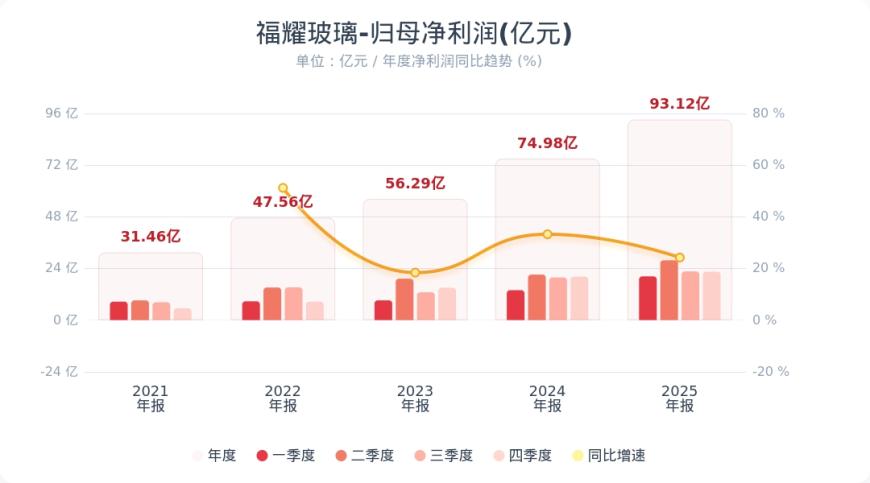
Group 1: Acquisition Announcements - Company Shapais plans to acquire 100% equity of Shanghai Qinli for 528 million yuan, which will indirectly give it 100% ownership of Shanghai Tianlun Hospital [1] - Company Kute Intelligent intends to sign a memorandum of understanding to acquire controlling interest in a major operating company of South Korea's apM Group for approximately 500 million yuan [2] Group 2: Financial Performance - Company Fuyao Glass reported a net profit of 9.312 billion yuan for 2025, representing a year-on-year increase of 24.20%, with total revenue of 45.787 billion yuan, up 16.65% [3] - Company Wancheng Group announced a net profit of 1.345 billion yuan for 2025, a significant increase of 358.09%, with total revenue of 51.459 billion yuan, up 59.17% [4] - Company Sinopharm Unity reported a net profit of 1.136 billion yuan for 2025, reflecting a year-on-year growth of 76.80%, despite total revenue declining by 1.29% to 73.416 billion yuan [5] Group 3: Shareholding Changes - Company Haotaitai announced that shareholder Hou Pengde plans to reduce his holdings by no more than 12.072 million shares, accounting for up to 3% of the total share capital [6] - Company Jinyinhai reported that shareholder Haihui Wealth intends to reduce its holdings by no more than 7.5 million shares, representing 4.31% of the total shares, due to personal funding needs [7] - Company Zhaoyan New Drug announced that shareholders Gu Xiaolei and Gu Meifang adjusted their combined reduction plan to no more than 3% of the total share capital, changing the method to a combination of centralized bidding and block trading [8] Group 4: Operational Issues - Company Huitian New Materials reported a fire incident at its wholly-owned subsidiary, leading to a temporary production halt until the cause is determined, with potential impacts on the company's 2026 performance [11] - Company Huide Technology announced that its wholly-owned subsidiary needs to pay back taxes of 9.6798 million yuan and late fees of 2.6215 million yuan, which will affect the company's 2025 net profit by approximately 12.3013 million yuan [12]
31.32亿元!福耀玻璃派“红包”
Shang Hai Zheng Quan Bao· 2026-03-17 16:00
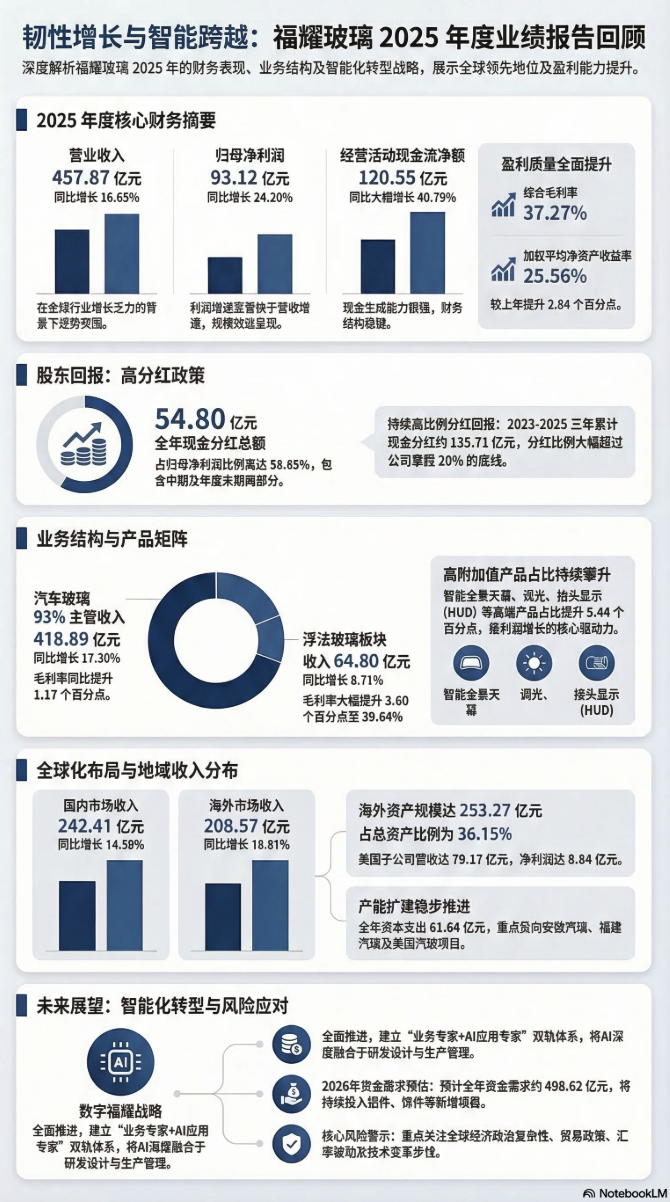
Core Viewpoint - Fuyao Glass reported record-high revenue and profit for the year 2025, demonstrating resilience and growth in a complex environment under the leadership of new chairman Cao Hui [2][4]. Financial Performance - The company achieved an operating revenue of 45.79 billion yuan, a year-on-year increase of 16.65% [3]. - Profit before tax reached 11.16 billion yuan, up 24.15% from the previous year [3]. - Net profit attributable to shareholders was 9.31 billion yuan, reflecting a 24.20% increase year-on-year [3]. - Earnings per share were 3.57 yuan, marking a 24.39% growth compared to the previous year [4]. Dividend Distribution - Fuyao Glass proposed a cash dividend of 1.20 yuan per share, totaling 3.132 billion yuan for all shareholders [5]. - The total cash dividend for 2025 is projected to be 5.48 billion yuan, accounting for 58.85% of the net profit attributable to shareholders [6]. Production and Sales Growth - The company reported cumulative sales of automotive glass at 169.18 million square meters, an increase of 8.54% year-on-year, equivalent to equipping approximately 40.28 million vehicles [9]. - Key projects in Hefei, Fuzhou, Benxi, and Hungary have been launched, significantly enhancing production capacity and global supply chain capabilities [9]. Market Trends and Innovations - The automotive market is recovering, and Fuyao Glass is capitalizing on opportunities presented by the "new four modernizations" in the automotive industry [10]. - The company is focusing on high-value products such as smart panoramic glass and adjustable light glass, which have increased their proportion in total sales by 5.44 percentage points [11]. Future Outlook - Fuyao Glass aims to maintain its upward trajectory as it approaches its 50th anniversary in 2026, emphasizing steady operations and resource integration to navigate global uncertainties [12].

福耀玻璃交棒之年逆势大赚93亿元 新帅曹晖发令“二次创业”
Mei Ri Jing Ji Xin Wen· 2026-03-17 15:09
Core Viewpoint - Fuyao Glass achieved significant growth in 2025 despite a challenging global economic environment, with a revenue of 45.787 billion yuan, a 16.65% increase year-on-year, and a net profit of 9.312 billion yuan, up 24.20% [4][5] Group 1: Financial Performance - In 2025, Fuyao Glass reported a revenue of 45.787 billion yuan, representing a year-on-year growth of 16.65% [4] - The net profit attributable to shareholders reached 9.312 billion yuan, reflecting a 24.20% increase compared to the previous year [4] - The company maintained a high cash dividend ratio, proposing a cash dividend of 1.20 yuan per share, totaling 5.48 billion yuan, which is 58.85% of the net profit attributable to shareholders [5] Group 2: Leadership Transition - 2025 marked a significant leadership change as founder Cao Dewang stepped down as chairman, becoming the honorary chairman, while Cao Hui took over as the new chairman [3][6] - The transition aims to optimize the company's governance structure and ensure sustainable development as Fuyao approaches its 50th anniversary [3][6] Group 3: Strategic Initiatives - The new chairman, Cao Hui, announced a "second entrepreneurship" initiative focusing on digital and intelligent transformation to enhance production and management efficiency [7] - Fuyao plans to extend its industry boundaries by developing smart glass and expanding into related projects such as aluminum components and precision parts [8] - The company is investing in automation and digital control to improve overall operational efficiency and product quality [7][8] Group 4: Future Financial Needs - For 2026, Fuyao Glass anticipates a total funding requirement of 49.862 billion yuan, including 39 billion yuan for operational expenses and 7.73 billion yuan for capital expenditures [9]
福耀玻璃交棒之年逆势大赚93亿元,新帅曹晖发令“二次创业”
Mei Ri Jing Ji Xin Wen· 2026-03-17 15:04
Core Viewpoint - Fuyao Glass achieved significant growth in 2025 despite a challenging global economic environment, with a revenue of 45.787 billion yuan, a 16.65% increase year-on-year, and a net profit of 9.312 billion yuan, up 24.20% from the previous year [1][3]. Group 1: Financial Performance - In 2025, Fuyao Glass reported a total revenue of 45.787 billion yuan, reflecting a year-on-year growth of 16.65% [3]. - The net profit attributable to shareholders reached 9.312 billion yuan, marking a 24.20% increase compared to the previous year [1][3]. - The company maintained a high cash dividend ratio, proposing a cash dividend of 1.20 yuan per share, with total cash dividends for the year amounting to 5.48 billion yuan, which is 58.85% of the net profit attributable to shareholders [4]. Group 2: Leadership Transition - 2025 marked a significant leadership transition for Fuyao Glass, with founder Cao Dewang stepping down as chairman to become the honorary chairman, while Cao Hui was appointed as the new chairman [2][5]. - The leadership change is seen as a pivotal moment as the company approaches its 50th anniversary, with a focus on strategic governance and sustainable development [2][6]. Group 3: Strategic Initiatives - Fuyao Glass is focusing on a "second entrepreneurship" strategy under the new leadership, emphasizing digital and intelligent transformation to enhance production and management processes [6]. - The company plans to extend its industry boundaries by developing smart glass and expanding into related products such as precision aluminum components and intelligent decorative parts [6]. - Continuous investment in research and development is evident, with R&D expenses reaching 1.913 billion yuan in 2025, a 14.03% increase from the previous year [4]. Group 4: Market Position and Challenges - The global automotive industry is facing challenges such as weakened demand and rising costs, yet Fuyao Glass has managed to thrive due to its global market presence and high-value product offerings [3]. - The company is adapting to trends in automotive electrification, connectivity, intelligence, and sharing, which are driving the demand for advanced glass products [3].
福耀玻璃2025年净利润同比增长24.2% 拟每股派1.2元
Zheng Quan Ri Bao Wang· 2026-03-17 13:46
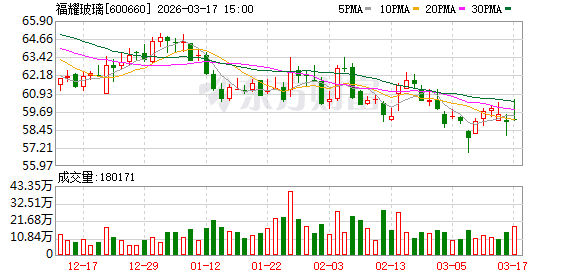
Core Viewpoint - Fuyao Glass Industry Group Co., Ltd. has achieved significant growth in its 2025 annual report, with a revenue of 45.787 billion yuan, marking a 16.65% increase year-on-year, and a net profit attributable to shareholders of 9.312 billion yuan, reflecting a 24.20% growth compared to the previous year [1] Financial Performance - In 2025, the company plans to distribute a cash dividend of 1.20 yuan per share, totaling 3.132 billion yuan, with a cumulative cash dividend of 5.48 billion yuan for the year, representing 58.85% of the net profit attributable to shareholders [1] - Since its listing, Fuyao Glass has distributed a total of 40.221 billion yuan in cash dividends [1] Market Position and Strategy - As of March 17, the total market capitalization of Fuyao Glass A-shares is approximately 154.3 billion yuan [2] - The company is set to celebrate its 50th anniversary in 2026 and aims to deepen its digital and intelligent transformation, integrating AI technology to enhance operational efficiency [2] Industry Context - In 2025, China's automotive production and sales reached 34.531 million and 34.4 million units, respectively, with year-on-year growth of 10.4% and 9.4%, setting new records [2] - Fuyao Glass, as the largest automotive glass supplier globally, sold 169.18 million square meters of automotive glass in 2025, a year-on-year increase of 8.54%, equivalent to equipping 4.028 million vehicles [2] Production Capacity and Innovation - The company has significantly enhanced its production capacity with key projects in Anhui Hefei, Fuzhou Yangxia, Benxi, and Hungary now operational, strengthening its global supply chain and competitiveness [2] - Fuyao Glass has increased its R&D investment to 1.913 billion yuan in 2025, focusing on high-value products such as smart panoramic glass and adjustable light glass, which are becoming integral to smart vehicle interiors [3] - The company has established an integrated supply chain from upstream silica sand and float glass production to automotive glass manufacturing and downstream decorative parts, improving cost control and global delivery capabilities [3]
福耀玻璃:去年归母净利润同比增长24.20%
Bei Ke Cai Jing· 2026-03-17 13:34
Core Viewpoint - Fuyao Glass announced a significant increase in its financial performance for 2025, indicating strong growth in revenue and profits compared to the previous year [1] Financial Performance Summary - The company achieved a consolidated revenue of 45.787 billion yuan, representing a year-on-year growth of 16.65% [1] - The pre-tax profit reached 11.161 billion yuan, marking a 24.15% increase from the previous year [1] - The annual profit attributable to the owners of the company was 9.312 billion yuan, which is a 24.20% increase year-on-year [1] - Earnings per share (EPS) stood at 3.57 yuan, reflecting a growth of 24.39% compared to the previous year [1]
福耀玻璃2025年净利润增24%创历史新高,汽车智能化浪潮带来增长机遇 | 财报见闻
Hua Er Jie Jian Wen· 2026-03-17 12:59
Core Viewpoint - Fuyao Glass, the world's largest automotive glass manufacturer, demonstrated its ability to navigate through trade frictions and uncertainties in the automotive industry with record-high revenue and profit, while also announcing a substantial cash dividend of over 5.48 billion yuan for the year [2] Financial Performance - In 2025, Fuyao Glass achieved a consolidated operating revenue of 45.79 billion yuan, a year-on-year increase of 16.65% [3][4] - The net profit attributable to shareholders reached 9.31 billion yuan, reflecting a year-on-year growth of 24.20% [3][4] - The net cash flow from operating activities was 12.06 billion yuan, showing a significant increase of 40.79% compared to the previous year [3][4] - The gross profit margin improved to 37.27%, and the weighted average return on equity rose to 25.56%, an increase of 2.84 percentage points from the previous year [3] Revenue Breakdown - Automotive glass remained the core segment, generating revenue of 41.89 billion yuan, a 17.30% increase year-on-year, accounting for approximately 93% of total revenue [5] - The float glass segment reported revenue of 6.48 billion yuan, with a gross margin increase of 3.60 percentage points to 39.64% [6] Geographic Performance - Domestic revenue was 24.24 billion yuan, up 14.58% year-on-year, while overseas revenue reached 20.86 billion yuan, marking an 18.81% increase [7] Cash Flow and Capital Expenditure - The net cash flow from operating activities was 12.06 billion yuan, a 40.79% increase from the previous year, indicating strong cash generation capabilities [9] - Capital expenditures for the year totaled 6.16 billion yuan, focusing on projects in Anhui and the U.S. [9] Dividend Policy - The company proposed a final cash dividend of 1.20 yuan per share, resulting in a total dividend payout of approximately 5.48 billion yuan, which represents 58.85% of the net profit attributable to shareholders [4][14] - The total cash dividend for the year amounted to 5.48 billion yuan, continuing the trend of high dividend payouts [13][14] Industry Outlook - The automotive industry in China saw record production and sales in 2025, with production and sales reaching 34.53 million and 34.40 million units, respectively, marking year-on-year growth of 10.4% and 9.4% [9] - The trend of "electrification, connectivity, intelligence, and sharing" in the automotive sector is accelerating, leading to increased demand for high-value-added products [10]
福耀玻璃2025年盈利增超两成 恒安国际去年净赚超25亿元
Xin Lang Cai Jing· 2026-03-17 12:39
Performance Summary - Fuyao Glass (03606.HK) reported a revenue of approximately 45.787 billion yuan for 2025, representing a year-on-year increase of 16.65%, with a net profit of about 9.312 billion yuan, up 24.2% [1] - Hengan International (01044.HK) achieved a revenue of 23.069 billion yuan in 2025, a 1.8% increase year-on-year, and a net profit of 2.535 billion yuan, up 10.3%. E-commerce and new retail sales revenue grew by 10.1%, with an annual gross margin improvement to approximately 33.8% [1] - Sunac China (01918.HK) expects a loss between 12 billion to 13 billion yuan for 2025, a reduction compared to the previous year, primarily due to gains from overseas debt restructuring [1] - Tencent Music (01698.HK) reported total revenue of 32.9 billion yuan for 2025, a 15.8% year-on-year increase, with a net profit of 11.06 billion yuan, up 66.4% [2] - China Eastern Education (00667.HK) achieved a revenue of 4.616 billion yuan in 2025, a 12.1% increase, with adjusted net profit of 792 million yuan, up 50.9% [4] - Hong Kong Electric (02638.HK) reported a revenue of 12.125 billion yuan for 2025, a 0.6% increase, and a net profit of 3.149 billion yuan, up 1.2% [5] - Longjiang Life Science (00775.HK) reported a revenue of 5.41 billion HKD, a 2% decrease, with a net loss of 187 million HKD, an increase of 47.61% year-on-year [3] Company News - Weisheng Holdings (03393.HK) won a supply contract for reclosers from CEMIG, Brazil's largest power company, valued at 138 million Brazilian Reais (approximately 182 million yuan or 206 million HKD), to be delivered in batches over the next two years [9] - Hong Kong International Holdings (00480.HK) partnered with Jiaxing Xiutuo Construction Investment Group to acquire a commercial land plot in Jiaxing for approximately 216.4 million yuan, planning to develop a shopping center [9] Financing and Buyback Activities - Xindong Company (02400.HK) repurchased 108,000 shares at a cost of approximately 7.911 million HKD, with prices ranging from 72.00 to 75.05 HKD [16] - Yum China (09987.HK) repurchased 18,500 shares for about 7.714 million HKD, with prices between 414.8 and 420.6 HKD [16] - CNOOC Oilfield Services (02883.HK) completed the issuance of 5 billion yuan in bonds through its wholly-owned overseas subsidiary [17]

福耀玻璃(03606.HK)2025年净利约93.12亿元 同比增加24.2%
Ge Long Hui A P P· 2026-03-17 12:36
1.数字与智能双轮驱动,开启"二次创业":面对时代变革,作为行业头部企业,唯有主动担当、积极破 局,方能引领前行。为此,公司将全面深化数字化与智能化转型,重塑生产与管理模式,致力于打造真 正意义上的"数字福耀"。2.向内深潜,向管理要效益:推动全价值链的精益化与智能化升级,构建高效 协同、全局可视的供应链体系,贯彻极致成本理念,深挖潜力、严控损耗,持续增强企业内生动力与经 营质量。3.人才为本,AI为冀:着力构建"业务专家+AI应用专家"双轨融合的人才体系,将AI技术深度 融合于研发设计、生产管理、市场分析与客户服务等核心环节,推动业务智能化升级,实现从专业赋能 到技术驱动增长的全面跨越。 公司将始终坚守"做好一片玻璃"的初心,坚守实业,以质量为根基、以技术为核心、以供应链为支撑, 发挥全球布局与多基地协同优势,持续为汽车工业提供可靠支持。企业发展需"向上突破"与"稳扎根 基"并举:以技术突破推动研发转化,以精细管理筑牢运营与风控防线,方能在全球竞争中行稳致远。 格隆汇3月17日丨福耀玻璃(03606.HK)公告,2025年公司合并实现收入人民币457.87亿元,比上年同期 增长16.65%;实现除税前利润人 ...
福耀玻璃:2025年净利润同比增长24% 拟每股派1.2元
Jin Rong Jie· 2026-03-17 12:26
责任编辑:山上 3月17日,福耀玻璃(600660.SH)发布2025年年报显示,2025年实现营业收入457.87亿元,同比增长16.65%;归母净利润93.12 亿元,同比增长24.2%;基本每股收益3.57元。公司拟每股分配现金股利1.2元(含税)。报告期内,公司汽车玻璃销售收入 同比上升17.3%。 股票频道更多独家策划、专家专栏,免费查阅>> ...