
FYG,FUYAO GLASS(600660)

Search documents
汽车零部件行业专题研究:专注汽车零部件优质赛道
Yuan Da Xin Xi· 2026-03-24 03:24
Investment Rating - The report gives an investment rating of "Positive" for the automotive parts industry [7] Core Viewpoints - The automotive parts industry in China is experiencing a historic development opportunity driven by the transformation towards electric and intelligent vehicles, with domestic brands surpassing joint ventures and accelerating globalization [1][13] - The investment focus is on four main themes: quality tracks, globalization, intelligence, and robotics, with a specific emphasis on high-barrier and well-structured segments such as automotive glass, headlights, passive safety, and seats [1][15] Summary by Sections Automotive Glass - The automotive glass market is expected to reach approximately 144.3 billion yuan globally by 2030, with a CAGR of about 9.7% from 2025 to 2030 [2][24] - The industry is highly concentrated, with the top four companies holding over 85% of the market share globally, and Fuyao Glass leading with a 28% market share [2][27] - Fuyao Glass is focusing on high-value products and increasing capital expenditure, which is expected to boost its market share to around 37% by 2025 [2][29] Headlights - The domestic market for passenger car headlights is projected to reach about 128.6 billion yuan by 2030, with a CAGR of approximately 5.8% from 2025 to 2030 [3][48] - The industry has high barriers to entry and is concentrated, with the top five companies controlling over 50% of the market share globally [3][49] - Xingyu Co., a leading domestic player, has increased its market share from 10% in 2018 to 14.5% in 2024, with expectations for continued growth [3][52] Passive Safety - The market for seat belts and airbags is expected to reach around 43.8 billion yuan by 2030, with a CAGR of about 6.4% from 2025 to 2030 [4][48] - The passive safety industry is dominated by a few major players, with the top three companies holding over 90% of the market share globally [4][49] - Songyuan Safety, the only domestic listed company in this field, is expected to continue increasing its market share due to its strong pricing and R&D advantages [4][49] Seats - The domestic market for passenger car seats is projected to reach approximately 135.7 billion yuan by 2030, with a CAGR of about 6.1% from 2025 to 2030 [5][48] - The seat industry has high barriers to entry and is primarily dominated by foreign companies, with the top five companies holding around 80% of the market share globally [5][49] - Domestic players like Jifeng and Tiancheng are expected to capture a larger market share, although it is estimated that domestic brands will not exceed 10% by 2025, indicating significant room for domestic substitution [5][49] Investment Recommendations - Recommended stocks include Fuyao Glass for glass, Xingyu Co. for headlights, Songyuan Safety, and Junsheng Electronics for passive safety, and Jifeng and Tiancheng for seats [6]


汽车行业2026一季度业绩前瞻
2026-03-24 01:27
Summary of Automotive Industry Conference Call Industry Overview - The automotive industry is facing dual pressure on volume and profit in Q1 2026, with wholesale volume expected to decline by approximately 8% year-on-year, while new energy vehicle sales are projected to slightly decrease. Exports are the only bright spot, with a year-on-year increase of 55% [1][2][3]. Key Points Performance Expectations - **Overall Industry Performance**: Q1 2026 is anticipated to be the low point for volume and profit in the passenger car sector, with most automakers expected to see profit declines exceeding 20% year-on-year due to rising costs from copper, aluminum, lithium carbonate, and the appreciation of the RMB [1][2][3]. - **Geely Auto**: Expected to report profits exceeding 4 billion yuan, with a quarter-on-quarter increase of over 10%, driven by the high profitability of the Geely 9X model and a year-on-year export growth of 140% [1][4]. - **Heavy Truck Sector**: Strong export performance with a year-on-year increase of 30% in January-February 2026. China National Heavy Duty Truck Corporation (CNHTC) is expected to see a profit increase of 60% to 500 million yuan [1][2][3]. Segment Performance - **Intelligent Vehicle Sector**: Outperforming the overall vehicle sector, with Huayang Group expected to see a nearly 20% year-on-year growth, benefiting from Xiaomi's automotive sales and new product lines [1][7]. - **Parts Sector**: Mixed performance with leading companies like Fuyao Glass and Xingyu maintaining lower pressure due to strong overseas expansion. Companies like Kingood are expected to benefit from the rising aluminum prices [1][6]. Sales and Profitability - **Sales Disparities**: Despite overall industry decline, companies like NIO and Seres are expected to show significant sales growth due to new model launches, while BYD and XPeng are facing larger declines [2][3][4]. - **Profit Expectations**: Most passenger car companies are expected to see a year-on-year profit decline of over 20%. Geely is projected to stand out with a profit of over 4 billion yuan [4][5]. Market Trends - **Two-Wheeler Sector**: The sector continues to show strong growth in large-displacement exports, with Chuanfeng Power's exports expected to increase by 60% year-on-year, although overall performance is expected to remain flat due to tariff impacts [1][10]. Additional Insights - **Investment Strategy**: The investment strategy for 2026 focuses on performance and valuation, with recommendations in areas such as AIGC-enabled "power shortage," L4-level intelligence, and robotics. Key companies recommended include Weichai Power, Xpeng Motors, and Top Group [2]. - **Challenges**: The industry faces challenges from rising raw material costs and currency fluctuations, which are expected to negatively impact profitability in Q1 2026 [3][4]. This summary encapsulates the key insights and performance expectations for the automotive industry as discussed in the conference call, highlighting both opportunities and challenges within various segments.





福耀玻璃:尽管全球局势动荡,管理层仍保持乐观
2026-03-24 01:27
Summary of Fuyao Glass Conference Call Company Overview - **Company**: Fuyao Glass - **Industry**: Auto Glass Manufacturing Key Financial Highlights - **FY25 Results**: - Net Sales: RMB 45.79 billion, a 17% year-over-year increase [22] - Gross Profit: RMB 17.07 billion, Gross Margin: 37.3% [22] - Net Profit: RMB 9.31 billion, Net Margin: 20.3% [22] - Core Net Profit Margin improved to 22%, up 1.14% year-over-year [9] Revenue Growth Drivers - **ASP and Volume Growth**: - Auto glass revenue growth driven by an 8.1% ASP increase and an 8.5% volume increase [7] - High-value-added products accounted for 54.2% of auto glass revenue, contributing significantly to ASP growth [8] - **Overseas Performance**: - Overseas auto glass revenue increased by 21% year-over-year, outpacing domestic growth of 15% [7] Management Guidance and Outlook - **ASP Growth**: Management expects a sustainable ASP CAGR of 6-7% over the next decade, driven by the trend of auto intelligence and high-value-added products [5] - **Sales Rebates**: Sales rebates are projected to increase to approximately 2% in FY26, up from 1.61% in FY25, indicating pricing pressure from OEM customers [10] - **Market Share**: Management noted a potential loss in market share in China due to capacity constraints, with domestic sales volume growth lagging behind the overall auto production growth [11] Operational Updates - **US Plant Performance**: - The US plant's operating margin reached 13.3% in FY25, with expectations for a 15% net profit margin in the next 2-3 years [12][14] - Management anticipates a ramp-up in capacity utilization from 30% in FY25 to 60-65% in FY26 [15] - **Natural Gas and Freight Costs**: Limited impact from natural gas price hikes due to stable supply and long-term contracts [19] Capacity and Expansion Plans - **Domestic Capacity**: - 6 million sets of new domestic capacity expected to be operational by end-2025, with delays in additional capacity expansion [18][44] - **Aluminum Trim Business**: Projected revenue growth of 25% year-over-year in FY26, supported by ongoing capacity expansion [17] Pricing Dynamics - **US Pricing Post-Tariff Hike**: Successful ASP hikes were achieved following the US tariff increase, with potential for further increases in 2026 as OEM profitability recovers [16] Financial Projections - **Price Targets**: - A-share price target remains at RMB 62, while H-share price target is lowered to HK$ 68 [2] Conclusion - **Management's Optimism**: Despite challenges, management maintains a positive outlook for growth driven by market share gains, ASP increases, and the introduction of high-value-added products [2][5]
福耀玻璃(03606.HK)获Mitsubishi UFJ Financial Group增持81.76万股
Ge Long Hui· 2026-03-23 13:44
Group 1 - Mitsubishi UFJ Financial Group, Inc. increased its stake in Fuyao Glass (03606.HK) by purchasing 817,600 shares at an average price of HKD 60.7035 per share, totaling approximately HKD 49.6312 million [1] - Following the acquisition, Mitsubishi UFJ's total holdings in Fuyao Glass rose to 37,218,400 shares, increasing its ownership percentage from 5.99% to 6.13% [1]


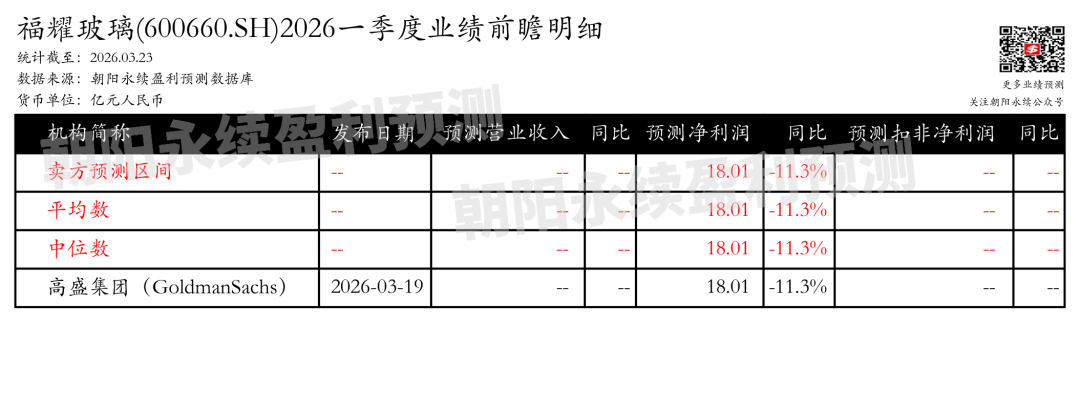
福耀玻璃:业绩增长 份额提升,预测一季度净利润18.01亿元,同比变动-11.3%
Xin Lang Cai Jing· 2026-03-23 12:16
Core Viewpoint - Fuyao Glass is expected to report a net profit of 1.801 billion yuan for Q1 2026, reflecting a year-on-year decline of 11.3% [1][6]. Group 1: Earnings Forecast - The forecasted net profit for Fuyao Glass is 1.801 billion yuan, with a year-on-year change of -11.3% [1][2][6]. - The average and median estimates for net profit are both 1.801 billion yuan, indicating consensus among analysts [2][7]. Group 2: Recent Seller Opinions - Dongwu Securities reports that Fuyao Glass's 2025 annual report shows a revenue increase of 16.65% and a net profit increase of 24.20%, with Q4 showing revenue growth of 14.15% and net profit growth of 11.35% [3][8]. - The company continues to grow its global market share, with an 8.07% increase in the average price per unit of automotive glass, although gross margin has slightly decreased [3][8]. - Fuyao Glass is positioned as a leader in the global automotive glass industry, with expected further market share growth due to capacity expansions in the U.S. and other facilities [9]. Group 3: Financial Performance - Fuyao Glass achieved a total revenue of 45.787 billion yuan in 2025, with a net profit of 9.312 billion yuan, marking significant growth [4][9]. - The automotive glass segment remains the primary revenue driver, with both sales volume and revenue increasing, and an average price per unit increase of 8.08% [4][9]. - The company reported a robust operating cash flow of 12.055 billion yuan, a year-on-year increase of 40.8%, and plans to distribute cash dividends of 5.48 billion yuan, with a payout ratio of 58.85% [4][9].
福耀玻璃:2025年实现合并营业收入457.87亿元,同比增长16.65%
Xin Lang Cai Jing· 2026-03-23 12:10
Core Viewpoint - Fuyao Glass emphasizes that its market value management is rooted in solid internal value, focusing on excellent operational performance, continuous R&D innovation, substantial shareholder returns, transparent information disclosure, and effective communication with investors [1][2] Financial Performance - In 2025, Fuyao Glass expects to achieve consolidated revenue of 45.787 billion yuan, representing a year-on-year increase of 16.65% [1][2] - The company anticipates a total profit of 11.162 billion yuan, reflecting a year-on-year growth of 24.15% [1][2] - The net profit attributable to shareholders is projected to be 9.312 billion yuan, with a year-on-year increase of 24.20% [1][2] Shareholder Returns - Since its listing in 1993, Fuyao Glass has distributed a total of 38.815 billion yuan in cash dividends to investors, including 3.132 billion yuan in cash dividends declared but not yet distributed for 2025 [1][2] - The company has also issued stock dividends totaling 1.406 billion yuan, with total dividends and stock distributions accounting for 64.30% of cumulative net profit attributable to shareholders [1][2] Investor Relations and Communication - Fuyao Glass places a high priority on information disclosure and investor relations management, adhering strictly to regulations from the CSRC, Shanghai Stock Exchange, and Hong Kong Stock Exchange to ensure information is disclosed in a truthful, accurate, complete, timely, and fair manner [1][2] - The company actively enhances communication with investors and analysts through various channels, including earnings release meetings, roadshows, conference calls, investor hotlines, emails, and the "Shanghai Stock Exchange e-Interaction" platform, aiming to protect the rights of investors, especially small and medium-sized investors [1][2]
Mitsubishi UFJ Financial Group, Inc.增持福耀玻璃81.76万股 每股作价约60.7港元
Zhi Tong Cai Jing· 2026-03-23 12:10
Group 1 - Mitsubishi UFJ Financial Group, Inc. increased its stake in Fuyao Glass (03606) by 817,600 shares at a price of HKD 60.7035 per share, totaling approximately HKD 49.6312 million [1] - After the increase, Mitsubishi UFJ's total shareholding in Fuyao Glass reached 37.2184 million shares, representing a holding percentage of 6.13% [1]
Mitsubishi UFJ Financial Group, Inc.增持福耀玻璃(03606)81.76万股 每股作价约60.7港元
智通财经网· 2026-03-23 11:57
Group 1 - Mitsubishi UFJ Financial Group, Inc. increased its stake in Fuyao Glass (03606) by 817,600 shares at a price of HKD 60.7035 per share, totaling approximately HKD 49.6312 million [1] - After the increase, Mitsubishi UFJ's total shareholding in Fuyao Glass reached 37,218,400 shares, representing a holding percentage of 6.13% [1]
——汽车行业周报:宇树科技披露招股书,小米发布新一代SU7-20260323
Guohai Securities· 2026-03-23 09:06
Investment Rating - The report maintains a "Recommended" rating for the automotive industry [1] Core Insights - The automotive industry is experiencing a structural transformation with opportunities in high-end domestic brands and accelerated penetration of smart technologies. Despite challenges such as the reduction of new energy vehicle purchase tax incentives, the overall sentiment for 2026 remains optimistic [4][13] - The report highlights significant growth in companies like Yushu Technology, which reported a revenue of 1.71 billion yuan in 2025, a year-on-year increase of 335.4%, and a net profit of 600 million yuan, up 674.3% [11] - Xiaomi's new generation SU7 was launched with advanced safety and intelligent driving features, indicating a trend towards enhanced vehicle technology [12] Summary by Sections Recent Trends - The automotive sector's performance from March 16 to March 20 shows a decline of 4.4%, with passenger vehicles increasing by 0.8% while commercial vehicles decreased by 4.0% [14] - The report notes that the A-share automotive sector outperformed the Shanghai Composite Index during this period [14] Key Companies and Earnings Forecast - The report provides a detailed earnings forecast for key companies, recommending stocks such as BYD, Geely, and Great Wall Motors, with various ratings from "Buy" to "Increase" based on their projected earnings per share (EPS) and price-to-earnings (PE) ratios [6][54] - For instance, BYD is projected to have an EPS of 5.33 in 2026 with a "Buy" rating, while Great Wall Motors is expected to have an EPS of 1.70 with an "Increase" rating [54] Industry Indicators - In February 2026, the automotive production and sales figures were reported at 1.672 million and 1.805 million units respectively, showing a year-on-year decline of 20.5% and 15.2% [34] - New energy vehicles accounted for approximately 42.4% of total new vehicle sales, indicating a significant market share despite the overall decline [34]


汽车零部件、机器人主线周报:宇树IPO获受理,2025年收入、利润同比实现倍数增长-20260322
Soochow Securities· 2026-03-22 01:26
Investment Rating - The industry investment rating is "Overweight," indicating an expected outperformance of the industry index relative to the benchmark by more than 5% in the next six months [59]. Core Insights - The automotive parts sector saw a weekly decline of 6.20%, ranking 5th among the SW automotive indices, while the robot sector declined by 5.82%, with a year-to-date performance of -9.93% [2][15]. - The latest trading day PE (TTM) for the automotive parts sector is at the 70.62% historical percentile, and the PB (LF) is at the 64.82% historical percentile [24]. - The humanoid robot sector's trading heat has dropped to a historical low, with the latest PE (TTM) at the 22.34% percentile since 2025 [34]. Summary by Sections Automotive Parts Weekly Review - The automotive parts sector's performance this week was -6.20%, with a year-to-date performance of -7.28% [20][21]. - The sector's valuation metrics have decreased, with PE and PB ratios both declining since the beginning of 2026 [24]. - Key companies in the sector reported varied performance, with Fuyao Glass showing a revenue increase of 16.65% and a net profit increase of 24.20% for 2025 [52]. Humanoid Robot Weekly Review - The humanoid robot index declined by 5.82% this week, with a year-to-date decline of 9.93% [26]. - The trading volume and turnover rate for humanoid robots have reached historical lows, indicating reduced market activity [30]. - The latest PE (TTM) for the humanoid robot sector is at the 22.34% percentile, reflecting a significant drop in valuation [34]. Key Company Tracking - Notable companies include Fuyao Glass, which reported a revenue of 457.87 billion yuan and a net profit of 93.12 billion yuan for 2025, and Xinyuan Co., which reported a revenue increase of 17.04% but a net profit decrease of 16.54% [52]. - The top-performing stocks this week included Shuanghuan Transmission (+0.71%) and Songyuan Safety (+0.55%) [46]. Investment Recommendations - For the automotive parts sector, the report suggests focusing on product-oriented companies and those entering high-value segments to enhance ASP [54]. - In the robot sector, the report highlights the importance of technological synergies and manufacturing collaboration, recommending companies like Top Group and Junsheng Electronics [54].


