HAIER SMART HOME(600690)

Search documents
2025年上海市电饭锅(含电压力锅)产品质量监督抽查结果公布
Zhong Guo Zhi Liang Xin Wen Wang· 2025-07-31 08:48
Core Insights - The Shanghai Municipal Market Supervision Administration conducted a quality inspection of rice cookers (including electric pressure cookers) in the city, with 20 batches tested and no non-compliant products found [2] Group 1: Inspection Results - The inspection covered 20 batches of rice cookers, including 4 from production, 10 from physical sales, and 6 from e-commerce [2] - The sampled products originated from 7 provinces and cities, with 7 batches from local manufacturers and 13 from external manufacturers [2] Group 2: Compliance Standards - The inspection was conducted based on the SHSSXZ0055-2025 guidelines for product quality supervision of rice cookers in Shanghai [2] - All tested products met the relevant quality standards, indicating a high level of compliance in the market [2]



海尔智家(600690.SH):已累计回购3338万股
Ge Long Hui A P P· 2025-07-31 08:25
格隆汇7月31日丨海尔智家(600690.SH)公布,2025年7月当月,公司通过集中竞价交易方式已累计回购A 股(下同)股份1,550,000股,占公司总股本的比例为0.017%,购买的最高价为26.05元/股、最低价为 24.83元/股,支付的金额为39,709,866.04元(不含手续费等,下同);本次回购实施起始日(2025年4月 7日)至2025年7月31日,公司已累计回购股份33,380,800股,占公司总股本的比例为0.356%,购买的最 高价为26.30元/股、最低价为23.60元/股,支付的金额为834,064,561.24元。 ...
海尔智家(600690) - 海尔智家股份有限公司关于以集中竞价交易方式回购A股股份的进展公告
2025-07-31 08:17
证券代码:600690 证券简称:海尔智家 公告编号:临 2025-051 海尔智家股份有限公司 关于以集中竞价交易方式回购 A 股股份的进展公告 本公司董事会及全体董事保证本公告内容不存在任何虚假记载、误导性陈述 或者重大遗漏,并对其内容的真实性、准确性和完整性承担法律责任。 重要内容提示: 续也披露了回购进展公告。 二、回购股份的进展情况 根据《上海证券交易所上市公司自律监管指引第 7 号——回购股份》等相关 规定,现将公司回购股份进展情况公告如下: 2025 年 7 月当月,公司通过集中竞价交易方式已累计回购 A 股(下同)股份 1,550,000 股,占公司总股本的比例为 0.017%,购买的最高价为 26.05 元/股、最低 价为 24.83 元/股,支付的金额为 39,709,866.04 元(不含手续费等,下同);本次回 购实施起始日(2025 年 4 月 7 日)至 2025 年 7 月 31 日,公司已累计回购股份 33,380,800 股,占公司总股本的比例为 0.356%,购买的最高价为 26.30 元/股、最 低价为 23.60 元/股,支付的金额为 834,064,561.24 元。 ...
家用电器业CFO群体观察:海尔智家等5家公司CFO一职真空东方电热罗月芬年薪最低仅15.48万
Xin Lang Cai Jing· 2025-07-31 06:03
就薪酬水平而言,2024年家用电器上市公司CFO平均年薪为94.14万元,共有36位CFO高于平均值;年薪中位数为72.72万元,最大值和最小值的差距高达930.52万元。年收入在100万元以上 超四成CFO身兼数职。报告期内,约13.1%的CFO兼任董事会秘书职位,26.3%的CFO兼任总经理或副总经理职位,14.1%的CFO同时担任审计委员会成员、战略委员会成员或薪酬与考核委员会成 美的集团CFO钟铮以946万元薪酬稳坐第一,约为第二名苏泊尔CFO徐波2024年薪近3倍。此外,她还通过员工持股计划持有公司股份,具体持股比例未披露。财报显示,钟铮现年43岁,于200 薪酬最低的CFO为东方电热罗月芬,当期从公司获得的税前报酬总额仅为15.48万元,较2023年微增5.5%。她通过员工持股计划持有84655股股份,约占股本总额0.01%。罗月芬现年58岁,自 据不完全统计,2024年家用电器上市公司共有2位CFO出现违规情况。同洲电子的财务总监孙贺因《2023年业绩预告》未披露预计营业收入和扣除后营业收入,且未在会计年度后一个月内,披露 责任编辑:公司观察 登录新浪财经APP 搜索【信披】查看更多考评等级 专 ...

助力家电以旧换新!海尔消费金融智家分期落地全国
Qi Lu Wan Bao Wang· 2025-07-31 05:40
Core Insights - The People's Bank of China and five other departments issued guidelines to boost consumption, proposing 19 key measures to encourage financial institutions to support consumption through various innovative financing methods [1] Group 1: Financial Support Initiatives - Haier Consumer Finance launched the "Smart Home Installment" product, offering 0 down payment, 0 interest, and 0 fees for home appliance financing, aligning with national policies to promote consumption [1] - The product integrates advanced technology into the installment process, enabling rapid approval and enhancing customer experience through a seamless application process [1][12] Group 2: Sales Performance - In Shanxi, the "Smart Home Installment" program significantly boosted appliance sales, with a single event achieving sales of over 2 million yuan, where installment transactions accounted for 38% [3] - Another event in Shanxi recorded sales of 2.36 million yuan, with installment transactions making up 35% and a 90% increase in average transaction value for installment purchases [5] Group 3: Customer Experience - Customers reported positive experiences with the "Smart Home Installment," such as a couple who, after learning about the financing options, quickly purchased a full set of appliances without any interest costs [7] - In Guizhou, 139 families utilized the installment service, with an average transaction value of 14,100 yuan per customer [8] Group 4: Product Integration and Expansion - The "Smart Home Installment" has been integrated with UnionPay's upgraded services, allowing for a seamless process from subsidy application to interest-free installment and appliance delivery [12] - The program has rapidly expanded to over 1,800 Haier stores nationwide, providing nearly 100 million yuan in interest-free loans [12]
金十图示:2025年07月31日(周四)富时中国A50指数成分股午盘收盘行情一览:多数板块下跌,银行股涨跌互现
news flash· 2025-07-31 03:38
金十图示:2025年07月31日(周四)富时中国A50指数成分股午盘收盘行情一览:多数板块下跌,银行股涨跌互现 2433.44亿市值 1886.09亿市值 6831.53亿市值 43.93亿成交额 5.84亿成交额 8.99亿成交额 15.71 27.92 9.17 -0.78(-2.72%) -0.27(-1.69%) -0.09(-0.97%) 证券 电池 宁德时代 中信证券 国泰海通 CATL 4366.13亿市值 3607.04亿市值 12306.03亿市值 71.39亿成交额 18.54亿成交额 15.98亿成交额 269.91 29.46 20.46 -0.40(-1.92%) -7.18(-2.59%) -0.32(-1.07%) 消费电子 互联网服务 XD工业富 立讯精密 东方财富 7042.17亿市值 2715.88亿市值 3732.91亿市值 17.55亿成交额 47.18亿成交额 69.90亿成交额 35.46 37.45 23.62 -0.19(-0.80%) +2.82(+8.64%) -0.29(-0.77%) 家电行业 食品饮料 格力电器 海尔智家 海天味业 油气电音 2255. ...







家用电器业CFO群体观察:5-10年长任期架构稳定 超三成财务总监年薪逾百万
Xin Lang Zheng Quan· 2025-07-31 02:35
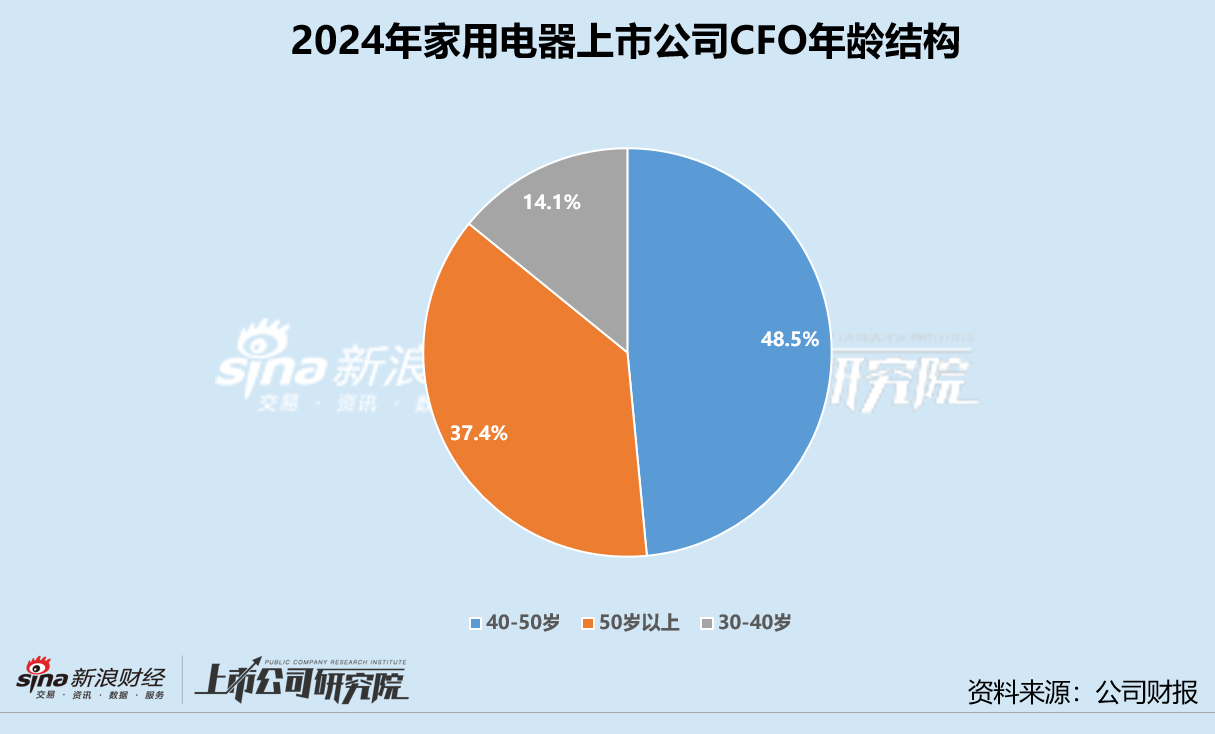
Core Insights - The report highlights the importance of CFOs in listed companies, revealing that the total salary for CFOs in A-share companies reached 4.27 billion yuan in 2024, with an average annual salary of 814,800 yuan [1][8] - The household appliance sector saw a revenue of 1.66 trillion yuan, a year-on-year increase of 4.5%, and a net profit of 118.1 billion yuan, up 6.3% from 2023, with over 40% of companies experiencing growth in both revenue and net profit [1][8] Salary and Compensation - The average salary for CFOs in the household appliance sector is 941,400 yuan, with a median salary of 727,200 yuan, and a significant disparity between the highest and lowest salaries, which is 9.31 million yuan [8][9] - Midea Group's CFO, Zhong Zheng, earns 9.46 million yuan, nearly three times that of the second-highest, Supor's CFO, Xu Bo, who earns 3.24 million yuan [8][10] - Approximately 31.3% of CFOs earn over 1 million yuan annually, while 13.1% hold dual roles as board secretaries [8][10] Age and Gender Demographics - The average age of CFOs in the household appliance sector is 47.79 years, with 48.5% aged between 40-50 and 37.4% over 50 [1][8] - Male CFOs make up 55.6% of the total, with an average age of 48.71 years, while female CFOs account for 44.4%, with an average age of 46.64 years [1][8] Tenure and Turnover - The most common tenure for CFOs is between 5-10 years, comprising 30.3% of the total, while 22.2% have served for over 10 years [4] - A total of 20 CFOs resigned during the reporting period, primarily due to health and job changes, with 75% replaced by successors [4] Educational Background - Over half of the CFOs in the household appliance sector hold a bachelor's degree, while 31.6% have a master's degree and 17.3% have an associate degree [6] Compliance and Violations - Two CFOs were reported for compliance violations, with their salaries being 720,000 yuan and 524,300 yuan respectively [10]


上半年营销案例启示:用户创作的内容,正成为品牌资产
3 6 Ke· 2025-07-30 09:16
Group 1 - The core idea of the article is that brand equity is shifting from being controlled by companies to being co-created by users, highlighting the importance of user-generated content (UGC) in modern marketing strategies [4][30][32] - Traditional brand equity was built through a top-down approach, focusing on logos, slogans, and advertisements, while the new paradigm emphasizes user-led creation and interaction [8][10][12] - Companies like Alibaba and ByteDance have recognized this shift, promoting concepts like "consumer assets" and "community assets" to engage users in the brand-building process [4][8][30] Group 2 - User-generated content (UGC) enhances authenticity and credibility, as consumers trust peer recommendations over polished advertisements [10][11] - UGC fosters stronger engagement and loyalty, as users feel a sense of ownership and connection to the brand when they contribute creatively [12][13] - The ability of UGC to expand brand meanings and interpretations allows for a richer and more diverse brand narrative [14][15] Group 3 - UGC spreads rapidly and widely due to its decentralized nature, leading to viral marketing effects that traditional advertising struggles to achieve [18][21] - Successful UGC marketing can significantly reduce costs, as brands can leverage user creativity without extensive advertising budgets [21][30] - Brands must adapt to this new landscape by embracing user creativity, engaging in two-way communication, and allowing for organic content creation [22][29][30] Group 4 - Companies should cultivate a long-term dialogue with users, treating them as partners in the brand development process [29][30] - The role of brand managers is evolving to focus on community engagement and ecosystem maintenance rather than solely on advertising [31][32] - The measurement of brand equity is transitioning from static metrics to dynamic indicators of user participation and community resilience [32][33]
5家鲁企上榜《财富》世界500强,青岛占一席,是谁?
Quan Jing Wang· 2025-07-30 09:08
Group 1 - The 2025 Fortune Global 500 list was released, with Walmart ranked as the largest company for the twelfth consecutive year, followed by Amazon and China's State Grid Corporation [1] - The revenue threshold for this year's list was $32.2 billion, an increase of approximately $100 million from last year [2] - A total of 130 Chinese companies made the list, with five from Shandong province, including Shandong Energy Group (ranked 82), Shandong Weiqiao Pioneering Group (ranked 166), Haier Smart Home (ranked 390), Shandong High-Speed Group (ranked 401), and Shandong Gold Group (ranked 465) [2] Group 2 - The ranking of Shandong companies reflects the province's economic structure and characteristics [3] - The Fortune Global 500 list is recognized for its rigorous selection process, requiring companies to disclose financial data and rank based on revenue, which is less influenced by financing activities and tax policies [4] - Among the Shandong companies, Haier Smart Home had the highest profit, with overseas revenue accounting for over 50% in 2024, indicating its global expansion strategy [5] Group 3 - Haier Smart Home has made significant investments globally, including a $490 million washing machine factory in the U.S. and new production facilities in Egypt and Thailand [5] - The smart home appliance industry, led by Haier Smart Home, is a key competitive sector in Qingdao, with plans to reach a scale of 420 billion yuan by 2027 [7] - Shandong has potential companies like Weichai Power, which is close to the revenue threshold for the Fortune Global 500, indicating further growth opportunities [8]

白色家电板块7月30日涨0.94%,深康佳A领涨,主力资金净流入3.07亿元
Zheng Xing Xing Ye Ri Bao· 2025-07-30 08:26
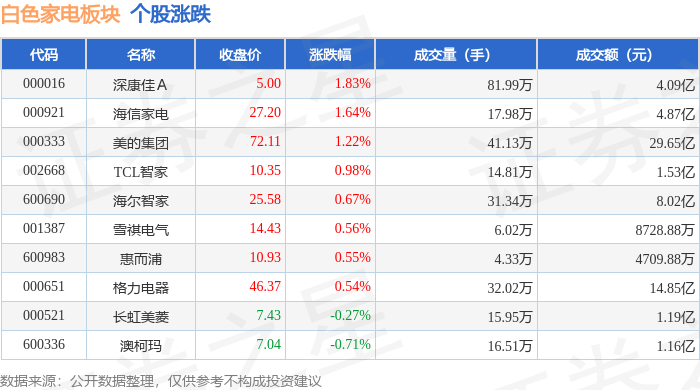
Market Overview - The white goods sector increased by 0.94% on July 30, with Shenzhen Konka A leading the gains [1] - The Shanghai Composite Index closed at 3615.72, up 0.17%, while the Shenzhen Component Index closed at 11203.03, down 0.77% [1] Stock Performance - Shenzhen Konka A (000016) closed at 5.00, up 1.83% with a trading volume of 819,900 shares [1] - Hisense Home Appliances (000921) closed at 27.20, up 1.64% with a trading volume of 179,800 shares [1] - Midea Group (000333) closed at 72.11, up 1.22% with a trading volume of 411,300 shares [1] - TCL Smart Home (002668) closed at 10.35, up 0.98% with a trading volume of 148,100 shares [1] - Haier Smart Home (600690) closed at 25.58, up 0.67% with a trading volume of 313,400 shares [1] - Gree Electric Appliances (000651) closed at 46.37, up 0.54% with a trading volume of 320,200 shares [1] Capital Flow - The white goods sector saw a net inflow of 307 million yuan from institutional investors, while retail investors experienced a net outflow of 189 million yuan [1] - Midea Group had a net inflow of 14.5 million yuan from institutional investors, but retail investors had a net outflow of 82 million yuan [2] - Gree Electric Appliances experienced a net inflow of 68.42 million yuan from institutional investors, with retail investors also seeing a net outflow of 18.42 million yuan [2] - Haier Smart Home had a net inflow of 32.30 million yuan from institutional investors, while retail investors had a net outflow of 21.02 million yuan [2]