
BAIC BluePark(600733)

Search documents
车企账期观察:18家企业半年延长12天、蔚来和理想超200天,长城资金缺口232亿
Sou Hu Cai Jing· 2025-09-03 05:25
Core Insights - The automotive industry in China is experiencing intensified price wars and a collective commitment from 17 companies to reduce supplier payment terms to no more than 60 days to alleviate cash flow pressures on component manufacturers [2][4][8] Group 1: Industry Overview - The first half of 2025 saw a significant increase in accounts payable turnover days among major automotive companies, with an average of 187.97 days, up from 175.75 days at the end of 2024, indicating a trend of extended payment periods [4][6] - Out of 18 major passenger car manufacturers, 12 experienced an increase in payment terms, while only 6 managed to shorten them, highlighting a broader industry trend towards longer payment cycles [4][5] Group 2: Company-Specific Changes - Among the companies, Xpeng Motors had the most significant reduction in accounts payable turnover days, decreasing by 63 days to 170 days, while Seres saw the largest increase, with a rise of 101 days to 266 days [5][6] - BYD's accounts payable turnover days increased by 15 days to 142 days, while NIO's increased by 23 days to 220 days, reflecting a common trend of extended payment terms across the industry [6][12] Group 3: Cash Flow and Financial Health - The cash reserves of many companies are insufficient to cover their accounts payable, with only Jiangling Motors and Haima Automotive having cash reserves that exceed their payables [10][11] - Companies like BYD and Geely are facing significant cash shortfalls, with BYD having a deficit of 805.86 million and Geely 462.61 million, indicating a critical cash flow challenge in meeting supplier payments [11][12] - The shift to a 60-day payment term has led to increased cash flow pressures, as companies like Li Auto reported a negative free cash flow of 38 million, exacerbating their financial strain [9][10]





北汽集团8月整车销量突破13.5万辆,今年累计销量达107万辆
Ju Chao Zi Xun· 2025-09-02 09:37
| 单位 | | | | 产量(辆) | | | | | | 销量(辆) | | | | --- | --- | --- | --- | --- | --- | --- | --- | --- | --- | --- | --- | --- | | | 本月 | 去年 | 同比 | 本年 | 去年同期 | 同比 | 本月 | 去年 | 同比 | 本年 | 去年同期 | 同比 | | | | 同期 | 变动 | 累计 | 累计 | 变动 | | 同期 | 变动 | 累计 | 累计 | 变动 | | 北京新能源汽车 股份有限公司 | 10587 | 12474 | -15. 13% | 89341 | 42527 | 110.08% | 13530 | 13076 | 3. 47% | 90962 | 52068 | 74. 70% | | 合计 | 10587 | 12474 | -15. 13% | 89341 | 42527 | 110.08% | 13530 | 13076 | 3. 47% | 90962 | 52068 | 74. 70% | 此外,文章称,北汽集团8月海外市场销量达2.4万辆,同比增 ...


乘用车板块9月2日涨0.36%,赛力斯领涨,主力资金净流出295.6万元
Zheng Xing Xing Ye Ri Bao· 2025-09-02 08:55
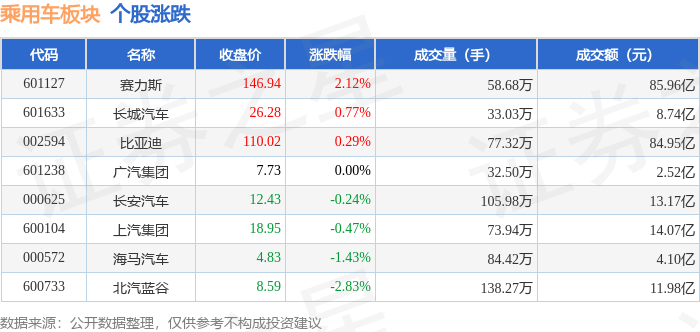
Market Overview - The passenger car sector increased by 0.36% on September 2, with Sailyis leading the gains [1] - The Shanghai Composite Index closed at 3858.13, down 0.45%, while the Shenzhen Component Index closed at 12553.84, down 2.14% [1] Individual Stock Performance - Sailyis (601127) closed at 146.94, up 2.12% with a trading volume of 586,800 shares and a transaction value of 859.6 million [1] - Great Wall Motors (601633) closed at 26.28, up 0.77% with a trading volume of 330,300 shares and a transaction value of 874 million [1] - BYD (002594) closed at 110.02, up 0.29% with a trading volume of 773,200 shares and a transaction value of 849.5 million [1] - GAC Group (601238) remained unchanged at 7.73 with a trading volume of 325,000 shares and a transaction value of 252 million [1] - Changan Automobile (000625) closed at 12.43, down 0.24% with a trading volume of 1,059,800 shares and a transaction value of 1.317 billion [1] - SAIC Motor (600104) closed at 18.95, down 0.47% with a trading volume of 739,400 shares and a transaction value of 1.407 billion [1] - Haima Automobile (000572) closed at 4.83, down 1.43% with a trading volume of 844,200 shares and a transaction value of 410 million [1] - BAIC Blue Valley (600733) closed at 6.59, down 2.83% with a trading volume of 1,382,700 shares and a transaction value of 1.198 billion [1] Fund Flow Analysis - The passenger car sector experienced a net outflow of 2.956 million from institutional investors and a net outflow of 232 million from speculative funds, while retail investors saw a net inflow of 235 million [1] - Sailyis had a net inflow of 49.7 million from institutional investors, while speculative funds saw a net outflow of 24.7 million [2] - BYD had a net inflow of 31.958 million from institutional investors, with a net outflow of 10.5 million from speculative funds and a net inflow of 73.159 million from retail investors [2] - Great Wall Motors had a net outflow of 83.706 million from institutional investors, with a net inflow of 30.448 million from speculative funds and a net inflow of 53.257 million from retail investors [2] - Changan Automobile had a net outflow of 130 million from institutional investors, with a net inflow of 12.374 million from speculative funds and a net inflow of 117 million from retail investors [2] - BAIC Blue Valley had a net outflow of 190 million from institutional investors, with a net inflow of 33.740 million from speculative funds and a net inflow of 15.67 million from retail investors [2]



汽车整车板块震荡走低,江铃汽车、北汽蓝谷跌超2%
Mei Ri Jing Ji Xin Wen· 2025-09-02 02:37
Group 1 - The automotive sector experienced a downward trend on September 2, with notable declines in stocks such as Jiangling Motors and BAIC Blue Valley, both dropping over 2% [1] - Other companies that followed the downward trend include Qianli Technology, Ankai Bus, Zhongtong Bus, and CIMC Vehicles [1]


北汽蓝谷(600733):发布“三年跃升计划” “规模效应+高端化”共振
Xin Lang Cai Jing· 2025-09-02 02:30
Core Viewpoint - The company has launched a "Three-Year Leap Plan" aimed at enhancing profitability, with significant revenue growth and margin improvement expected by Q1 2025 [1] Group 1: Three-Year Leap Plan - The plan focuses on increasing sales through a dual strategy of "Extreme Fox + Enjoy World," leveraging scale effects and high-end positioning [1] - Structural optimization is targeted to enhance the Enjoy World brand and increase overseas sales [1] - Cost reduction measures include strict control of management and marketing expenses, as well as increasing the proportion of self-manufactured components [1] - The company aims to enrich its profit ecosystem by collaborating with Pony.ai to develop Robotaxi, with plans to deploy a fleet of around 1,000 units [1] - Initial results of the reforms show a revenue increase of 151% year-on-year and a gross margin improvement of 4.1 percentage points in Q1 2025 [1] Group 2: Sales and Marketing Strategy - The Extreme Fox brand has seen a significant sales increase in 2024 due to comprehensive brand adjustments, including product positioning and marketing strategies [2] - Product adjustments include lowering prices for initial models and enhancing configurations, focusing on specific user needs in targeted scenarios [2] - The brand image has been strengthened through a focus on "technology + safety," and new media marketing has become a primary order source, accounting for 25% of orders by December 2024 [2] - The company has doubled its dealership network, particularly penetrating lower-tier markets to improve brand exposure [2] Group 3: Future Product Outlook - The company plans to launch new models such as the αT5/αS5 range-extended vehicles and MPVs, anticipating further sales growth [3] - The Enjoy World brand, empowered by the Huawei Smart Selection model, is entering the high-end vehicle market, with the S9 range-extended version showing improved sales performance [3] - The S9 range-extended version boasts a comprehensive range of 1,355 km and advanced features in smart driving and smart cabin technology, positioning it competitively against traditional luxury brands [3] - Future releases, including SUVs, are expected to provide additional growth opportunities for the Enjoy World brand [3]
汽车早报|多家车企公布8月销量数据 阿维塔明年将推出百万级大六座旗舰产品
Xin Lang Cai Jing· 2025-09-02 00:38
Group 1: Hubei and Geely Cooperation - Hubei Provincial Secretary Wang Zhonglin met with Geely Holding Group Chairman Li Shufu to discuss cooperation in the automotive industry [1] - A cooperation agreement was signed for a new vehicle project, aimed at deepening collaboration and mutual benefits [1] - Geely plans to accelerate the introduction of new models at its Wuhan factory and expand cooperation in various sectors including new energy vessels and automotive events [1] Group 2: BYD Sales Performance - BYD reported August sales of 373,600 new energy vehicles, slightly up from 373,100 units in the same month last year [2] - Cumulative sales from January to August reached 2.864 million units, representing a year-on-year growth of 23% [2] Group 3: SAIC Motor Corporation - SAIC Motor announced August vehicle production of 376,900 units, a year-on-year increase of 44.05% [4] - August sales reached 363,400 units, up 41.04% year-on-year, with new energy vehicle production at 140,500 units, growing 60.08% [4] Group 4: China FAW Group - China FAW reported August sales of 277,800 vehicles, a 3.7% increase year-on-year [5] - Cumulative sales for the first eight months surpassed 2.0813 million units, reflecting a 5.5% growth [5] Group 5: Geely Automobile - Geely Automobile announced August sales of 250,167 vehicles, marking a year-on-year growth of approximately 38% [6] Group 6: Changan Automobile - Changan Automobile reported August sales of 233,000 vehicles, with new energy vehicle sales reaching 88,000 units, up 80% year-on-year [7] Group 7: BAIC Group - BAIC Group's August vehicle sales exceeded 135,000 units, a 3.3% increase year-on-year [8] - Cumulative sales for the first eight months surpassed 1.07 million units, reflecting a 5.3% growth [8] Group 8: Great Wall Motors - Great Wall Motors reported August sales of 115,558 vehicles, a year-on-year increase of 22.33% [8] Group 9: FAW Toyota - FAW Toyota announced August sales of 70,125 vehicles, with cumulative sales for the first eight months reaching 515,980 units, up 11% year-on-year [9] Group 10: Changan Automobile New Models - Changan plans to launch several new intelligent vehicle models in the second half of the year, including the Changan Q07 and A06 [10] Group 11: Li Auto's Goals - Li Auto's CEO expressed a target to stabilize monthly sales of its electric models at 18,000 to 20,000 units by the end of the year [11] Group 12: CATL's Share Sale - CATL agreed to sell its 20.6% stake in Valmet Automotive to the Finnish government and Pontos, with the government set to inject approximately €35 million into the company [12][13] Group 13: South Korean Automakers - South Korea's top five automakers reported a 1.2% year-on-year increase in global sales for August, totaling 626,721 units [14] Group 14: French Automotive Market - France's new car registrations in August increased by 2.2% year-on-year, reaching 87,850 units [15]


贵州茅台,控股股东增持
Zhong Guo Zheng Quan Bao· 2025-09-01 23:29
Group 1: Company News - China Shipbuilding announced that the A-shares of China Heavy Industry will be delisted on September 5, 2023, due to voluntary termination of listing, and will not enter the delisting transition period [4] - Guizhou Moutai's controlling shareholder increased its stake by 67,821 shares on September 1, 2023, representing 0.0054% of the total share capital, with an investment amount of 100 million yuan [4] - BYD reported August sales of 373,600 new energy vehicles, slightly up from 373,100 units in the same month last year [3] - SAIC Motor's August vehicle sales reached 363,400 units, a year-on-year increase of 41.04% [3] - Great Wall Motors sold 115,600 vehicles in August, marking a year-on-year growth of 22.33% [3] - China FAW sold 277,800 vehicles in August, up 3.7% year-on-year [4] - Beijing Electric Vehicle Co., a subsidiary of BAIC Blue Valley, reported sales of 13,500 vehicles in August, a year-on-year increase of 3.47% [4] - Industrial Fulian announced a share buyback of 7.6974 million shares, accounting for 0.04% of the total share capital, with a total expenditure of 147 million yuan [4] - Su Dawei plans to acquire up to 51% of Changzhou Weipu Semiconductor Equipment Co., with an estimated total valuation of the target company not exceeding 1 billion yuan [5] - Tianqi Co. signed a strategic cooperation framework agreement with EVE Energy to build a closed-loop system for lithium battery lifecycle management [5] - Yonghui Supermarket adjusted its fundraising plan for 2025, reducing the total amount from 3.992 billion yuan to 3.114 billion yuan [5] Group 2: Industry News - The Shanghai Futures Exchange will expand the trading scope for qualified foreign institutional investors starting September 10, 2023, adding several commodity futures and options contracts [1] - The China Banking Association reported that by the end of 2024, there will be 67 financial leasing companies with total assets and leasing assets reaching 4.58 trillion yuan and 4.38 trillion yuan, respectively, reflecting year-on-year growth of 9.65% and 10.24% [1][2] - The biopharmaceutical market in China has become the second largest globally, with approximately 30% of the world's innovative drugs under research [2]

【公告精选】七连板天普股份称股价已严重偏离基本面,二连板德新科技称公司不直接生产固态电池
Sou Hu Cai Jing· 2025-09-01 19:51
Key Points - The stock price of Tianpu Co. has significantly deviated from its fundamentals after seven consecutive trading days of gains [1] - Dexin Technology clarified that it does not directly produce solid-state batteries after two consecutive trading days of gains [1] - Guizhou Moutai's controlling shareholder increased their stake by 67,821 shares, spending 100 million yuan [3] - Chint Electric has terminated the plan to spin off its subsidiary Chint Aneng for listing on the Shanghai Stock Exchange [4] - Chengdu Huamei launched a 40G high-precision RF direct sampling ADC chip [5] - ST Gaohong faces the risk of being delisted due to its stock price falling below par value [6] - Zhongtai Automobile's subsidiary assets are under compulsory execution, and the company is unable to resume operations this year [7] - The EU has initiated an anti-dumping investigation into Chinese pea protein [8] - Sierte is under investigation for suspected information disclosure violations by the China Securities Regulatory Commission [9] - Shenkai Co. disclosed the results of the tender offer from Shenzhen Huili and will resume trading on September 2 [10] Mergers and Acquisitions - Sudavige plans to acquire up to 51% of Changzhou Weipu Semiconductor Equipment Co., Ltd. [11] - Keli Sensor intends to purchase minority stakes in its subsidiary Huahong Technology for 121.5 million yuan [12] Operating Data - BYD's new energy vehicle sales in August reached 373,600 units, slightly up from 373,100 units in the same month last year [13] - SAIC Motor's vehicle sales in August were 363,400 units, a year-on-year increase of 41.04% [14] - Great Wall Motors sold 115,600 vehicles in August, marking a year-on-year growth of 22.33% [15] - BAIC Blue Valley's subsidiary sold 13,530 vehicles in August, up 3.47% year-on-year [16] - Hanma Technology's truck sales in August reached 1,051 units, a significant increase of 58.05% year-on-year [17] Shareholding Changes - Kesi Technology's key technical personnel Liang Hongjian plans to reduce their stake by up to 3% [18] - Longqi Technology's Suzhou Shunwei intends to reduce its stake by up to 4.09% [19] - Shengtai Group's Itochu Asia plans to reduce its stake by up to 3% [20] - Fangyuan Co.'s WISCO Yuanding intends to reduce its stake by up to 3% [21] - Dekeli's shareholder Qian Mingying and their concerted parties plan to reduce their stake by up to 3% [22] Contract Awards - Samsung Medical's wholly-owned subsidiary signed an overseas operating contract worth 5.88 million USD [24] - Yibin Technology received a project designation from a domestic new energy vehicle company, with an expected total sales of approximately 243 million yuan [24] - Teruid has pre-qualified for two projects with a total value of about 698 million yuan [24] - Xianghe Industrial recently signed a daily operating contract worth 400 million yuan [24] - Far East Holdings' subsidiary signed contracts worth over 1.689 billion yuan in August [24] Other Developments - Gujia Home intends to invest 1.124 billion yuan to build a self-owned base project in Indonesia [24] - Dongtu Technology is investing to establish a controlling subsidiary in the semiconductor sector [24] - Kangli Elevator has terminated the sale of its wholly-owned subsidiary Guangdong Kangli [24]


比亚迪37万台!吉利、上汽突破10万台!零跑/小鹏/蔚来再创新高!超20家品牌月销破万!丨8月新能源销量公布
电动车公社· 2025-09-01 16:05
Group 1 - In August, the competition in the automotive market intensified, with brands experiencing significant sales growth, indicating a critical period leading into the peak sales months of September and October [1] - BYD's passenger car sales reached 371,501 units in August, with a year-to-date total of 2.32 million units, showcasing a strong market position that is difficult for competitors to surpass [5] - Geely's total sales in August were 250,167 units, with 147,347 units being new energy vehicles, indicating a solid performance from its Galaxy brand [6][10] Group 2 - SAIC Group sold 363,371 units in August, with 129,771 units being new energy vehicles, reflecting a year-on-year growth of 208.6% for its passenger car segment [11][14] - Changan Automobile's sales exceeded 233,000 units in August, with over 88,000 units being new energy vehicles, marking an 80% year-on-year increase [19][31] - Leap Motor achieved a delivery of 57,066 units in August, indicating a strong upward trend in sales driven by new models and overseas market expansion [32] Group 3 - NIO delivered 31,305 units in August, marking a historical high, with the new ES8 and the L90 model contributing significantly to this growth [49][55] - Xiaomi's delivery volume exceeded 30,000 units in August, with the YU7 model performing exceptionally well, although challenges remain in scaling production [56] - Ideal Auto delivered 28,529 units in August, with ambitious targets set for its upcoming electric models, indicating confidence in future sales performance [62] Group 4 - GAC Aion's sales reached 27,044 units in August, supported by significant investments in charging infrastructure, positioning the brand for future growth [64] - BAIC New Energy sold 13,530 units in August, with the Arcfox brand achieving over 10,000 units, indicating a successful product strategy [68] - Lantu Auto delivered 13,505 units in August, maintaining a stable sales base with expectations for further growth due to new model launches [70]


每天三分钟 公告很轻松|贵州茅台:控股股东9月1日增持6.78万股公司股份;比亚迪等车企披露8月销售数据
Shang Hai Zheng Quan Bao· 2025-09-01 16:00
Group 1: Guizhou Moutai and Shareholder Actions - Guizhou Moutai's controlling shareholder, Moutai Group, increased its stake by 67,821 shares on September 1, 2025, representing 0.0054% of the total share capital, with a planned investment of no less than 30 billion yuan and no more than 33 billion yuan over six months [2] Group 2: BYD and Automotive Sales Data - BYD reported August 2025 sales of 373,626 new energy vehicles, a slight increase from 373,083 units in the same month last year, with a cumulative sales figure of 2,863,876 units for the year, reflecting a 23% year-on-year growth [3] - BAIC BluePark's subsidiary sold 13,530 units in August, up 3.47% year-on-year, with a cumulative total of 90,962 units for the year, marking a 74.7% increase [3] - SAIC Motor's August vehicle sales reached 363,371 units, a 41.04% increase year-on-year, with a cumulative total of 2,753,493 units for the year, up 17.87% [3] Group 3: Regulatory Actions and Company Listings - Sierte has been placed under investigation by the China Securities Regulatory Commission for suspected violations of information disclosure laws [4] - China Shipbuilding Industry Corporation announced that China Shipbuilding Heavy Industry's A-shares will be delisted on September 5, 2025, due to voluntary termination of listing [6] - ST Gaohong's stock closed at 0.98 yuan per share on September 1, 2025, falling below 1 yuan, which poses a risk of delisting [6] Group 4: Corporate Investments and Projects - Dongtu Technology has established a joint venture, Beijing Dongtu Semiconductor Technology Co., Ltd., with a registered capital of 10 million yuan, in which it holds a 70% stake [7] - Tianqi Co. signed a strategic cooperation framework agreement with Yiwei Lithium Energy to create a closed-loop system for lithium battery manufacturing and recycling [8] - Guangdong Construction's subsidiary has completed a 90MW solar-storage integrated project in Tibet, contributing to a total installed capacity of 4,662.89MW across various clean energy projects [9] - Gujia Home intends to invest approximately 112.37 million yuan in building a manufacturing base in Indonesia to enhance production efficiency and market competitiveness [10]


