
CATEC(600879)

Search documents
国防ETF(512670)红盘向上,太空旅游有望2028首飞
Xin Lang Cai Jing· 2026-01-23 02:08
Group 1 - The commercial space tourism sector is gaining momentum, with Beijing ChuanYueZhe Manned Space Technology Co., Ltd. showcasing its first commercial manned spacecraft, "ChuanYueZhe No. 1 (CYZ1)" [1] - The technical team of "ChuanYueZhe No. 1 (CYZ1)" announced that over three spacecraft seats have been booked, totaling more than 20 space tourists, with the first manned flight expected in 2028 [1] - Guojin Securities recommends focusing on listed companies related to state-owned platforms and high-value segments closely cooperating with leading private launch companies, such as 3D printing, storage tanks, servos, shell segments, fairings, and materials [1] Group 2 - The China Defense ETF closely tracks the China Defense Index, which includes listed companies under the top ten military industrial groups and those providing weaponry or equipment to the armed forces [2] - As of December 31, 2025, the top ten weighted stocks in the China Defense Index (399973) include Aerospace Electronics, Aero Engine Corporation, AVIC Shenyang Aircraft, AVIC Optoelectronics, and others, accounting for 42.34% of the total index weight [2]


一则大消息!掀起一个涨停潮
格隆汇APP· 2026-01-22 12:04
Core Viewpoint - The article discusses the resurgence of the commercial aerospace sector in China, highlighting significant developments and investment opportunities driven by government policies and technological advancements [12][42]. Group 1: Market Dynamics - The recent rebound in the A-share market reflects a broader recovery in the technology sector, particularly in the commercial aerospace segment, with over 20 stocks hitting the daily limit up [3][14]. - The Aerospace ETF (159227) has shown a remarkable performance, increasing by 53.64% since its launch in May last year, and has been included in the top ten core ETFs for global investment in China by 2026 [4][14]. Group 2: Industry Developments - Five key commercial aerospace companies, including Xinghe Power and Blue Arrow Aerospace, are progressing towards IPOs, aiming to raise funds for ambitious projects [9][11]. - China's commercial aerospace industry is projected to reach a scale of 2.5 to 2.8 trillion yuan by 2025, with an annual growth rate exceeding 20% and over 600 companies expected to operate in this sector [13][22]. Group 3: Technological Advancements - Significant advancements in technology are being made, such as the construction of the first offshore liquid rocket launch and recovery platform in Yantai, and successful tests of manned spacecraft landing systems [13][21]. - The development of reusable rocket technology is identified as a critical factor for reducing launch costs and enhancing capacity, with expectations for multiple successful test flights in 2026 [43][44]. Group 4: Investment Opportunities - The commercial aerospace sector is viewed as a major investment opportunity, with the potential for substantial returns as the industry matures and expands [36][42]. - The Aerospace ETF (159227) is highlighted as a strategic investment tool, focusing on high-purity military applications and leading commercial aerospace content, with a market size of 2.975 billion yuan and an average daily trading volume of 843 million yuan [41][39].




3.56亿主力资金净流入 太赫兹概念涨3.01%
Zheng Quan Shi Bao Wang· 2026-01-22 09:23
Core Viewpoint - The terahertz concept sector has shown a positive performance with a 3.01% increase, ranking fifth among concept sectors, driven by significant gains in stocks like Tianyin Electromechanical, Leike Defense, and Aerospace Electronics [1][2]. Group 1: Sector Performance - The terahertz concept sector recorded a 3.01% increase, with 19 stocks rising, including Tianyin Electromechanical (up 12.92%), Leike Defense (up 9.13%), and Aerospace Electronics (up 6.20%) [1][2]. - The sector experienced a net inflow of 356 million yuan, with 13 stocks receiving net inflows, and 7 stocks attracting over 50 million yuan each [2]. Group 2: Key Stocks - Tianyin Electromechanical led the net inflow with 252 million yuan, followed by Saiwei Electronics (207 million yuan), Taihao Technology (117 million yuan), and Leike Defense (91.61 million yuan) [2][3]. - The top stocks by net inflow ratio included Taihao Technology (14.76%), Hitec High-New (7.84%), and Phoenix Optical (7.80%) [3][4]. Group 3: Stock Performance - The top performers in the terahertz concept included Tianyin Electromechanical (up 12.92%, turnover rate 22.28%), Saiwei Electronics (up 2.74%, turnover rate 11.46%), and Taihao Technology (up 5.60%, turnover rate 9.12%) [3][4]. - Conversely, stocks like Changfei Fiber and Hengtong Optic-Electric saw declines of 3.54% and 3.50%, respectively [1][4].




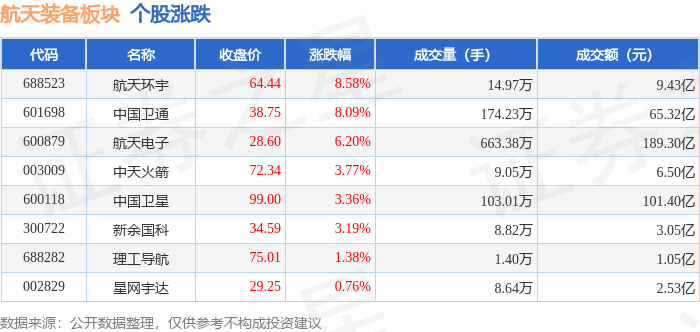
航天装备板块1月22日涨5.87%,航天环宇领涨,主力资金净流入4.31亿元
Zheng Xing Xing Ye Ri Bao· 2026-01-22 09:01
Core Viewpoint - The aerospace equipment sector experienced a significant increase of 5.87% on January 22, with Aerospace Hanyu leading the gains [1] Group 1: Market Performance - The Shanghai Composite Index closed at 4122.58, up 0.14%, while the Shenzhen Component Index closed at 14327.05, up 0.5% [1] - Key stocks in the aerospace equipment sector showed notable price increases, with Aerospace Hanyu rising by 8.58% to a closing price of 64.44 [1] Group 2: Stock Performance Details - Aerospace Hanyu (688523) had a trading volume of 149,700 shares and a transaction value of 943 million [1] - China Satellite (600118) closed at 99.00, up 3.36%, with a trading volume of 1,030,100 shares and a transaction value of 101.40 million [1] - Aerospace Electronics (600879) saw a 6.20% increase, closing at 28.60, with a trading volume of 6,633,800 shares and a transaction value of 189.30 million [1] Group 3: Fund Flow Analysis - The aerospace equipment sector saw a net inflow of 431 million from institutional investors, while retail investors experienced a net outflow of 645 million [1] - China Satellite (601698) had a net inflow of 321 million from institutional investors, but a net outflow of 417 million from retail investors [2] - Aerospace Hanyu (688523) recorded a net inflow of 99.16 million from institutional investors, with retail investors showing a net outflow of 82.14 million [2]





沪深两市今日成交额合计2.69万亿元,中际旭创成交额居首
Xin Lang Cai Jing· 2026-01-22 07:11
Summary of Key Points Core Viewpoint - The total trading volume of the Shanghai and Shenzhen stock markets reached 2.69 trillion yuan on January 22, reflecting an increase of approximately 910.31 billion yuan compared to the previous trading day [1] Trading Volume Details - The trading volume in the Shanghai market was 1.2 trillion yuan, while the Shenzhen market accounted for 1.49 trillion yuan [1] - The top traded stock was Zhongji Xuchuang, with a trading volume of 24.275 billion yuan [1] - Other notable stocks included Lanke Technology, Aerospace Electronics, Xinyisheng, and Tongfu Microelectronics, with trading volumes of 19.457 billion yuan, 18.93 billion yuan, 17.614 billion yuan, and 16.247 billion yuan respectively [1]


商业航天板块强势回归,航空航天ETF(159227)涨幅3.83%,规模稳居同类第一
Mei Ri Jing Ji Xin Wen· 2026-01-22 06:11
Group 1 - The A-share market saw a positive performance in the afternoon, with the aerospace sector showing strong gains, particularly the Aerospace ETF (159227), which rose by 3.83% and achieved a trading volume of 5.33 billion yuan, making it the largest in its category [1] - Key stocks in the aerospace sector, such as Triangle Defense, Beimo High-Tech, and Aero Engine Corporation, reached their daily limit, while Steel Research High-Tech increased by over 12% [1] - The Aerospace ETF has reached a total scale of 29.75 billion yuan, making it the largest in its category [1] Group 2 - Recent updates from three commercial aerospace companies, including Xinghe Power, Xingji Glory, and Tianbing Technology, regarding their listing guidance, along with the acceptance of Blue Arrow Aerospace's IPO application and the completion of guidance filing by China Aerospace, indicate that five core enterprises focused on launch vehicles are preparing to compete for the title of "first commercial aerospace stock" [1] - According to Ping An Securities, the aerospace sector is recognized as an important new productive force in the country, benefiting from government support, technological advancements, and supply chain development, leading to an acceleration in space launch tasks [1] - The continuous decrease in rocket launch costs and the maturation of recovery technologies are expected to further expedite the rocket launch process [1] Group 3 - The Aerospace ETF (159227) closely tracks the National Aerospace Index, covering leading companies across the entire industry chain, including fighter jets, aircraft engines, rockets, missiles, satellites, and radars, aligning perfectly with the strategic direction of "integrated air and space" [2] - The ETF includes emerging fields such as large aircraft, commercial aerospace, and low-altitude economy, with a high commercial aerospace content of 70.19% [2]




卫星ETF鹏华(563790)涨超3.3%,商业航天利好不断
Xin Lang Cai Jing· 2026-01-22 05:48
Group 1 - The core viewpoint of the news highlights the positive developments in the commercial aerospace sector, with multiple companies making progress towards IPOs and significant advancements in rocket launch capabilities [1] - Five key enterprises focused on launch vehicles are now actively pursuing the title of "first commercial aerospace stock," indicating a competitive landscape in the industry [1] - The investment opportunities in commercial aerospace can be categorized into three main tracks: the first focuses on launch and manufacturing, the second on core components and systems, and the third on downstream applications and operational services [1] Group 2 - As of January 22, 2026, the China Satellite Industry Index (931594) has seen a strong increase of 3.92%, with notable gains in constituent stocks such as XW Communication (up 10.64%) and China Satcom (up 7.89%) [2] - The Satellite ETF Penghua (563790) closely tracks the China Satellite Industry Index, which includes 50 companies involved in satellite manufacturing, launching, communication, navigation, and remote sensing [2] - By December 31, 2025, the top ten weighted stocks in the China Satellite Industry Index accounted for 63.64% of the index, indicating a concentration of investment in key players like China Satellite and Aerospace Electronics [2]




商业航天,又爆发!
中国基金报· 2026-01-22 04:34
Market Overview - On January 22, the A-share market opened high but closed lower, with the Shanghai Composite Index down 0.15%, Shenzhen Component down 0.17%, and ChiNext down 0.4% [2] - A total of 3,265 stocks rose, 60 stocks hit the daily limit, and 2,044 stocks fell, with a trading volume of 1.77 trillion yuan, an increase of 142.6 billion yuan compared to the previous trading day [3] Sector Performance - The oil and gas, aerospace military, superhard materials, coal, and photovoltaic sectors saw significant gains, while the precious metals and semiconductor equipment sectors experienced notable declines [3] - The superhard materials sector showed a strong upward trend, with stocks like Yujing Co. and Boyun New Materials hitting the daily limit [14] - The precious metals sector faced a downturn, with significant declines in stocks such as Western Gold and Xiaocheng Technology, which fell over 5% [18][20] Commercial Aerospace Sector - The commercial aerospace sector continued to recover, with stocks like Jili Rigging and Boyun New Materials seeing substantial gains [6] - Recent updates from companies like Xinghe Power and Blue Arrow Aerospace regarding their IPO progress have contributed to the positive sentiment in this sector [8] Oil and Gas Sector - The oil sector experienced a rapid increase, with major companies like PetroChina and Sinopec showing notable gains [10] - As of January 22, the Brent crude oil price was reported at $64.92 per barrel, up 5.85% from the beginning of the month [11] Superhard Materials Sector - The superhard materials sector is benefiting from advancements in artificial intelligence and related technologies, with expectations of significant growth in the industry [16] - The sector is projected to see a rise in demand, particularly for products related to artificial intelligence and robotics [14] Precious Metals Sector - The precious metals sector is undergoing a correction after previous gains, with gold prices fluctuating due to geopolitical factors and market sentiment [20] - The current price of gold has seen a decline, with spot gold trading around $4,787.966 per ounce, reflecting a nearly 1% drop [20]





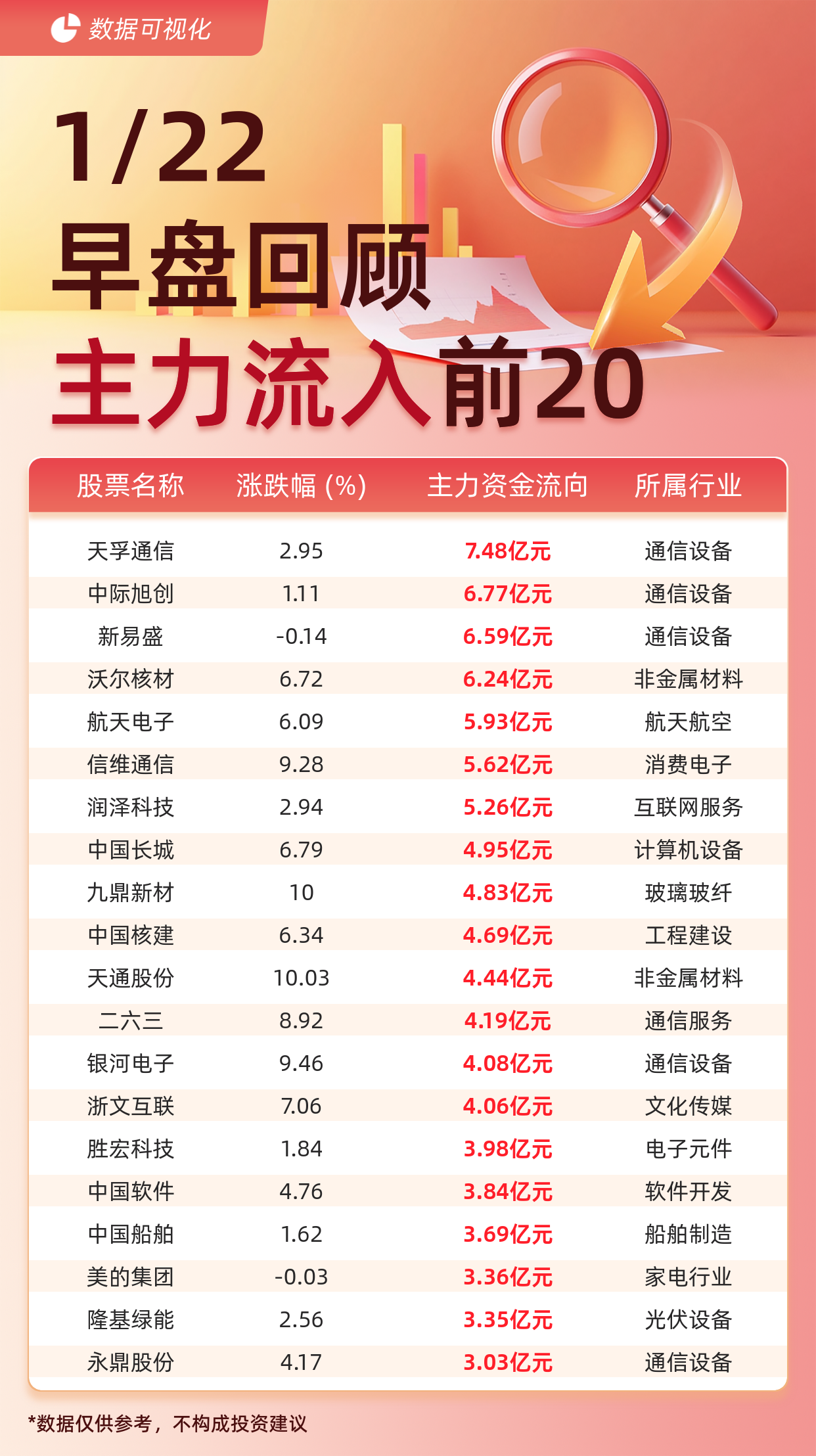
主力资金流入前20:天孚通信流入7.48亿元、中际旭创流入6.77亿元
Jin Rong Jie· 2026-01-22 03:45
Group 1 - The top 20 stocks with significant capital inflow include Tianfu Communication (748 million), Zhongji Xuchuang (677 million), and Xinyi Sheng (659 million) [1] - The sectors represented among the top inflow stocks include communication equipment, non-metal materials, aerospace, and software development [2][3] - Notable stock performances include Tianfu Communication with a 2.95% increase, Zhongji Xuchuang with a 1.11% increase, and Walden Materials with a 6.72% increase [2][3] Group 2 - The highest capital inflow was observed in Tianfu Communication with 748 million, followed by Zhongji Xuchuang with 677 million and Xinyi Sheng with 659 million [1] - Other significant stocks with capital inflow include Aerospace Electronics (593 million), Xinwei Communication (562 million), and Runze Technology (526 million) [1][2] - The stock with the highest percentage increase is Tiantong Co., Ltd. with a 10.03% rise, followed by Jiu Ding New Materials with a 10% increase [3]


44股受融资客青睐,净买入超亿元
Zheng Quan Shi Bao Wang· 2026-01-22 03:06
| 代码 | 简称 | 1月21日涨跌幅 | 融资净买入额 | 最新融资余额 | 占流通市值比例 | 所属行 | | --- | --- | --- | --- | --- | --- | --- | | | | (%) | (万元) | (万元) | (%) | 业 | | 600879 | 航天电 | 2.36 | 83020.85 | 403444.77 | 4.54 | 国防军 | | | 子 | | | | | 工 | | 300502 | 新易盛 | 3.20 | 55533.83 | 2016279.47 | 5.77 | 通信 | | 300750 | 宁德时 | 0.06 | 49559.04 | 2385295.63 | 1.60 | 电力设 | | | 代 | | | | | 备 | | 601899 | 紫金矿 | 2.20 | 46325.37 | 1035691.61 | 1.32 | 有色金 | | | 业 | | | | | 属 | | 600519 | 贵州茅 | -1.64 | 42446.00 | 1923375.54 | 1.14 | 食品饮 | | | 台 | | | ...


