YILI(600887)

Search documents
扩内需:食品饮料行业投资机会
2025-12-24 12:57
Summary of Key Points from the Conference Call Industry Overview - The food and beverage industry is experiencing systemic opportunities driven by policies aimed at expanding domestic demand and increasing residents' income levels, which are expected to enhance consumption capabilities [1][2] - The liquor industry is undergoing a deep adjustment, with expectations of entering an EPS killing phase by 2025, while high-end liquor brands like Moutai and Lao Jiao are recommended for investment [1][4] - The dairy industry has completed supply-demand adjustments, with anticipated increases in demand for milk powder and liquid milk due to fertility and income policies, highlighting companies like Yili and New Dairy as potential recovery opportunities [1][5] - The snack food sector is benefiting from the "lipstick effect," new channels, and health trends, with recommendations for companies such as Salted Fish, Wei Long, Wan Chen Food, and Qiaqia Food [1][6] - The beverage sector is seeing a clear trend towards health, with non-traditional channels gaining market share, making high-growth companies like Dongpeng Beverage noteworthy [1][7] Key Insights and Arguments - The central economic work conference in 2026 will prioritize expanding domestic demand, which is expected to lead to a series of policies stimulating consumption, positively impacting the food and beverage industry [2] - The food and beverage sector has faced significant changes in volume, price, and channel structure over the past six years, with varying performances across sub-sectors [3] - The liquor sector is expected to see marginal improvements in 2026, driven by policies aimed at boosting business and government consumption [4] - The dairy sector is projected to enter a recovery phase, with increased demand anticipated due to supportive policies [5] - The snack food market is expected to gradually recover, supported by rising incomes and new retail channels [6] Additional Important Content - Cost fluctuations are a significant factor affecting the performance of consumer goods companies, with some agricultural product costs declining, providing investment opportunities [9] - The planting area for sunflower seeds is expected to recover, leading to a projected 10% decrease in the cost of sunflower seeds, which will positively impact Qiaqia Food's gross margin [10][11] - The konjac market is facing supply-demand imbalances, with high prices expected to ease in 2026, alleviating cost pressures for companies like Wei Long and Salted Fish [12] - The sugar molasses market is currently at low prices, providing strong support for Angel Yeast's profitability [13] - Innovative companies are leveraging product and channel innovations to drive growth, with notable examples including Nongfu Spring and Uni-President [14] - Efficient supply chain management is crucial for companies, with Dongpeng Beverage demonstrating strong performance in this area [15] Future Outlook - Dongpeng Beverage is expected to achieve double-digit growth in 2026 through strategic measures and product innovations [16] - Wan Chen is enhancing store quality and accelerating store openings, which is expected to improve profitability in the snack food sector [17][18] - Hai Tian Flavoring has implemented efficiency improvements under new management, resulting in revenue and profit growth exceeding industry averages [19] - The restaurant industry is expected to see a mild recovery, with companies like Yihai International and Tianhe Flavoring showing potential for improvement [20][21] - In the liquor sector, companies like Yanghe and Budweiser are expected to benefit from product and channel improvements, leading to potential breakthroughs in performance [22][23][25] - Gan Yuan Food is focusing on expanding e-commerce and high-end membership stores, with a stable development outlook [26][27] - Overall, companies in the food and beverage sector are expected to experience gradual recovery and growth, making them worthy of investor attention [28]





食品饮料2026年投资策略报告:曙光渐显,在分化中前行-20251224
Hua Yuan Zheng Quan· 2025-12-24 12:13
Group 1: Core Insights - The report emphasizes the recovery stage of consumer spending, highlighting that different sectors exhibit both commonalities and differences in their recovery rhythms, driven by supply-demand dynamics and industry structure [4][5] - ROA (Return on Assets) is identified as a leading indicator for the operational recovery of consumer companies, with a focus on analyzing various sub-sectors [4][13] Group 2: Sector Performance - The current recovery sequence indicates that soft drinks and snacks are leading, followed by the catering supply chain, condiments, dairy products, beer, and finally, liquor [5][25] - The report draws parallels with Japan's 1990s consumption differentiation, noting that sectors addressing consumer pain points and with low penetration rates are likely to succeed [5][6] Group 3: Investment Strategy - The report suggests focusing on sectors where ROA is stabilizing, indicating potential valuation recovery opportunities, particularly in traditional sectors like liquor, beer, and dairy [6][8] - It recommends identifying sub-sectors with either price or volume growth, with a preference for price-driven strategies [6][8] Group 4: Detailed Sector Analysis - The frozen food sector is showing signs of marginal improvement, with leading companies enhancing operational efficiency through product innovation and channel reforms [27][28] - The snack sector is experiencing high demand, driven by new channel developments, although competition is intensifying [33][35] - The beer industry is under pressure, with a focus on high-end products, but overall growth is slowing due to external economic factors [39][41] - The dairy sector is nearing the end of its adjustment phase, with expectations of improved performance as raw milk prices rise [41][42] - The liquor sector is currently in a phase of inventory reduction, with performance risks gradually clearing as channels stabilize [43][48]


乳业概念下跌0.85%,主力资金净流出22股
Zheng Quan Shi Bao Wang· 2025-12-24 09:45
Group 1 - The dairy sector experienced a decline of 0.85% as of the market close on December 24, ranking among the top losers in concept sectors [1] - Major stocks within the dairy sector that saw significant declines include Zhuangyuan Pasture, which hit the daily limit down, and others like Huanlejia, Miaokelan, and Fucheng Shares, which also faced notable drops [1] - Conversely, stocks that gained in the market included Yiyatong, Huangshi Group, and Yiming Foods, with increases of 3.41%, 2.70%, and 2.12% respectively [1] Group 2 - The dairy sector saw a net outflow of 141 million yuan in capital today, with 22 stocks experiencing net outflows, and 10 stocks seeing outflows exceeding 10 million yuan [1] - The stock with the highest net outflow was Miaokelan, with a net outflow of 50.84 million yuan, followed by Sanyuan Shares, Panda Dairy, and Western Pastoral, with net outflows of 29.91 million yuan, 20.07 million yuan, and 18.61 million yuan respectively [1] - Stocks with the highest net inflows included Yiyatong, Huangshi Group, and Jinjian Rice Industry, with net inflows of 46.43 million yuan, 21.71 million yuan, and 10.66 million yuan respectively [1]





国盛证券:反补贴初裁落地 有望推动乳制品深加工业务向国内转移
智通财经网· 2025-12-24 08:07
Core Viewpoint - The Ministry of Commerce has announced a preliminary ruling on anti-subsidy investigations against EU dairy imports, implementing temporary anti-subsidy deposit measures starting December 23, 2025, which could accelerate domestic dairy product processing and promote local alternatives [1][2]. Group 1: Anti-subsidy Measures - The Ministry of Commerce decided to impose temporary anti-subsidy tax deposits on EU dairy products, with rates ranging from 21.9% to 42.7%, generally close to 30% [1]. - The investigation found that EU dairy products have received subsidies that harm the domestic dairy industry [1]. Group 2: Impact on Domestic Market - The anti-subsidy tax is expected to increase import prices, thereby accelerating the shift towards domestic dairy product processing [2]. - The current domestic milk prices are lower than international prices, which may further enhance the competitiveness of local products [2]. Group 3: Demand and Supply Dynamics - The deep processing of dairy products is anticipated to increase the consumption of raw milk, improving the supply-demand balance in the upstream raw milk industry [3]. - Domestic milk prices have stabilized since August, driven by supply adjustments from social pastures and increased demand from expanding consumption scenarios such as milk tea [3]. Group 4: Investment Opportunities - Companies benefiting from the deep processing business include Miaokelando (600882.SH), Yili (600887.SH), Mengniu Dairy (02319), and Lihigh Food (300973.SZ) [4]. - Upstream livestock companies that may benefit include Youran Dairy (09858), Modern Dairy (01117), and China Shengmu (01432) [4].


华创证券:我国对欧盟乳业反补贴 利好深加工品类国产替代加速与原奶周期改善
智通财经网· 2025-12-24 06:25
Core Viewpoint - The Ministry of Commerce has announced a countervailing policy against EU imported dairy products, specifically targeting cheese and high-fat cream, which are core categories in deep processing of dairy products. This policy is set to enhance the price advantage of domestic manufacturers and is expected to have a rapid market impact [1][2][3]. Summary by Sections Policy Announcement - The Ministry of Commerce has issued a preliminary ruling on countervailing investigations against EU dairy imports, confirming that these products are subsidized and have caused substantial harm to the domestic industry. Starting December 23, 2025, temporary countervailing measures will be implemented, requiring importers to provide a deposit of 21.9% to 42.7% based on the value of the goods [2]. Characteristics of the Policy - The ruling specifically targets cheese and high-fat cream, which are heavily reliant on imports, with over 50% of high-fat cream being imported. The measures impose a significant cost increase on EU products, with an average subsidy rate close to 30%. The policy takes effect immediately, demonstrating the government's commitment to market stability [3]. Market Impact - The countervailing policy is expected to accelerate domestic substitution in the deep processing sector, potentially freeing up a market space of 20 billion for cream and 14 billion for cheese. Historically, China's dairy processing industry has been heavily reliant on imports due to high raw milk costs and immature technology, with domestic products only accounting for 14%-18% of the market in 2023. The policy is anticipated to enhance the price advantage of domestic manufacturers, particularly benefiting those in high-fat cream production [4]. Investment Opportunities - The report suggests three categories of investment opportunities: - Domestic substitution beneficiaries: Recommended stocks include Lihigh Foods (300973.SZ) and Miaokelando (600882.SH), with Lihigh being the largest domestic cream producer and poised to benefit from price increases in imported brands [5]. - Dairy price reversal benefiting upstream farms: Companies like Youran Dairy (09858) and Modern Dairy (01117) are highlighted, as they are expected to show resilience and potential profit recovery with the reversal of raw milk prices [5]. - Strengthening competitiveness of leading dairy companies: Recommendations include Yili (600887.SH) and Mengniu Dairy (02319), which are expected to benefit from stabilized milk prices and accelerated deep processing business, enhancing their long-term growth potential [5].
伊利股份在内蒙古成立多家投资公司
Zheng Quan Shi Bao Wang· 2025-12-24 02:52
Group 1 - Inner Mongolia Taiwei Investment Co., Ltd. has been established with a registered capital of 174 million yuan, and its legal representative is Uyun Dalai [1] - The business scope of Inner Mongolia Taiwei includes enterprise management, enterprise management consulting, and investment activities using its own funds [1] - Inner Mongolia Taiwei is wholly owned by Yili Co., Ltd. (stock code: 600887) [1] Group 2 - Yili Co., Ltd. has also invested in the establishment of Inner Mongolia Yuchao Investment Co., Ltd., Inner Mongolia Longzhuo Investment Co., Ltd., and Inner Mongolia Yonghao Investment Co., Ltd. [1]
食品饮料行业重大事项点评:对欧盟乳业反补贴,利好国产替代加速
Huachuang Securities· 2025-12-24 02:05
Investment Rating - The report maintains a "Recommendation" rating for the food and beverage industry, expecting the industry index to outperform the benchmark index by over 5% in the next 3-6 months [24]. Core Insights - The Ministry of Commerce has announced a countervailing policy against EU dairy imports, which is expected to accelerate domestic product substitution and stabilize raw milk prices. The policy will impose temporary countervailing measures on EU dairy products starting December 23, 2025, with subsidy rates ranging from 21.9% to 42.7% [2][8]. - The policy targets high-fat dairy products, particularly cheese and cream, which have a high dependency on imports. This is expected to significantly increase the cost of EU products, thereby enhancing the price advantage for domestic manufacturers [8]. - The domestic dairy processing industry has historically relied on imports due to high raw milk costs and immature technology. The report estimates that the domestic production of similar products accounted for only 14%-18% in 2023, indicating a substantial market opportunity for local producers [8]. Summary by Sections Industry Overview - The food and beverage industry comprises 126 listed companies with a total market capitalization of 46,266.30 billion and a circulating market value of 45,144.74 billion [5]. Market Performance - The absolute performance of the industry over the past month is -2.1%, with a 6-month performance of 2.7% and a 12-month performance of -4.9%. Relative performance shows a decline of -5.9% over one month, -17.1% over six months, and -22.4% over twelve months [6]. Policy Impact - The countervailing measures are expected to create a market space of approximately 20 billion for cream and 14 billion for cheese, accelerating domestic substitution. The report highlights that the production capacity of deep processing projects is expected to consume over 400 million tons of raw milk, potentially leading to a reversal in the raw milk cycle by the second half of 2026 [8]. Investment Opportunities - The report identifies three main investment opportunities: - Domestic substitutes that will directly benefit from the policy, with a focus on companies like Lihigh and Miaoke, which are positioned to capture high-end market segments [8]. - Dairy farms such as Youran and Modern Dairy, which are expected to benefit from a reversal in raw milk prices [8]. - Leading dairy companies like Yili and Mengniu, which are anticipated to strengthen their competitive edge through accelerated deep processing business and improved operational stability [8].
斗不过中国,欧盟全球宣告!马克龙闯下大祸,最大赢家已浮出水面
Sou Hu Cai Jing· 2025-12-23 18:40
Core Viewpoint - The Chinese Ministry of Commerce has imposed temporary anti-subsidy tariffs of up to 42.7% on EU dairy products, significantly impacting French companies and altering the global trade landscape [1][3][5]. Group 1: Tariff Details - The temporary anti-subsidy tariffs are categorized into three tiers: 21.9% to 42.7% for sampled companies cooperating with the investigation, a uniform rate of 28.6% for other cooperating EU companies, and a maximum rate of 42.7% for non-cooperating companies [1][3]. - The affected dairy products include fresh cheese, processed cheese, blue cheese, and cream, excluding infant formula [3][5]. - The new tariffs increase the effective tax rates on EU cheese exports to China by over 20 percentage points, with some products exceeding a total tax rate of 50% [3][5]. Group 2: Background and Investigation - The trade dispute began with a complaint from the China Dairy Industry Association in August 2024, leading to an investigation into EU subsidies affecting Chinese dairy companies [5][10]. - The investigation revealed that EU subsidies under the Common Agricultural Policy have significantly harmed Chinese dairy producers, with EU dairy exports to China reaching €1.7 billion in 2023, accounting for over 30% of China's total dairy imports [5][10]. Group 3: Impact on Companies - French dairy companies, particularly those producing high-end products like Roquefort and Camembert, are expected to face severe impacts, with prices for French cheese in China projected to rise by 30% to 50% [8][12]. - New Zealand is positioned to benefit significantly from this trade dispute, as it currently supplies 60% of China's cheese imports, and the new tariffs will likely allow New Zealand to capture the market share left by EU products [12][14]. - Domestic dairy companies in China, such as Yili and Mengniu, are expected to accelerate their production capabilities in response to the tariff changes, with Yili planning to expand its cheese production lines [12][14].


全景呈现中国乳业背后的全球产业链 《超级牛奶》讲述一杯奶的品质马拉松
Zheng Quan Ri Bao Wang· 2025-12-23 08:48
Core Insights - The documentary "Super Milk," co-produced by Yili Group and NetEase News, showcases the entire milk industry chain, emphasizing quality and the integration of global resources in China's dairy industry [1][5] Group 1: Industry Overview - "Super Milk" presents a systematic view of the milk production journey, from sourcing to packaging, highlighting the collaborative efforts in building a quality system within the global supply chain [1][4] - The documentary features Yili's global sourcing strategies and pasture management practices, including the transformation of previously degraded land into high-quality alfalfa fields in Inner Mongolia [2][5] Group 2: Global Collaboration - Yili has established a diversified global milk source system, collaborating with over 400 farms in New Zealand and engaging in long-term partnerships in countries like the Netherlands to enhance the stability and quality of raw milk supply [2][3] - The documentary illustrates Yili's commitment to global resource integration, showcasing the sourcing of ingredients like probiotics from Denmark and chocolate from Belgium, which supports product upgrades based on consumer needs [2][3] Group 3: Research and Innovation - Research and innovation are highlighted as key drivers for industry advancement, with Yili collaborating with prestigious universities on projects related to breast milk research and cheese localization [3] - Yili operates 15 global innovation centers, focusing on expanding dairy applications across different demographics and scenarios, thus promoting high-value and high-tech dairy products [3] Group 4: Quality Management - The documentary emphasizes Yili's comprehensive quality management system, which includes smart inspection systems and international sensory evaluation frameworks, ensuring quality across the entire production chain [3][4] - Yili's quality assurance mechanisms are implemented globally, establishing unified standards and collaborative quality management across various countries [3][4] Group 5: Manufacturing and Sustainability - Yili's manufacturing capabilities are showcased, including advanced production lines that achieve high efficiency and sustainability, with 81 production bases established worldwide [3][4] - The documentary outlines Yili's commitment to sustainable packaging, aiming for over 99.5% recyclability and a reduction in plastic usage through innovative materials and technologies [4] Group 6: Industry Recognition - The global screening of "Super Milk" during the 2025 World Dairy Summit received positive feedback from international figures, indicating global recognition of China's dairy development path [5] - The documentary serves as a practical example for the industry, illustrating Yili's focus on quality and global collaboration to enhance the competitiveness of China's dairy sector [5]
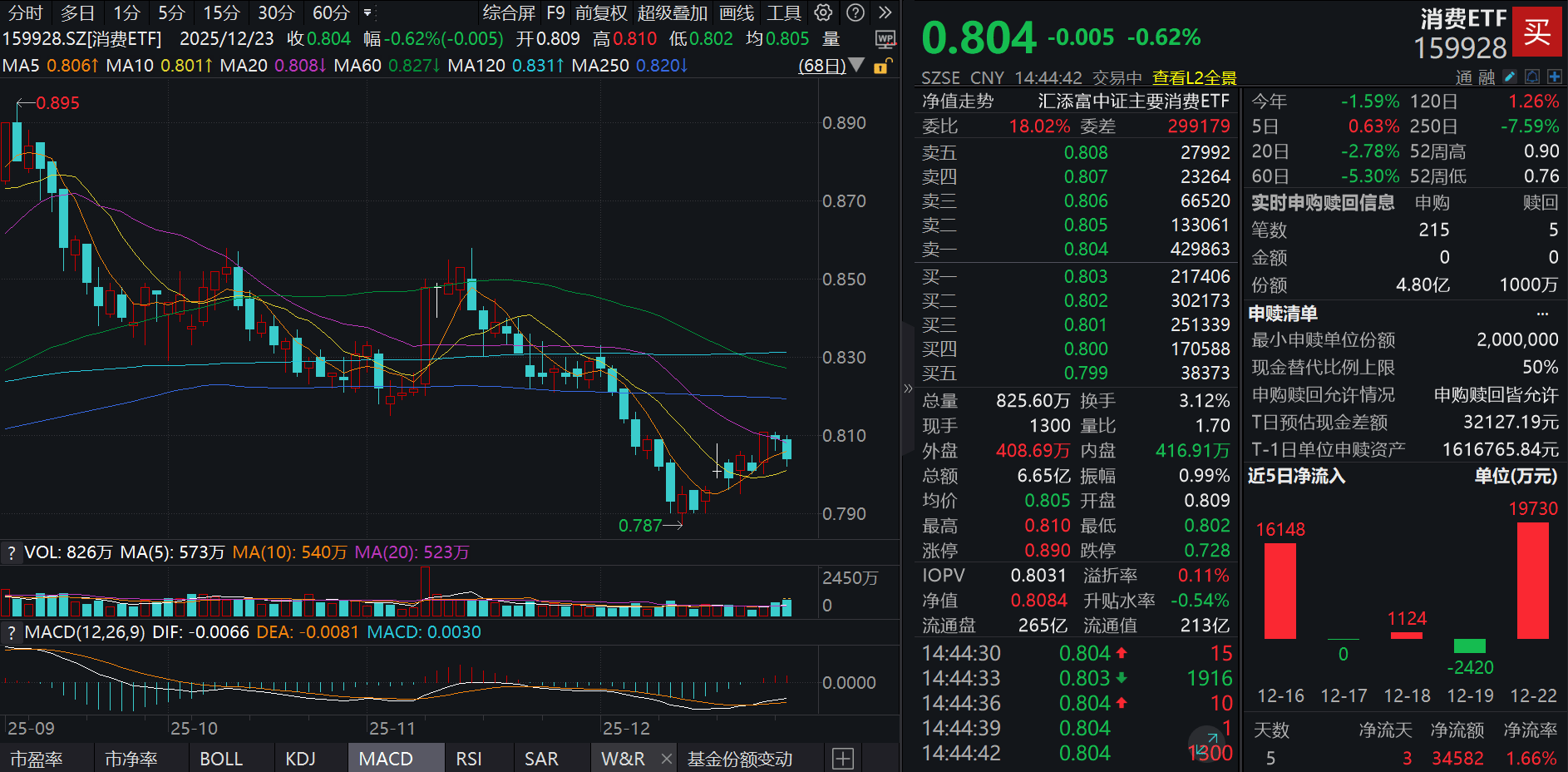
欧盟乳品反补贴落地,国产替代有望加速!消费ETF(159928)回调再获近5亿份净申购,昨日吸金近2亿元!
Sou Hu Cai Jing· 2025-12-23 07:06
Group 1: Market Performance - A-shares experienced fluctuations and a decline, with the Consumer ETF (159928) dropping by 0.74% and a trading volume exceeding 650 million yuan [1] - The Consumer ETF (159928) has seen a net subscription of over 470 million units during the day, accumulating over 600 million yuan in the last 20 days [1] - As of December 22, the latest scale of the Consumer ETF (159928) exceeded 21.3 billion yuan, leading its peers [1] Group 2: EU Dairy Products Subsidy - The EU has announced a preliminary ruling on dairy products, determining that subsidies exist with a countervailing duty rate ranging from 21.9% to 42.7% [3][7] - Starting December 23, temporary countervailing measures will be implemented on imported dairy products from the EU [3] - The additional countervailing duty is expected to increase import prices, potentially accelerating domestic substitution in the dairy sector [8] Group 3: Domestic Dairy Industry Impact - The countervailing duties are projected to shift the deep processing of dairy products to domestic enterprises, as domestic milk prices are currently lower than international prices [8] - The deep processing sector is anticipated to enhance demand for raw milk, improving the supply-demand balance in the upstream raw milk industry [8] - Domestic dairy companies are actively focusing on deep processing, which is expected to drive demand growth and stabilize the industry [8] Group 4: Consumer Sector Insights - The Consumer ETF (159928) is characterized by its resilience across economic cycles, with the top ten constituent stocks accounting for over 68.55% of its weight [13] - The ETF includes major players such as Yili (10.37%), Kweichow Moutai (9.94%), and Wuliangye (9.50%) [14] - The current valuation of the Consumer ETF (159928) is attractive, with a TTM P/E ratio of 19.4, placing it in the lower 3.13% of the past decade [5] Group 5: Future Consumption Trends - The service consumption sector is expected to grow significantly as China's GDP per capita exceeds $10,000, indicating a shift in consumer spending patterns [11] - Emerging consumer groups, particularly the Z generation and affluent elderly, are likely to drive demand for service-oriented consumption [12] - Investment opportunities in the service sector are anticipated, particularly in areas such as event economy and AI applications [12]