
Bank Of Jiangsu(600919)

Search documents
江苏银行(600919) - 江苏银行优先股股息派发实施公告
2025-11-18 09:45
证券代码:600919 证券简称:江苏银行 公告编号:2025-042 优先股代码:360026 优先股简称:苏银优 1 江苏银行股份有限公司 优先股股息派发实施公告 本公司董事会及全体董事保证本公告内容不存在任何虚假记载、 误导性陈述或者重大遗漏,并对其内容的真实性、准确性和完整性承 担个别及连带责任。 重要内容提示 ●优先股代码:360026 ●优先股简称:苏银优1 ●每股优先股派发现金股息人民币3.86元(含税) ●最后交易日:2025年11月26日(星期三) 2、发放金额:根据《江苏银行股份有限公司非公开发行优先股 募集说明书》,本次优先股股息发放的计息起始日为2024年11月28 日,按照苏银优1票面股息率3.86%计算,每股优先股派发现金股息人 民币3.86元(含税),以苏银优1发行量2亿股为基数,合计派发现金 股息人民币7.72亿元(含税)。 3、扣税情况:根据国家税法相关规定,属于《中华人民共和国 企业所得税法》规定的居民企业股东(含机构投资者),其现金股息 所得税由其自行缴纳;其他股东现金股息所得税的缴纳,根据相关规 定执行。若派息前相关税法规定变动,以最新规定为准。 二、优先股股息发放时间 ...

申万宏源:险资密集增配银行已验证趋势 期待2026年行业基本面新变化
Zhi Tong Cai Jing· 2025-11-18 08:25
Core Viewpoint - The report from Shenwan Hongyuan indicates a significant trend of long-term capital, represented by insurance funds, increasingly allocating to the banking sector, with a potential inflow space of approximately 600 billion yuan if 40% of new funds are allocated to bank stocks [1][2]. Group 1: Capital Inflow and Allocation - The unprecedented low interest rate environment is driving incremental capital towards dividend sectors, with the banking sector offering superior value. The current banking index dividend yield is about 4.3%, significantly higher than the ten-year government bond yield, making it an attractive investment option [1]. - Assuming that 40% of the new capital is allocated to OCI and 40% to bank stocks, this could lead to a potential inflow of around 600 billion yuan. Additionally, public fund reforms are expected to increase capital allocation to underrepresented sectors, with bank stock holdings in public funds dropping to a near ten-year low of 1.74% in Q3 2025, suggesting an additional potential inflow of over 370 billion yuan if allocations align with the CSI 300 [2]. Group 2: Expected Changes in Banking Fundamentals - The central bank has explicitly stated its support for stabilizing net interest margins, linking this to the expansion of monetary policy's counter-cyclical adjustment space. It is anticipated that by 2026, bank interest margins may reverse their downward trend and show a slight year-on-year increase, with banks that can improve deposit costs expected to perform better than their peers [3]. - The importance of "high provisioning" is becoming more pronounced as banks' provisioning capacity is gradually consumed. While systemic risks from real estate and platforms may ease, risks in retail sectors still require provisioning. Focus should be on banks with low non-performing loans and high loan-to-deposit ratios, as well as those with clear asset quality improvements [3]. - Some small and medium-sized banks may face revenue growth challenges due to high base pressures in their capital market operations, with reduced non-interest income growth and declining financial investment yields [3]. Group 3: Capital Focus and Investment Recommendations - Bank capital is becoming a focal point, with banks that have strong internal capital generation or substantial reserves being better positioned for stable lending and dividends. External financing remains challenging, making convertible bonds a scarce resource [4]. - The banking sector is entering a new cycle of stable profitability, with long-term capital inflows ongoing. If the macro environment sees a gradual recovery in PPI and marginal increases in long-term interest rates, this will create favorable operating conditions for banks. Even under economic pressure, banks with clear risk thresholds and stable dividend expectations remain attractive dividend assets [5]. - The report recommends focusing on a dual strategy of "leading banks (state-owned and China Merchants Bank) as the foundation" and "bottom-tier joint-stock banks and quality city commercial banks as the performers." Leading banks are expected to see valuation recovery, while quality small and medium-sized banks with improving fundamentals are likely to exhibit stock price elasticity in response to economic recovery [5].





行业深度报告:2025Q4上市银行AC潜在兑现及回补债券评估
KAIYUAN SECURITIES· 2025-11-18 05:10
Investment Rating - The industry investment rating is optimistic (maintained) [1] Core Insights - The report highlights that listed banks have sold approximately 2 trillion yuan in bonds to realize floating profits from their available-for-sale (AC) accounts in the first three quarters of 2025 [13] - It is estimated that in Q4 2025, listed banks will need to sell about 900 billion yuan in bonds to support non-interest income [10] - The cumulative floating profit of listed banks' AC accounts is approximately 3.3 trillion yuan as of the end of H1 2025, accounting for 58.3% of the total revenue for the year 2024 [30] Summary by Sections Investment Growth - Since 2024, the investment growth rate of listed banks' AC accounts has consistently lagged behind the growth rate of financial investments, with a year-on-year growth of 11.5% in Q3 2025, which is 4.28 percentage points lower than that of financial investments [13][15] - The growth rates for different types of banks from Q2 2023 to Q2 2025 are as follows: state-owned banks 14.7%, joint-stock banks 2.8%, city commercial banks 9.7%, and rural commercial banks -3.8% [13] Bond Selling and Profit Realization - The report estimates that the floating profit realization ratio for listed banks' AC accounts in the first three quarters of 2025 is about 3.06%, with a bond selling scale of approximately 2.04 trillion yuan [36] - The selling proportions for different bank types are: state-owned banks 2.26%, joint-stock banks 5.29%, city commercial banks 5.57%, and rural commercial banks 9.65%, with rural commercial banks showing the highest selling intensity [36] Financial Performance - The floating profit from the sale of bonds in the first three quarters of 2025 is estimated to be 1,078 billion yuan, which represents 2.50% of the total revenue, an increase of 1.59 percentage points compared to 2024 [22][25] - The breakdown of floating profit realization ratios by bank type is as follows: state-owned banks 2.24%, joint-stock banks 2.44%, city commercial banks 3.79%, and rural commercial banks 5.52% [22] Investment Recommendations - The report suggests a bottom-line allocation to large state-owned banks, with beneficiaries including Agricultural Bank of China and Industrial and Commercial Bank of China [6] - Core allocations should focus on leading comprehensive banks such as China Merchants Bank, CITIC Bank, and Industrial Bank [6] - Flexible allocations can be made to banks like Jiangsu Bank, Chongqing Bank, and Chongqing Rural Commercial Bank [6]



2026年银行业投资策略:盈利新周期,估值新起点,迎银行长牛
Shenwan Hongyuan Securities· 2025-11-18 04:45
Core Viewpoints - The banking sector is at the beginning of a long-term recovery cycle, with current valuations around 0.7 times PB, significantly improved from the low of 0.49 times PB in 2018 [3][9] - The low interest rate environment is a key driver for capital inflow into dividend-paying stocks, with the banking sector offering a dividend yield of approximately 4.3%, which is over 250 basis points higher than the 10-year government bond yield [12][14] - The expectation for 2026 includes a stabilization and potential slight increase in net interest margins, driven by central bank policies aimed at supporting banks [3][4] Investment Highlights - The banking sector is expected to benefit from a new cycle of stable profitability, with long-term capital inflows continuing to support the sector [3][30] - The focus should be on leading banks and quality regional banks, as they are likely to outperform in terms of valuation recovery and profitability [3][30] - The report emphasizes the importance of high provisioning and capital adequacy for banks to navigate through economic challenges [4][30] Market Dynamics - The banking sector has seen a shift in risk perception, with systemic risks significantly alleviated, allowing for a more favorable outlook on bank valuations [27][28] - The report highlights that banks have actively managed their asset quality, with significant write-offs contributing to improved financial stability [27] - The structural changes in credit allocation are expected to resolve existing issues, with a focus on sectors that contribute positively to economic growth [25][27] Future Expectations - The banking sector is anticipated to enter a new phase of stable return on equity (ROE), with steady profit growth already being validated [30] - The report suggests that the valuation of banks is likely to trend towards 1 times PB, reflecting a return to more normalized risk assessments [23][28] - The potential for increased capital inflows from institutional investors, particularly insurance funds, is expected to further support the banking sector's recovery [3][12]
30年,突破60万亿!
中国基金报· 2025-11-17 15:09
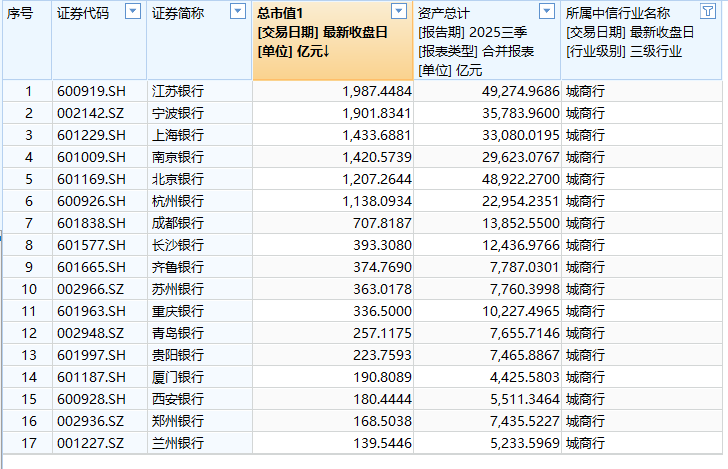
Core Viewpoint - The asset scale of urban commercial banks in China has surpassed 60 trillion yuan, marking significant growth over the past 30 years, with a 134-fold increase since 1995, and now accounting for 13.53% of the total assets of banking financial institutions [2][4]. Development of Urban Commercial Banks - Urban commercial banks have evolved into a crucial part of China's multi-tiered financial system since their establishment in 1995, with a focus on serving urban residents, small and medium-sized enterprises, and local economies [4]. - Key financial indicators for urban commercial banks show stable profitability, improved asset quality, a non-performing loan rate of 1.76%, a provision coverage ratio of 188.08%, and a capital adequacy ratio of 12.97% as of the end of 2024 [4]. Market Position and Performance - As of 2024, there are 12 urban commercial banks with asset scales exceeding 1 trillion yuan, and 5 of these banks are classified as systemically important banks in China [4]. - The market share of urban commercial banks has increased by 8.24 percentage points over the years, reflecting their growing significance in the banking sector [4]. Financial Resource Allocation - Urban commercial banks have strategically focused on high-quality development areas and sectors that align with their capabilities, continuously exploring differentiated and specialized development paths [5]. Market Capitalization of Listed Banks - Among the 17 urban commercial banks listed on the A-share market, Jiangsu Bank, Ningbo Bank, and Shanghai Bank have the highest market capitalizations, with Jiangsu Bank nearing 200 billion yuan and Ningbo Bank at 190.2 billion yuan [7][8].







30年,突破60万亿!
Zhong Guo Ji Jin Bao· 2025-11-17 14:02
Core Insights - The asset scale of urban commercial banks in China has surpassed 60 trillion yuan, reaching 60.15 trillion yuan by the end of 2024, marking a 134-fold increase since 1995 and accounting for 13.53% of the total assets of banking financial institutions [1][2] Development of Urban Commercial Banks - Urban commercial banks have evolved over 30 years, becoming a crucial part of China's multi-tiered financial system, with stable profitability and improving asset quality [2] - Key financial metrics include a non-performing loan ratio of 1.76%, a provision coverage ratio of 188.08%, and a capital adequacy ratio of 12.97% [2] - There are 12 urban commercial banks with assets exceeding 1 trillion yuan, and 5 of them are classified as systemically important banks [2] Market Position and Performance - Among the 17 urban commercial banks listed on the A-share market, Jiangsu Bank, Ningbo Bank, and Shanghai Bank have the highest market capitalizations, with Jiangsu Bank nearing 200 billion yuan [4][5] - Jiangsu Bank and Beijing Bank both have asset scales of approximately 4.9 trillion yuan, while Ningbo Bank and Shanghai Bank exceed 3 trillion yuan [4][5] Strategic Focus - Urban commercial banks have focused on serving urban and rural residents, small and medium-sized enterprises, and local economies, enhancing their service channels and offering diverse financial products [2][3] - They have aligned their financial resources with high-quality development strategies and key sectors, exploring differentiated and specialized development paths [3]
江苏银行拟不再设立监事会
Bei Jing Shang Bao· 2025-11-17 11:54
股东大会会议资料显示,根据《中华人民共和国公司法》等法律法规、监管规定和相关文件要求,江苏 银行将不再设立监事会,由董事会审计委员会行使《中华人民共和国公司法》和监管制度规定的监事会 职权;监事会下设的各专门委员会同步撤销;《江苏银行股份有限公司监事会议事规则》等监事会相关 公司治理文件相应废止;现任监事不再担任该行监事及监事会、监事会专门委员会相关职务;撤销监事 会办公室。上述调整自该行修改后的《江苏银行股份有限公司章程》获监管机构核准生效之日起生效, 此前监事会和监事会办公室继续存续,以保障相关工作顺利平稳过渡。本议案已经该行第六届董事会第 二十二次会议、第六届监事会第十四次会议审议通过,现提请股东大会审议批准,同时提请股东大会授 权董事会,并由董事会转授权高级管理层,全权办理与本议案相关的一切事宜,并在修改后的《江苏银 行股份有限公司章程》生效后,相应修改或废止公司相关制度。 北京商报讯(记者 孟凡霞 周义力)11月17日,江苏银行发布2025年第二次临时股东大会决议公告,会 议审议通过了《关于江苏银行股份有限公司不再设立监事会相关事项的议案》。 ...
江苏银行(600919) - 江苏银行关于召开2025年三季度业绩说明会的公告
2025-11-17 10:46
重要内容提示 投资者可于 2025 年 11 月 20 日 17:30 前将重点关注的问题通 过电子邮件的形式发送至指定邮箱:dshbgs@jsbchina.cn。公司将在 业绩说明会上对投资者普遍关注的问题进行回答。 证券代码:600919 证券简称:江苏银行 公告编号:2025-039 优先股代码:360026 优先股简称:苏银优 1 江苏银行股份有限公司 关于召开 2025 年三季度业绩说明会的公告 本公司董事会及全体董事保证本公告内容不存在任何虚假记载、 误导性陈述或者重大遗漏,并对其内容的真实性、准确性和完整性承 担个别及连带责任。 一、会议类型 江苏银行股份有限公司(以下简称"公司")于 2025 年 10 月 31 日披露《江苏银行股份有限公司 2025 年第三季度报告》。公司决 定召开 2025 年三季度业绩说明会,就经营发展情况进行沟通交流, 广泛听取投资者的意见和建议。 (一)召开时间:2025 年 11 月 25 日(星期二)上午 10:00-11:00 (二)召开形式:上证路演中心网络互动 (三)召开网址:上证路演中心(https://roadshow.sseinfo.com/) 三、 ...
江苏银行(600919) - 江苏世纪同仁律师事务所关于江苏银行股份有限公司2025年第二次临时股东大会的法律意见书
2025-11-17 10:45
江苏世纪同仁律师事务所关于 江苏银行股份有限公司 2025年第二次临时 股东大会的法律意见书 致:江苏银行股份有限公司 根据《公司法》等法律、行政法规和规范性文件以及公司《章程》的规定, 本所受公司董事会的委托,指派本所律师出席公司 2025年第二次临时股东大会, 并就本次股东大会的召集、召开程序、出席会议人员资格、表决程序以及表决结 果的合法有效性等事项出具法律意见。 为出具本法律意见书,本所律师对本次股东大会所涉及的有关事项进行了审 查,查阅了相关会议文件,并对有关问题进行了必要的核查和验证。 本所律师根据相关法律、行政法规和规范性文件的要求,按照律师行业公认 的业务标准、道德规范和勤勉尽责精神,出具法律意见如下; 一、关于本次股东大会的召集、召开程序 1. 本次股东大会由公司董事会召集。 公司已分别于 2025年 10月 31 日、2025年 11月 7 日在上海证券交易所网站 (http://www.sse.com.cn)和《中国证券报》《上海证券报》《证券时报》 上刊登了《江苏银行股份有限公司关于召开 2025年第二次临时股东大会的通知》 以及《江苏银行股份有限公司关于 2025 年第二次临时股东大 ...
江苏银行(600919) - 江苏银行2025年第二次临时股东大会决议公告
2025-11-17 10:45
(二) 股东大会召开的地点:南京市秦淮区中华路 26 号江苏银行 总部大厦 4 楼大会议室 证券代码:600919 证券简称:江苏银行 公告编号:2025-040 优先股代码:360026 优先股简称:苏银优 1 江苏银行股份有限公司 2025年第二次临时股东大会决议公告 本公司董事会及全体董事保证本公告内容不存在任何虚假记载、 误导性陈述或者重大遗漏,并对其内容的真实性、准确性和完整性承 担法律责任。 重要内容提示: 本次会议是否有否决议案:无 一、 会议召开和出席情况 (一) 股东大会召开的时间:2025 年 11 月 17 日 (三) 出席会议的普通股股东和恢复表决权的优先股股东及其持 有股份情况: | 1、出席会议的股东和代理人人数 | 1,346 | | --- | --- | | 2、出席会议的股东所持有表决权的股份总数(股) | 9,069,657,564 | | 3、出席会议的股东所持有表决权股份数占公司有 | | | 表决权股份总数的比例(%) | 49.4223 | (四) 出席会议的优先股股东(不包括恢复表决权的优先股)及其 所持股份情况: | | | | 2、出席会议的优先股股东所持有 ...