Bank Of Jiangsu(600919)

Search documents
江苏银行晋升城商行“一哥” 长三角四小龙携手迈向3万亿
2 1 Shi Ji Jing Ji Bao Dao· 2025-09-02 11:01
Core Viewpoint - The major city commercial banks in the Yangtze River Delta region have reported strong performance in the first half of the year, achieving growth in both revenue and net profit despite challenges such as narrowing interest margins and weakened credit demand [1][2]. Group 1: Financial Performance - Jiangsu Bank has the highest total assets among city commercial banks, reaching 4.79 trillion yuan, with a year-on-year growth of 26.99% [2][6]. - Ningbo Bank and Shanghai Bank also reported total assets exceeding 3 trillion yuan, with figures of 3.47 trillion yuan and 3.29 trillion yuan respectively [2]. - The net profit growth for Jiangsu Bank was 7.78%, while Ningbo Bank, Nanjing Bank, and Shanghai Bank reported growth rates of 7.91%, 8.64%, and 4.18% respectively [2][4]. Group 2: Asset Quality - The non-performing loan (NPL) ratios for these banks are below 1%, with Ningbo Bank having the lowest at 0.76%, followed by Jiangsu and Nanjing Banks at 0.84%, and Shanghai Bank at 1.18% [3][2]. Group 3: Loan Growth - Jiangsu Bank's loan and advance scale reached 2.37 trillion yuan, with a year-on-year growth of 18.79% [6][7]. - Ningbo Bank's loans and advances totaled 1.67 trillion yuan, with a growth of 13.36% [8]. - Nanjing Bank's total loans reached 1.39 trillion yuan, with a growth of 10.41% [6]. Group 4: Market Performance - The stock prices of these banks have shown an upward trend in the first half of the year, with Ningbo Bank experiencing the highest increase of 23.18% [5]. Group 5: Retail Business Challenges - Retail banking performance has lagged behind corporate banking, with Jiangsu Bank's retail loan growth at only 3.07% compared to 23.30% for corporate loans [11][12]. - Nanjing Bank's personal loan balance increased by 3.67%, while Shanghai Bank's personal loan balance decreased by 4.86% [13][12]. Group 6: Capital Adequacy Concerns - Concerns regarding capital adequacy have arisen due to rapid asset expansion, prompting banks to focus on optimizing asset structures and maintaining stable profit accumulation [9][10].






持仓最高达100多亿!券商自营重仓股出炉,上半年都买了哪些股票?
Di Yi Cai Jing· 2025-09-02 10:49
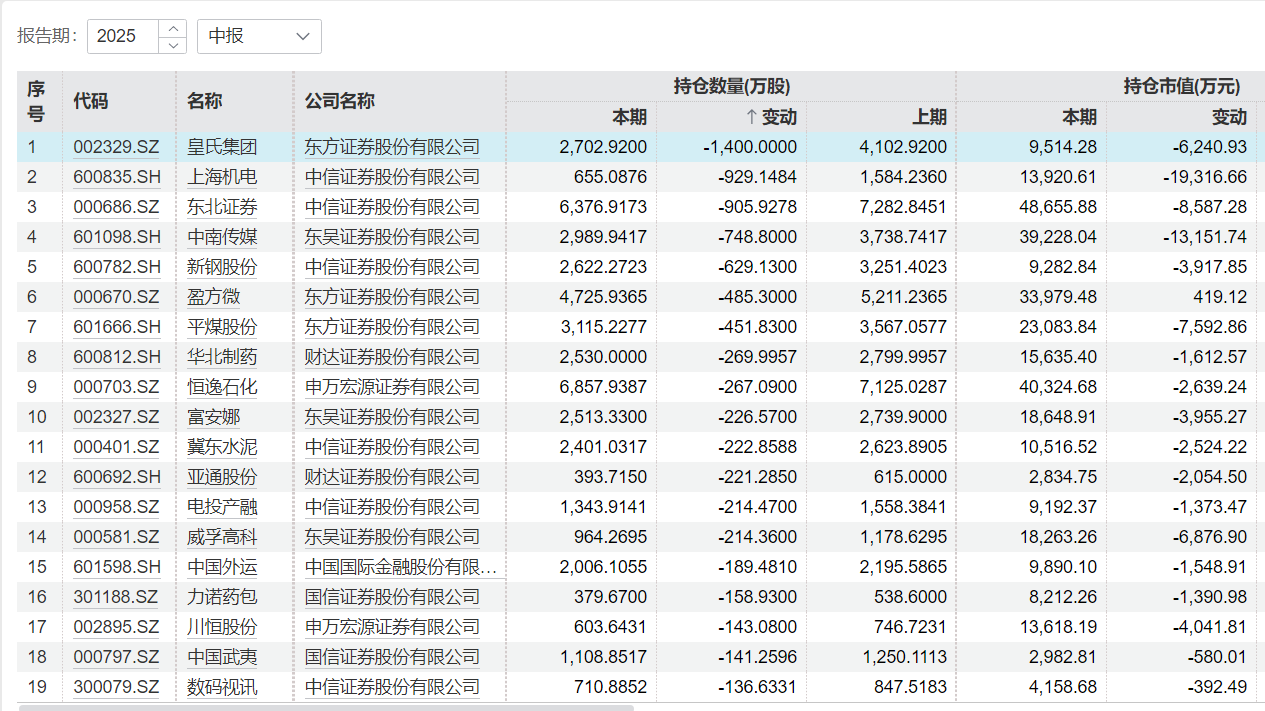
Core Viewpoint - The A-share market is experiencing active trading, leading to significant performance gains for brokerage firms, particularly in their proprietary trading segments [1][2]. Group 1: Brokerage Performance - In the first half of the year, 42 listed brokerages achieved a total operating income of 251.87 billion yuan and a net profit of 104.02 billion yuan, representing year-on-year growth of 11.37% and 65.08% respectively [2]. - The proprietary trading income for these brokerages reached 112.35 billion yuan, a year-on-year increase of 53.53%, accounting for over 40% of total income and becoming a major growth driver [2][3]. - Among the brokerages, CITIC Securities reported the highest proprietary trading income of 19.05 billion yuan, contributing approximately 57% to its total revenue [3]. Group 2: Top Holdings and Stock Preferences - As of the end of June, the largest holdings among brokerages included Jiangsu Bank, Yong'an Futures, and CITIC Construction Investment, with respective holdings of 923 million shares, 43.9 million shares, and 38.3 million shares [6]. - The preferred sectors for proprietary trading include non-bank financials, electronics, and biomedicine, with brokerages also investing in bonds and funds [2][4]. - Notably, some brokerages significantly increased their positions in stocks like Sichuan Chengyu and Hongchuang Holdings during the second quarter, with increases of 151.33% and substantial additions in share quantities [8][9]. Group 3: Changes in Holdings - In the second quarter, several brokerages reduced their holdings in stocks such as Huangshi Group and Shanghai Mechanical, with significant decreases in share quantities [10][11]. - The reduction in holdings was particularly pronounced for stocks facing regulatory scrutiny, such as Huangshi Group, which saw a 34% decrease in shares held by Dongfang Securities [12][13]. - Other stocks that experienced substantial reductions in brokerage holdings included Xin Steel and Yingfang Micro, with decreases exceeding 2 million shares [14].



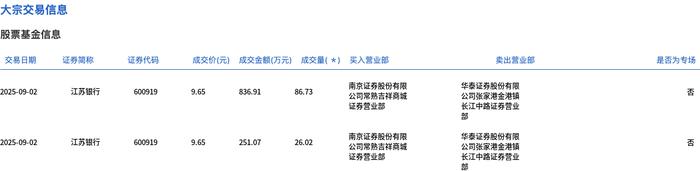
江苏银行今日大宗交易折价成交112.75万股,成交额1087.98万元
Xin Lang Cai Jing· 2025-09-02 09:44
Summary of Key Points Core Viewpoint - On September 2, Jiangsu Bank executed a block trade of 1,127,500 shares, amounting to 10.8798 million yuan, which represented 0.62% of the total trading volume for the day. The transaction price was 9.65 yuan, reflecting an 11.39% discount compared to the market closing price of 10.89 yuan [1]. Group 1 - Jiangsu Bank's block trade involved a total of 1,127,500 shares [1]. - The total transaction value for the block trade was 10.8798 million yuan [1]. - The transaction price of 9.65 yuan was 11.39% lower than the market closing price of 10.89 yuan [1]. Group 2 - The block trade was executed on September 2, 2025 [2]. - The trading volume for Jiangsu Bank was 1,127,500 shares, with a transaction amount of 8,368,910 yuan for one of the trades [2]. - The trade involved multiple brokerage firms, including Guojin Securities and Huatai Securities [2].
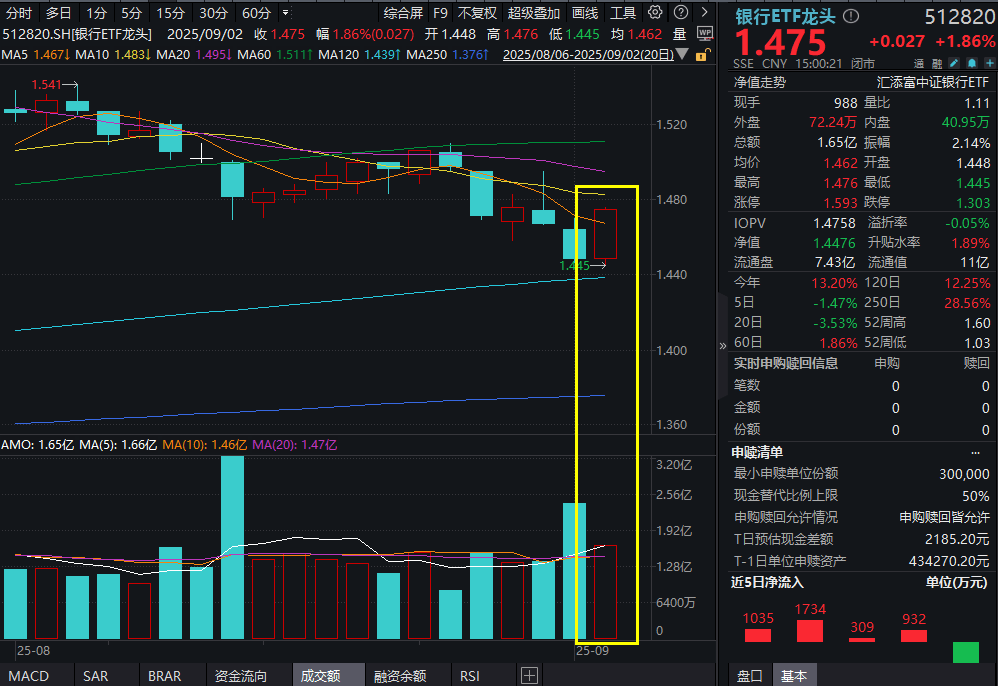
大盘回调,银行“扛鼎”逆市上扬!银行ETF龙头(512820)强势收涨1.86%!中报最全汇总,有何看点?银行高股息配置仍存
Sou Hu Cai Jing· 2025-09-02 09:16
Core Viewpoint - The banking sector shows resilience with a notable increase in the Bank ETF leader (512820) by 1.86%, indicating a rebound after two consecutive declines, while the tech sector experiences a pullback [1][3]. Banking Sector Performance - The Bank ETF leader (512820) saw nearly all constituent stocks rise, with notable gains from Chongqing Rural Commercial Bank (over 4%), Shanghai Rural Commercial Bank, and China Merchants Bank (over 3%), and several others exceeding 2% [3][4]. - The top ten constituent stocks of the Bank ETF leader include major banks like China Merchants Bank, Industrial and Commercial Bank of China, and Agricultural Bank of China, all showing positive performance [5][4]. Financial Results - As of August 29, 42 A-share banks reported their semi-annual results, with revenue, PPOP, and net profit attributable to shareholders increasing by 1.03%, 1.13%, and 0.77% year-on-year, respectively, showing an improvement compared to Q1 [7][10]. - 17 listed banks have announced interim dividends, reinforcing the high dividend yield logic within the banking sector [10]. Market Valuation - The banking sector's price-to-earnings (PE) ratio is approximately 7 times, significantly lower than the overall market PE of about 21 times, suggesting a favorable valuation for long-term returns [11]. - The banking sector is viewed as a stable investment option due to its low valuation and relatively high return on equity (ROE) compared to the market, making it attractive for long-term investors [11]. Future Outlook - The banking sector is expected to benefit from a stable expansion trend, with decreasing liability costs and a recovery in non-interest income, although asset quality remains a concern with rising overdue rates [10][11]. - The sector is anticipated to attract more long-term capital as market conditions evolve, particularly with the potential for increased passive index fund investments [11].




金工定期报告20250902:预期高股息组合跟踪
Soochow Securities· 2025-09-02 09:04
Quantitative Models and Construction Methods - **Model Name**: Expected High Dividend Portfolio **Model Construction Idea**: The model aims to construct a portfolio with high expected dividend yield by leveraging historical dividend data, fundamental indicators, and short-term factors like reversal and profitability[5][10][16] **Model Construction Process**: 1. **Dividend Yield Calculation**: - Phase 1: Calculate dividend yield based on annual report profit distribution announcements - Phase 2: Predict and calculate dividend yield using historical dividend data and fundamental indicators[5][10] 2. **Screening Process**: - Exclude suspended and limit-up stocks from the CSI 300 constituents[15] - Remove the top 20% of stocks with the highest short-term momentum (21-day cumulative return)[15] - Exclude stocks with declining profitability (quarterly net profit YoY growth < 0)[15] 3. **Final Selection**: - Rank the remaining stocks by expected dividend yield - Select the top 30 stocks with the highest expected dividend yield and construct an equally weighted portfolio[11] **Model Evaluation**: The model demonstrates strong historical performance with significant excess returns and controlled drawdowns, making it a robust strategy for high-dividend stock selection[13] Model Backtesting Results - **Expected High Dividend Portfolio**: - Cumulative Return: 358.90% - Cumulative Excess Return (vs CSI 300 Total Return Index): 107.44% - Annualized Excess Return: 8.87% - Maximum Rolling 1-Year Drawdown of Excess Return: 12.26% - Monthly Excess Win Rate: 60.19%[13] Quantitative Factors and Construction Methods - **Factor Name**: Expected Dividend Yield Factor **Factor Construction Idea**: Predict future dividend yield by combining historical dividend data, fundamental indicators, and short-term influencing factors[5][16] **Factor Construction Process**: 1. Calculate historical dividend yield based on profit distribution announcements[5][10] 2. Predict future dividend yield using fundamental indicators and historical dividend patterns[5][10] 3. Incorporate two short-term factors: - **Reversal Factor**: Accounts for short-term price reversals - **Profitability Factor**: Reflects the company's earnings performance[5][16] **Factor Evaluation**: The factor effectively identifies high-dividend stocks and serves as a reliable input for portfolio construction[16] - **Factor Name**: Red Dividend Timing Framework (Composite Signal) **Factor Construction Idea**: Combines multiple single-factor signals to assess the market's outlook on dividend stocks[25][28] **Factor Construction Process**: 1. Evaluate five single-factor signals: - **Inflation**: PPI YoY (High/Low) - **Liquidity**: M2 YoY (High/Low) - **M1-M2 Gap**: Scissors Difference (High/Low) - **Interest Rate**: US 10-Year Treasury Yield (High/Low) - **Market Sentiment**: Dividend Stock Turnover Ratio (Up/Down)[28] 2. Assign binary signals (1 for bullish, 0 for bearish) to each factor 3. Aggregate the signals into a composite indicator[28] **Factor Evaluation**: The framework provides a systematic approach to timing dividend stock investments, though the September 2025 signal suggests a cautious stance[25][28] Factor Backtesting Results - **Expected Dividend Yield Factor**: - August 2025 Portfolio Average Return: 5.69% - Excess Return (vs CSI 300 Index): -4.80% - Excess Return (vs CSI Dividend Index): +4.70%[5][16] - **Red Dividend Timing Framework (Composite Signal)**: - Latest Signal (September 2025): 0 (Neutral)[25][28]





城商行的二十年:展望“十五五”,谁是未来大赢家?
NORTHEAST SECURITIES· 2025-09-02 09:02
Investment Rating - The report rates the industry as "Outperforming the Market" [4] Core Insights - The report emphasizes that the evolution of local government financing behavior and regulatory adjustments over the past two decades have significantly influenced the financial sector. It predicts that the proportion of bank credit in local government debt will increase from 38% to 42% during the "14th Five-Year Plan" period, with an annual growth rate fluctuating between 10% and 17% [1][18][19] - City commercial banks (CCBs) have played a crucial role in supporting local government debt resolution, with their credit growth in government-related loans outpacing that of other banks. The report identifies a complementary relationship between CCBs' government-related loan growth and the issuance of urban investment bonds [1][2] - The report forecasts that CCBs will take on greater responsibilities in the future, driven by increasing state ownership, leadership changes reflecting regulatory attributes, and strong local government relationships. This will enhance local market competitiveness and provide growth opportunities for CCBs [2][18] Summary by Sections 1. Changes in Local Government Financing Structure - The report outlines the historical evolution of local government debt and financing needs, highlighting the significant role of regulatory and policy adjustments in shaping the financial sector [14][18] - It provides a detailed analysis of local government debt structure changes from 2008 to 2025, noting the shift from bank loans to urban investment bonds and shadow banking during various phases [19][24] 2. CCBs' Role in Debt Resolution - CCBs have shown proactive engagement in local government debt resolution, with their government-related loan growth significantly higher than that of other banks. The report indicates that CCBs have effectively supplied funds during periods of heightened repayment pressure [1][2][19] 3. Future Prospects for CCBs - The report identifies several CCBs, including Chongqing Bank, Xiamen Bank, and Shanghai Bank, as potential winners during the "14th Five-Year Plan" period, expecting them to achieve faster expansion and higher returns for investors [2][3] - It predicts that the overall valuation of CCBs will have substantial room for improvement, estimating a price-to-book (PB) ratio of 0.7x by the end of 2026 and 1.22x by the end of 2030 [2][3] 4. Investment Recommendations - The report recommends focusing on specific CCBs such as Chongqing Bank, Xiamen Bank, Shanghai Bank, Qilu Bank, and Chengdu Bank for potential investment opportunities [3][6]
城商行“一哥”易主,江苏银行超越北京银行成为榜首
第一财经· 2025-09-02 08:15
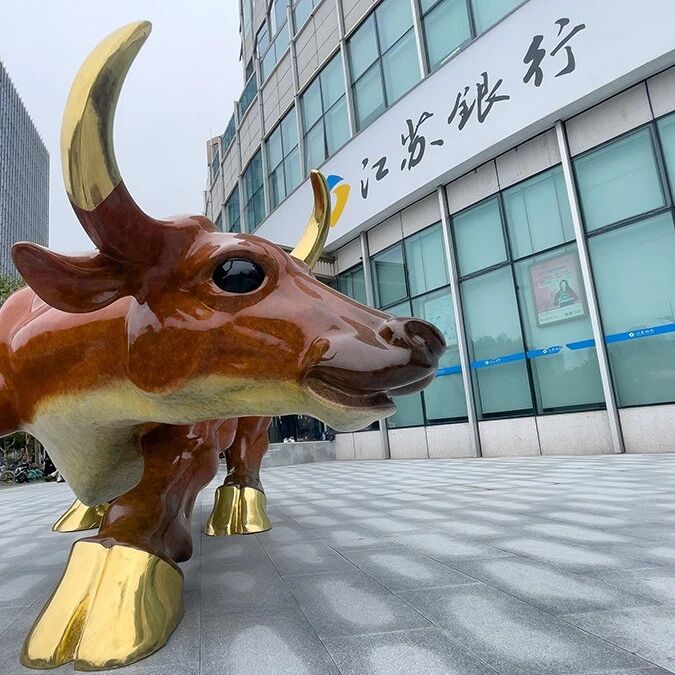
Core Viewpoint - The article highlights a significant shift in the ranking of city commercial banks in A-shares, with Jiangsu Bank surpassing Beijing Bank to become the largest by total assets, marking a new phase of competition focused on quality and stability after the scale competition [3][4]. Asset Scale Ranking Update - Jiangsu Bank's total assets reached 4.79 trillion yuan, a year-on-year increase of 26.99%, surpassing Beijing Bank's 4.75 trillion yuan [6]. - Beijing Bank had maintained its leading position since its listing in 2007, but Jiangsu Bank has rapidly closed the gap over the past three years, ultimately achieving a lead in 2025 [6][12]. Profitability Comparison - Jiangsu Bank has consistently outperformed Beijing Bank in profitability metrics since 2022, with a net profit of 202.38 billion yuan in the first half of 2025 compared to Beijing Bank's 150.53 billion yuan [7][9]. - Despite the growth in revenue, Jiangsu Bank faces challenges with its capital adequacy ratios, which are at 12.36% for total capital, 11.17% for tier 1 capital, and 8.49% for core tier 1 capital, placing it in the middle to lower range among listed banks [7][8]. Industry Segmentation - The 17 city commercial banks have formed a clear three-tier structure, with Jiangsu and Beijing Banks in the first tier, followed by Ningbo and Shanghai Banks in the second tier, and a mix of performance in the third tier [12][13]. - The third tier shows significant internal differentiation, with some banks like Chongqing Bank and Xi'an Bank performing well, while others like Guiyang Bank and Xiamen Bank are experiencing negative growth in revenue [12][13]. Challenges in Non-Interest Income - Many banks reported a significant decline in fair value changes, attributed to fluctuations in the bond market, which directly impact their non-interest income [14]. - Jiangsu Bank's investment income decreased by approximately 1.25 billion yuan, and its fair value change net income dropped by 22.72% in the first half of 2025 [11][14].

今日53只个股突破半年线
Zheng Quan Shi Bao Wang· 2025-09-02 07:34
Group 1 - The Shanghai Composite Index closed at 3858.13 points, above the six-month moving average, with a decline of 0.45% [1] - The total trading volume of A-shares reached 29,124.23 billion yuan [1] - A total of 53 A-shares have surpassed the six-month moving average today, with notable stocks including Tailong Co., Supply and Marketing Group, and Huayuan Co., showing significant deviation rates of 8.86%, 6.45%, and 5.75% respectively [1] Group 2 - The stocks with the highest deviation rates from the six-month moving average include: - Tailong Co. (9.99% increase, 17.21% turnover rate, 7.28 yuan six-month line, 7.93 yuan latest price, 8.86% deviation) - Supply and Marketing Group (9.84% increase, 5.36% turnover rate, 2.52 yuan six-month line, 2.68 yuan latest price, 6.45% deviation) - Huayuan Co. (6.40% increase, 5.89% turnover rate, 17.14 yuan six-month line, 18.13 yuan latest price, 5.75% deviation) [1] - Other notable stocks with smaller deviation rates include: - Taide Co. (6.18% increase, 7.79% turnover rate, 5.24 yuan six-month line, 5.50 yuan latest price, 4.91% deviation) - ST Sansheng (5.10% increase, 2.70% turnover rate, 4.55 yuan six-month line, 4.74 yuan latest price, 4.29% deviation) [1]



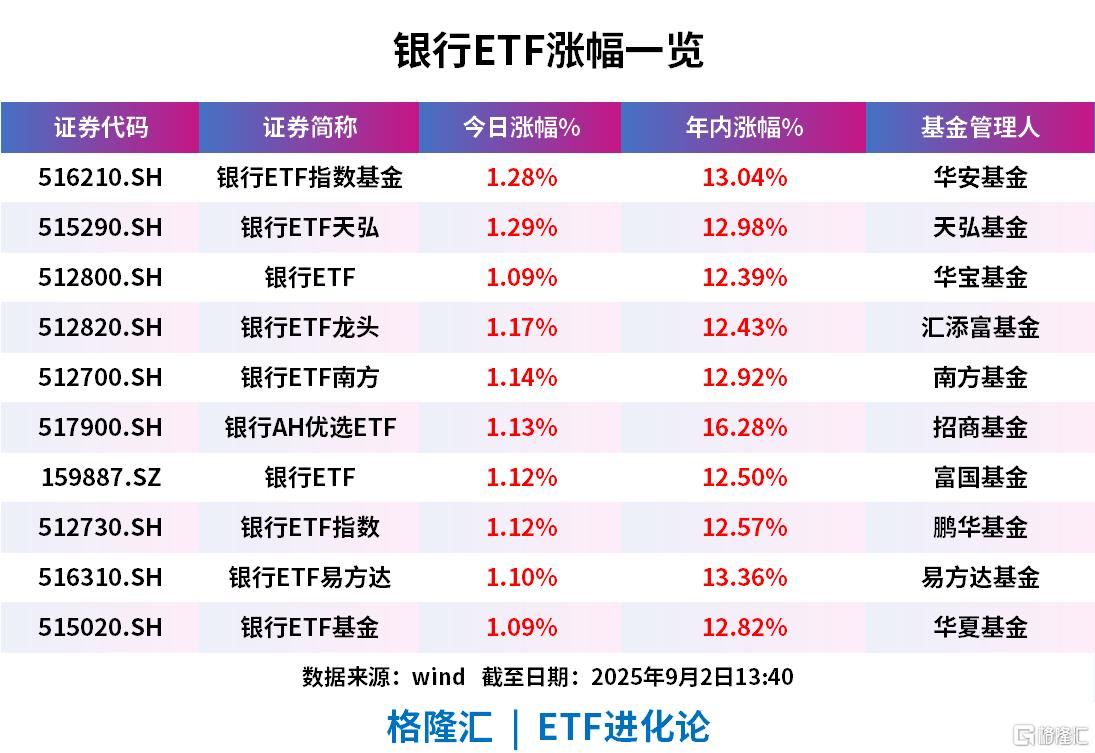
银股逆势上涨,银行ETF天弘、银行ETF、银行AH优选ETF上涨
Ge Long Hui A P P· 2025-09-02 05:59
Core Viewpoint - The banking sector is showing signs of recovery with improved financial metrics and a favorable investment environment, particularly for bank ETFs that track the performance of listed banks in China [4][5][6]. Group 1: Bank ETFs Performance - The Bank ETFs are designed to passively track the CSI Bank Index, which includes 42 listed banks in A-shares, with nearly 30% of the portfolio allocated to major state-owned banks like ICBC, ABC, and CCB, capturing high dividend opportunities [4]. - Approximately 70% of the portfolio focuses on high-growth joint-stock banks and city commercial banks, making it an efficient investment tool for tracking the overall banking sector [4]. - The Bank AH Preferred ETF tracks the Bank AH Index, which consists of securities listed in both A-shares and Hong Kong, employing a monthly security category conversion strategy [4]. Group 2: Financial Performance of Banks - In the first half of the year, 42 A-share listed banks achieved total operating income exceeding 2.9 trillion yuan, a year-on-year increase of over 1%, and a net profit attributable to shareholders of 1.1 trillion yuan, up 0.8% year-on-year [4]. - Major state-owned banks reported net profits exceeding 100 billion yuan each in the first half of the year, with non-performing loan ratios remaining low across the six major commercial banks [4]. Group 3: Sector Analysis and Outlook - The performance of state-owned banks has improved beyond expectations, with significant recovery in fee and other non-interest income growth compared to Q1, driving overall performance [5]. - Joint-stock banks are experiencing a rebound in revenue and profit growth due to stable asset quality and improved non-interest income [5]. - The banking sector is expected to see a rotation and rebound, with the overall performance of banks in the mid-year report indicating a recovery in ROE [5]. - The ranking of bank sub-sectors is as follows: joint-stock banks > city commercial banks = state-owned banks > rural commercial banks, with a strong outlook for joint-stock banks due to financial clearing and valuation recovery [5]. Group 4: Long-term Valuation Recovery - The long-term logic for systemic valuation recovery of bank stocks remains unchanged, with marginal improvements in the banking sector helping to boost market confidence [6]. - The easing of loan rate declines and continuous improvement in deposit costs are expected to support the stabilization of the banking sector's fundamentals [6]. - The attractiveness of bank stocks to medium- and long-term funds remains strong, with low interest rates and an "asset shortage" environment enhancing dividend yield and valuation advantages [6].

江苏银行带你解锁福利新惊喜!太湖湾音乐节门票开抽,薛之谦、吴青峰、汪苏泷等明星等你一起来嗨唱!
Zhong Jin Zai Xian· 2025-09-02 05:12
Core Points - Jiangsu Bank continues to upgrade its "Follow Su Chao to Celebrate" theme activity, leveraging millions in consumer vouchers to provide users with various benefits across dining, entertainment, and shopping, thereby boosting consumption potential and empowering regional economic growth [1] - The announcement of the Taihu Bay Music Festival features a star-studded lineup including popular artists such as Xue Zhi Qian, Wu Qing Feng, and Ella Chen, promising an unparalleled music experience [1] - New promotional offers include 999 mobile phone vouchers and discounts from four popular dining brands, enhancing customer engagement and satisfaction [1] - Jiangsu Bank collaborates with Didi Chuxing to offer ride vouchers for event attendees, further incentivizing participation in local events [1] - Users can participate in the promotional activities through the Jiangsu Bank App, with multiple opportunities to win prizes across various categories [1]