
Bank Of Jiangsu(600919)

Search documents
上市银行大洗牌
Sou Hu Cai Jing· 2025-09-03 16:19
Group 1 - The number of listed banks in China has decreased from 60 to 57, with Jinzhou Bank, Jiutai Rural Commercial Bank, and Shengjing Bank announcing their exit from the market [3] - As of June 30, 2025, Agricultural Bank of China remains the second-largest bank in China with total assets of 46.86 trillion, surpassing China Construction Bank's 44.43 trillion [5] - Jiangsu Bank and Ningbo Bank have risen to the 1st and 3rd positions among city commercial banks, with total assets of 4.79 trillion and 3.47 trillion respectively, overtaking Beijing Bank and Shanghai Bank [7] Group 2 - Eight banks have achieved a total asset growth rate exceeding 10%, with Jiangsu Bank leading at an impressive 21.16% [9] - 32 banks have a total asset growth rate below 5%, indicating a slowdown in growth for many institutions [10] - Two banks, Bohai Bank and Minsheng Bank, are in a shrinking state, with total assets decreasing by 1.09% and 0.59% respectively [11] Group 3 - Nine banks have achieved double-digit loan growth, with Xi'an Bank leading at 22.75% [13] - Twelve banks have also seen double-digit growth in financial investments, with Jiangsu Bank again at the top with 23.38% [13] - The competitive landscape among city commercial banks is intensifying, with frequent changes in the rankings of the top 10 banks [14]






金融中报观|银行零售业务梯队格局背后,谁在领跑,谁在补课
Bei Jing Shang Bao· 2025-09-03 14:17
Core Insights - The competitive landscape of retail banking in A-shares is becoming clearer as the 2025 mid-year reports are disclosed, revealing a distinct tiered structure in retail AUM (Assets Under Management) [1][2] - The first tier consists of major state-owned banks and China Merchants Bank, all exceeding 16 trillion yuan in retail AUM, while the second tier includes joint-stock banks and some leading city commercial banks [1][2] - The retail business performance is mixed, with many banks facing pressure on retail revenue and net profit, highlighting a structural issue of profit growth without revenue increase [1][6] Tiered Structure of Retail AUM - The first tier banks, including Industrial and Commercial Bank of China (ICBC) and Agricultural Bank of China (ABC), lead with AUM exceeding 16 trillion yuan, with ICBC at over 24 trillion yuan and ABC at 23.68 trillion yuan [2][3] - China Construction Bank (CCB) and Postal Savings Bank of China also show strong performance, with CCB managing over 22 trillion yuan and Postal Savings Bank at 17.67 trillion yuan [2] - China Merchants Bank, known as the "king of retail," has a retail AUM of 16.03 trillion yuan, reflecting a 7.39% increase from the previous year [2] Second Tier Performance - The second tier banks have retail AUM ranging from 1 trillion to 6 trillion yuan, with notable growth from banks like Bank of Communications at 5.79 trillion yuan and Industrial Bank at 5.52 trillion yuan [3] - Joint-stock banks are active in this tier, with CITIC Bank and Shanghai Pudong Development Bank also showing significant growth in retail AUM [3] Third Tier Characteristics - The third tier banks have retail AUM mostly below 1 trillion yuan, with Nanjing Bank and Shanghai Rural Commercial Bank showing notable growth rates of 14.25% and 3.99% respectively [4] - Regional banks are leveraging local advantages to deepen market penetration, but face challenges in competing with larger banks [5] Retail Profitability Challenges - The retail banking sector is undergoing significant adjustments, with a shift in customer demand towards diversified financial solutions, which raises the bar for product innovation and service customization [6] - Leading banks like ICBC and China Merchants Bank are showing resilience, with ICBC's net profit rising by 46.05% despite a slight revenue decline [6][7] - However, some banks, including ABC and Ping An Bank, are experiencing declines in both revenue and net profit, indicating a challenging environment [7] Asset Quality Concerns - The retail banking sector is facing challenges in asset quality, particularly in personal loans, with rising non-performing loan (NPL) ratios reported by several banks [9][10] - For instance, China Merchants Bank's retail loan NPL ratio increased to 1.04%, while Chongqing Rural Commercial Bank's rose to 2.04% [9] - Some banks, like Ping An Bank and Industrial Bank, have managed to improve their asset quality through refined risk management practices [10] Strategic Recommendations - Analysts suggest that banks, especially smaller ones, should focus on enhancing their support for small and micro enterprises and optimizing financial resource allocation to uncover new growth points [8] - There is a call for banks to improve their digital capabilities and customer experience to better compete with larger institutions [8]



持仓最高达100多亿!券商自营重仓股出炉
Di Yi Cai Jing· 2025-09-03 09:18
Group 1 - The A-share market has shown strong performance, with 42 listed brokerages achieving a total operating income of 251.87 billion yuan and a net profit of 104.02 billion yuan in the first half of the year, representing year-on-year growth of 11.37% and 65.08% respectively [2] - The significant increase in brokerage performance is largely attributed to proprietary trading, which generated a total income of 112.35 billion yuan, a year-on-year increase of over 50%, accounting for more than 40% of total income [2][3] - Among the listed brokerages, CITIC Securities reported the highest proprietary income exceeding 10 billion yuan, reaching 19.05 billion yuan, contributing approximately 57% to its total revenue [3] Group 2 - A total of 25 listed brokerages reported proprietary income exceeding 1 billion yuan, representing nearly 60% of the total number of listed brokerages [4] - Notable increases in proprietary income were observed in several mid-sized brokerages, with Changjiang Securities reporting a staggering increase of 668.35% to 1.48 billion yuan [4] - Some brokerages, such as CITIC Securities and Guotai Junan, also reported significant increases in proprietary income, with growth rates exceeding 60% [5] Group 3 - The latest disclosures reveal that Jiangsu Bank, Yong'an Futures, and CITIC Construction Investment are the top three holdings among brokerages, with shareholdings of 923 million shares, 439 million shares, and 383 million shares respectively [6] - In terms of market value, the holdings in Jiangsu Bank are valued at approximately 11.03 billion yuan, while Yong'an Futures and CITIC Construction Investment are valued at 6.51 billion yuan and 9.21 billion yuan respectively [6] - Brokerages have also shown interest in other stocks, with significant increases in holdings for companies like Sichuan Chengyu and Hongchuang Holdings during the second quarter [8] Group 4 - Some stocks have seen significant reductions in holdings by brokerages, particularly those facing regulatory scrutiny, such as Huangshi Group, which saw a reduction of over 34% in shares held by Dongfang Securities [11] - Other stocks that experienced substantial reductions in brokerage holdings include Xinjing Steel and Yingfangwei, with each seeing a decrease of over 2 million shares in the second quarter [12]

持仓最高达100多亿!券商自营重仓股出炉
第一财经· 2025-09-03 09:08
Core Viewpoint - The A-share market continues to rise, leading to a prosperous season for brokerage firms, with significant growth in their performance driven by proprietary trading income [2][3]. Group 1: Brokerage Performance - In the first half of the year, 42 listed brokerages achieved a total operating income of 251.87 billion yuan and a net profit of 104.02 billion yuan, representing year-on-year growth of 11.37% and 65.08% respectively [2]. - Proprietary trading contributed significantly to the performance, with total proprietary income reaching 112.35 billion yuan, a year-on-year increase of 53.53%, accounting for over 40% of total income [3][4]. - Among the brokerages, CITIC Securities was the only firm with proprietary income exceeding 10 billion yuan, totaling 19.05 billion yuan, contributing approximately 57% to its total revenue [3]. Group 2: Top Holdings and Stock Preferences - As of the end of June, the top three stocks held by brokerages were Jiangsu Bank, Yong'an Futures, and CITIC Construction Investment, with holdings of 923 million shares, 439 million shares, and 383 million shares respectively [9]. - The market value of these holdings was over 10 billion yuan for Jiangsu Bank alone, indicating strong interest from brokerages in non-bank financials, electronics, and biomedicine sectors [2][9]. - In the second quarter, brokerages significantly increased their positions in stocks like Sichuan Chengyu and Hongchuang Holdings, with notable increases in shareholdings [11]. Group 3: Changes in Holdings - Brokerages reduced their holdings in several stocks, including Huangshi Group and Shanghai Mechanical, with significant decreases in share quantities [12][16]. - The reduction in holdings was particularly pronounced for Huangshi Group, where Oriental Securities cut its stake by over 34% due to regulatory issues [15]. - Other stocks that saw substantial reductions included New Steel and Yingfang Micro, with brokerages decreasing their holdings by over 2 million shares in the second quarter [16].





股东拟增持青岛银行2.33亿股 年内已有9家银行发布增持报告
2 1 Shi Ji Jing Ji Bao Dao· 2025-09-03 05:39
Group 1 - Qingdao Bank announced that its shareholder Guoxin Chanquan Holdings plans to increase its stake through secondary market transactions, aiming for a total holding of 19.00% to 19.99% after the increase, with a minimum of 233 million shares and a maximum of 291 million shares to be acquired within six months [1] - Nanjing Bank's major shareholder, Nanjing Gaoke, increased its stake by 7.51 million shares, raising its holding from 8.94% to 9.00%, reflecting confidence in the bank's future development [2] - Shanghai Bank reported that ten directors and senior management purchased a total of 440,000 shares, with a total investment estimated between 4.60 million to 4.70 million yuan, indicating strong internal confidence in the bank's value [3] Group 2 - Suzhou Bank's major shareholder, Guofazhong Group, completed its share increase plan, acquiring 118 million shares for a total investment of 856 million yuan, based on confidence in the bank's long-term value [4] - Chengdu Bank adjusted its share increase plan due to rising stock prices, with a new plan to invest between 700 million to 1.4 billion yuan without a price cap, reflecting ongoing confidence in the bank's future [5] - Huaxia Bank announced a plan for its directors and senior management to voluntarily increase their holdings by at least 30 million yuan, demonstrating confidence in the bank's long-term investment value [6] Group 3 - The trend of share increases among banks is concentrated when valuations are at historical lows, indicating a strong internal belief in long-term value [4] - Analysts noted that the banking sector's profitability is stabilizing, with expectations for continued growth in earnings, suggesting a favorable investment environment for bank stocks [6]


江苏银行晋升城商行新“一哥”
21世纪经济报道· 2025-09-03 04:56
Core Viewpoint - The head city commercial banks in the Yangtze River Delta region have shown strong performance in the first half of the year, achieving growth in both revenue and net profit despite challenges such as narrowing interest margins and weakened credit demand [1][4]. Group 1: Financial Performance - Jiangsu Bank has become the largest city commercial bank by total assets, reaching 4.79 trillion yuan, with a year-on-year growth of 26.99% [2][6]. - Ningbo Bank and Shanghai Bank also reported total assets exceeding 3 trillion yuan, with figures of 3.47 trillion yuan and 3.29 trillion yuan respectively [1]. - The non-performing loan (NPL) ratios for these banks are below 1%, with Ningbo Bank having the lowest at 0.76% [1][2]. Group 2: Revenue and Profit Growth - Jiangsu Bank led in revenue with 448.64 billion yuan, followed by Ningbo Bank at 371.60 billion yuan, and Nanjing Bank at 284.80 billion yuan [2]. - All four banks maintained a positive growth trend in revenue, with Jiangsu Bank's revenue increasing by 7.78% year-on-year [2]. Group 3: Loan Growth and Composition - The growth in asset scale is primarily driven by loans, particularly corporate loans, with Jiangsu Bank's corporate loan growth significantly outpacing retail loans [7][8]. - Jiangsu Bank's corporate loans increased by approximately 3 billion yuan, reaching 1.63 trillion yuan, while retail loans grew by only 200 million yuan [7]. - Ningbo Bank's corporate loans also showed strong growth, with a total of 998.20 billion yuan, reflecting a 21.34% increase [8]. Group 4: Interest Margin and Market Performance - Nanjing Bank reported the highest interest margin at 1.86%, followed by Jiangsu Bank at 1.78% [4]. - The stock prices of these banks have generally trended upward, with Ningbo Bank showing a year-to-date increase of 23.18% [4]. Group 5: Capital Adequacy Concerns - There are concerns regarding the capital adequacy ratios due to significant asset expansion, prompting bank executives to address these issues during earnings calls [10][11]. - Jiangsu Bank emphasized maintaining stable capital adequacy through internal growth and optimizing asset-liability structures [11]. Group 6: Retail Business Performance - Retail banking performance has lagged behind corporate banking, with retail deposits primarily driven by fixed-term deposits rather than demand deposits [12][13]. - For instance, Jiangsu Bank's retail demand deposits increased by only 80 million yuan, while fixed-term deposits grew by approximately 1 billion yuan [13].

江苏银行发生2笔大宗交易 合计成交1087.98万元
Zheng Quan Shi Bao Wang· 2025-09-02 15:24
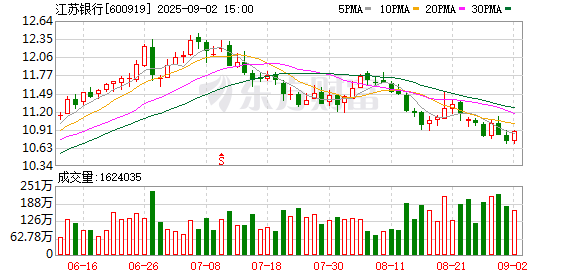
两融数据显示,该股最新融资余额为52.03亿元,近5日增加4.91亿元,增幅为10.43%。 机构评级来看,近5日共有1家机构给予该股评级,预计目标价最高的是广发证券,8月27日广发证券发 布的研报预计公司目标价为13.37元。(数据宝) 9月2日江苏银行大宗交易一览 江苏银行9月2日大宗交易平台共发生2笔成交,合计成交量112.75万股,成交金额1087.98万元。成交价 格均为9.65元,相对今日收盘价折价11.39%。 进一步统计,近3个月内该股累计发生4笔大宗交易,合计成交金额为6709.83万元。 证券时报·数据宝统计显示,江苏银行今日收盘价为10.89元,上涨1.59%,日换手率为0.89%,成交额为 17.55亿元,全天主力资金净流入1.68亿元,近5日该股累计下跌1.18%,近5日资金合计净流出6.20亿 元。 | 成交量 (万 | 成交金 额(万 | 成交价 格 | 相对当日收盘 折溢价(%) | 买方营业部 | 卖方营业部 | | --- | --- | --- | --- | --- | --- | | 股) | 元) | (元) | | | | | 86.73 | 836.91 | 9 ...
你追我赶!长三角头部城商行业绩背后:新排序靠什么?
Nan Fang Du Shi Bao· 2025-09-02 12:59
Core Viewpoint - The performance of the five leading city commercial banks in the Yangtze River Delta region listed on A-shares showed growth in revenue and net profit for the first half of 2025, but the growth rate has generally slowed compared to the previous year, with significant differentiation among them [2][3]. Group 1: Financial Performance - Jiangsu Bank led with a revenue of 44.86 billion yuan and a net profit of 21.06 billion yuan, maintaining its top position [3][4]. - Nanjing Bank surpassed Shanghai Bank in revenue, dropping Shanghai Bank to fourth place, while net profit rankings remained consistent [2][3]. - All five banks reported year-on-year growth in net profit, with Hangzhou Bank achieving the highest growth rate of 16.7% due to a reduction in credit impairment losses [5][12]. Group 2: Revenue and Profit Growth Rates - Revenue growth rates for the five banks showed a decline compared to last year, with Hangzhou Bank experiencing the largest drop from 9.6% to 3.9% [4][5]. - Jiangsu Bank and Ningbo Bank had revenue growth rates around 8%, while Shanghai Bank and Hangzhou Bank lagged behind with growth rates around 4% [4][5]. Group 3: Interest Income and Non-Interest Income - All five banks saw an increase in net interest income, with Nanjing Bank achieving the highest growth rate of 22.13% [5][6]. - Non-interest income showed mixed results, with four banks reporting growth while Shanghai Bank experienced a decline of 6% [7][11]. Group 4: Asset Quality and Capital Adequacy - The non-performing loan (NPL) ratios remained low, with only Shanghai Bank exceeding 1% at 1.18% [12][13]. - Jiangsu Bank's core Tier 1 capital adequacy ratio fell below 9%, the lowest among the five banks, while Shanghai Bank led with a ratio of 10.78% [14]. Group 5: Financial Investment and Loan Composition - Financial investment assets accounted for a significant portion of total assets, with Hangzhou Bank having the highest ratio at 46.8% [8][9]. - Jiangsu Bank's financial investment assets grew at a rate nearly double that of its loan assets, indicating a shift in asset allocation strategy [10][11].



持仓最高达100多亿!券商自营重仓股出炉 上半年都买了哪些股票?
Di Yi Cai Jing· 2025-09-02 12:16
Core Viewpoint - The A-share market has shown strong performance, leading to significant revenue and profit growth for listed securities firms in the first half of the year, primarily driven by proprietary trading income. Group 1: Financial Performance - In the first half of the year, 42 listed securities firms achieved a total operating income of 251.87 billion yuan and a net profit of 104.02 billion yuan, representing year-on-year growth of 11.37% and 65.08% respectively [1] - Proprietary trading contributed significantly, with total proprietary income reaching 112.35 billion yuan, a year-on-year increase of 53.53%, accounting for over 40% of total revenue [1][2] - Among these firms, CITIC Securities was the only one to exceed 10 billion yuan in proprietary income, achieving 19.05 billion yuan, which constituted approximately 57% of its total revenue [2] Group 2: Major Shareholdings - As of the end of June, the top three heavily held stocks by securities firms were Jiangsu Bank, Yong'an Futures, and CITIC Construction Investment, with holdings of 923 million shares, 439 million shares, and 383 million shares respectively [5] - The market value of these holdings was approximately 11.03 billion yuan for Jiangsu Bank, 6.51 billion yuan for Yong'an Futures, and 9.21 billion yuan for CITIC Construction Investment [5] - Other notable stocks included Sinopec, Shanghai Laishi, and Yuheng Pharmaceutical, with significant holdings by various securities firms [5] Group 3: Changes in Holdings - In the second quarter, securities firms significantly increased their positions in stocks such as Sichuan Chengyu, Hongchuang Holdings, and Yuntianhua, with increases of 9.89 million shares, 5.76 million shares, and 5 million shares respectively [6] - Conversely, stocks like Huangshi Group, Shanghai Mechanical, and Northeast Securities saw substantial reductions in holdings, with Huangshi Group experiencing a decrease of over 14 million shares [7][8] - Regulatory issues led to a sharp decline in holdings for certain stocks, with securities firms reducing their positions in Huangshi Group following investigations and penalties [8][9]



持仓最高达100多亿 券商自营重仓股出炉(附名单)
Di Yi Cai Jing· 2025-09-02 11:13
Core Insights - The A-share market continues to rise, leading to a prosperous season for brokerage firms, with 42 listed brokerages achieving a total operating income of 251.87 billion yuan and a net profit of 104.02 billion yuan in the first half of the year, representing year-on-year growth of 11.37% and 65.08% respectively [1] - The significant increase in brokerage performance is largely attributed to proprietary trading, which generated a total income of 112.35 billion yuan, a year-on-year increase of over 50%, accounting for more than 40% of total income [1][2] - Among the brokerages, CITIC Securities stands out as the only firm with proprietary income exceeding 10 billion yuan, reaching 19.05 billion yuan, contributing approximately 57% to its total revenue [2] Brokerage Performance - In the first half of the year, 25 out of 42 listed brokerages reported proprietary income exceeding 1 billion yuan, accounting for nearly 60% of the total [2] - Notable performers include Changjiang Securities, which saw a staggering year-on-year increase of 668.35% in proprietary income, and Guolian Minsheng and Huaxi Securities with increases of 458.78% and 245.07% respectively [2] Stock Holdings - As of the end of June, the top three stocks held by brokerages were Jiangsu Bank, Yong'an Futures, and CITIC Construction Investment, with holdings of 923 million shares, 43.9 million shares, and 38.3 million shares respectively, translating to market values of 11.03 billion yuan, 6.51 billion yuan, and 9.21 billion yuan [4] - Brokerages have shown a preference for sectors such as non-bank financials, electronics, and biomedicine in their proprietary trading [1] Changes in Holdings - In the second quarter, significant increases in holdings were observed in stocks like Sichuan Chengyu, Hongchuang Holdings, and Yuntianhua, with increases of 9.89 million shares, 5.76 million shares, and 5 million shares respectively [6] - Conversely, stocks such as Huangshi Group, Shanghai Mechanical, and Northeast Securities experienced substantial reductions in holdings, with the largest decrease being 14 million shares for Huangshi Group [8][11] Regulatory Impact - Some stocks faced significant reductions in holdings due to regulatory penalties, with brokerages exiting positions in companies like Huangshi Group, which was under investigation for information disclosure violations [10][11]



