
NJBK(601009)

Search documents
多部门统筹推进科技金融,银行信贷如何才能加大“含科量”?路径依赖等多重障碍待破除
Xin Lang Cai Jing· 2025-12-04 09:07
Core Viewpoint - The central theme of the news is the emphasis on accelerating the construction of a technology finance system in China, with a focus on increasing credit support for technology enterprises by banks [1]. Group 1: Credit Support for Technology Enterprises - Various banks have reported significant growth in technology loans this year, with Agricultural Bank of China (ABC) indicating a technology loan balance exceeding 4.7 trillion yuan, an annual increase of over 800 billion yuan [1]. - Industrial and Commercial Bank of China (ICBC) has also surpassed 6 trillion yuan in technology loans, with loans to technology enterprises exceeding 2.5 trillion yuan [1]. - Other banks, including CITIC Bank and Nanjing Bank, are actively increasing their technology loan portfolios, with CITIC Bank reporting a technology loan balance exceeding 1 trillion yuan [1]. Group 2: Sector Focus and Loan Distribution - The manufacturing sector, particularly advanced manufacturing and traditional enterprise upgrades, remains a primary focus for bank lending, with a significant portion of loans directed towards these areas [3]. - As of the end of Q3, loans to manufacturing enterprises from ABC's Hubei branch reached 576.2 billion yuan, accounting for 54% of technology loans, with advanced manufacturing receiving 360.3 billion yuan [3]. - Emerging sectors such as robotics and deep-sea economy are also gaining attention, with banks expanding credit support in these areas [4]. Group 3: Challenges in Technology Finance - Despite the growth in technology loans, banks face challenges in advancing technology finance, including reliance on traditional credit channels and a need for enhanced industry analysis and research [5]. - There is a dependency on external trade and small micro-enterprises for credit, which may hinder the motivation for technology loan issuance [5]. - The unique characteristics of technology enterprises, such as reliance on intellectual property and human capital rather than physical collateral, necessitate innovative financing solutions [5][6].




12月3日基金调研瞄准这些公司
Zheng Quan Shi Bao Wang· 2025-12-04 04:13
证券时报·数据宝统计,12月3日共24家公司被机构调研,按调研机构类型看,基金参与13家公司的调研 活动。南京银行最受关注,参与调研的基金达7家;大地海洋、实丰文化等分别获5家、4家基金集体调 研。 昨日基金共对13家公司进行调研,扎堆调研南京银行、大地海洋、实丰文化等。 数据宝统计,基金参与调研股中,近5日资金净流入的有5只,丰元股份近5日净流入资金9062.39万元, 主力资金净流入最多;净流入资金较多的还有实丰文化、联动科技等,净流入资金分别为5655.29万 元、5492.20万元。(数据宝) 12月3日基金调研公司一览 | 代码 | 简称 | 基金家数 | 最新收盘价(元) | 近5日涨跌幅(%) | 行业 | | --- | --- | --- | --- | --- | --- | | 601009 | 南京银行 | 7 | 11.81 | 2.79 | 银行 | | 301068 | 大地海洋 | 5 | 29.60 | 4.89 | 环保 | | 002862 | 实丰文化 | 4 | 21.98 | 0.18 | 轻工制造 | | 000957 | 中通客车 | 2 | 10.90 | 1 ...
南京银行北京分行:校企联动共筑人才培养生态
Xin Hua She· 2025-12-04 00:41
Core Insights - Nanjing Bank's Beijing branch has progressed to the physical examination stage of its 2026 campus recruitment, emphasizing the goal of "talent empowerment and win-win cooperation" through precise recruitment and deepening school-enterprise collaboration [1][2] Recruitment Process - The recruitment process has included multiple assessment rounds such as resume screening, unified written tests, and semi-structured interviews, with physical examination notifications sent to selected candidates [2] - The recruitment strategy employs a dual-track approach of "offline deep cultivation + online linkage," expanding talent acquisition channels and enhancing recruitment effectiveness [2] - The total number of resumes submitted has increased by 30% compared to the same period last year, indicating strong interest from graduates across the country [2] School-Enterprise Cooperation - Nanjing Bank is actively deepening its school-enterprise cooperation, exemplified by a recent career planning course held at the University of International Business and Economics, focusing on banking and career futures [3] - The bank also conducted a "Financial Safety First Lesson," educating students on anti-money laundering, fraud prevention, and counterfeit currency, thereby enhancing students' awareness of financial security [3] - The bank aims to ensure high-quality talent selection in its recruitment process while exploring new models for collaborative talent development to support the high-quality growth of the financial industry [3]
南京银行一年净利润突破200亿 被外资股东增持股份值得警惕!
Sou Hu Cai Jing· 2025-12-03 05:41
Core Viewpoint - Nanjing Bank has become a market focus due to significant shareholding increases by its largest shareholder, BNP Paribas, raising concerns about foreign control over domestic banks [1][3]. Group 1: Shareholding Changes - BNP Paribas and its concerted parties have increased their stake in Nanjing Bank to over 18.06% through continuous market purchases [1]. - This marks the second large-scale increase by BNP Paribas in 2023, having previously raised its stake from 16.14% to 17.02% between September 22 and 26 by acquiring 108 million shares [3]. - Other major shareholders, including Zijin Trust and Nanjing Gaoke, have also made decisions to increase their holdings, indicating a consensus among multiple stakeholders [3]. Group 2: Financial Performance - Nanjing Bank reported a revenue of 41.949 billion yuan for the first three quarters of the year, reflecting an 8.79% year-on-year growth [3]. - The net profit attributable to shareholders reached 18 billion yuan, marking an 8.06% increase compared to the previous year [3]. - As of the end of September, the bank's total assets amounted to 2.96 trillion yuan, a 14.31% increase from the end of the previous year, with deposits and loans growing by 9.65% and 12.34%, respectively [3]. Group 3: Concerns Over Foreign Control - There is a heightened caution regarding foreign entities increasing their stakes in domestic banks, referencing the case of Supor, which was acquired by France's SEB Group, leading to significant dividend outflows to foreign shareholders [4]. - The more shares foreign entities hold in Nanjing Bank, the greater the potential for dividend losses to foreign companies [4].


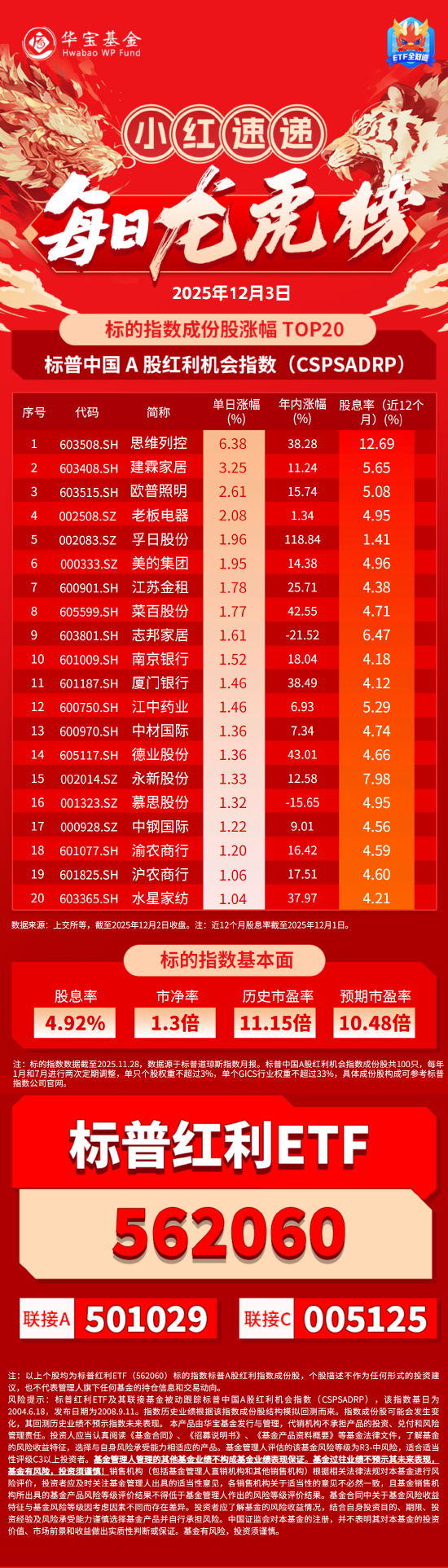
小红日报 | 思维列控领涨,标普红利ETF(562060)标的指数收涨0.02%四连阳再秀防御力
Xin Lang Cai Jing· 2025-12-03 01:43
Core Insights - The article highlights the top-performing stocks in the S&P China A-Share Dividend Opportunity Index (CSPSADRP) as of December 2, 2025, showcasing significant daily and year-to-date gains along with dividend yields [1][4]. Summary by Category Stock Performance - The top stock, 思维列控 (Code: 603508.SH), recorded a daily increase of 6.38% and a year-to-date increase of 38.28%, with a dividend yield of 12.69% [1][4]. - 建霖家居 (Code: 603408.SH) and 欧普照明 (Code: 603515.SH) also showed strong performance, with daily increases of 3.25% and 2.61%, and year-to-date increases of 11.24% and 15.74%, respectively [1][4]. - 录日股份 (Code: 002083.SZ) stands out with an impressive year-to-date increase of 118.84%, despite a lower daily increase of 1.96% [1][4]. Dividend Yields - The highest dividend yield among the top performers is from 永新股份 (Code: 002014.SZ) at 7.98%, with a year-to-date increase of 12.58% [1][4]. - Other notable dividend yields include 志邦家居 (Code: 603801.SH) at 6.47% and 思维列控 (Code: 603508.SH) at 12.69% [1][4]. Market Trends - The article indicates a positive market trend with the formation of MACD golden cross signals, suggesting potential upward momentum for the highlighted stocks [3][6].




银行直供房批量上架,还是没人买
Xin Lang Cai Jing· 2025-12-02 11:45
Core Insights - The rise of "bank direct supply housing" has garnered attention due to its price advantages, but complexities and risks associated with certain properties deter ordinary buyers [2][18] - Major banks are accelerating asset liquidation as year-end approaches, with significant volumes of properties being auctioned through platforms like Alibaba and JD [4][20] - Despite attractive pricing, many properties are facing high rates of unsold listings and repeated auctions, indicating a lack of buyer interest [9][25] Group 1: Definition and Market Dynamics - "Bank direct supply housing" refers to properties obtained by banks through judicial processes after borrower defaults, allowing banks to sell with complete ownership [6][22] - The volume of properties listed for sale has surged, with banks like Lanzhou Bank and Jilin Bank significantly increasing their offerings, indicating a shift in asset disposal strategies [7][23] - The recovery rate for non-performing assets through direct sales is reported to be 15%-20% higher than traditional debt transfer methods, enhancing banks' efficiency in asset management [7][23] Group 2: Pricing and Market Response - "Bank direct supply housing" typically offers prices 20%-30% lower than market evaluations, with some properties discounted by over 50% [8][24] - Despite these discounts, many properties remain unsold, with over 9,000 listings entering second auction phases, highlighting a disconnect between pricing and buyer demand [9][25] - Specific examples illustrate the challenges, such as properties that failed to attract bids even after price reductions, indicating potential issues with property desirability [11][27] Group 3: Risks and Considerations - Buyers are cautioned to scrutinize the reasons behind low pricing, as properties may have underlying issues such as lack of liquidity or legal complications [30][32] - The cleanliness of the asset is a critical factor, as buyers must ensure that properties are legally compliant and free from outstanding debts or occupancy issues [30][32] - The expansion of bank direct sales poses both risks and opportunities for real estate agents, as banks may require professional assistance in property sales despite not traditionally being in the real estate business [30][32]



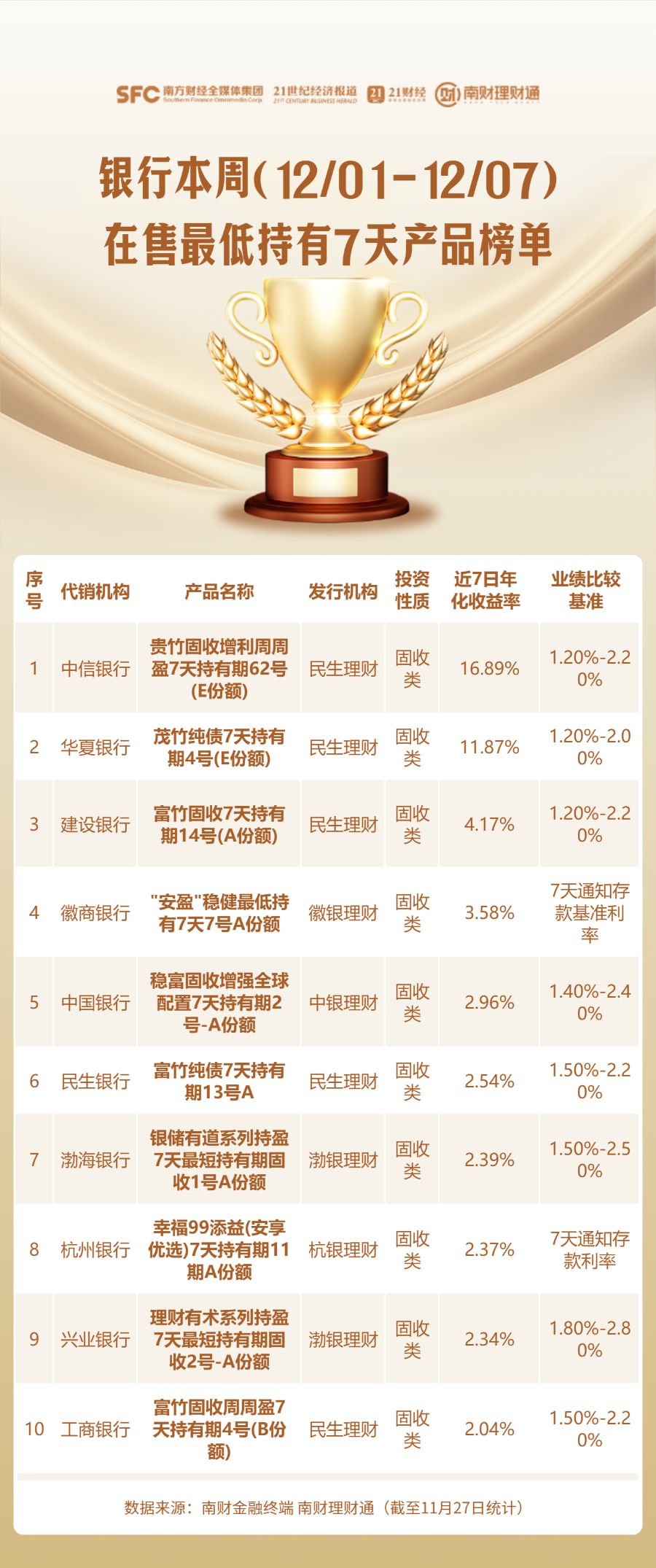
哪家商业银行最低持有期理财产品收益更高?
2 1 Shi Ji Jing Ji Bao Dao· 2025-12-02 10:37
Core Insights - The article focuses on the performance of minimum holding period RMB public offering products, ranking them based on annualized returns for holding periods of 7, 14, 30, and 60 days [1][4][12] Group 1: 7-Day Holding Period Products - The top-performing product is from Minsheng Bank with an annualized return of 4.17% [3] - Other notable products include: - Huishang Bank with 3.58% [3] - Bank of China with 2.96% [3] - Minsheng Bank's Fuzhu Pure Bond with 2.54% [3] - Bohai Bank with 2.39% [3] Group 2: 14-Day Holding Period Products - Minsheng Bank's product "Jingxiang Fixed Income Incremental Dual-Week" leads with a return of 34.68% [5] - Other significant products include: - Minsheng Bank's Fuzhu Pure Bond with 5.66% [5] - WeBank's "Anying" Stable Income with 4.47% [5] - SPDB's "Wealth Management Series" with 2.33% [5] Group 3: 30-Day Holding Period Products - Minsheng Bank's "Guizhu Fixed Income Incremental Monthly" tops the list with a return of 21.23% [9] - Other key products include: - Minsheng Bank's Fuzhu Fixed Income with 13.53% [9] - Bank of China with 7.64% [9] - Huishang Bank's "Happiness 99" with 6.07% [9] Group 4: 60-Day Holding Period Products - The leading product is from Minsheng Bank with a return of 15.12% [13] - Other notable products include: - CITIC Bank's Fuzhu Pure Bond with 8.94% [14] - Bank of China with 4.57% [14] - Huishang Bank's product with 3.46% [14]





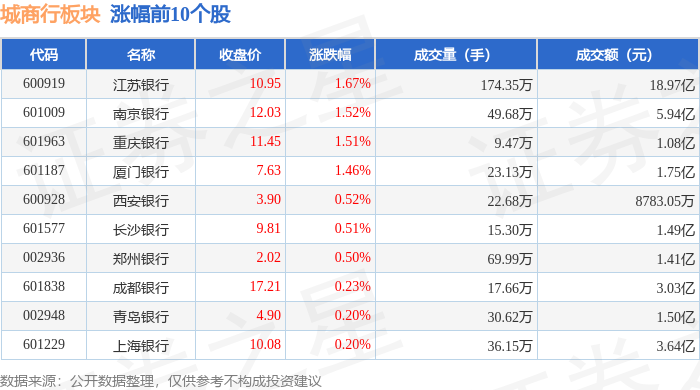
城商行板块12月2日涨0.43%,江苏银行领涨,主力资金净流出3.16亿元
Zheng Xing Xing Ye Ri Bao· 2025-12-02 09:05
Group 1 - The city commercial bank sector increased by 0.43% on December 2, with Jiangsu Bank leading the gains [1] - The Shanghai Composite Index closed at 3897.71, down 0.42%, while the Shenzhen Component Index closed at 13056.7, down 0.68% [1] - Jiangsu Bank's closing price was 10.95, reflecting a 1.67% increase, with a trading volume of 1.7435 million shares and a transaction value of 1.897 billion [1] Group 2 - The city commercial bank sector experienced a net outflow of 316 million from institutional funds, while retail investors saw a net inflow of 421 million [2][3] - The trading data for various banks showed mixed performance, with Ningbo Bank declining by 0.69% and Guizhou Bank remaining unchanged [2] - Shanghai Bank had a net outflow of 46.6477 million from institutional funds, while retail investors contributed a net inflow of 2.33839 million [3]




ETF盘中资讯|逆市显韧性!低估值+盈利稳定双驱动,机构集中看好高股息策略!
Sou Hu Cai Jing· 2025-12-02 06:50
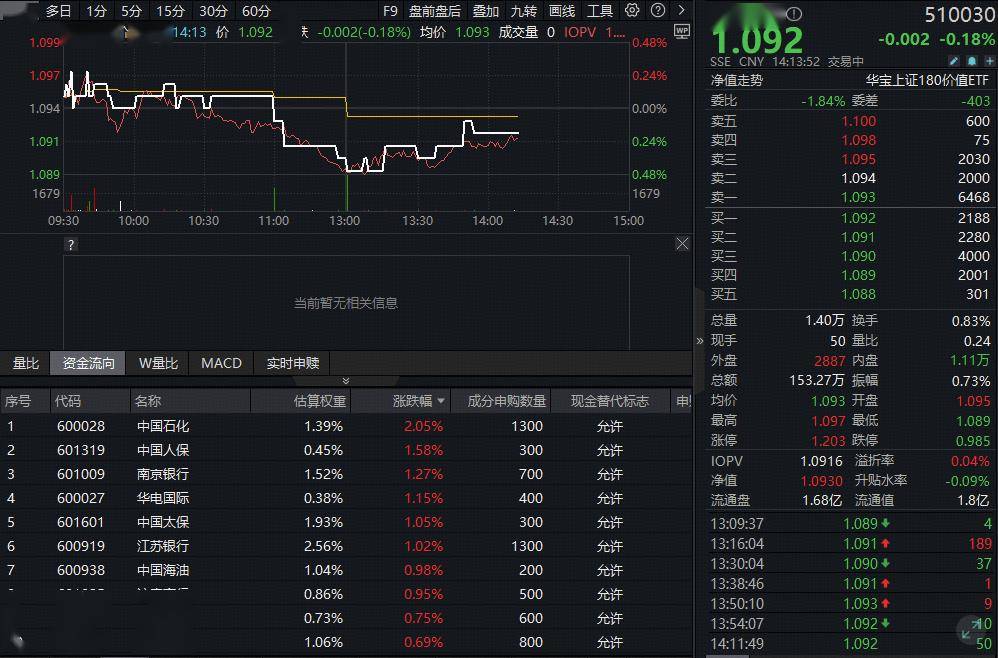
Core Viewpoint - The A-share market experienced fluctuations with a focus on high dividend and undervalued large-cap blue-chip stocks, particularly the value ETF (510030), which showed resilience despite a slight decline in price [1] Group 1: Market Performance - The value ETF (510030) saw a price drop of 0.18% during the trading session, indicating a slight downturn in the market [1] - Certain sectors such as banking, insurance, and petrochemicals showed positive performance, with China Petroleum rising over 2% and several other stocks gaining more than 1% [1] - Conversely, sectors like shipping and infrastructure faced declines, with China Merchants Energy dropping over 9% and other stocks in the sector falling more than 1% [1] Group 2: Investment Strategy - Future high dividend strategies are expected to expand, driven by two main demands: the strategic transformation needs of brokerages and the influence of capital market reforms [2] - The low interest rate environment has made high dividend assets attractive, as they can provide both self-operated income and risk control [2] - The current policy encourages listed companies to increase buybacks and dividends, enhancing investor returns and boosting the appeal of high dividend assets amid geopolitical uncertainties [3][4] Group 3: Valuation Insights - As of December 1, the value ETF (510030) tracked the 180 Value Index, which had a price-to-book ratio of 0.85, indicating a relatively low valuation compared to historical levels [3] - The valuation level is positioned at the 40.9 percentile over the past decade, suggesting a favorable long-term investment opportunity [3] - The combination of low valuation and stable earnings makes high dividend assets particularly attractive, with recommendations to focus on sectors such as finance, non-ferrous metals, public utilities, and transportation [3][4]



逆市显韧性!低估值+盈利稳定双驱动,机构集中看好高股息策略!
Xin Lang Cai Jing· 2025-12-02 06:37
Core Viewpoint - The A-share market experienced fluctuations with a focus on high dividend and low valuation large-cap stocks, particularly the value ETF (510030), which showed resilience despite a slight decline [1][8]. Group 1: Market Performance - The value ETF (510030) saw a midday increase but closed down by 0.18% [1][8]. - Key sectors such as banking, insurance, and petrochemicals had stocks that performed well, with China Petroleum rising over 2% and several others gaining more than 1% [1][8]. - Conversely, sectors like shipping and infrastructure faced declines, with China Merchants Energy dropping over 9% and others falling more than 1% [1][8]. Group 2: Investment Strategy - Future high dividend strategies are expected to expand, driven by two main demands: the need for brokerage strategic transformation and capital market reforms [10]. - The low interest rate environment encourages the allocation of high dividend assets, balancing self-operated income and risk control [10]. - Policies are increasingly guiding listed companies to enhance buybacks and dividends, thereby strengthening investor returns [10][11]. Group 3: Valuation Insights - The value ETF (510030) tracks the 180 Value Index, which has a price-to-book ratio of 0.85, indicating a relatively low valuation at the 40.9 percentile over the past decade [10][11]. - The combination of low valuation and stable earnings enhances the appeal of high dividend assets, particularly in sectors like finance, non-ferrous metals, public utilities, and transportation [10][11]. Group 4: Market Outlook - The fourth quarter is likely to see a shift in market style, with December favoring low valuation value stocks [11]. - The current growth style is expected to continue, supported by trends in AI and improvements in high-end manufacturing [11]. - However, the valuation advantage of value stocks may lead to a recovery in underweighted sectors like finance [11].


