
Chongqing Rural Commercial Bank(601077)

Search documents
A股银行股出现反弹,邮储银行涨逾2%,青农商行涨近2%,兰州银行、渝农商行等涨逾1%。
news flash· 2025-07-30 02:00
A股银行股出现反弹,邮储银行涨逾2%,青农商行涨近2%,兰州银行、渝农商行等涨逾1%。 ...



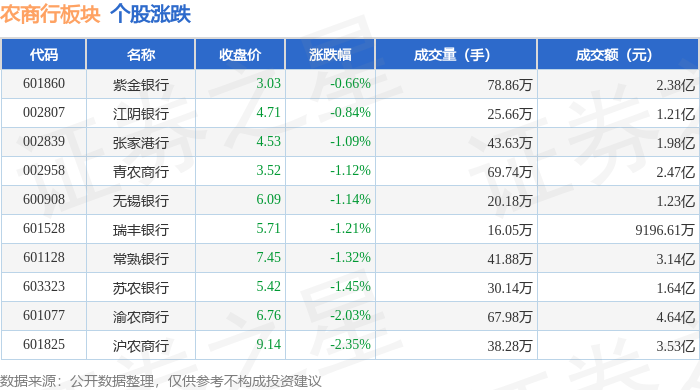
农商行板块7月29日跌1.76%,沪农商行领跌,主力资金净流入1527.75万元
Zheng Xing Xing Ye Ri Bao· 2025-07-29 08:47
证券之星消息,7月29日农商行板块较上一交易日下跌1.76%,沪农商行领跌。当日上证指数报收于 3609.71,上涨0.33%。深证成指报收于11289.41,上涨0.64%。农商行板块个股涨跌见下表: 以上内容为证券之星据公开信息整理,由AI算法生成(网信算备310104345710301240019号),不构成投资建议。 从资金流向上来看,当日农商行板块主力资金净流入1527.75万元,游资资金净流入1793.62万元,散户资 金净流出3321.37万元。农商行板块个股资金流向见下表: | 代码 | 名称 | 主力净流入(元) | 主力净占比 游资净流入 (元) | | 游资净占比 散户净流入(元) | | 散户净占比 | | --- | --- | --- | --- | --- | --- | --- | --- | | 002958 青农商行 | | 4267.56万 | 17.30% | -1987.80万 | -8.06% | -2279.76万 | -9.24% | | 601860 | 紫金银行 | 1903.52万 | 8.00% | -965.71万 | -4.06% | -937.81 ...

银行股再现普涨,已有银行年内涨幅超30%,未来行情如何演绎
Bei Jing Shang Bao· 2025-07-28 09:56
Core Viewpoint - The banking sector in A-shares is experiencing a "small bull market" with 29 out of 42 listed banks showing gains as of July 28, driven by multiple positive factors and expected to present a structural market trend in the future [1][3][7] Group 1: Market Performance - On July 28, banks like Qilu Bank and Qingdao Bank saw significant intraday gains, with Qilu Bank rising over 5% and Qingdao Bank over 3% [1][3] - Year-to-date, the banking sector has shown a steady upward trend, with banks like Qingdao Bank, Shanghai Pudong Development Bank, and Xiamen Bank achieving over 30% gains [3][4] - Despite a brief fluctuation in July, the overall upward trend remains supported by low valuations and high dividend yields [3][4] Group 2: Fundamental Improvements - The banking sector's asset quality has improved significantly, with a decrease in non-performing loan ratios and stable provision coverage ratios [4][6] - The economic recovery expectations have alleviated net interest margin pressures, leading to a steady rebound in profitability [4][6] Group 3: Policy and Valuation Support - Regulatory support for the banking sector, including liquidity release and optimized regulatory assessments, has created a favorable external environment [4][5] - Long-standing low valuations of bank stocks, with price-to-book ratios generally below 1, are expected to undergo a correction as market risk appetite increases [4][5] Group 4: Capital Inflows - Continuous inflows of long-term funds, particularly from insurance capital seeking stable returns, have bolstered the banking sector [5][6] - The expansion of passive funds and foreign capital inflows since Q2 have further supported the upward movement of bank stocks [5][6] Group 5: Positive Feedback Loop - Rising bank stock prices enhance banks' financing capabilities, reducing equity financing costs and improving credit image [6][7] - The increase in core capital through convertible bonds can enhance banks' credit expansion capabilities, ultimately benefiting the real economy [7] Group 6: Future Outlook - Analysts predict a structural market trend for the banking sector, with a focus on banks with strong asset quality and profitability [7][8] - The second half of 2025 is expected to see a fluctuating upward trend in the banking sector, with particular attention on low-valuation banks and those with strong fundamentals [7][8]




复盘:牛市氛围渐浓,顺周期优质个股迎较好布局时机
Guoxin Securities· 2025-07-27 07:31
Core Insights - The report indicates that the banking sector is entering a favorable period for investment as the bull market atmosphere strengthens, suggesting a good opportunity for high-quality cyclical stocks [1][5][33] - Historical analysis shows that in previous bull markets, the banking sector typically experiences three phases: initial phase with moderate gains, mid-phase where growth sectors outperform, and a late phase where banks present the best investment opportunities with both absolute and excess returns [4][9][28] Market Performance Analysis - Since 2010, the banking sector has shown varying performance across three bull market cycles, with only the 2016-2018 cycle yielding excess returns for banks [6][9] - In the 2014-2015 bull market, the banking index rose by 96.8%, while the Shanghai Composite Index increased by 152.2% [6][10] - The 2016-2018 bull market saw the banking index increase by 44.8%, compared to a 32.3% rise in the Shanghai Composite Index [6][10] - The 2019-2021 cycle had the banking index rising by 37.1%, while the Shanghai Composite Index rose by 50.0% [6][10] Sector Rotation and Stock Selection - The report highlights that during the 2014-2015 bull market, city commercial banks and joint-stock banks performed well, with Nanjing Bank, Everbright Bank, and Ningbo Bank leading with gains of 181.6%, 171.3%, and 154.6% respectively [12][15] - In the 2016-2018 period, leading banks included China Merchants Bank and Ningbo Bank, with respective gains of 144.6% and 126.5% [15][25] - The 2019 cycle saw Ping An Bank and Ningbo Bank leading with gains of 79.1% and 77.9%, indicating significant stock differentiation [18][21] Investment Recommendations - The report suggests focusing on high-quality stocks with a significant retail component, as they are expected to have improved win rates and high payout ratios [5][36] - Specific banks recommended for investment include Ningbo Bank, Changshu Bank, Changsha Bank, China Merchants Bank, and Chongqing Rural Commercial Bank, as they are positioned well in the current market environment [5][36]



本周聚焦:银行理财2025H1半年报:存续规模达30.67万亿,母行代销占比降至65%左右
GOLDEN SUN SECURITIES· 2025-07-27 06:56
Investment Rating - The report does not explicitly provide an investment rating for the banking sector Core Insights - The banking wealth management market showed stable growth in the first half of 2025, with a total scale of 30.67 trillion yuan, a year-on-year increase of 7.53% [1] - Cash management products continued to decline, with a scale of 6.4 trillion yuan, down 14.55% year-on-year, attributed to lower deposit rates and regulatory policies [1] - The market share of wealth management companies increased, with 32 companies holding 89.61% of the market by the end of Q2 2025, up 1.8 percentage points from the end of the previous year [2] - The asset allocation in wealth management products shifted, with a decrease in credit bond allocation and a notable increase in public fund allocation, which rose to 4.2% [3] - The average annualized yield of wealth management products was 2.12%, a decrease of 53 basis points compared to 2024, indicating a low-interest-rate environment [4] - The proportion of sales through parent banks has decreased to around 65%, as companies expand their distribution channels [5][8] Summary by Sections 1. Wealth Management Market Overview - As of the end of Q2 2025, the total scale of wealth management products reached 30.67 trillion yuan, with a year-on-year growth of 7.53% [1] - Cash management products saw a significant decline, with a scale of 6.4 trillion yuan, down 14.55% year-on-year [1] 2. Market Structure - The market share of wealth management companies increased to 89.61%, reflecting a concentration of market power among leading firms [2] 3. Asset Allocation - The allocation to credit bonds decreased, while public funds saw a significant increase, indicating a shift in investment strategy [3] 4. Yield Trends - The average annualized yield of wealth management products fell to 2.12%, continuing a downward trend since 2023 [4] 5. Distribution Channels - The share of sales through parent banks has decreased to approximately 65%, as firms diversify their distribution strategies [5][8] 6. Sector Outlook - The banking sector is expected to benefit from policy catalysts, with specific banks like Ningbo Bank, Postal Savings Bank, and others highlighted as potential investment opportunities [9]




二季度公募基金大幅增持银行股
Cai Jing Wang· 2025-07-25 10:45
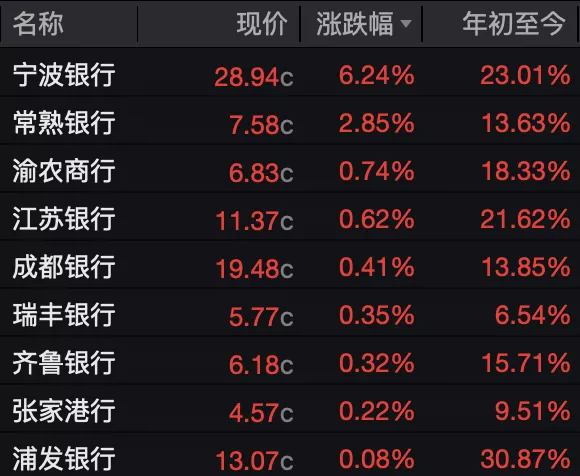
Core Viewpoint - Ningbo Bank's revenue and profit are accelerating, leading to a stock price increase of over 6%, reaching a nearly two-year high, with other city commercial banks also experiencing gains [1] Group 1: Stock Performance - Ningbo Bank's current price is 28.94c, with a year-to-date increase of 23.01% [2] - Other banks such as Changshu Bank, Chongqing Rural Commercial Bank, and Jiangsu Bank also saw price increases, with year-to-date gains of 13.63%, 18.33%, and 21.62% respectively [2] - The banking sector has cumulatively risen over 12% this year, significantly outperforming the broader market [2] Group 2: Institutional Investment - As of the end of Q2 2025, public funds held a total market value of approximately 25.837 billion yuan across 2,917 A-share companies, with significant investments in the banking sector [3] - Public funds increased their holdings in banks and telecommunications by over 40 billion yuan, leading the industry [3] - Major banks like China Merchants Bank, Industrial Bank, and Jiangsu Bank have seen substantial public fund investments, with China Merchants Bank leading at 75.9 billion yuan [3] Group 3: ETF Inflows - In the first half of the year, a total of 12.2 billion yuan flowed into the banking sector through ETFs, primarily from the CSI 300 ETF and dividend ETFs [4] - Individual banks such as Industrial Bank, Agricultural Bank, and China Merchants Bank benefited from significant net inflows exceeding 500 million yuan [4] Group 4: Future Outlook - The banking sector's weight in active equity funds is currently 3.35%, while the CSI 300 index has a weight of 15.71%, indicating potential for increased allocation [5] - The recent reforms in public funds are expected to align fund allocation closer to benchmark weights, benefiting the underweighted banking sector [5] - Insurance capital is also anticipated to further support inflows into the banking sector [5]
首批中期业绩快报出炉,银行股再迎上扬!杭州银行净利涨16%,宁波银行股价半日涨超6%
Sou Hu Cai Jing· 2025-07-25 04:25
Group 1 - The banking sector has shown strong performance, with Ningbo Bank leading the gains, rising by 6.5% in the morning session on July 25, following a positive earnings report [2][6] - Ningbo Bank reported a net profit of 14.772 billion yuan for the first half of the year, representing a year-on-year growth of 8.23%, which acted as a catalyst for the stock price increase [4][6] - The banking sector has seen a cumulative increase of 12.40% year-to-date, significantly outperforming the broader market [2][6] Group 2 - Several regional banks have reported double-digit profit growth, with Hangzhou Bank achieving a net profit of 11.662 billion yuan, up 16.67% year-on-year [3] - Changshu Bank reported a net profit of 1.969 billion yuan, a year-on-year increase of 13.55%, and its total assets surpassed 400 billion yuan for the first time [3][4] - The asset quality of Changshu Bank remains strong, with a non-performing loan ratio of 0.76%, which has decreased by 0.01 percentage points since the beginning of the year [3] Group 3 - Institutional investors remain optimistic about the banking sector, anticipating a continuation of the valuation recovery trend [7][9] - Northbound capital has increased its holdings in A-share banking stocks, with a reported growth of 26.6 billion yuan in the second quarter of 2025 [8] - Public funds have reached a record high in their allocation to banking stocks, with a fund position of 4.33%, the highest since the second quarter of 2021 [9]


行长隋军代行董事长董秘两职超期违规 渝农商行不回应
Zhong Guo Jing Ji Wang· 2025-07-24 06:32
Core Viewpoint - The Chongqing Rural Commercial Bank (渝农商行) is facing regulatory scrutiny due to the prolonged acting roles of its current president, Sui Jun, as both chairman and board secretary, which exceeds the allowed time frame set by regulatory guidelines [1][2][4]. Group 1: Leadership Changes - Sui Jun has been acting as chairman and legal representative since October 17, 2024, for over 9 months, and has been acting as board secretary since January 18, 2025, for over 6 months [1][2]. - The previous chairman, Xie Wenhui, resigned due to work relocation, effective from the date of his resignation letter submission [2]. - Zhang Peizong, the former board secretary, also resigned due to work relocation, effective January 17, 2025 [3]. Group 2: Regulatory Compliance - According to the revised Administrative Licensing Measures for Chinese Commercial Banks, acting roles should not exceed 6 months, and a qualified individual must be appointed within this timeframe [2]. - The bank is required to report to the regulatory authority within 3 days of appointing an acting official, and failure to comply may result in regulatory action [1][2]. Group 3: Future Appointments - The bank's board has proposed Liu Xiaojun as a candidate for executive director and chairman, pending approval from the shareholders' meeting and regulatory authority [4]. - As of now, Sui Jun continues to hold both the chairman and board secretary roles, with no confirmation of Liu Xiaojun's qualifications being approved by the regulatory authority [4].
“反内卷”如何影响信贷脉冲?
NORTHEAST SECURITIES· 2025-07-24 06:14
Investment Rating - The report maintains an "Outperform" rating for the banking sector, consistent with the previous rating [6]. Core Insights - The impact of the current "anti-involution" trend on credit is expected to be small overall, but slightly greater than the effects observed during the supply-side reform period from 2015 to 2017 [11][12]. - Credit management is a crucial tool for banks in responding to supply-side reforms, primarily through reducing credit exposure to overcapacity industries and refining client lists to limit loan amounts [12][13]. - The report suggests that the current banking environment is facing a credit slowdown, which may amplify the impact of "anti-involution" on credit growth [13]. Summary by Sections Investment Suggestions - The report recommends focusing on banks such as Xiamen Bank, Chongqing Bank, Yucheng Rural Commercial Bank, Shanghai Bank, and Shanghai Agricultural Bank, as well as major state-owned banks [2][57]. Historical Context and Data Analysis - During the supply-side reform period, the year-on-year growth rates of RMB credit were 14%, 13.5%, and 13.5% from 2015 to 2017, with social financing growth rates of 12.5%, 12.6%, and 14.8% respectively, indicating limited impact on credit pulses [12][13]. - The analysis shows that the impact of supply-side reform on credit was less than 1%, with a more significant effect on joint-stock banks compared to state-owned banks [18][22]. Credit Management and Asset Quality - Credit management during the supply-side reform led to a notable increase in non-performing loan (NPL) ratios in overcapacity industries, with a significant rise in overall NPL ratios for listed banks in the second half of 2016 [13][32]. - The report indicates that the "anti-involution" trend may lead to a similar, albeit slightly larger, impact on credit quality compared to the previous reforms, particularly affecting private enterprises more than state-owned ones [11][45]. Industry Trends and Projections - The report highlights that the proportion of private enterprises in the affected industries has increased compared to the supply-side reform period, suggesting that credit control measures may disproportionately impact these firms [45]. - It notes that the current banking sector is experiencing a degree of asset scarcity, which could further exacerbate the effects of credit management policies [45][46].

债务周期视角下,目前银行资产质量处于什么阶段?
Orient Securities· 2025-07-24 02:15
Investment Rating - The report maintains a "Positive" investment rating for the banking industry [7] Core Insights - The overall non-performing loan (NPL) ratio of listed banks has shown a steady decline since 2021, with a potential hidden NPL ratio of approximately 5 basis points by the end of 2024 [4][10] - Credit costs have been decreasing, leading to a robust provisioning buffer, with the provisioning coverage ratio and loan-to-provision ratio standing at 238% and 2.93% respectively as of Q1 2025 [4][10] - The report emphasizes that the current asset quality pressure on banks is expected to be better than in previous cycles, primarily due to the diversified nature of household loans and supportive regulatory policies [9][10] Summary by Sections Understanding the Relationship Between Economic Debt Cycles and Banking Risk Cycles - The report discusses how the debt of the real economy corresponds to the assets of banks, with credit expansion flowing from banks to the economy and risk exposure arising from debt risks in the economy [9][16] Historical Overview of Excess Capacity and Non-Performing Loans - From 2008 onwards, the banking sector experienced a cycle of rising non-performing loans, particularly in the corporate sector, driven by excess capacity and deteriorating profitability [21][27] - The macro leverage ratio increased significantly during 2009 and 2012-2014, with corporate sectors being the main contributors to this leverage [21][25] Current Debt Cycle and Asset Quality - The report indicates that while household sector risks are still evolving, the asset quality pressure on banks is expected to be more manageable compared to previous cycles [9][10] - The provisioning levels remain robust, with a significant decline in credit costs, indicating a strong safety net for banks [4][10] Investment Recommendations - The report suggests focusing on high-dividend banks in anticipation of a potential reduction in insurance premium rates, recommending banks such as China Construction Bank and Industrial and Commercial Bank of China [10] - It also highlights the strong performance of small and medium-sized banks, suggesting continued interest in banks like Industrial Bank and CITIC Bank based on various factors including valuation and dividend yield [10]



