
FII(601138)

Search documents
同花顺果指数概念下跌1.68%,7股主力资金净流出超亿元
Zheng Quan Shi Bao Wang· 2025-11-11 08:40
Group 1 - The Tonghuashun Fruit Index concept fell by 1.68%, ranking among the top declines in the concept sector, with notable declines in companies such as Lante Optics, Industrial Fulian, and Lens Technology [1] - The leading gainers in the concept sector included Dongshan Precision, Zhuhai Guanyu, and Desay Battery, with increases of 2.53%, 0.43%, and 0.21% respectively [1] - The concept sectors with the highest gains included Cultivated Diamonds at 6.08% and Perovskite Batteries at 2.98%, while sectors like Chinese AI 50 and Internet Insurance saw declines of 1.76% and 1.43% respectively [1] Group 2 - The Tonghuashun Fruit Index concept experienced a net outflow of 3.492 billion yuan, with 15 stocks seeing net outflows, and 7 stocks with outflows exceeding 100 million yuan [1] - Industrial Fulian had the highest net outflow of 1.462 billion yuan, followed by Luxshare Precision, Lingyi Technology, and GoerTek with outflows of 620 million yuan, 453 million yuan, and 450 million yuan respectively [1] - The stocks with the highest net inflows included Dongshan Precision, Xunwei Communication, and Zhongshi Technology, with inflows of 461 million yuan, 8.196 million yuan, and 1.444 million yuan respectively [2]




国际投行一致看好AI后市 工业富联到底还能不能买?
Quan Jing Wang· 2025-11-11 07:05
Core Viewpoint - The recent adjustment in AI concept stocks has sparked discussions about a potential "bubble," yet major international investment banks like Goldman Sachs, UBS, and Citigroup continue to express strong support for the future of AI, indicating that long-term institutional investors remain committed to the sector [1][2]. Group 1: Investment Bank Support - Major investment banks have released reports affirming their positive outlook on AI, suggesting that the current investment cycle has room for growth and is comparable to the early stages of the 1990s tech boom rather than a speculative peak [2][3]. - Goldman Sachs emphasizes that the current AI hype resembles the tech boom of 1997-1998, indicating that the market is still in a foundational phase rather than experiencing excessive speculation [2]. - UBS asserts that the AI sector has not yet reached the dangerous peak of the 2000 internet bubble, highlighting that valuations are not extreme and that key conditions for a bubble burst are absent [2]. Group 2: Demand Drivers - The optimism from investment banks is underpinned by a global surge in demand for computing power, with AI applications expanding beyond the tech sector into traditional industries such as finance, manufacturing, healthcare, and automotive [3][4]. - Goldman Sachs projects that the widespread application of generative AI could boost U.S. labor productivity by 15% over the next decade, driving increased corporate investment [3]. - Morgan Stanley forecasts that capital expenditures for large-scale cloud providers will reach $445 billion by 2025, growing 56% year-over-year, and further increase to $582 billion by 2026, reflecting explosive underlying demand [3]. Group 3: Focus on Certainty - The recurring bubble discussions highlight the ongoing market debate regarding new technologies, but long-term stock prices will ultimately be determined by companies' actual profitability [5]. - Companies in the computing infrastructure sector, such as Industrial Fulian, are positioned as core assets in the computing era, supported by strong market share, exceeding performance expectations, and substantial order backlogs [5]. - The recent market correction in the AI sector has eliminated speculative excess, thereby enhancing the visibility of high-quality companies' values [5].
A股算力概念股走低,寒武纪跌超5%,工业富联跌超4%
Ge Long Hui A P P· 2025-11-11 06:08
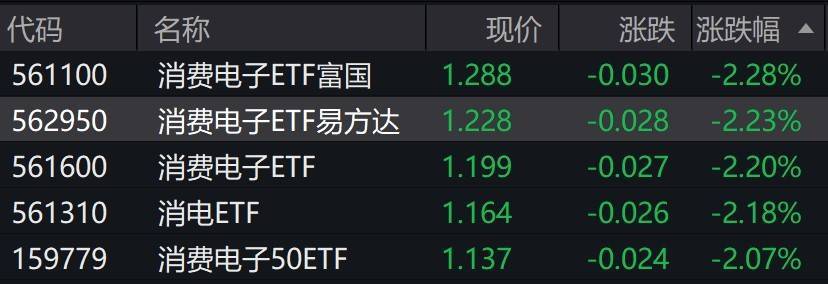
Group 1 - The MACD golden cross signal has formed, indicating potential upward momentum in certain stocks [1] - A-share computing power concept stocks have experienced declines, with Tianfu Communication dropping over 8%, Cambrian-U falling over 5%, and Hongxin Electronics, Zhongji Xuchuang, and Industrial Fulian each decreasing over 4% [1]




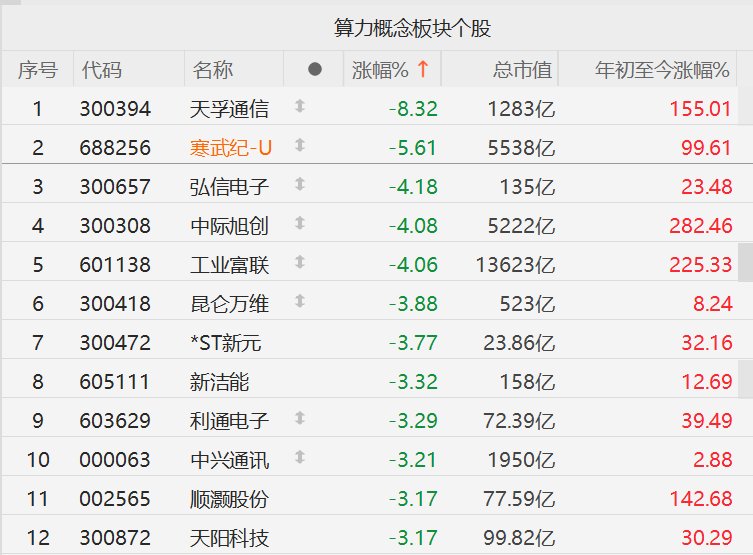
消费电子概念股走弱,相关ETF跌超2%
Sou Hu Cai Jing· 2025-11-11 05:50
Group 1 - The consumer electronics sector has weakened, with companies like Industrial Fulian and Huagong Technology dropping over 4%, while Luxshare Precision and Cambricon Technologies-U fell more than 3% [1] - The ETFs tracking the CSI Consumer Electronics Theme Index have also declined, with a drop of over 2% [1] - The CSI Consumer Electronics Theme Index includes 50 listed companies involved in component production and complete machine brand design and production, reflecting the overall performance of the consumer electronics sector [2] Group 2 - Some institutions believe that the long-term growth logic of the consumer electronics sector remains solid, with clear trends in AI innovation, and they are optimistic about recovery opportunities in the sector [2] - Leading companies in the domestic supply chain, which possess strong R&D capabilities and benefit from a favorable engineer demographic, are expected to deeply benefit from the wave of AI terminal innovations [2]

算力硬件股午后持续走低
Di Yi Cai Jing· 2025-11-11 05:35
Core Viewpoint - The stocks of Tianfu Communication and Tengjing Technology fell over 8%, with Cambridge Technology, Jingwang Electronics, Shenghong Technology, Zhongji Xuchuang, and Industrial Fulian also experiencing significant declines [1] Group 1 - Tianfu Communication and Tengjing Technology saw a drop exceeding 8% in their stock prices [1] - Cambridge Technology, Jingwang Electronics, Shenghong Technology, Zhongji Xuchuang, and Industrial Fulian were among the companies with the largest declines [1]


午评:沪指半日调整跌0.38%,培育钻石、电池材料方向再度爆发
Xin Lang Cai Jing· 2025-11-11 04:14
Market Overview - The three major indices collectively adjusted, with the Shanghai Composite Index down 0.38%, the Shenzhen Component down 0.52%, and the ChiNext Index down 0.74% [1] - The total trading volume in the Shanghai and Shenzhen markets was 12,680 billion yuan, a decrease of 1,864 billion yuan compared to the previous day [1] - Over 2,900 stocks in the market rose [1] Sector Performance - The sectors that saw the highest gains included cultivated diamonds, photovoltaic equipment, battery chemicals, gas, pharmaceutical commerce, and non-ferrous metals [1] - Conversely, sectors that experienced the largest declines included coal mining and processing, insurance, liquor, AI corpus, computing power hardware, and securities [1] Notable Stocks - The cultivated diamond and superhard materials sectors saw a collective surge, with Sifangda hitting the daily limit up, and Huanghe Xuanfeng also closing at the limit [1] - Huifeng Diamond, Power Diamond, and World Diamond saw intraday increases of over 10% [1] - The battery industry chain strengthened again, with upstream material stocks leading the gains; Fangyuan Co. hit the daily limit up, while Tianji Co., Shida Shenghua, Penghui Energy, and Xinzhou Bang were among the top gainers [1] - The photovoltaic equipment sector was also active, with Aters reaching a new high, and Guosheng Technology and Jincheng Co. achieving consecutive gains [1] - On the downside, several computing power hardware stocks fell, with Tianfu Communication down over 7%, and Cambridge Technology, Shenghong Technology, Zhongji Xuchuang, and Industrial Fulian also experiencing declines [1]


半日主力资金丨加仓电力设备板块 抛售非银金融板块



Di Yi Cai Jing· 2025-11-11 03:44
Group 1 - Main capital inflow observed in sectors such as power equipment, basic chemicals, and machinery equipment, while non-bank financials, computers, and non-ferrous metals experienced capital outflow [1] - Specific stocks with significant net inflow include Jiangbolong, Juhua Technology, and Fangda Carbon, attracting net inflows of 1.287 billion, 878 million, and 871 million respectively [1] - Stocks facing notable net outflow include Shenghong Technology, Cambricon, and Industrial Fulian, with net outflows of 1.056 billion, 847 million, and 733 million respectively [1]
25家高利润公司首次中期分红,平均每家分近28亿元
2 1 Shi Ji Jing Ji Bao Dao· 2025-11-10 15:31
Core Viewpoint - The A-share market is experiencing an unprecedented wave of dividend reform, with 25 companies announcing their first interim dividend plans since listing, distributing a total of 69.39 billion yuan in cash dividends as of November 10, 2025 [1][4][5] Group 1: Dividend Trends - As of November 10, 2025, 25 companies with net profits exceeding 3 billion yuan in the third quarter have collectively announced interim dividends, averaging 2.78 billion yuan per company [1][4] - The trend of interim dividends is becoming a new standard for high-quality companies, with over half of the 207 companies reporting net profits over 3 billion yuan in the third quarter opting for interim dividends, a sixfold increase compared to three years ago [1][4][5] - The number of companies choosing to implement interim dividends has seen exponential growth, with 58 out of 80 companies with net profits over 10 billion yuan in 2025 announcing interim dividends, marking a significant increase from previous years [4][5][7] Group 2: Leading Companies - Leading companies such as China Shenhua, Industrial Fulian, and Industrial Bank are at the forefront of this dividend reform, with China Shenhua leading with a dividend of 19.47 billion yuan [1][5][6] - China Shenhua's total market value reached 852.86 billion yuan, with a net profit of 46.92 billion yuan in the third quarter of 2025, while Industrial Fulian's market value increased from 427.16 billion yuan to 1.44 trillion yuan [5][6] - The banking sector, particularly Industrial Bank, has also contributed significantly to the total dividend distribution, with its first interim dividend amounting to 11.96 billion yuan [5][6] Group 3: Regulatory Influence - Regulatory policies are significantly driving the transformation of the A-share dividend ecosystem, with new regulations imposing stricter requirements on companies that have not distributed dividends for years [10][11] - The introduction of policies encouraging multiple dividends per year aims to enhance investor returns and promote a healthy investment environment [10][11] - The evolution of the dividend system from soft constraints to hard indicators reflects a shift towards a more mature and rational dividend ecosystem in the A-share market [10][11]



25家高利润公司首次中期分红,平均每家分近28亿元
21世纪经济报道· 2025-11-10 15:24
Core Viewpoint - The A-share market is experiencing an unprecedented wave of dividend reform, with a significant increase in companies announcing mid-term dividends for the first time, driven by regulatory policies and market ecology [1][3]. Group 1: Dividend Trends - As of November 10, 2025, 25 companies with net profits exceeding 3 billion yuan have announced their first mid-term dividend plans, distributing a total of 69.387 billion yuan, averaging 2.775 billion yuan per company [1][5]. - The trend of mid-term dividends is becoming a new standard for high-quality companies, with over half of the 207 companies reporting net profits over 3 billion yuan in 2025 implementing mid-term dividends, a nearly sixfold increase from three years ago [1][4]. Group 2: Industry Leaders - Leading companies in sectors such as energy, manufacturing, and finance are at the forefront of this dividend reform, with China Shenhua leading the way with a dividend of 19.471 billion yuan, followed by Industrial Fulian and Industrial Bank [1][6]. - The banking sector is a major contributor to dividends, with Industrial Bank also announcing its first mid-term dividend of 11.957 billion yuan, highlighting the significant role of industry leaders in setting a positive example for the market [6]. Group 3: Regulatory Influence - Regulatory bodies are encouraging companies to increase mid-term dividend frequency, shifting from primarily annual dividends to more frequent distributions [3][11]. - New policies introduced in 2024 and 2025 are tightening dividend requirements, compelling companies with low or no dividends to enhance their dividend policies, thereby improving shareholder returns [11][12]. Group 4: Future Outlook - The ongoing reforms in the A-share market are expected to inject new vitality into the dividend ecosystem, with differentiated guidance for technology innovation companies and mature enterprises to balance reinvestment and dividend payouts [12]. - The evolution of the dividend system from soft constraints to hard indicators and now to precise policies indicates a shift towards a more mature and rational dividend ecosystem in the A-share market [12].

高利润公司分红“破冰”:25家季利超30亿企业首派中期红包
2 1 Shi Ji Jing Ji Bao Dao· 2025-11-10 13:25
Core Insights - The A-share market is experiencing an unprecedented wave of dividend reform, with 25 companies announcing their first interim dividend plans since listing, distributing a total of 69.39 billion yuan, averaging 2.78 billion yuan per company [1][3][4] Group 1: Dividend Trends - The trend of interim dividends is becoming a new standard for high-quality companies, with over half of the 207 companies reporting profits exceeding 3 billion yuan in Q3 2025 implementing interim dividends, a significant increase from three years ago [1][3] - The number of companies choosing to implement interim dividends has seen exponential growth, with 72.5% of companies with profits over 10 billion yuan in 2025 participating in interim dividends, compared to only 10% in 2023 [2][3] Group 2: Leading Companies - China Shenhua leads the way with a dividend payout of 19.47 billion yuan, followed by Industrial Fulian and Industrial Bank, with these three companies accounting for 54.73% of the total dividends distributed [4][5] - Notable companies like China Shenhua and Industrial Fulian have significant market capitalizations, with China Shenhua's market cap reaching 852.86 billion yuan and Industrial Fulian's rising from 427.16 billion yuan to 1.44 trillion yuan [3][4] Group 3: Regulatory Influence - Regulatory policies are significantly driving the change in the dividend landscape, with new rules imposing stricter requirements on companies that have not paid dividends for years, thereby encouraging higher dividend payouts [6][7] - The 2025 financial forum introduced policies aimed at promoting long-term investment, emphasizing the importance of companies' long-term dividend capabilities [7][8]