INDUSTRIAL BANK(601166)

Search documents
每周股票复盘:兴业银行(601166)发行30亿元人民币债券
Sou Hu Cai Jing· 2026-01-17 17:48
Core Viewpoint - As of January 16, 2026, Industrial Bank Co., Ltd. (601166) closed at 20.08 CNY, down 3.65% from the previous week's 20.84 CNY, indicating a decline in stock performance [1] Group 1: Stock Performance - The highest intraday price for Industrial Bank on January 14 was 21.18 CNY, while the lowest intraday price on January 16 was 19.97 CNY [1] - The current total market capitalization of Industrial Bank is 424.95 billion CNY, ranking 2nd among 9 in the joint-stock bank sector and 30th among 5,183 in the A-share market [1] Group 2: Trading and Corporate Announcements - On January 15, there was a large transaction of 102 million CNY involving Industrial Bank [2][3] - Industrial Bank's Shanghai Free Trade Zone branch issued bonds worth 3 billion CNY under a 5 billion USD medium-term note program, with an interest rate of 1.95% and a maturity of 3 years, aimed at supporting credit business development [2][3]

范波会见兴业银行董事长吕家进一行
Su Zhou Ri Bao· 2026-01-17 01:45
Group 1 - The meeting between the Secretary of the Municipal Party Committee, Fan Bo, and the Chairman of Industrial Bank, Lv Jiajin, highlights the importance of financial support for the development of Suzhou as a key city in Eastern China [1][2] - Suzhou is focusing on historical cultural heritage, high-tech innovation, and high-quality development, aiming to become a first-class international city [1] - Industrial Bank has been actively involved in Suzhou's modernization and aims to deepen cooperation with the city in various financial services to better support the real economy [1] Group 2 - Lv Jiajin expressed gratitude for the support from Suzhou and emphasized the city's rich historical background, complete industrial support, abundant talent resources, and vibrant innovation as key factors for investment [2] - The bank aims to leverage its strengths alongside Suzhou's advantages to expand cooperation in areas such as technological innovation, industrial cultivation, green development, corporate mergers, and cross-border settlements [2]
兴业银行股份有限公司关于 上海自贸试验区分行发行债券的公告
Sou Hu Cai Jing· 2026-01-17 01:19
Core Viewpoint - The announcement details the issuance of a bond by Industrial Bank Co., Ltd. to support the development of credit business in the Shanghai Free Trade Zone, with specific terms outlined for the bond issuance [1]. Group 1: Bond Issuance Details - The Shanghai Free Trade Zone branch of Industrial Bank is issuing a bond under a $5 billion medium-term note program [1]. - The bond will be issued in Hong Kong, with a total size of 3 billion RMB [1]. - The bond has a fixed annual interest rate of 1.95% and a maturity period of 3 years [1].
一箱难求!银行“古早”业务突然火了,保管箱为何“爆单”?
券商中国· 2026-01-16 23:38
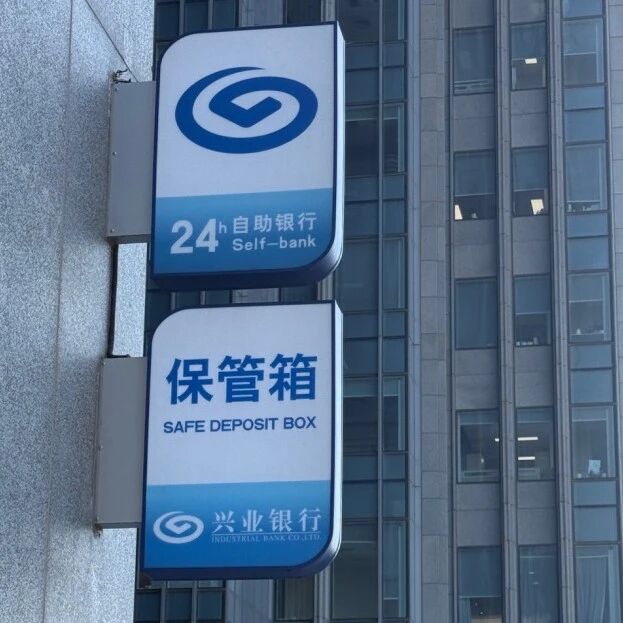
所谓保管箱服务,其全称为保管箱租赁服务,是银行以出租保管箱形式,代租用人保管贵重物品、有价证券及文件等财物的一项服务业务。券商中国记者从已使用 多年银行保管箱服务的人士处了解到,通常会将重要合同等文件放在保管箱中,"以前也放过金条,在银行买的金条不开封直接就放进去了。" 记者走访多家银行网点发现,目前北京地区保管箱"一箱难求"的情况较为普遍。 "我们这儿现在已经有40多位客户在排队了,但去年只有1位退箱,所以目前也就不再接受新的排队。"工商银行某支行营业部工作人员对记者表示。 近期,银行保管箱"一箱难求"引发关注。券商中国记者近日走访或致电工商银行、农业银行、中国银行、招商银行、民生银行、兴业银行在北京地区的多家分支机 构,仅中国银行一家支行仍有空箱,其余网点均需排队等待或因排队人数过多而不再新增预约。 从排队等待人数来看, 少则三四人,多则三四十人 ;至于等待时长,多数网点工作人员表示无法给出准确时点,因为这一业务已存续很长时间,客户大多为存量 客户,只能等待每年自然退租、腾出空箱;而腾退本身又具有比较强的主观性,因此无法给出明确判断。 "一箱难求"情况普遍 "一般其他网点没有(空箱)了,才会再到我们这儿来 ...




并购市场需求旺盛 贷款投放密集落地
Zhong Guo Jing Ying Bao· 2026-01-16 20:35
Group 1 - The core viewpoint of the article highlights the increasing activity in the domestic merger and acquisition (M&A) market, driven by a series of supportive policies from regulatory authorities, particularly the new guidelines on M&A loans issued by the National Financial Regulatory Administration [1][2][3] - The new M&A loan management regulations allow for a higher proportion of controlling M&A loans in the transaction price, increasing the limit from 60% to 70%, and extending the loan term from seven years to ten years, thereby facilitating financing for M&A transactions [3][4] - The implementation of these regulations has led to a rapid increase in M&A loan projects being approved and disbursed by various commercial banks within a short period, indicating a positive market response to the new policies [2][3][4] Group 2 - The new regulations specifically include minority stake acquisitions in the scope of M&A loans, which aligns with current industrial upgrade needs and is expected to promote industrial integration and high-quality economic development [4][7] - Several banks, including Industrial and Commercial Bank of China and Agricultural Bank of China, have successfully issued the first M&A loans under the new regulations, demonstrating proactive engagement with local enterprises to meet their financing needs [4][5][6] - The regulatory environment is further supported by multiple government departments encouraging industrial mergers and acquisitions, particularly in technology sectors such as electronics and biomedicine, which are seeing increased M&A activity [8][9]



银行“古早”业务焕新机,保管箱“一箱难求”为哪般?
Zheng Quan Shi Bao· 2026-01-16 14:28
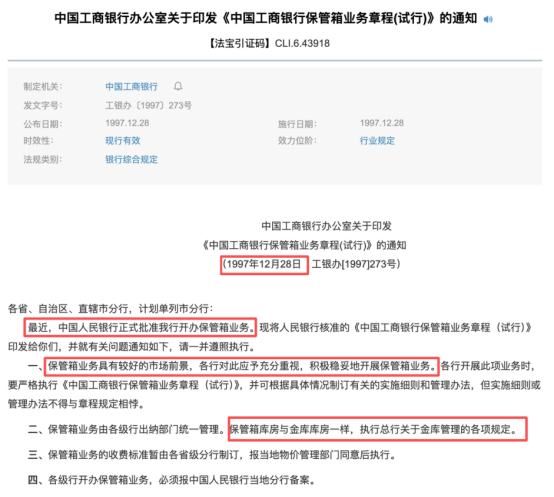
Core Insights - The demand for bank safe deposit boxes has surged, leading to a situation where they are difficult to obtain, with many banks in Beijing reporting long waiting lists and limited availability [1][2][6] Group 1: Current Situation - Many banks, including Industrial and Commercial Bank of China (ICBC), Agricultural Bank of China, and China Bank, have reported that they are no longer accepting new reservations for safe deposit boxes due to high demand [1][2] - The waiting lists for safe deposit boxes can range from a few people to over 40, with some banks unable to provide an estimated waiting time due to the unpredictable nature of box availability [1][2][3] - China Bank is the only institution currently offering a limited number of available boxes, but customers must meet a minimum asset requirement of 1 million yuan [3] Group 2: Historical Context - The safe deposit box service in China has its origins in the early 20th century, introduced by modern commercial banks as a means to store valuable items securely [5] - The service has been a longstanding part of banking operations, with many branches reporting that they have not seen significant turnover in box rentals, contributing to the current scarcity [4][6] Group 3: Market Dynamics - The current shortage of safe deposit boxes is attributed to a mismatch between high demand and limited supply, driven by increased interest in physical assets like gold and important documents amid low interest rates and market volatility [6][8] - Banks face challenges in expanding this service due to the need for specialized physical space and high security costs, which limits their incentive to increase supply [6][8] Group 4: Customer Segmentation - Some banks are offering expedited access to safe deposit boxes for high-net-worth clients, indicating a trend towards prioritizing services for wealthier customers [8] - Banks are using the scarcity of safe deposit boxes as a means to attract and retain high-end clients, suggesting that the service may evolve into a more exclusive offering rather than a widely available one [8]

兴业银行济南分行绘就数链金融新图景
Zhong Guo Jin Rong Xin Xi Wang· 2026-01-16 12:20
Core Insights - The core viewpoint of the news is that Industrial Bank's Jinan Branch is leveraging "finance + technology" to enhance the digital financial service ecosystem in Linyi, focusing on regional and industry-specific value creation [1][2]. Group 1: Financial Technology Integration - The bank has developed a three-dimensional digital service system that includes a financial cloud platform, a smart park system, and an aggregated payment ecosystem to address pain points in enterprise operations, park management, and consumer services [1]. - The financial management platform launched by the bank connects multiple bank systems, enabling real-time visibility and intelligent scheduling of funds, thus transforming financial management from manual to digital [2]. Group 2: Digital Transformation in Logistics and Markets - The bank has tailored a park service platform and a smart market system to meet the digital transformation needs of Linyi's logistics parks and specialized markets, integrating financial services into park management [2]. - As of now, the platform has been implemented in three logistics parks and three specialized markets in Linyi, effectively addressing issues of management inefficiency and fragmented services [2]. Group 3: Scene-Based Services - A one-stop aggregated payment platform has been introduced to streamline payment processes for merchants, integrating major payment channels and providing real-time fund settlement [3]. - The smart canteen system has been launched to cater to large-scale employee dining needs, significantly improving dining efficiency and reducing management costs [3]. Group 4: Future Outlook - The successful implementation of the three-dimensional digital service system exemplifies the bank's commitment to the "good quality finance" concept and highlights the role of financial technology in empowering the real economy [3]. - The bank plans to continue deepening the integration of finance and technology, focusing on key industrial chains and specialized parks in Linyi to optimize digital products and expand application scenarios [3].
兴业银行(601166.SH):上海自贸试验区分行发行债券
Ge Long Hui A P P· 2026-01-16 12:20
Core Viewpoint - Industrial Bank (601166.SH) has announced the issuance of a 30 billion RMB bond in Hong Kong under its 5 billion USD medium-term note program, aimed at supporting the credit business development of its Shanghai Free Trade Zone branch [1] Group 1: Bond Issuance Details - The bond type is a senior unsecured bond denominated in RMB [1] - The total issuance amount is 30 billion RMB [1] - The annual interest rate is set at 1.95% with a maturity period of 3 years [1]
兴业银行(601166) - 兴业银行关于上海自贸试验区分行发行债券的公告
2026-01-16 12:15
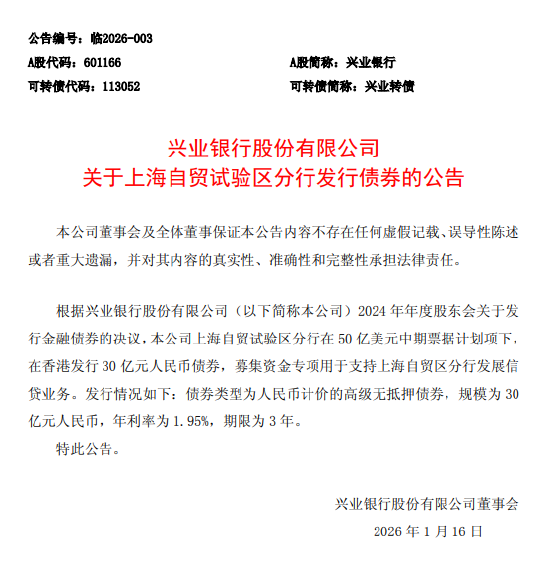
公告编号:临2026-003 A股代码:601166 A股简称:兴业银行 可转债代码:113052 可转债简称:兴业转债 兴业银行股份有限公司 关于上海自贸试验区分行发行债券的公告 特此公告。 兴业银行股份有限公司董事会 2026 年 1 月 16 日 本公司董事会及全体董事保证本公告内容不存在任何虚假记载、误导性陈述 或者重大遗漏,并对其内容的真实性、准确性和完整性承担法律责任。 根据兴业银行股份有限公司(以下简称本公司)2024 年年度股东会关于发 行金融债券的决议,本公司上海自贸试验区分行在 50 亿美元中期票据计划项下, 在香港发行 30 亿元人民币债券,募集资金专项用于支持上海自贸区分行发展信 贷业务。发行情况如下:债券类型为人民币计价的高级无抵押债券,规模为 30 亿元人民币,年利率为 1.95%,期限为 3 年。 ...
兴业银行:上海自贸试验区分行发行债券,规模为30亿元人民币
Xin Lang Cai Jing· 2026-01-16 12:04
Core Viewpoint - Industrial Bank announced the issuance of a 30 billion RMB bond to support the development of its Shanghai Free Trade Zone branch, under a 5 billion USD medium-term note program [1][3]. Group 1: Bond Issuance Details - The bond is a senior unsecured bond denominated in RMB, with a total size of 30 billion RMB [1][3]. - The annual interest rate for the bond is set at 1.95% [1][3]. - The maturity period for the bond is 3 years [1][3]. Group 2: Purpose of Fundraising - The funds raised from the bond issuance will be specifically used to support the credit business development of the Shanghai Free Trade Zone branch [1][3].